
keyword
Gradient Episodic Memory
Gradient Episodic Memory is a continual machine learning algorithm designed to prevent neural networks from forgetting previously learned information when acquiring knowledge across a sequence of tasks. The method maintains an episodic memory buffer containing a small subset of training examples from each past task. When updating model parameters on a current task, the algorithm checks whether the proposed parameter adjustment would increase the loss on the stored examples of earlier tasks. If an update would degrade past performance, the algorithm projects the gradient of the current task onto a feasible region where its dot product with the gradients of previous tasks is non-negative, using quadratic programming to prevent catastrophic forgetting while facilitating beneficial knowledge transfer.
6 items
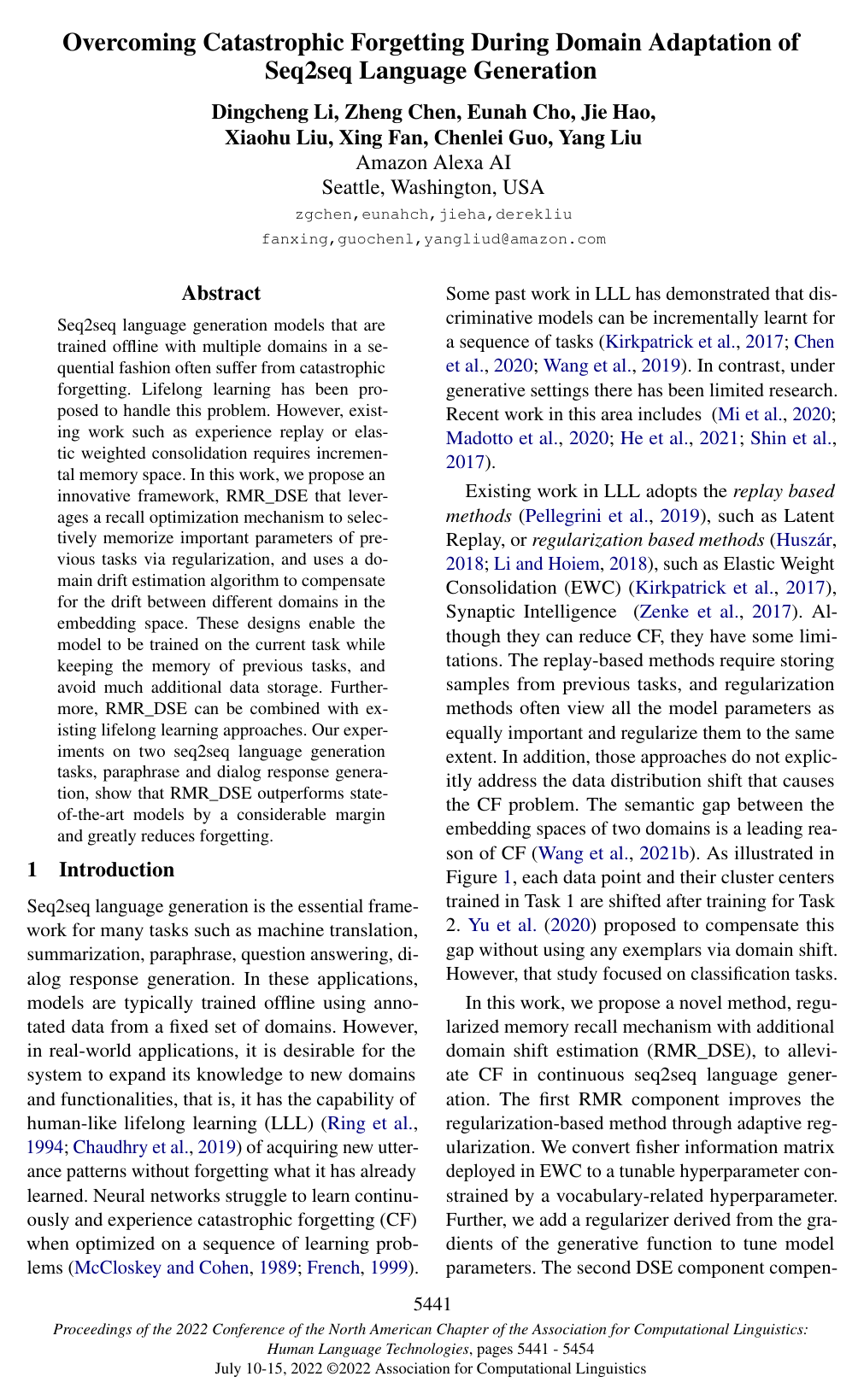
Overcoming Catastrophic Forgetting During Domain Adaptation of Seq2seq Language Generation
Dingcheng Li, Zheng Chen, Eunah Cho, Jie Hao, Xiaohu Liu, Fan Xing, Chenlei Guo, Yang Liu
Why you should read this
Proposes a framework combining adaptive parameter regularization with embedding-space domain drift estimation to prevent catastrophic forgetting in sequential sequence-to-sequence language generation without storing past task data.
Seq2seq language generation models that are trained offline with multiple domains in a sequential fashion often suffer from catastrophic forgetting. Lifelong learning has been proposed to handle this problem. However, existing work such as experience replay or elastic weighted consolidation requires incremental memory space. In this work, we propose an innovative framework, RMR_DSE that leverages a recall optimization mechanism to selectively memorize important parameters of previous tasks via regularization, and uses a domain drift estimation algorithm to compensate for the drift between different domains in the embedding space. These designs enable the model to be trained on the current task while keeping the memory of previous tasks, and avoid much additional data storage. Furthermore, RMR_DSE can be combined with existing lifelong learning approaches. Our experiments on two seq2seq language generation tasks, paraphrase and dialog response generation, show that RMR_DSE outperforms state-of-the-art models by a considerable margin and greatly reduces forgetting.
Added
2026-10-03
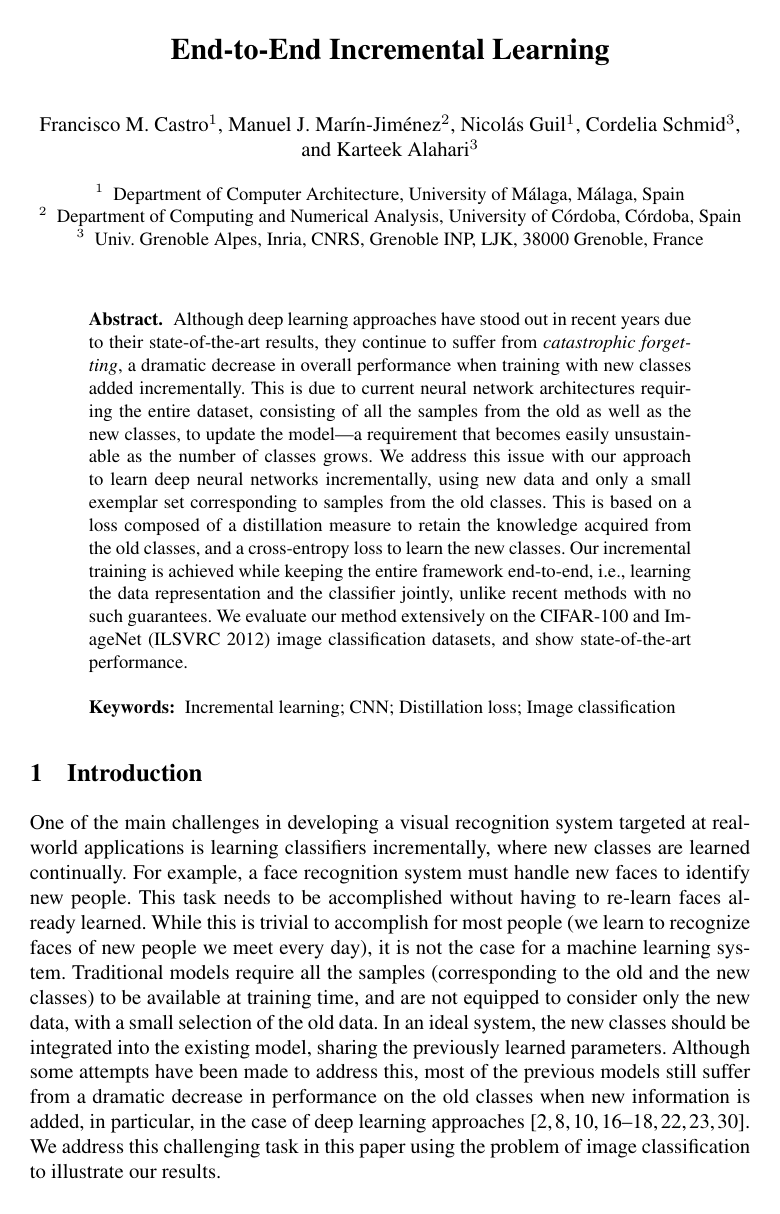
End-to-End Incremental Learning
Francisco M. Castro, Manuel J. Marín-Jiménez, Nicolás Guil, Cordelia Schmid, Karteek Alahari
Why you should read this
Proposes a fully end-to-end incremental learning framework that mitigates catastrophic forgetting by combining knowledge distillation with a small exemplar set to jointly optimize feature representations and classifiers on sequentially added image classes.
Although deep learning approaches have stood out in recent years due to their state-of-the-art results, they continue to suffer from catastrophic forgetting, a dramatic decrease in overall performance when training with new classes added incrementally. This is due to current neural network architectures requiring the entire dataset, consisting of all the samples from the old as well as the new classes, to update the model -a requirement that becomes easily unsustainable as the number of classes grows. We address this issue with our approach to learn deep neural networks incrementally, using new data and only a small exemplar set corresponding to samples from the old classes. This is based on a loss composed of a distillation measure to retain the knowledge acquired from the old classes, and a cross-entropy loss to learn the new classes. Our incremental training is achieved while keeping the entire framework end-to-end, i.e., learning the data representation and the classifier jointly, unlike recent methods with no such guarantees. We evaluate our method extensively on the CIFAR-100 and ImageNet (ILSVRC 2012) image classification datasets, and show state-of-the-art performance.
Added
2026-09-25
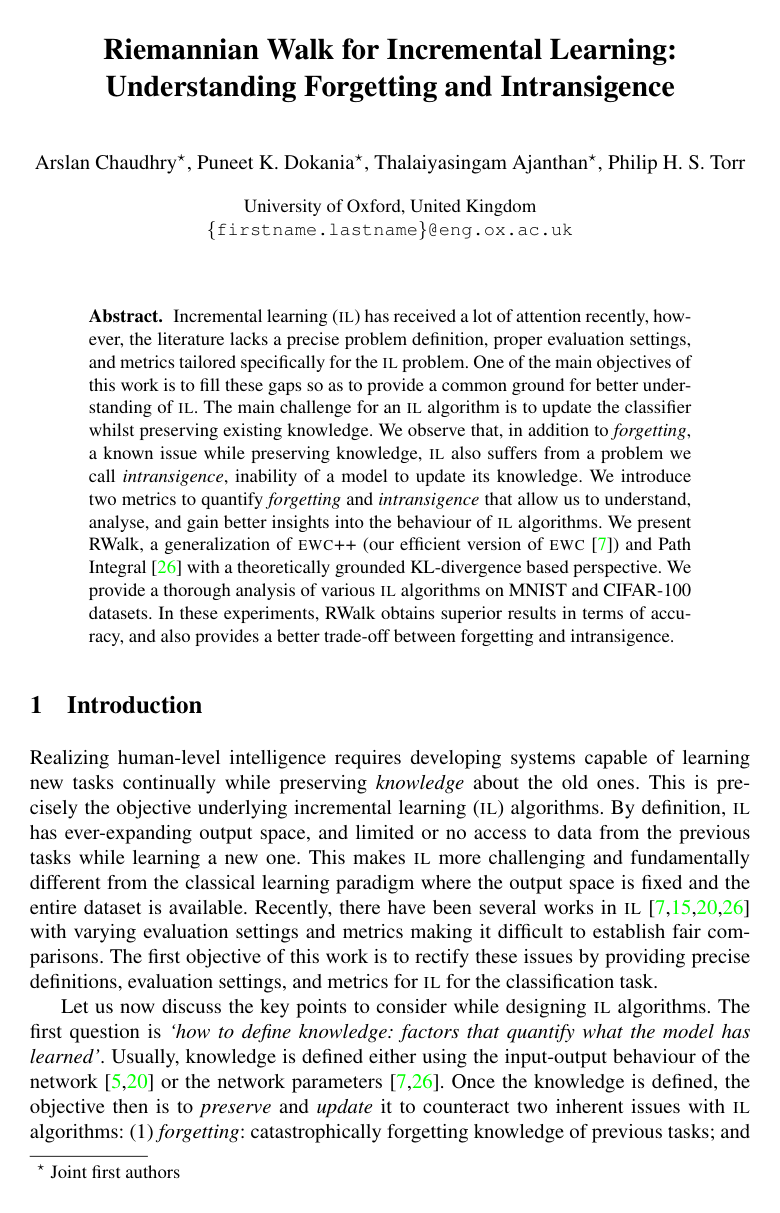
Riemannian Walk for Incremental Learning: Understanding Forgetting and Intransigence
Arslan Chaudhry, Puneet K. Dokania, Thalaiyasingam Ajanthan, Philip H. S. Torr
Why you should read this
Proposes Riemannian Walk (RWalk), a continual learning method based on KL-divergence that optimizes the trade-off between catastrophic forgetting and model intransigence, while establishing formal metrics to quantify both behaviors.
Incremental learning (IL) has received a lot of attention recently, however, the literature lacks a precise problem definition, proper evaluation settings, and metrics tailored specifically for the IL problem. One of the main objectives of this work is to fill these gaps so as to provide a common ground for better understanding of IL. The main challenge for an IL algorithm is to update the classifier whilst preserving existing knowledge. We observe that, in addition to forgetting, a known issue while preserving knowledge, IL also suffers from a problem we call intransigence, inability of a model to update its knowledge. We introduce two metrics to quantify forgetting and intransigence that allow us to understand, analyse, and gain better insights into the behaviour of IL algorithms. We present RWalk, a generalization of EWC++ (our efficient version of EWC [Kirkpatrick2016EWC]) and Path Integral [Zenke2017Continual] with a theoretically grounded KL-divergence based perspective. We provide a thorough analysis of various IL algorithms on MNIST and CIFAR-100 datasets. In these experiments, RWalk obtains superior results in terms of accuracy, and also provides a better trade-off between forgetting and intransigence.
Added
2026-09-25
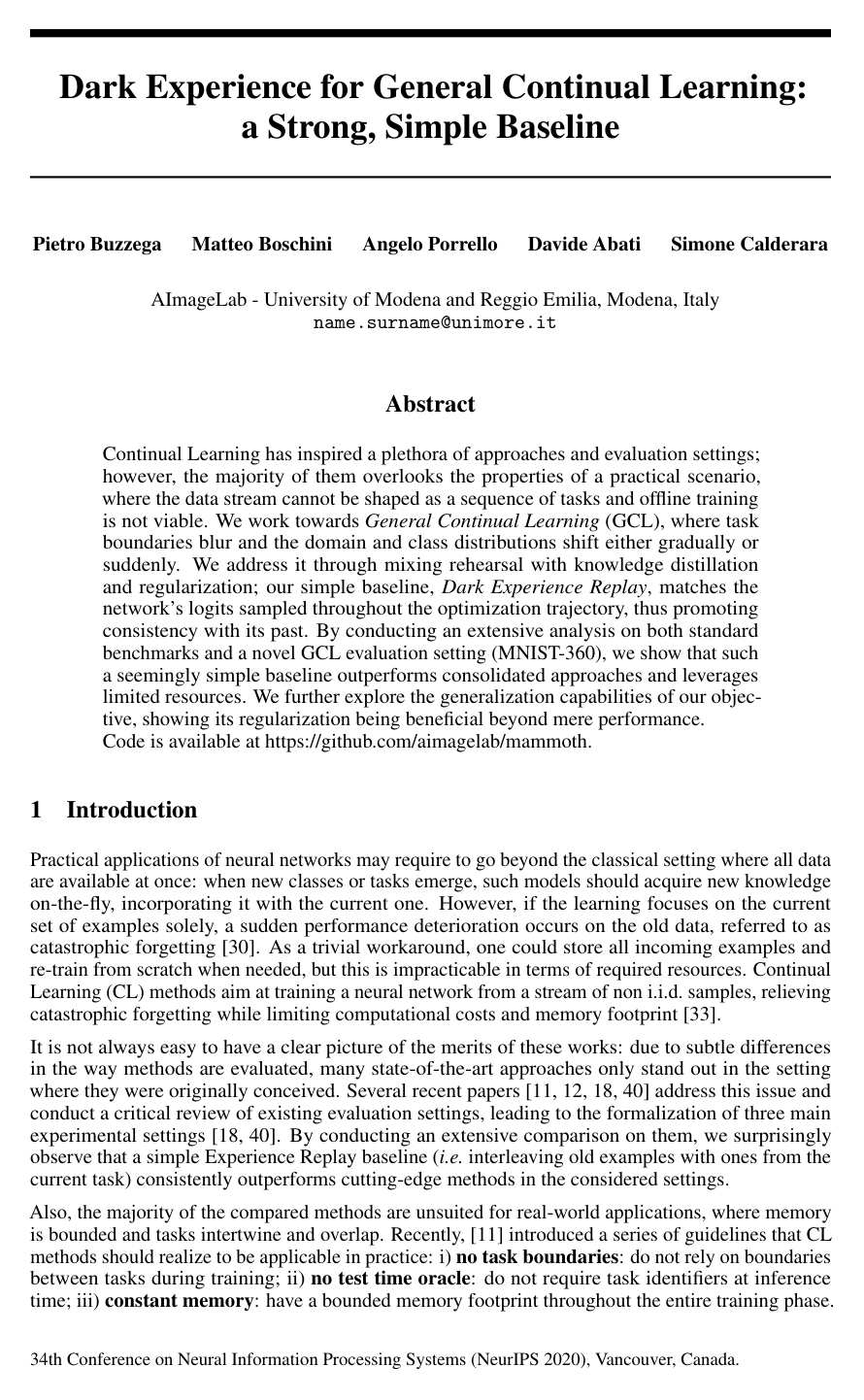
Dark Experience for General Continual Learning: a Strong, Simple Baseline
Pietro Buzzega, Matteo Boschini, Angelo Porrello, Davide Abati, Simone Calderara
Why you should read this
Proposes Dark Experience Replay, a simple baseline that matches past network logits during replay to outperform complex state-of-the-art methods in realistic continual learning settings without explicit task boundaries.
Continual Learning has inspired a plethora of approaches and evaluation settings; however, the majority of them overlooks the properties of a practical scenario, where the data stream cannot be shaped as a sequence of tasks and offline training is not viable. We work towards General Continual Learning (GCL), where task boundaries blur and the domain and class distributions shift either gradually or suddenly. We address it through mixing rehearsal with knowledge distillation and regularization; our simple baseline, Dark Experience Replay, matches the network's logits sampled throughout the optimization trajectory, thus promoting consistency with its past. By conducting an extensive analysis on both standard benchmarks and a novel GCL evaluation setting (MNIST-360), we show that such a seemingly simple baseline outperforms consolidated approaches and leverages limited resources. We further explore the generalization capabilities of our objective, showing its regularization being beneficial beyond mere performance.
Added
2026-09-25
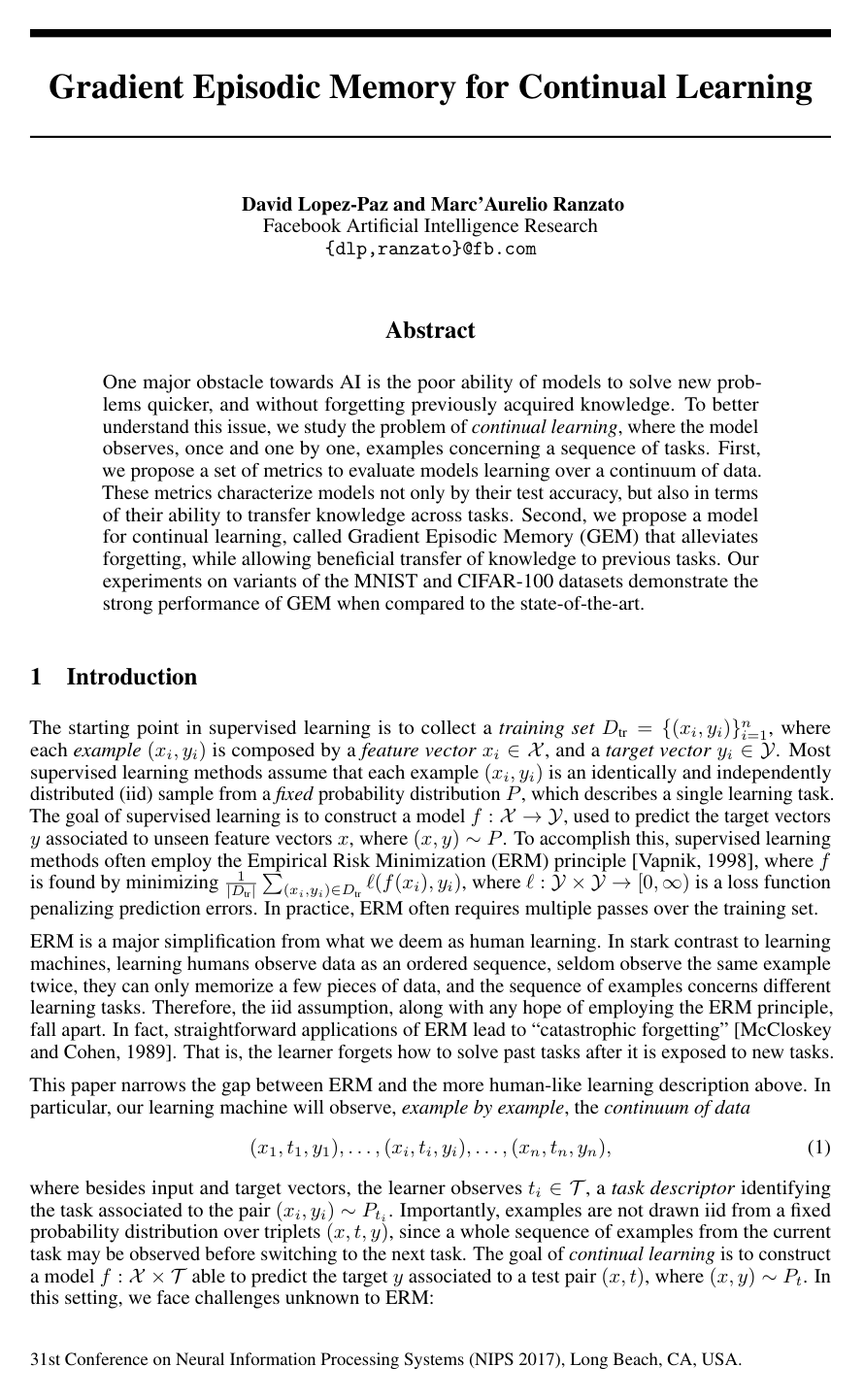
Gradient Episodic Memory for Continual Learning
David Lopez-Paz, Marc'Aurelio Ranzato
Why you should read this
Introduces Gradient Episodic Memory (GEM), a constrained optimization method that prevents catastrophic forgetting in neural networks while enabling positive backward transfer across sequentially learned tasks.
One major obstacle towards AI is the poor ability of models to solve new problems quicker, and without forgetting previously acquired knowledge. To better understand this issue, we study the problem of continual learning, where the model observes, once and one by one, examples concerning a sequence of tasks. First, we propose a set of metrics to evaluate models learning over a continuum of data. These metrics characterize models not only by their test accuracy, but also in terms of their ability to transfer knowledge across tasks. Second, we propose a model for continual learning, called Gradient Episodic Memory (GEM) that alleviates forgetting, while allowing beneficial transfer of knowledge to previous tasks. Our experiments on variants of the MNIST and CIFAR-100 datasets demonstrate the strong performance of GEM when compared to the state-of-the-art.
Added
2026-09-11
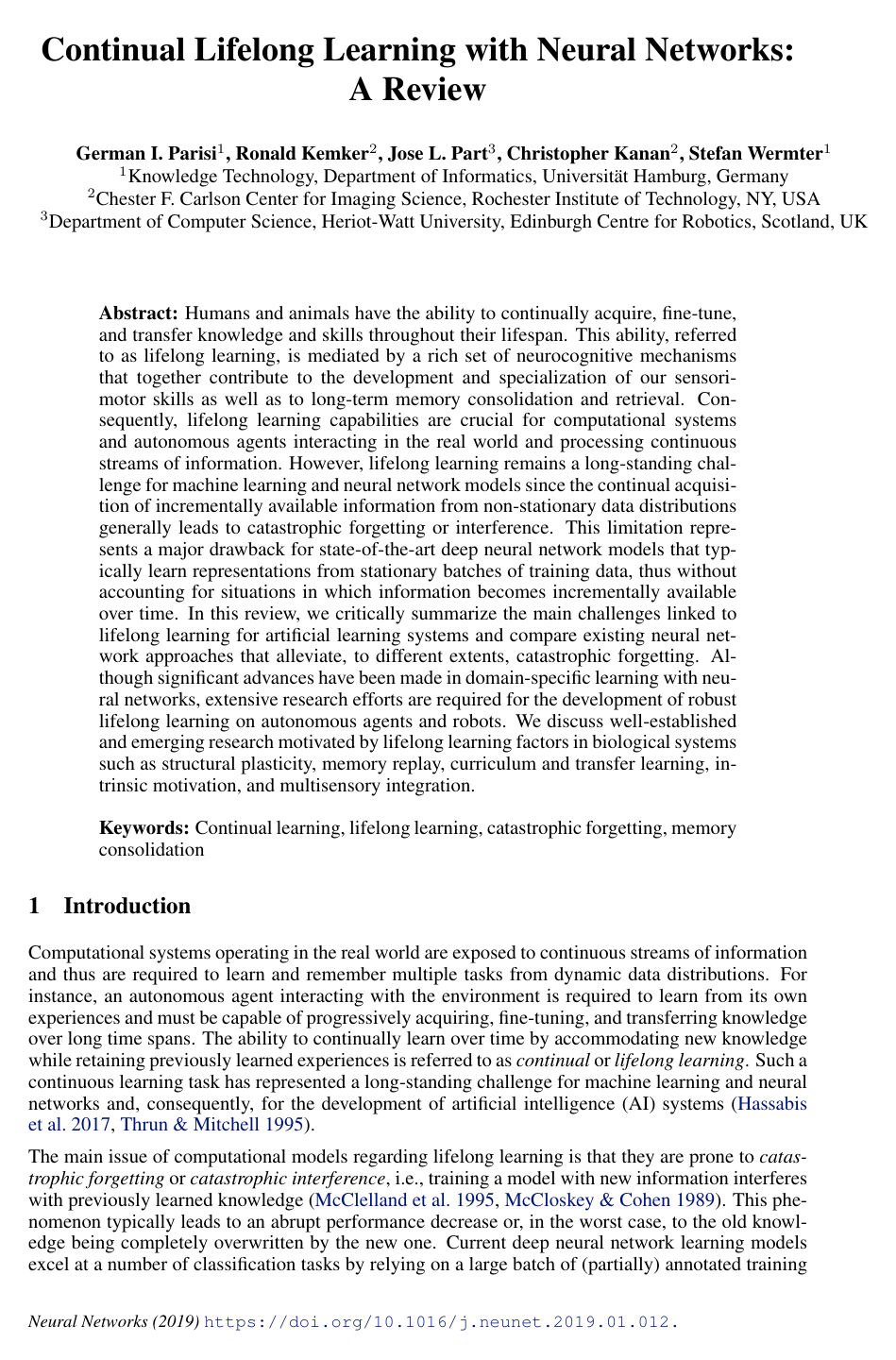
Continual Lifelong Learning with Neural Networks: A Review
German I. Parisi, Ronald Kemker, Jose L. Part, Christopher Kanan, Stefan Wermter
Why you should read this
Synthesizes neural network approaches for preventing catastrophic forgetting in continual learning and connects these algorithmic strategies to biological mechanisms such as structural plasticity and memory replay.
Humans and animals have the ability to continually acquire, fine-tune, and transfer knowledge and skills throughout their lifespan. This ability, referred to as lifelong learning, is mediated by a rich set of neurocognitive mechanisms that together contribute to the development and specialization of our sensorimotor skills as well as to long-term memory consolidation and retrieval. Consequently, lifelong learning capabilities are crucial for autonomous agents interacting in the real world and processing continuous streams of information. However, lifelong learning remains a long-standing challenge for machine learning and neural network models since the continual acquisition of incrementally available information from non-stationary data distributions generally leads to catastrophic forgetting or interference. This limitation represents a major drawback for state-of-the-art deep neural network models that typically learn representations from stationary batches of training data, thus without accounting for situations in which information becomes incrementally available over time. In this review, we critically summarize the main challenges linked to lifelong learning for artificial learning systems and compare existing neural network approaches that alleviate, to different extents, catastrophic forgetting. We discuss well-established and emerging research motivated by lifelong learning factors in biological systems such as structural plasticity, memory replay, curriculum and transfer learning, intrinsic motivation, and multisensory integration.
Added
2026-09-11