
keyword
Gradient-based optimization
Gradient-based optimization is a mathematical and computational approach used to find the minimum or maximum of a differentiable objective function by iteratively adjusting parameters in the direction indicated by the function's derivatives. The gradient, a vector of partial derivatives representing the rate and direction of steepest ascent, provides local geometric information that guides parameter updates toward an optimal value. Widely utilized in machine learning, scientific computing, and statistical modeling, this class of algorithms operates over continuous search spaces and includes methods such as gradient descent, stochastic gradient descent, and adaptive moment-based optimizers. Compared to derivative-free or heuristic search methods, gradient-based approaches offer computationally efficient convergence in high-dimensional settings, though their effectiveness depends on the differentiability and curvature of the underlying objective function.
8 items
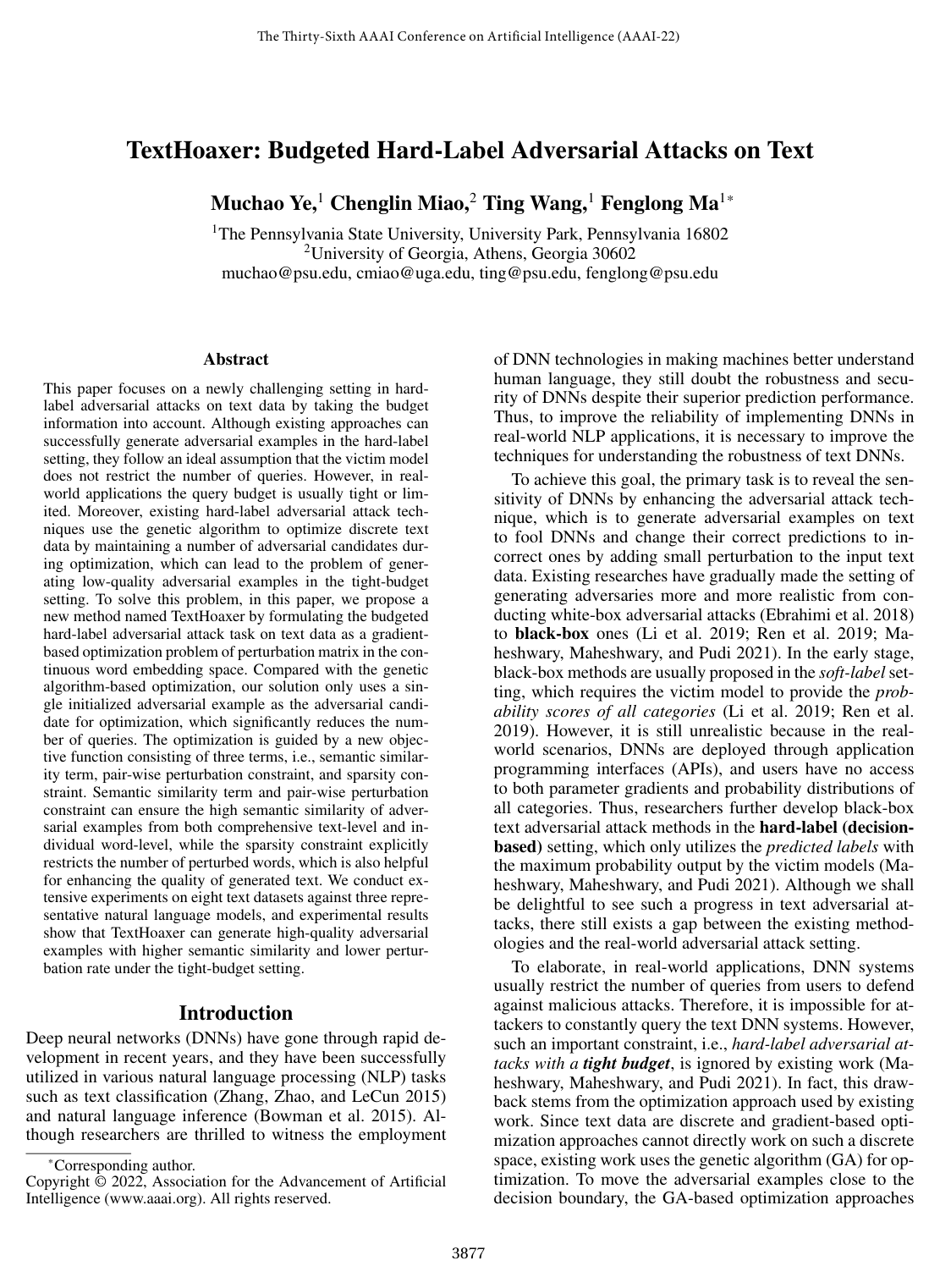
TextHoaxer: Budgeted Hard-Label Adversarial Attacks on Text
Muchao Ye, Chenglin Miao, Ting Wang, Fenglong Ma
Why you should read this
Proposes TextHoaxer, a gradient-based framework that formulates hard-label text adversarial attacks in continuous word embedding space to generate high-similarity adversarial examples under strict query budgets without relying on query-expensive genetic algorithms.
This paper focuses on a newly challenging setting in hard-label adversarial attacks on text data by taking the budget information into account. Although existing approaches can successfully generate adversarial examples in the hard-label setting, they follow an ideal assumption that the victim model does not restrict the number of queries. However, in real-world applications the query budget is usually tight or limited. Moreover, existing hard-label adversarial attack techniques use the genetic algorithm to optimize discrete text data by maintaining a number of adversarial candidates during optimization, which can lead to the problem of generating low-quality adversarial examples in the tight-budget setting. To solve this problem, in this paper, we propose a new method named TextHoaxer by formulating the budgeted hard-label adversarial attack task on text data as a gradient-based optimization problem of perturbation matrix in the continuous word embedding space. Compared with the genetic algorithm-based optimization, our solution only uses a single initialized adversarial example as the adversarial candidate for optimization, which significantly reduces the number of queries. The optimization is guided by a new objective function consisting of three terms, i.e., semantic similarity term, pair-wise perturbation constraint, and sparsity constraint. Semantic similarity term and pair-wise perturbation constraint can ensure the high semantic similarity of adversarial examples from both comprehensive text-level and individual word-level, while the sparsity constraint explicitly restricts the number of perturbed words, which is also helpful for enhancing the quality of generated text. We conduct extensive experiments on eight text datasets against three representative natural language models, and experimental results show that TextHoaxer can generate high-quality adversarial examples with higher semantic similarity and lower perturbation rate under the tight-budget setting.
Added
2026-09-26
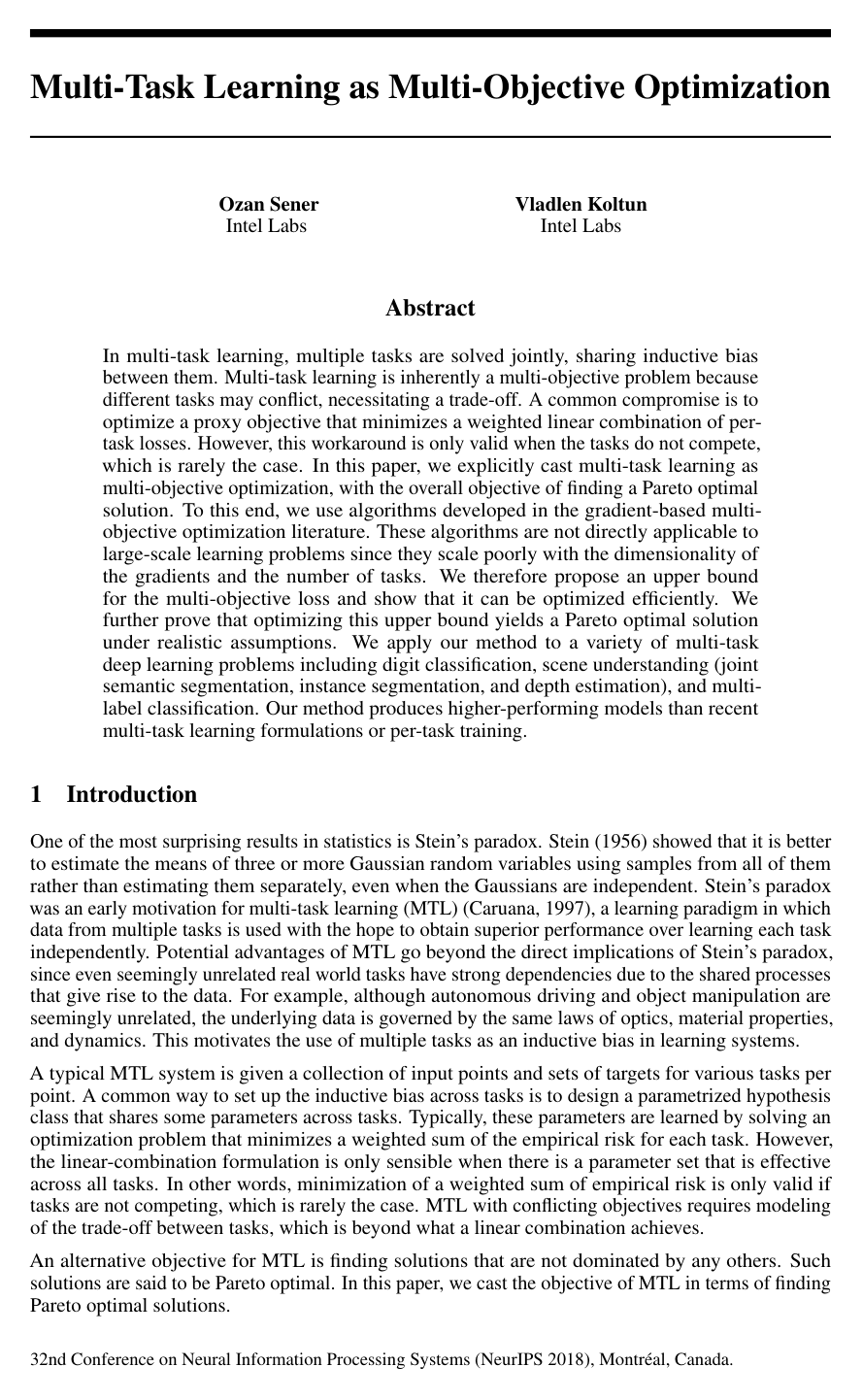
Multi-Task Learning as Multi-Objective Optimization
Ozan Sener, Vladlen Koltun
Why you should read this
Proposes a scalable gradient-based optimization algorithm that frames multi-task learning as multi-objective optimization, guaranteeing Pareto-optimal trade-offs across competing tasks without relying on heuristic loss weighting.
In multi-task learning, multiple tasks are solved jointly, sharing inductive bias between them. Multi-task learning is inherently a multi-objective problem because different tasks may conflict, necessitating a trade-off. A common compromise is to optimize a proxy objective that minimizes a weighted linear combination of per-task losses. However, this workaround is only valid when the tasks do not compete, which is rarely the case. In this paper, we explicitly cast multi-task learning as multi-objective optimization, with the overall objective of finding a Pareto optimal solution. To this end, we use algorithms developed in the gradient-based multi-objective optimization literature. These algorithms are not directly applicable to large-scale learning problems since they scale poorly with the dimensionality of the gradients and the number of tasks. We therefore propose an upper bound for the multi-objective loss and show that it can be optimized efficiently. We further prove that optimizing this upper bound yields a Pareto optimal solution under realistic assumptions. We apply our method to a variety of multi-task deep learning problems including digit classification, scene understanding (joint semantic segmentation, instance segmentation, and depth estimation), and multi-label classification. Our method produces higher-performing models than recent multi-task learning formulations or per-task training.
Added
2026-09-18
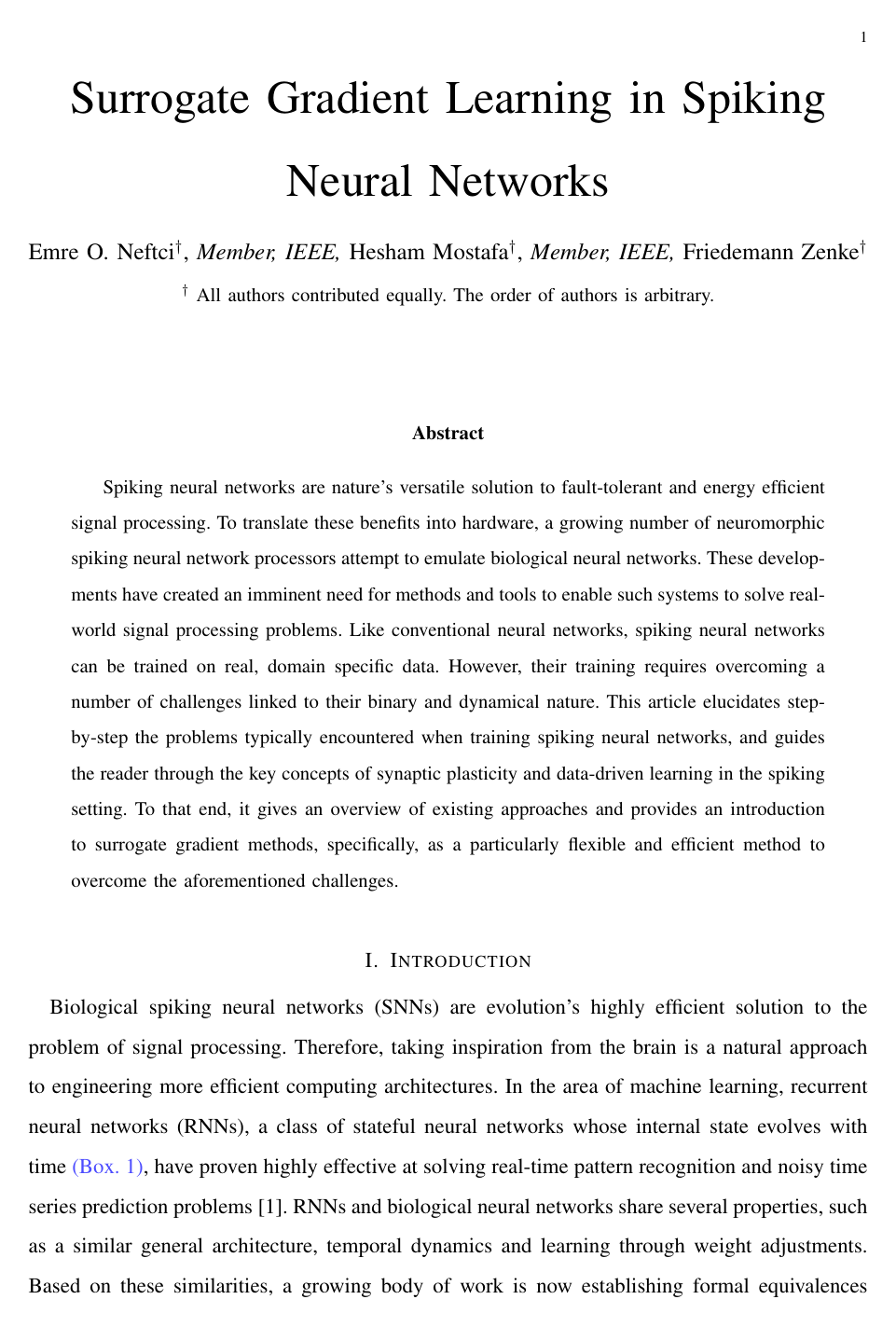
Surrogate Gradient Learning in Spiking Neural Networks: Bringing the Power of Gradient-based optimization to spiking neural networks
Emre O. Neftci, Hesham Mostafa, Friedemann Zenke
Why you should read this
Explains how surrogate gradient methods overcome the non-differentiability of biological spikes, providing a practical foundation for training energy-efficient spiking neural networks with standard backpropagation techniques.
Spiking neural networks are nature's versatile solution to fault-tolerant and energy efficient signal processing. To translate these benefits into hardware, a growing number of neuromorphic spiking neural network processors attempt to emulate biological neural networks. These developments have created an imminent need for methods and tools to enable such systems to solve real-world signal processing problems. Like conventional neural networks, spiking neural networks can be trained on real, domain specific data. However, their training requires overcoming a number of challenges linked to their binary and dynamical nature. This article elucidates step-by-step the problems typically encountered when training spiking neural networks, and guides the reader through the key concepts of synaptic plasticity and data-driven learning in the spiking setting. To that end, it gives an overview of existing approaches and provides an introduction to surrogate gradient methods, specifically, as a particularly flexible and efficient method to overcome the aforementioned challenges.
Added
2026-09-18
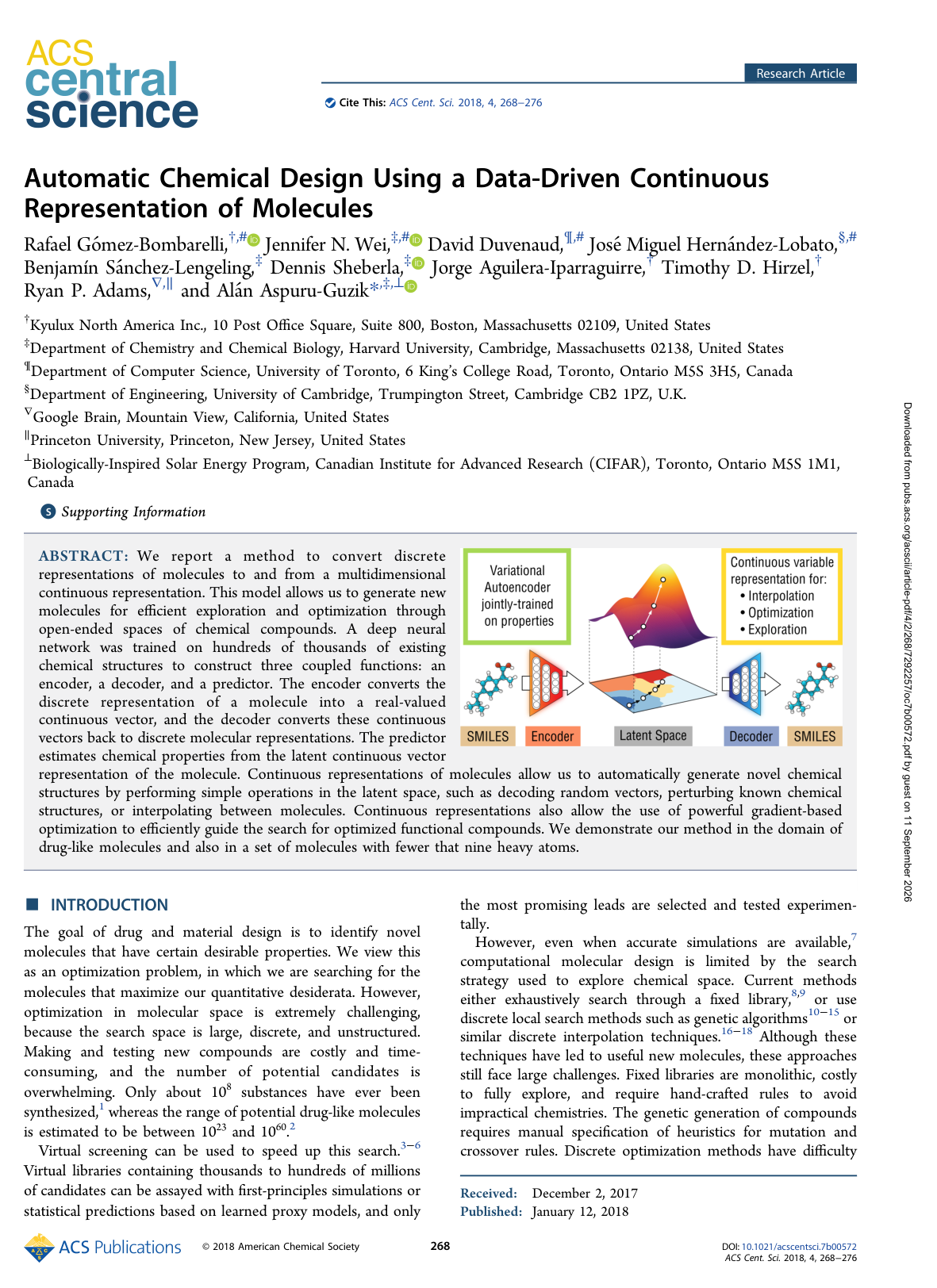
Automatic Chemical Design Using a Data-Driven Continuous Representation of Molecules
Rafael Gómez-Bombarelli, David Duvenaud, José Miguel Hernández-Lobato, Jorge Aguilera-Iparraguirre, Timothy D. Hirzel, Ryan P. Adams, Alán Aspuru-Guzik
Why you should read this
Introduces a variational autoencoder framework that converts discrete molecular SMILES strings into a continuous latent space, enabling efficient property prediction and gradient-based optimization for de novo chemical design.
We report a method to convert discrete representations of molecules to and from a multidimensional continuous representation. This model allows us to generate new molecules for efficient exploration and optimization through open-ended spaces of chemical compounds. A deep neural network was trained on hundreds of thousands of existing chemical structures to construct three coupled functions: an encoder, a decoder, and a predictor. The encoder converts the discrete representation of a molecule into a real-valued continuous vector, and the decoder converts these continuous vectors back to discrete molecular representations. The predictor estimates chemical properties from the latent continuous vector representation of the molecule. Continuous representations of molecules allow us to automatically generate novel chemical structures by performing simple operations in the latent space, such as decoding random vectors, perturbing known chemical structures, or interpolating between molecules. Continuous representations also allow the use of powerful gradient-based optimization to efficiently guide the search for optimized functional compounds. We demonstrate our method in the domain of drug-like molecules and also in a set of molecules with fewer that nine heavy atoms.
Added
2026-09-11
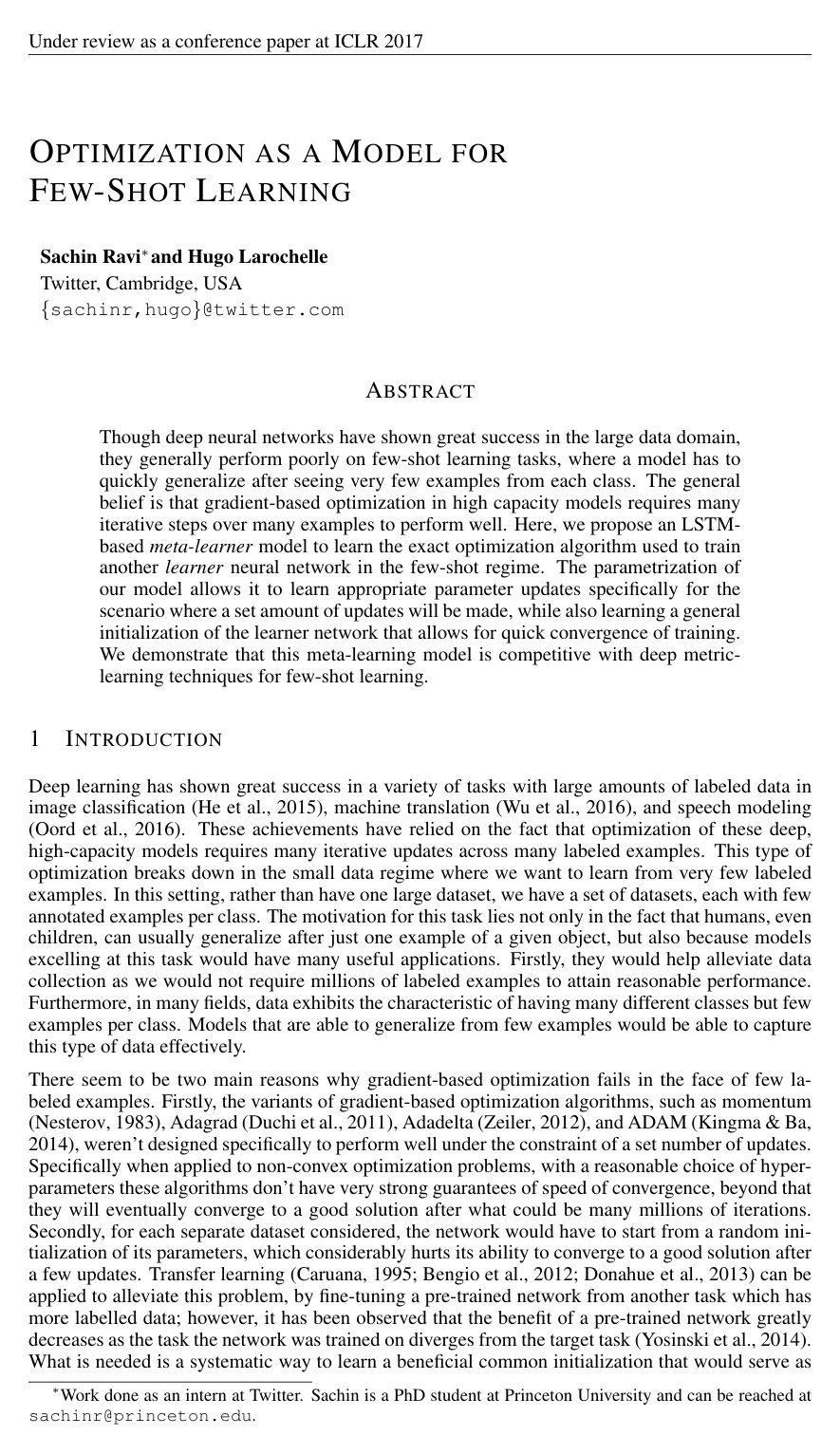
Optimization as a Model for Few-Shot Learning
Sachin Ravi, Hugo Larochelle
Why you should read this
Proposes an LSTM-based meta-learner that learns both parameter initializations and gradient-based update rules, enabling neural networks to rapidly adapt to new classification tasks from only a few training examples.
Though deep neural networks have shown great success in the large data domain, they generally perform poorly on few-shot learning tasks, where a model has to quickly generalize after seeing very few examples from each class. The general belief is that gradient-based optimization in high capacity models requires many iterative steps over many examples to perform well. Here, we propose an LSTM-based meta-learner model to learn the exact optimization algorithm used to train another learner neural network in the few-shot regime. The parametrization of our model allows it to learn appropriate parameter updates specifically for the scenario where a set amount of updates will be made, while also learning a general initialization of the learner network that allows for quick convergence of training. We demonstrate that this meta-learning model is competitive with deep metric-learning techniques for few-shot learning.
Added
2026-09-11
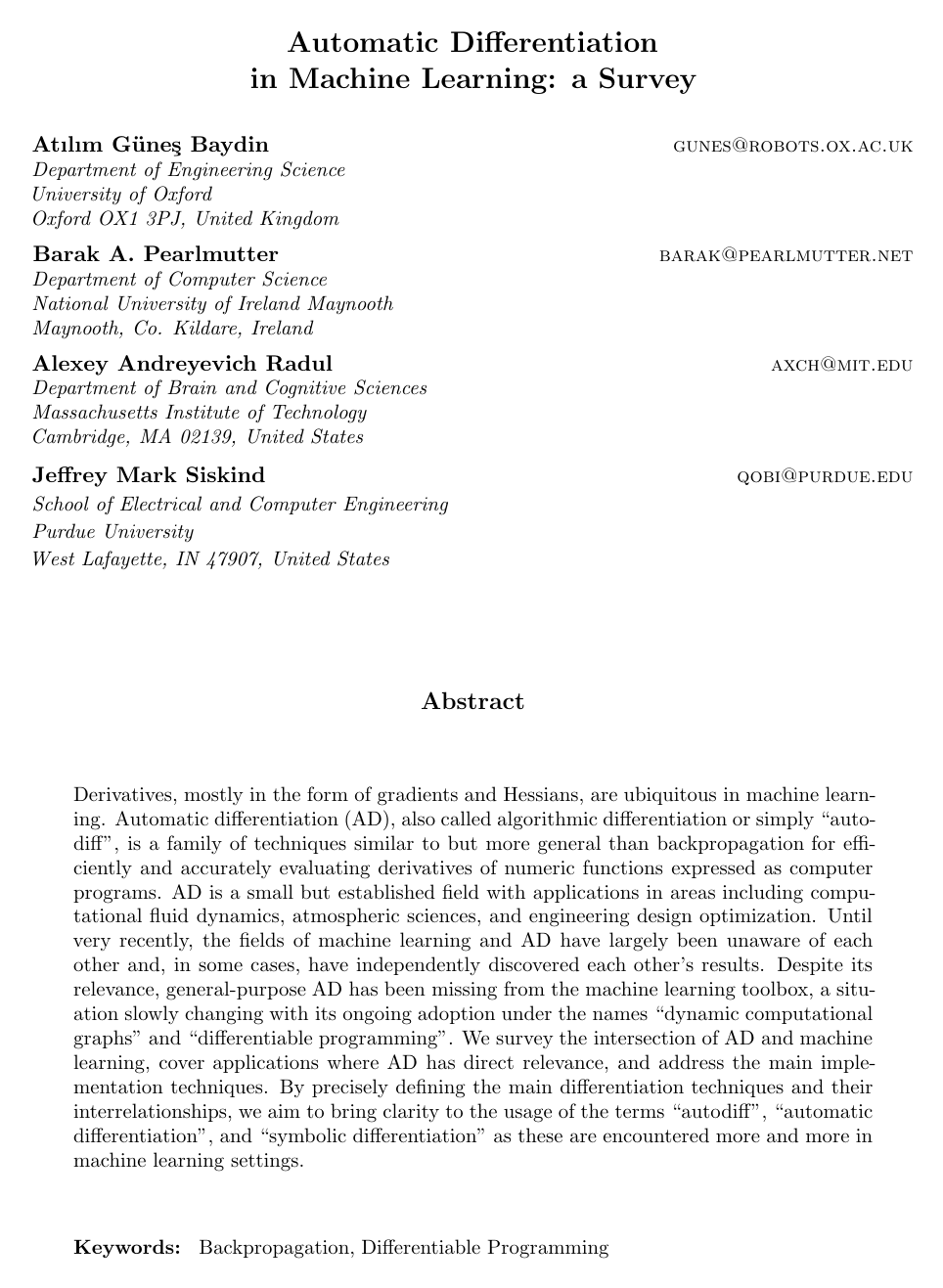
Automatic differentiation in machine learning: a survey
Atilim Gunes Baydin, Barak A. Pearlmutter, Alexey Andreyevich Radul, Jeffrey Mark Siskind
Why you should read this
Synthesizes the algorithmic foundations and implementation modes of automatic differentiation, demonstrating how general-purpose derivative computation extends beyond backpropagation to enable modern differentiable programming frameworks.
Derivatives, mostly in the form of gradients and Hessians, are ubiquitous in machine learning. Automatic differentiation (AD), also called algorithmic differentiation or simply "autodiff", is a family of techniques similar to but more general than backpropagation for efficiently and accurately evaluating derivatives of numeric functions expressed as computer programs. AD is a small but established field with applications in areas including computational fluid dynamics, atmospheric sciences, and engineering design optimization. Until very recently, the fields of machine learning and AD have largely been unaware of each other and, in some cases, have independently discovered each other's results. Despite its relevance, general-purpose AD has been missing from the machine learning toolbox, a situation slowly changing with its ongoing adoption under the names "dynamic computational graphs" and "differentiable programming". We survey the intersection of AD and machine learning, cover applications where AD has direct relevance, and address the main implementation techniques. By precisely defining the main differentiation techniques and their interrelationships, we aim to bring clarity to the usage of the terms "autodiff", "automatic differentiation", and "symbolic differentiation" as these are encountered more and more in machine learning settings.
Added
2026-09-11

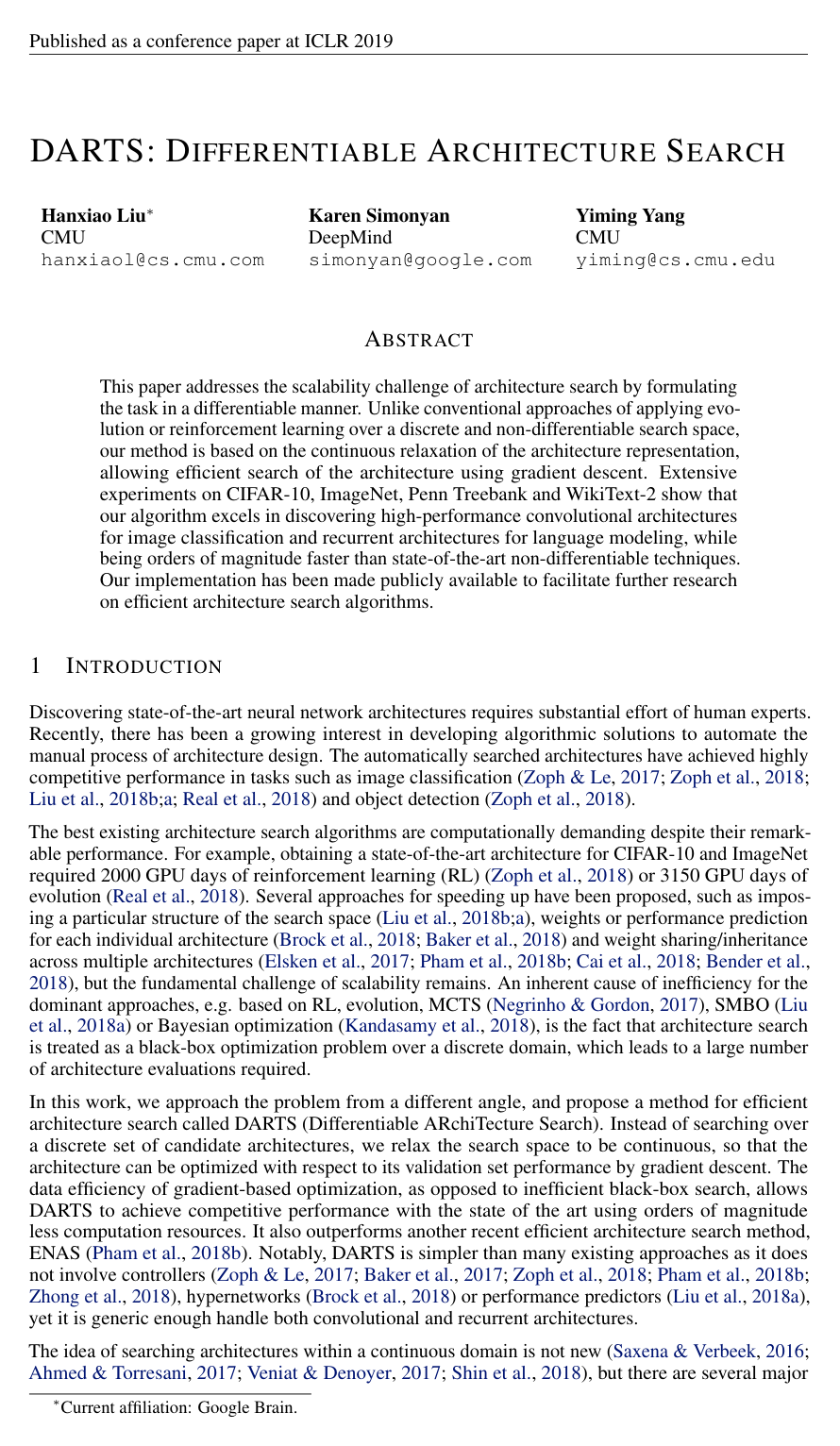
DARTS: Differentiable Architecture Search
Hanxiao Liu, Karen Simonyan, Yiming Yang
Why you should read this
Proposes a continuous relaxation method that optimizes neural architecture search using gradient descent, finding competitive vision and language models orders of magnitude faster than reinforcement learning and evolutionary approaches.
This paper addresses the scalability challenge of architecture search by formulating the task in a differentiable manner. Unlike conventional approaches of applying evolution or reinforcement learning over a discrete and non-differentiable search space, our method is based on the continuous relaxation of the architecture representation, allowing efficient search of the architecture using gradient descent. Extensive experiments on CIFAR-10, ImageNet, Penn Treebank and WikiText-2 show that our algorithm excels in discovering high-performance convolutional architectures for image classification and recurrent architectures for language modeling, while being orders of magnitude faster than state-of-the-art non-differentiable techniques. Our implementation has been made publicly available to facilitate further research on efficient architecture search algorithms.
Added
2026-09-10
License
Published with permission
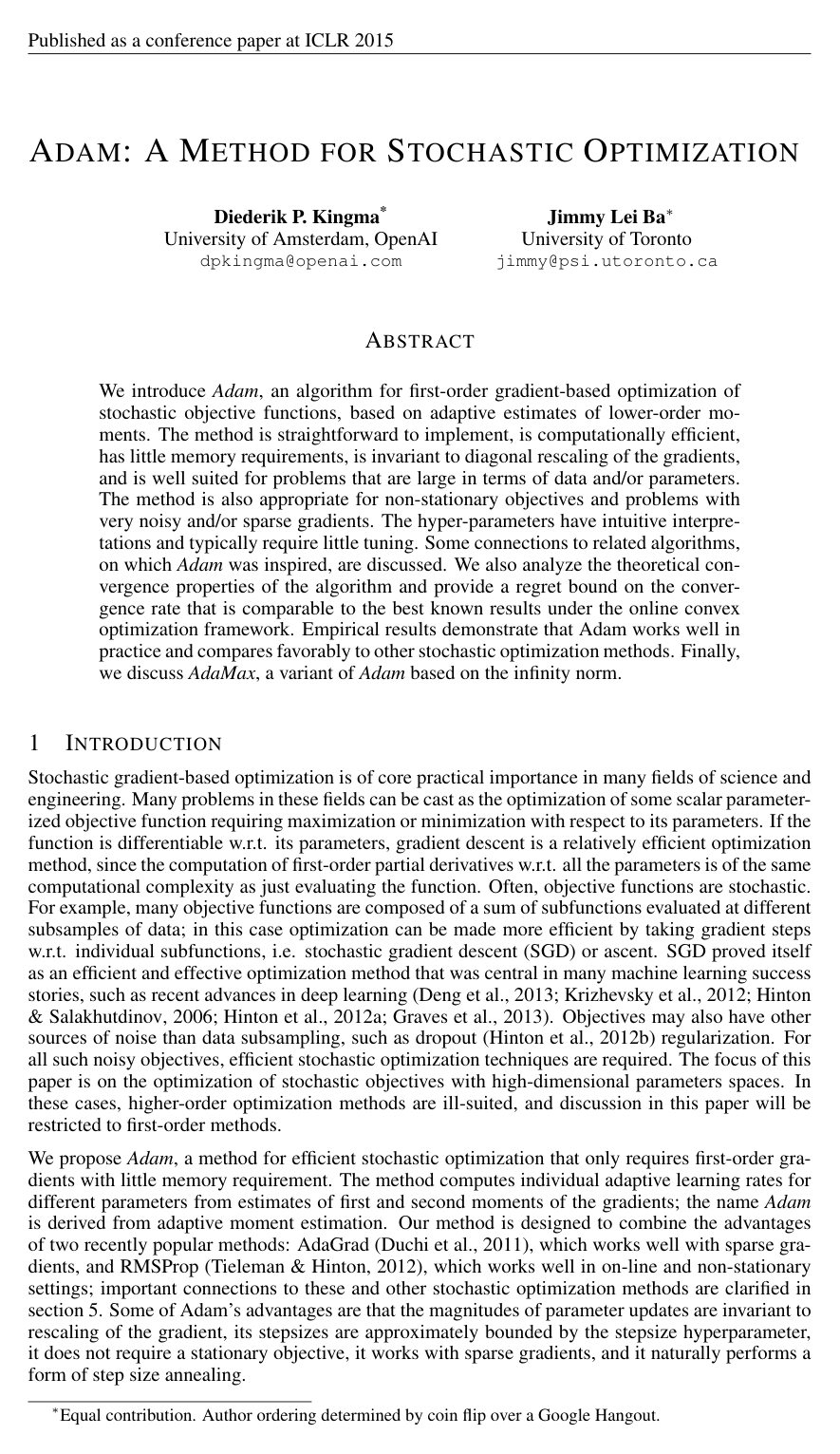
Adam: A Method for Stochastic Optimization
Diederik P. Kingma, Jimmy Ba
Why you should read this
Introduces Adam, an adaptive learning rate optimizer that combines the benefits of momentum and RMSprop to efficiently train deep neural networks on large-scale problems with minimal hyperparameter tuning.
We introduce Adam, an algorithm for first-order gradient-based optimization of stochastic objective functions, based on adaptive estimates of lower-order moments. The method is straightforward to implement, is computationally efficient, has little memory requirements, is invariant to diagonal rescaling of the gradients, and is well suited for problems that are large in terms of data and/or parameters. The method is also appropriate for non-stationary objectives and problems with very noisy and/or sparse gradients. The hyper-parameters have intuitive interpretations and typically require little tuning. Some connections to related algorithms, on which Adam was inspired, are discussed. We also analyze the theoretical convergence properties of the algorithm and provide a regret bound on the convergence rate that is comparable to the best known results under the online convex optimization framework. Empirical results demonstrate that Adam works well in practice and compares favorably to other stochastic optimization methods. Finally, we discuss AdaMax, a variant of Adam based on the infinity norm.
Added
2026-03-22
License
Published with permission