
keyword
generative retrieval
Generative retrieval is an information retrieval paradigm that treats document search as an end-to-end sequence-to-sequence generation task powered by a single neural network rather than relying on external indexing structures such as inverted indices or vector databases. In this approach, the model internalizes the knowledge of an entire document corpus within its learned parameters during training. When given a search query as input, the model autoregressively generates unique identifiers—such as numeric codes, titles, distinctive text strings, or synthetic tokens—corresponding to relevant documents, which are subsequently translated into a ranked list of search results.
5 items
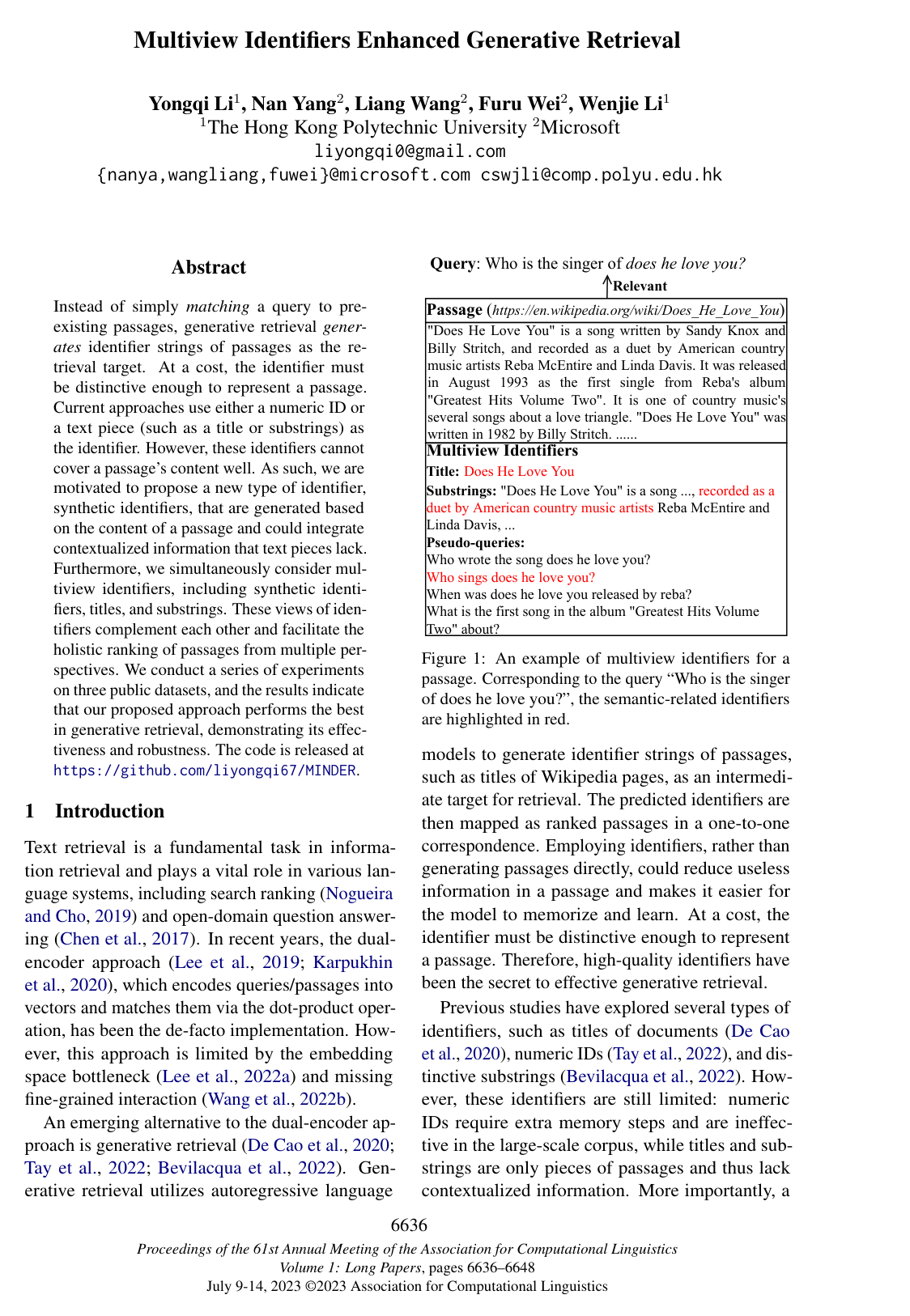
Multiview Identifiers Enhanced Generative Retrieval
Yongqi Li, Nan Yang, Liang Wang, Furu Wei, Wenjie Li
Why you should read this
Proposes MINDER, a generative retrieval framework that combines titles, substrings, and synthetic pseudo-queries into multiview passage identifiers to achieve state-of-the-art document ranking performance across multiple benchmark datasets.
Instead of simply matching a query to pre-existing passages, generative retrieval generates identifier strings of passages as the retrieval target. At a cost, the identifier must be distinctive enough to represent a passage. Current approaches use either a numeric ID or a text piece (such as a title or substrings) as the identifier. However, these identifiers cannot cover a passage's content well. As such, we are motivated to propose a new type of identifier, synthetic identifiers, that are generated based on the content of a passage and could integrate contextualized information that text pieces lack. Furthermore, we simultaneously consider multiview identifiers, including synthetic identifiers, titles, and substrings. These views of identifiers complement each other and facilitate the holistic ranking of passages from multiple perspectives. We conduct a series of experiments on three public datasets, and the results indicate that our proposed approach performs the best in generative retrieval, demonstrating its effectiveness and robustness. The code is released at https://github.com/liyongqi67/MINDER.
Added
2026-10-05
How Does Generative Retrieval Scale to Millions of Passages?
Ronak Pradeep, Kai Hui, Jai Gupta, Ádám D. Lelkes, Honglei Zhuang, Jimmy Lin, Donald Metzler, Vinh Q. Tran
Why you should read this
Presents the first comprehensive empirical evaluation of generative retrieval scaled up to 8.8 million passages and 11 billion parameters, showing that while synthetic queries are vital for indexing, current architectures struggle to match standard dual encoders as corpus size grows.
The emerging paradigm of generative retrieval re-frames the classic information retrieval problem into a sequence-to-sequence modeling task, forgoing external indices and encoding an entire document corpus within a single Transformer. Although many different approaches have been proposed to improve the effectiveness of generative retrieval, they have only been evaluated on document corpora on the order of 100K in size. We conduct the first empirical study of generative retrieval techniques across various corpus scales, ultimately scaling up to the entire MS MARCO passage ranking task with a corpus of 8.8M passages and evaluating model sizes up to 11B parameters. We uncover several findings about scaling generative retrieval to millions of passages; notably, the central importance of using synthetic queries as document representations during indexing, the ineffectiveness of existing proposed architecture modifications when accounting for compute cost, and the limits of naively scaling model parameters with respect to retrieval performance. While we find that generative retrieval is competitive with state-of-the-art dual encoders on small corpora, scaling to millions of passages remains an important and unsolved challenge. We believe these findings will be valuable for the community to clarify the current state of generative retrieval, highlight the unique challenges, and inspire new research directions.
Added
2026-09-26
Learning to Rank in Generative Retrieval
Yongqi Li, Nan Yang, Liang Wang, Furu Wei, Wenjie Li
Why you should read this
Proposes LTRGR, a framework that incorporates ranking losses into autoregressive models to bridge the gap between identifier generation and final passage ranking without adding computational overhead during inference.
Generative retrieval stands out as a promising new paradigm in text retrieval that aims to generate identifier strings of relevant passages as the retrieval target. This generative paradigm taps into powerful generative language models, distinct from traditional sparse or dense retrieval methods. However, only learning to generate is insufficient for generative retrieval. Generative retrieval learns to generate identifiers of relevant passages as an intermediate goal and then converts predicted identifiers into the final passage rank list. The disconnect between the learning objective of autoregressive models and the desired passage ranking target leads to a learning gap. To bridge this gap, we propose a learning-to-rank framework for generative retrieval, dubbed LTRGR. LTRGR enables generative retrieval to learn to rank passages directly, optimizing the autoregressive model toward the final passage ranking target via a rank loss. This framework only requires an additional learning-to-rank training phase to enhance current generative retrieval systems and does not add any burden to the inference stage. We conducted experiments on three public benchmarks, and the results demonstrate that LTRGR achieves state-of-the-art performance among generative retrieval methods. The code and checkpoints are released at https://github.com/liyongqi67/LTRGR.
Added
2026-09-26
GenRec: An LLM-Backed Recommendation Ranker at Netflix
Ying Li, Shradha Sehgal, Arjun Rao, Rein Houthooft, Yunan Hu, Yaochen Zhu, Sourabh Medapati, Yun Li, Linas Baltrunas, Grace Huang, Ashish Rastogi, Kamelia Aryafar
Why you should read this
Demonstrates how Netflix deploys GenRec, an LLM-based recommendation ranker that uses natural language context engineering, reward-weighted tuning, and single-pass catalog scoring to outperform a mature production ranker in large-scale online A/B tests using significantly fewer labeled examples.
Large language models (LLMs) are reshaping recommender systems by enabling richer modeling of users, content, and context directly in natural language. At Netflix, we are exploring this direction through GenRec, an LLM-backed recommendation ranker built on top of an in-house foundational LLM. GenRec follows a two-phase framework: Phase 1 adapts an open-source LLM to Netflix data, developing deep understanding of the catalog and member behavior while balancing capabilities such as content understanding and instruction following. Phase 2 post-trains this foundation model with recommendation-ranking specific data, labels, and reward signals, aiming to align the ranker with business requirements and long-term member satisfaction. This paper focuses on Phase 2 and the transition from a traditional discriminative ranker with thousands of engineered features to an LLM-backed ranker driven by verbalized user histories and context. We describe our design for input verbalization and context engineering, post-training data construction, reward integration, model architecture, and a cost-constrained serving design based on a prefill-only inference approach. We report results from a large-scale A/B test comparing GenRec against the current production ranker model, where we show that a GenRec model trained with substantially fewer Phase-2 labeled training examples and input signals can achieve statistically significant gains in offline and online metrics. We discuss how LLM-backed recommenders could shift the recommendation paradigm: from feature engineering to context engineering, and from bespoke architectures to shared foundation backbones. We also outline practical lessons for serving such systems under real-world resource constraints.
Added
2026-09-03
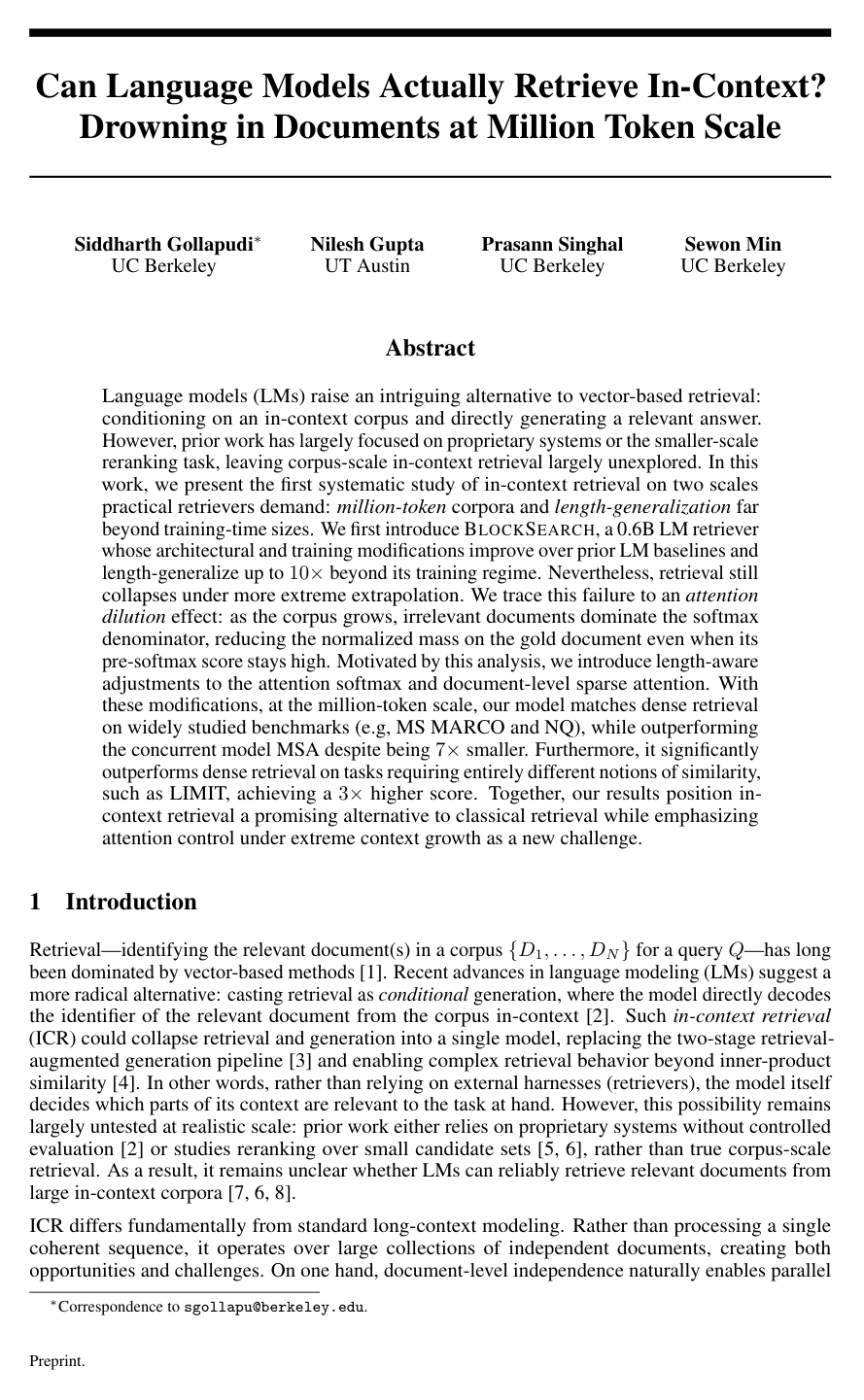
Can Language Models Actually Retrieve In-Context? Drowning in Documents at Million Token Scale
Siddharth Gollapudi, Nilesh Gupta, Prasann Singhal, Sewon Min
Why you should read this
Demonstrates that language models can achieve competitive and superior retrieval performance on million-token scale corpora by mitigating attention dilution through novel architectural and training modifications.
Language models (LMs) raise an intriguing alternative to vector-based retrieval: conditioning on an in-context corpus and directly generating a relevant answer. However, prior work has largely focused on proprietary systems or the smaller-scale reranking task, leaving corpus-scale in-context retrieval largely unexplored. In this work, we present the first systematic study of in-context retrieval on two scales practical retrievers demand: million-token corpora and length-generalization far beyond training-time sizes. We first introduce BlockSearch, a 0.6B LM retriever whose architectural and training modifications improve over prior LM baselines and length-generalize up to 10 times beyond its training regime. Nevertheless, retrieval still collapses under more extreme extrapolation. We trace this failure to an attention dilution effect: as the corpus grows, irrelevant documents dominate the softmax denominator, reducing the normalized mass on the gold document even when its pre-softmax score stays high. Motivated by this analysis, we introduce length-aware adjustments to the attention softmax and document-level sparse attention. With these modifications, at the million-token scale, our model matches dense retrieval on widely studied benchmarks (e.g, MS MARCO and NQ), while outperforming the concurrent model MSA despite being 7 times smaller. Furthermore, it significantly outperforms dense retrieval on tasks requiring entirely different notions of similarity, such as LIMIT, achieving a 3 times higher score. Together, our results position in-context retrieval a promising alternative to classical retrieval while emphasizing attention control under extreme context growth as a new challenge.
Added
2026-07-13
