
keyword
Generative pre-trained transformers
Generative pre-trained transformers are a class of artificial intelligence models built on the transformer neural network architecture that generate sequential data by predicting subsequent elements in a sequence. These models are pre-trained on massive datasets using self-supervised learning, enabling them to learn broad patterns, statistical dependencies, and contextual relationships without requiring manual labeling for initial training. Following this pre-training phase, they can be adapted to specific downstream applications or prompted to perform diverse tasks such as text completion, translation, and sequential data forecasting. Characterized predominantly by an autoregressive, decoder-only structure that uses self-attention mechanisms, generative pre-trained transformers are known for their high scalability and strong few-shot generalization capabilities across complex domain tasks.
2 items
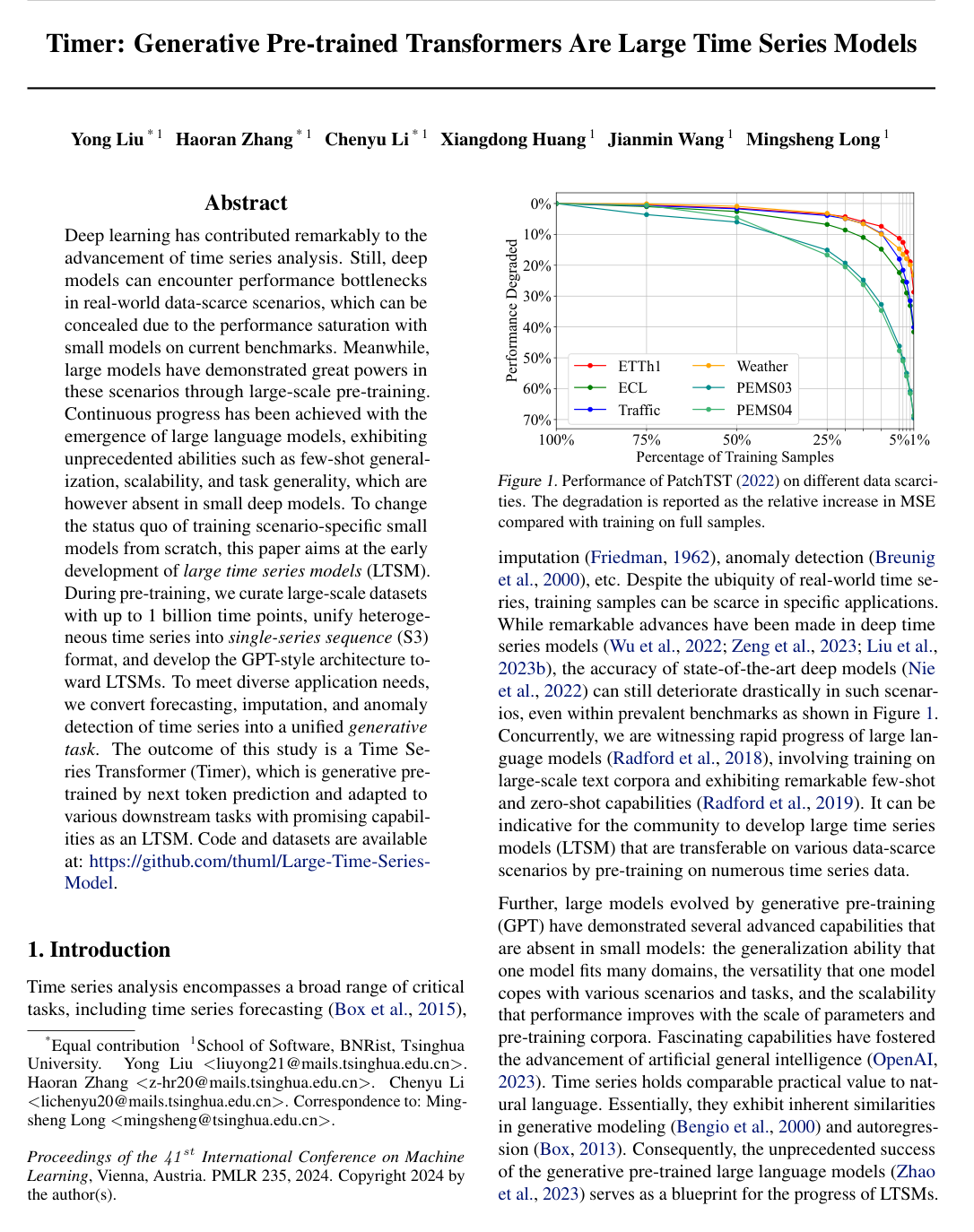
Timer: Generative Pre-trained Transformers Are Large Time Series Models
Yong Liu, Haoran Zhang, Chenyu Li, Xiangdong Huang, Jianmin Wang, Mingsheng Long
Why you should read this
Presents a billion-point pre-trained GPT-style model that unifies diverse time series forecasting, imputation, and anomaly detection into next-token prediction to deliver strong few-shot and zero-shot performance across heterogeneous domains.
Deep learning has contributed remarkably to the advancement of time series analysis. Still, deep models can encounter performance bottlenecks in real-world data-scarce scenarios, which can be concealed due to the performance saturation with small models on current benchmarks. Meanwhile, large models have demonstrated great powers in these scenarios through large-scale pre-training. Continuous progress has been achieved with the emergence of large language models, exhibiting unprecedented abilities such as few-shot generalization, scalability, and task generality, which are however absent in small deep models. To change the status quo of training scenario-specific small models from scratch, this paper aims at the early development of large time series models (LTSM). During pre-training, we curate large-scale datasets with up to 1 billion time points, unify heterogeneous time series into single-series sequence (S3) format, and develop the GPT-style architecture toward LTSMs. To meet diverse application needs, we convert forecasting, imputation, and anomaly detection of time series into a unified generative task. The outcome of this study is a Time Series Transformer (Timer), which is generative pre-trained by next token prediction and adapted to various downstream tasks with promising capabilities as an LTSM. Code and datasets are available at: https://github.com/thuml/Large-Time-Series-Model.
Added
2026-09-26
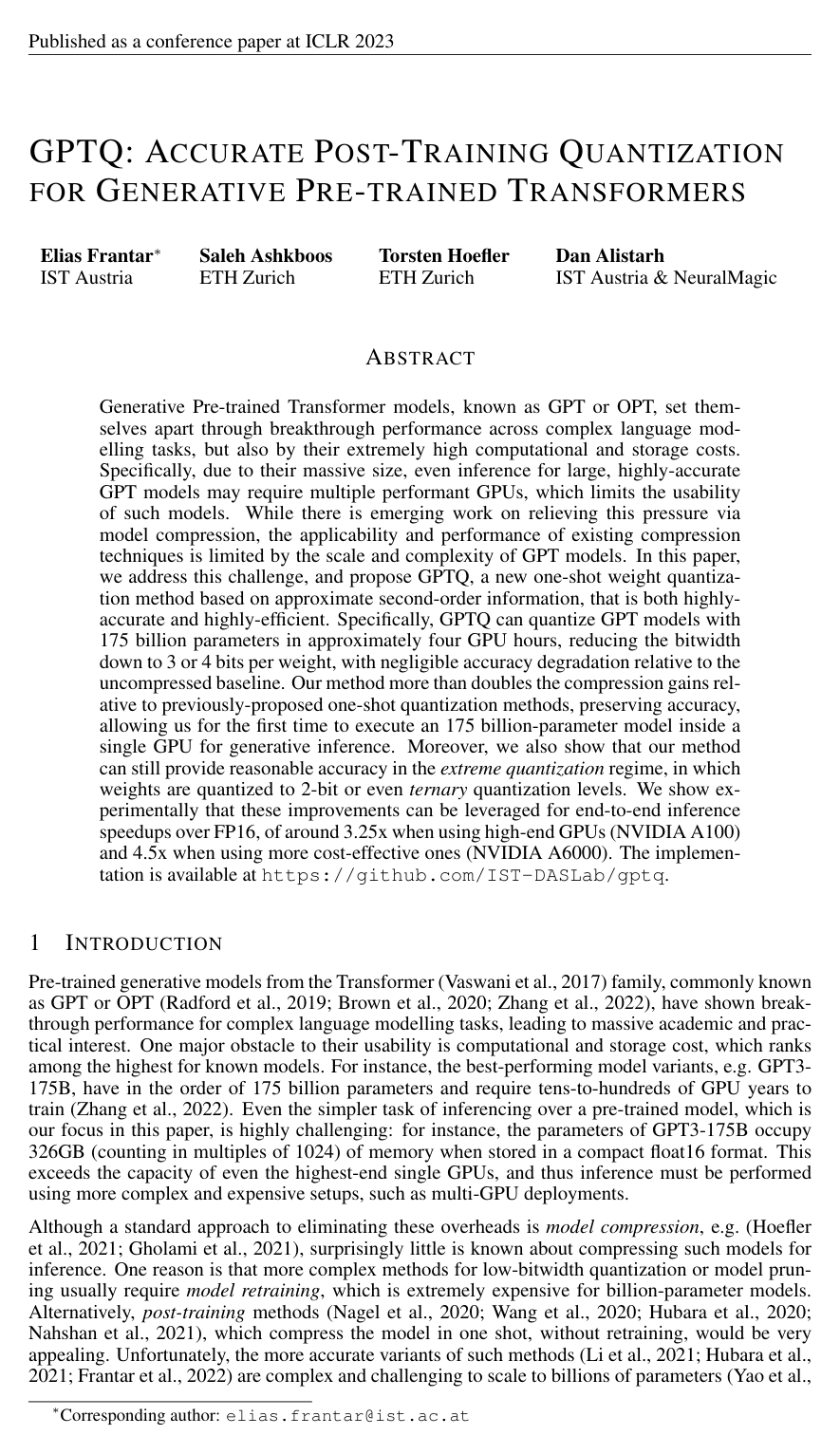
GPTQ: Accurate Post-Training Quantization for Generative Pre-trained Transformers
Elias Frantar, Saleh Ashkboos, Torsten Hoefler, Dan Alistarh
Why you should read this
Develops a layer-wise quantization scheme utilizing the inverse Hessian matrix to compress model weights to four bits with near-zero loss in predictive perplexity.
Generative Pre-trained Transformer models, known as GPT or OPT, set themselves apart through breakthrough performance across complex language modelling tasks, but also by their extremely high computational and storage costs. Specifically, due to their massive size, even inference for large, highly-accurate GPT models may require multiple performant GPUs, which limits the usability of such models. While there is emerging work on relieving this pressure via model compression, the applicability and performance of existing compression techniques is limited by the scale and complexity of GPT models. In this paper, we address this challenge, and propose GPTQ, a new one-shot weight quantization method based on approximate second-order information, that is both highly-accurate and highly-efficient. Specifically, GPTQ can quantize GPT models with 175 billion parameters in approximately four GPU hours, reducing the bitwidth down to 3 or 4 bits per weight, with negligible accuracy degradation relative to the uncompressed baseline. Our method more than doubles the compression gains relative to previously-proposed one-shot quantization methods, preserving accuracy, allowing us for the first time to execute an 175 billion-parameter model inside a single GPU for generative inference. Moreover, we also show that our method can still provide reasonable accuracy in the extreme quantization regime, in which weights are quantized to 2-bit or even ternary quantization levels. We show experimentally that these improvements can be leveraged for end-to-end inference speedups over FP16, of around 3.25x when using high-end GPUs (NVIDIA A100) and 4.5x when using more cost-effective ones (NVIDIA A6000). The implementation is available at https://github.com/IST-DASLab/gptq.
Added
2026-04-24