
keyword
generalization error
Generalization error is a measure of how accurately a machine learning model predicts outcomes on new, previously unseen data drawn from the same underlying distribution rather than on the specific data used to train it. In statistical learning theory, it is formally defined as the expected value of the loss function over the entire true data distribution, and in practical settings, it is typically estimated using a separate, held-out test dataset. The concept also commonly refers to the generalization gap, which quantifies the difference between the expected error on unseen data and the empirical error achieved on the training set. Minimizing generalization error is the primary objective of model training, as a large discrepancy between training accuracy and generalization performance indicates overfitting, which practitioners seek to mitigate through techniques such as regularization, capacity control, and robust optimization.
18 items
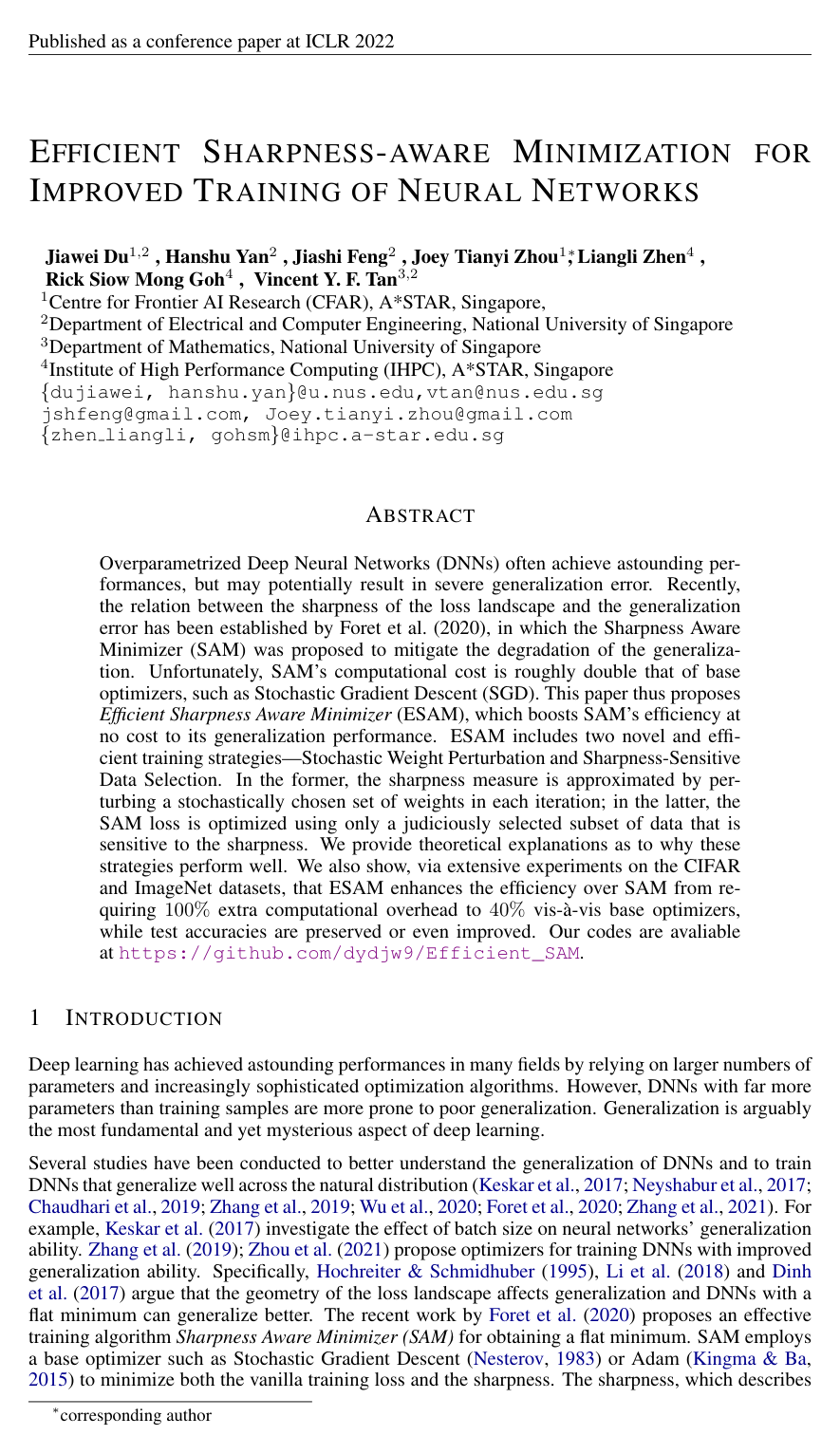
Efficient Sharpness-aware Minimization for Improved Training of Neural Networks
Jiawei Du, Hanshu Yan, Jiashi Feng, Joey Tianyi Zhou, Liangli Zhen, Rick Siow Mong Goh, Vincent Y. F. Tan
Why you should read this
Proposes Efficient Sharpness-Aware Minimizer (ESAM), an optimization technique that reduces the computational overhead of SAM from roughly 100% to 40% over base optimizers via stochastic weight perturbation and sharpness-sensitive data selection without sacrificing generalization accuracy.
Overparametrized Deep Neural Networks (DNNs) often achieve astounding performances, but may potentially result in severe generalization error. Recently, the relation between the sharpness of the loss landscape and the generalization error has been established by Foret et al. (2020), in which the Sharpness Aware Minimizer (SAM) was proposed to mitigate the degradation of the generalization. Unfortunately, SAM s computational cost is roughly double that of base optimizers, such as Stochastic Gradient Descent (SGD). This paper thus proposes Efficient Sharpness Aware Minimizer (ESAM), which boosts SAM s efficiency at no cost to its generalization performance. ESAM includes two novel and efficient training strategies-StochasticWeight Perturbation and Sharpness-Sensitive Data Selection. In the former, the sharpness measure is approximated by perturbing a stochastically chosen set of weights in each iteration; in the latter, the SAM loss is optimized using only a judiciously selected subset of data that is sensitive to the sharpness. We provide theoretical explanations as to why these strategies perform well. We also show, via extensive experiments on the CIFAR and ImageNet datasets, that ESAM enhances the efficiency over SAM from requiring 100% extra computations to 40% vis-a-vis base optimizers, while test accuracies are preserved or even improved.
Added
2026-10-05
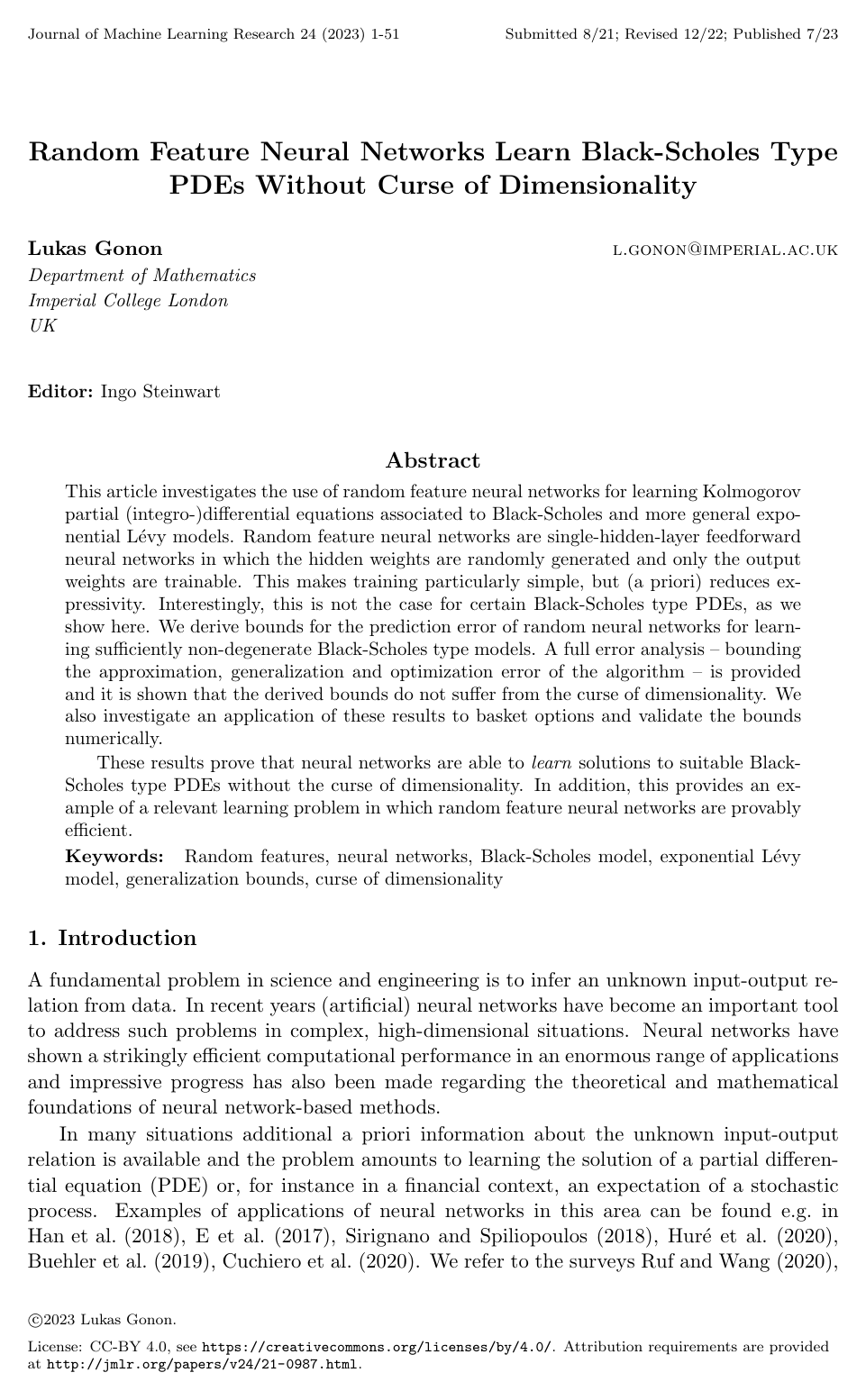
Random Feature Neural Networks Learn Black-Scholes Type PDEs Without Curse of Dimensionality
Lukas Gonon
Why you should read this
Proves that single-hidden-layer random feature neural networks overcome the curse of dimensionality when learning solutions to Black-Scholes and exponential Lévy partial differential equations by providing a complete error analysis covering approximation, generalization, and optimization.
This article investigates the use of random feature neural networks for learning Kolmogorov partial (integro-)differential equations associated to Black-Scholes and more general exponential Lévy models. Random feature neural networks are single-hidden-layer feedforward neural networks in which the hidden weights are randomly generated and only the output weights are trainable. This makes training particularly simple, but (a priori) reduces expressivity. Interestingly, this is not the case for certain Black-Scholes type PDEs, as we show here. We derive bounds for the prediction error of random neural networks for learning sufficiently non-degenerate Black-Scholes type models. A full error analysis – bounding the approximation, generalization and optimization error of the algorithm – is provided and it is shown that the derived bounds do not suffer from the curse of dimensionality. We also investigate an application of these results to basket options and validate the bounds numerically. These results prove that neural networks are able to learn solutions to suitable Black-Scholes type PDEs without the curse of dimensionality. In addition, this provides an example of a relevant learning problem in which random feature neural networks are provably efficient.
Added
2026-10-03
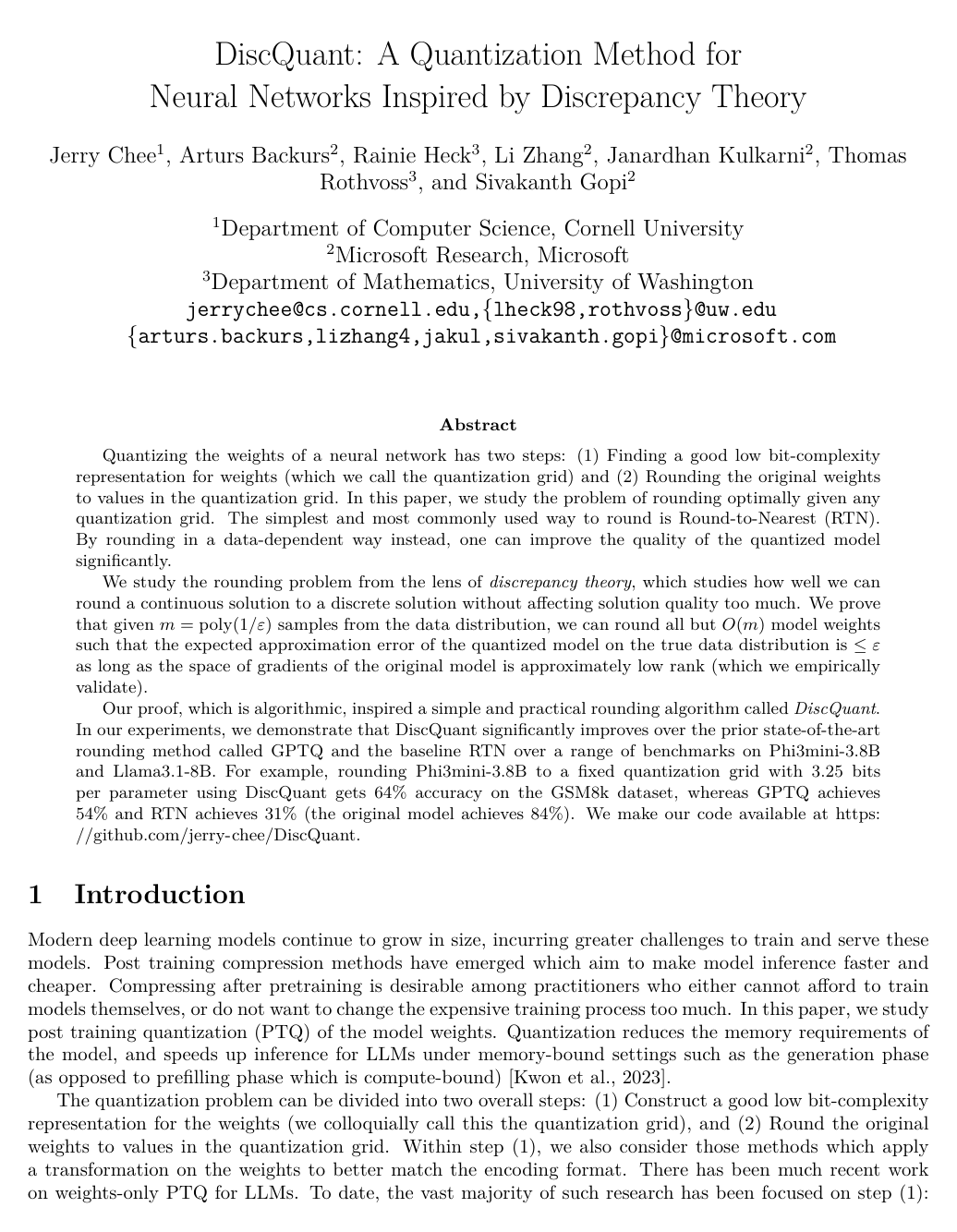
DiscQuant: A Quantization Method for Neural Networks Inspired by Discrepancy Theory
Jerry Chee, Arturs Backurs, Rainie Heck, Li Zhang, Janardhan (Jana) Kulkarni, Thomas Rothvoss, Sivakanth Gopi
Why you should read this
Introduces DiscQuant, a weight-rounding algorithm grounded in discrepancy theory that guarantees bounded quantization error and significantly outperforms standard post-training methods like GPTQ on low-bit large language model compression.
Quantizing the weights of a neural network has two steps: (1) Finding a good low bit-complexity representation for weights (which we call the quantization grid) and (2) Rounding the original weights to values in the quantization grid. In this paper, we study the problem of rounding optimally given any quantization grid. The simplest and most commonly used way to round is Round-to-Nearest (RTN). By rounding in a data-dependent way instead, one can improve the quality of the quantized model significantly. We study the rounding problem from the lens of \emph{discrepancy theory}, which studies how well we can round a continuous solution to a discrete solution without affecting solution quality too much. We prove that given samples from the data distribution, we can round all but model weights such that the expected approximation error of the quantized model on the true data distribution is as long as the space of gradients of the original model is approximately low rank (which we empirically validate). Our proof, which is algorithmic, inspired a simple and practical rounding algorithm called \emph{DiscQuant}. In our experiments, we demonstrate that DiscQuant significantly improves over the prior state-of-the-art rounding method called GPTQ and the baseline RTN over a range of benchmarks on Phi3mini-3.8B and Llama3.1-8B. For example, rounding Phi3mini-3.8B to a fixed quantization grid with 3.25 bits per parameter using DiscQuant gets 64\% accuracy on the GSM8k dataset, whereas GPTQ achieves 54\% and RTN achieves 31\% (the original model achieves 84\%). We make our code available at this https URL.
Added
2026-09-29
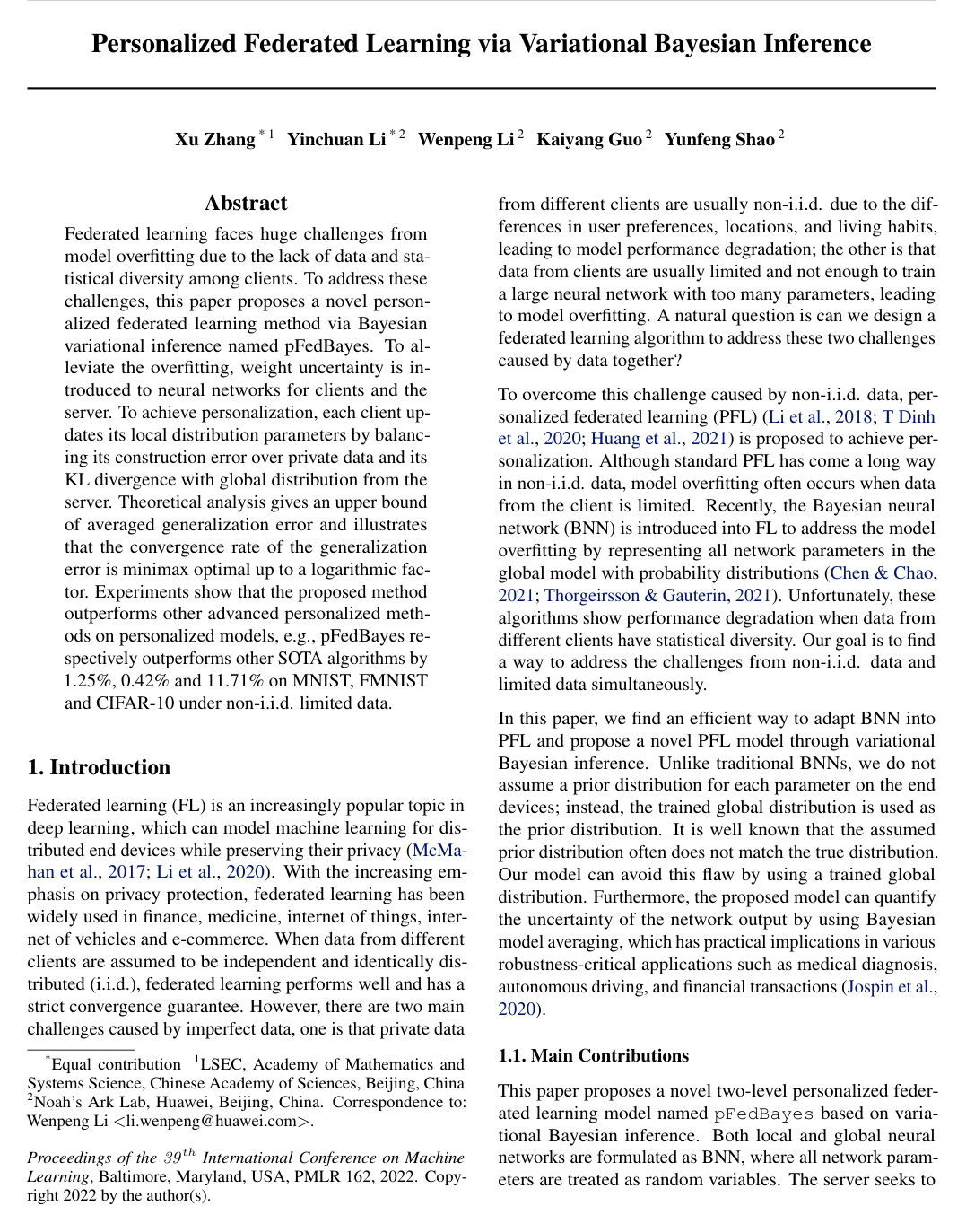
Personalized Federated Learning via Variational Bayesian Inference
Xu Zhang, Yinchuan Li, Wenpeng Li, Kaiyang Guo, Yunfeng Shao
Why you should read this
Develops pFedBayes, a personalized federated learning framework that uses variational Bayesian neural networks to prevent client overfitting on non-i.i.d. data while guaranteeing minimax-optimal generalization error bounds.
Federated learning faces huge challenges from model overfitting due to the lack of data and statistical diversity among clients. To address these challenges, this paper proposes a novel personalized federated learning method via Bayesian variational inference named pFedBayes. To alleviate the overfitting, weight uncertainty is introduced to neural networks for clients and the server. To achieve personalization, each client updates its local distribution parameters by balancing its construction error over private data and its KL divergence with global distribution from the server. Theoretical analysis gives an upper bound of averaged generalization error and illustrates that the convergence rate of the generalization error is minimax optimal up to a logarithmic factor. Experiments show that the proposed method outperforms other advanced personalized methods on personalized models, e.g., pFedBayes respectively outperforms other SOTA algorithms by 1.25%, 0.42% and 11.71% on MNIST, FMNIST and CIFAR-10 under non-i.i.d. limited data.
Added
2026-09-26
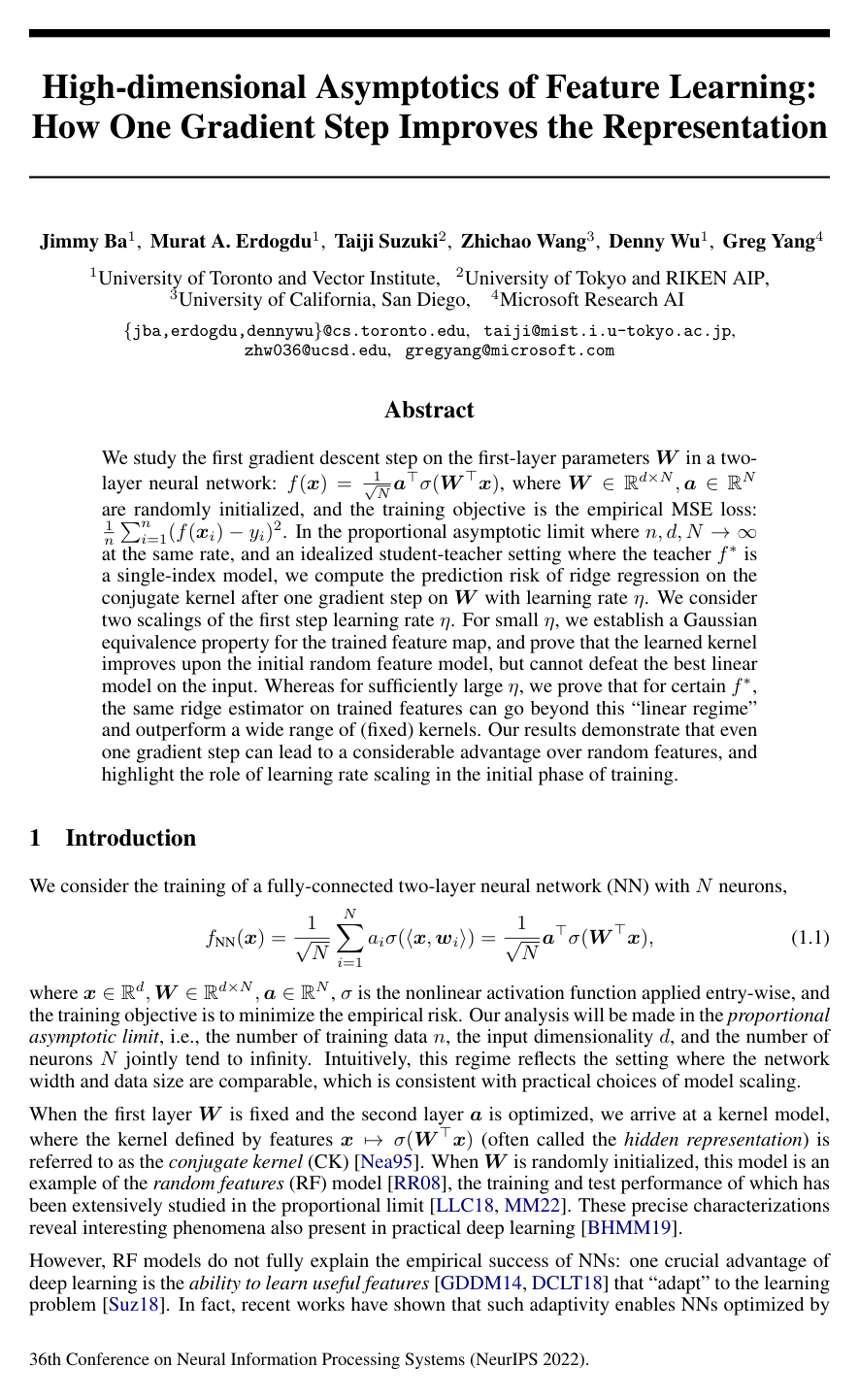
High-dimensional Asymptotics of Feature Learning: How One Gradient Step Improves the Representation
Jimmy Ba, Murat A. Erdogdu, Taiji Suzuki, Zhichao Wang, Denny Wu, Greg Yang
Why you should read this
Proves that taking a single gradient descent step on the first layer of a two-layer neural network with a sufficiently large learning rate enables the resulting kernel to outperform fixed random features and surpass linear estimators in high dimensions.
We study the first gradient descent step on the first-layer parameters W in a two-layer neural network: f(x) = 1/√N a^⊤ σ(W^⊤ x), where W ∈ ℝ^{d×N}, a ∈ ℝ^N are randomly initialized, and the training objective is the empirical MSE loss: 1/n ∑_{i=1}^n (f(x_i) - y_i)^2. In the proportional asymptotic limit where n, d, N → ∞ at the same rate, and an idealized student-teacher setting where the teacher f^* is a single-index model, we compute the prediction risk of ridge regression on the conjugate kernel after one gradient step on W with learning rate η. We consider two scalings of the first step learning rate η. For small η, we establish a Gaussian equivalence property for the trained feature map, and prove that the learned kernel improves upon the initial random feature model, but cannot defeat the best linear model on the input. Whereas for sufficiently large η, we prove that for certain f^*, the same ridge estimator on trained features can go beyond this “linear regime” and outperform a wide range of (fixed) kernels. Our results demonstrate that even one gradient step can lead to a considerable advantage over random features, and highlight the role of learning rate scaling in the initial phase of training.
Added
2026-09-26
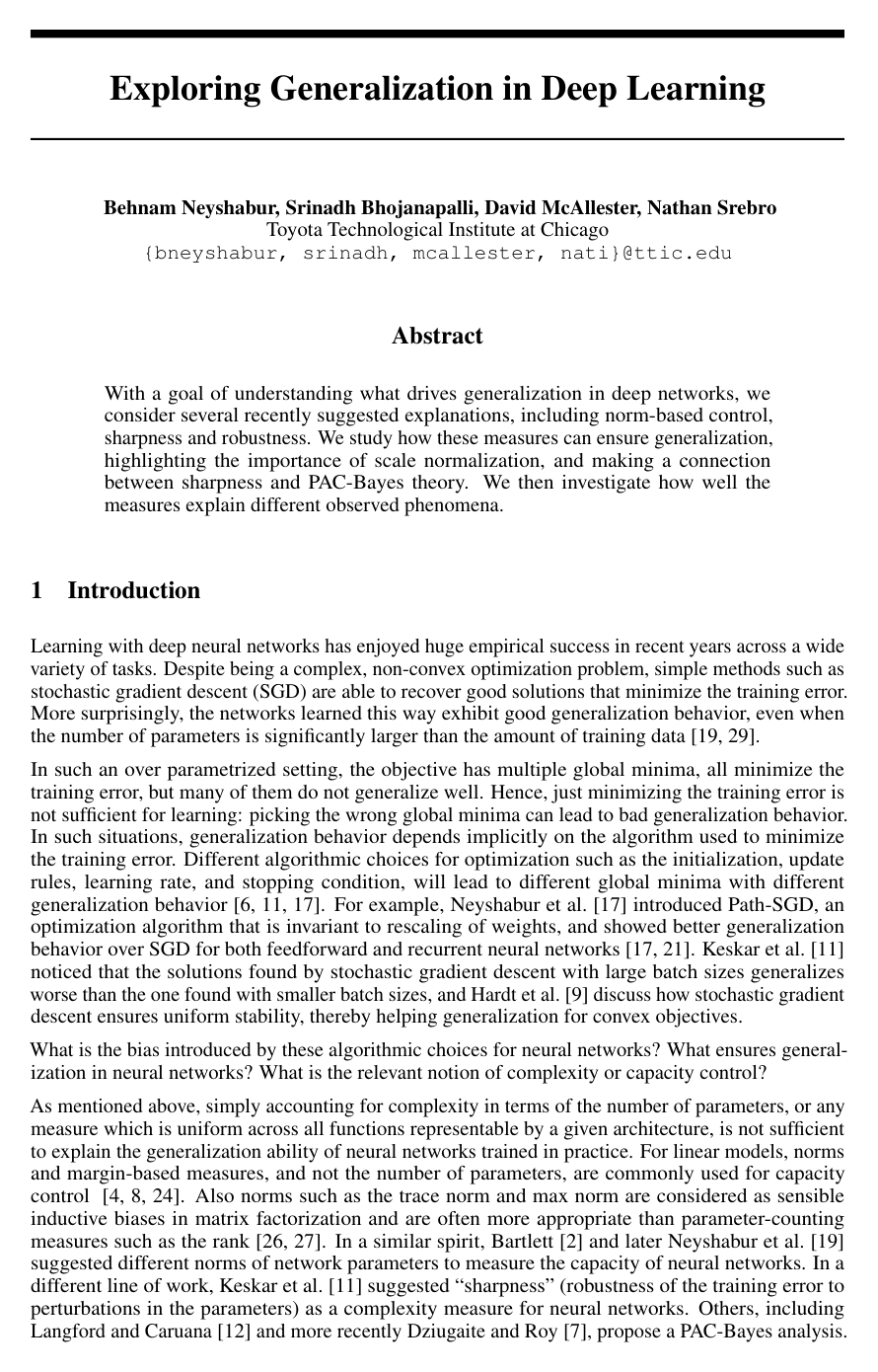
Exploring Generalization in Deep Learning
Behnam Neyshabur, Srinadh Bhojanapalli, David McAllester, Nathan Srebro
Why you should read this
Establishes a theoretical link between loss surface sharpness and PAC-Bayes bounds while evaluating which scale-normalized capacity measures genuinely explain generalization in deep neural networks.
With a goal of understanding what drives generalization in deep networks, we consider several recently suggested explanations, including norm-based control, sharpness and robustness. We study how these measures can ensure generalization, highlighting the importance of scale normalization, and making a connection between sharpness and PAC-Bayes theory. We then investigate how well the measures explain different observed phenomena.
Added
2026-09-25
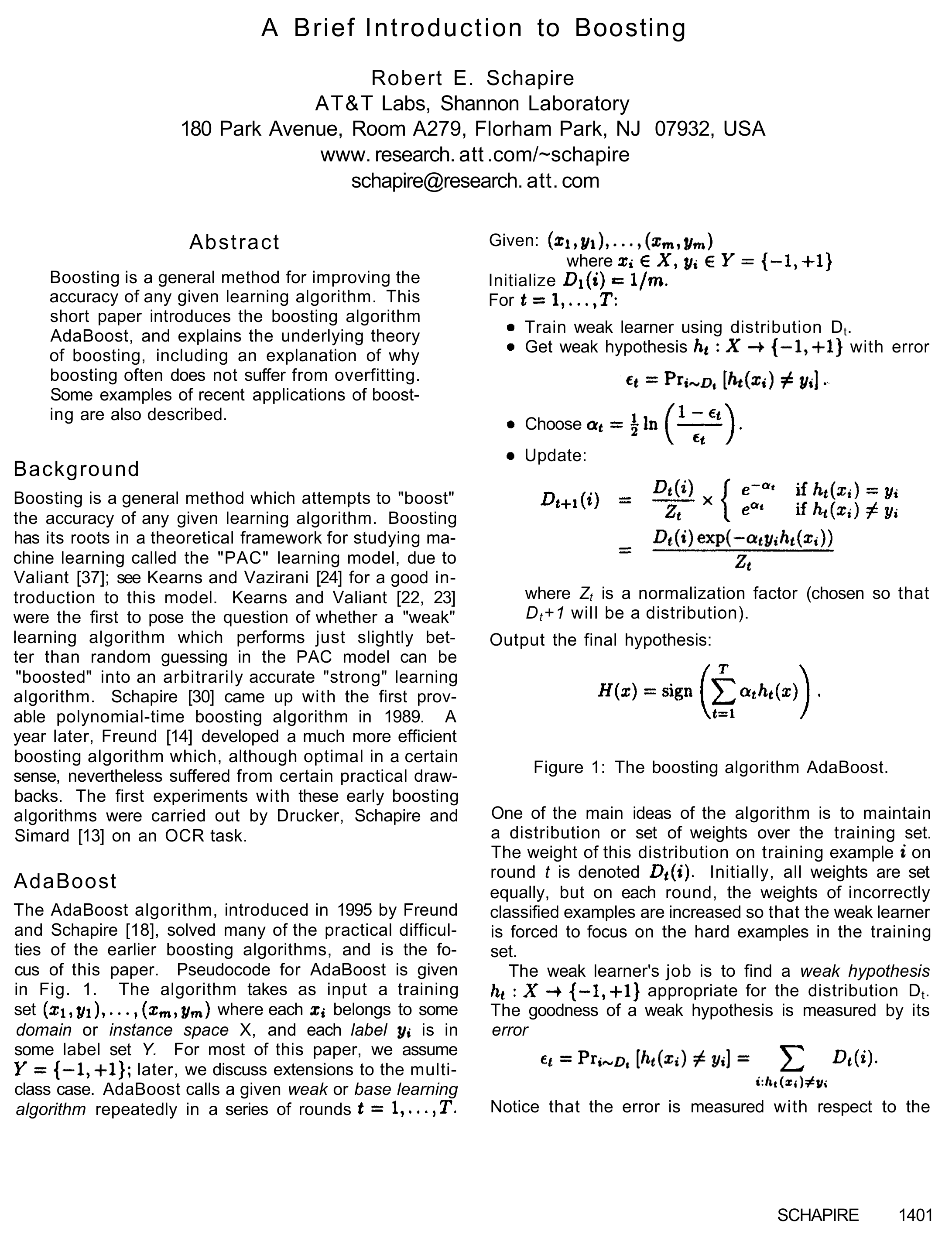
A Brief Introduction to Boosting
R. Schapire
Why you should read this
Explains the theoretical foundations and mechanics of AdaBoost, providing clear proofs of exponential training error reduction alongside a margin-based explanation for why boosting resists overfitting even after achieving zero training error.
Boosting is a general method for improving the accuracy of any given learning algorithm. This short paper introduces the boosting algorithm AdaBoost, and explains the underlying theory of boosting, including an explanation of why boosting often does not suffer from overfitting. Some examples of recent applications of boosting are also described.
Added
2026-09-24
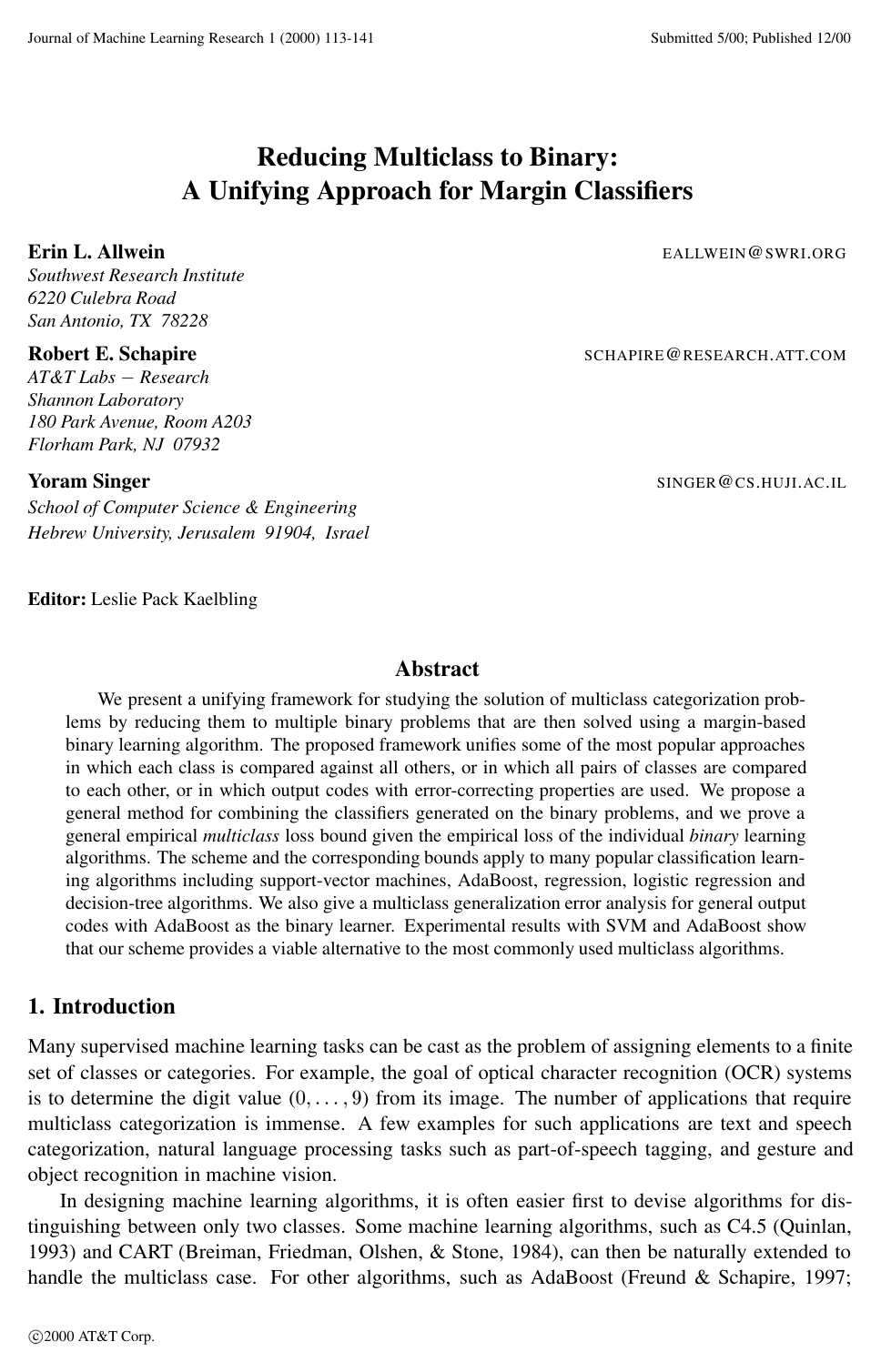
Reducing Multiclass to Binary: A Unifying Approach for Margin Classifiers
Erin L. Allwein, Rob Schapire, Y. Singer
Why you should read this
Unifies standard multiclass-to-binary reductions under a single framework by introducing margin- and loss-based decoding techniques backed by rigorous error bounds for algorithms like AdaBoost and support vector machines.
We present a unifying framework for studying the solution of multiclass categorization problems by reducing them to multiple binary problems that are then solved using a margin-based binary learning algorithm. The proposed framework unifies some of the most popular approaches in which each class is compared against all others, or in which all pairs of classes are compared to each other, or in which output codes with error-correcting properties are used. We propose a general method for combining the classifiers generated on the binary problems, and we prove a general empirical multiclass loss bound given the empirical loss of the individual binary learning algorithms. The scheme and the corresponding bounds apply to many popular classification learning algorithms including support-vector machines, AdaBoost, regression, logistic regression and decision-tree algorithms. We also give a multiclass generalization error analysis for general output codes with AdaBoost as the binary learner. Experimental results with SVM and AdaBoost show that our scheme provides a viable alternative to the most commonly used multiclass algorithms.
Added
2026-09-24
Improving Generalization with Active Learning
David Cohn, Les Atlas, Richard Ladner
Why you should read this
Presents a selective sampling framework implemented via SG-networks that queries an oracle only on regions of uncertainty, substantially improving neural network generalization over standard random training.
Active learning differs from "learning from examples" in that the learning algorithm assumes at least some control over what part of the input domain it receives information about. In some situations, active learning is provably more powerful than learning from examples alone, giving better generalization for a fixed number of training examples. In this article, we consider the problem of learning a binary concept in the absence of noise. We describe a formalism for active concept learning called selective sampling and show how it may be approximately implemented by a neural network. In selective sampling, a learner receives distribution information from the environment and queries an oracle on parts of the domain it considers "useful." We test our implementation, called an SG-network, on three domains and observe significant improvement in generalization.
Added
2026-09-18
Large Margin DAGs for Multiclass Classification
John C. Platt, N. Cristianini, J. Shawe-Taylor
Why you should read this
Introduces the Decision Directed Acyclic Graph architecture and the DAGSVM algorithm, providing dimension-independent generalization error bounds and substantially faster multiclass SVM evaluation by requiring only linear-time path traversals without sacrificing accuracy.
We present a new learning architecture: the Decision Directed Acyclic Graph (DDAG), which is used to combine many two-class classifiers into a multiclass classifier. For an N-class problem, the DDAG contains N(N − 1)/2 classifiers, one for each pair of classes. We present a VC analysis of the case when the node classifiers are hyperplanes; the resulting bound on the test error depends on N and on the margin achieved at the nodes, but not on the dimension of the space. This motivates an algorithm, DAGSVM, which operates in a kernel-induced feature space and uses two-class maximal margin hyperplanes at each decision-node of the DDAG. The DAGSVM is substantially faster to train and evaluate than either the standard algorithm or Max Wins, while maintaining comparable accuracy to both of these algorithms.
Added
2026-09-18
Feature selection, L1 vs. L2 regularization, and rotational invariance
Andrew Y. Ng
Why you should read this
Proves that L1-regularized logistic regression requires only logarithmically many training examples in the number of irrelevant features, whereas rotationally invariant methods like L2 regularization and SVMs suffer from sample complexity that scales at least linearly.
This document is a presentation slide deck and does not contain an abstract.
Added
2026-09-16
A Simple Weight Decay Can Improve Generalization
A. Krogh, J. Hertz
Why you should read this
Provides a foundational theoretical explanation and empirical validation for how weight decay improves neural network generalization by suppressing irrelevant weight components and mitigating target noise.
It has been observed in numerical simulations that a weight decay can improve generalization in a feed-forward neural network. This paper explains why. It is proven that a weight decay has two effects in a linear network. First, it suppresses any irrelevant components of the weight vector by choosing the smallest vector that solves the learning problem. Second, if the size is chosen right, a weight decay can suppress some of the effects of static noise on the targets, which improves generalization quite a lot. It is then shown how to extend these results to networks with hidden layers and non-linear units. Finally the theory is confirmed by some numerical simulations using the data from NetTalk.
Added
2026-09-16
Stability and Generalization
Olivier Bousquet, André Elisseeff
Why you should read this
Establishes an algorithmic stability framework that uses concentration inequalities to derive tight generalization error bounds for regularized learning methods like support vector machines without relying on standard uniform convergence or VC-dimension arguments.
We define notions of stability for learning algorithms and show how to use these notions to derive generalization error bounds based on the empirical error and the leave-one-out error. The methods we use can be applied in the regression framework as well as in the classification one when the classifier is obtained by thresholding a real-valued function. We study the stability properties of large classes of learning algorithms such as regularization based algorithms. In particular we focus on Hilbert space regularization and Kullback-Leibler regularization. We demonstrate how to apply the results to SVM for regression and classification.
Added
2026-09-16
Query by committee
H. Seung, Manfred Opper, Haim Sompolinsky
Why you should read this
Introduces the Query by Committee active learning framework, demonstrating that selecting unlabeled examples based on maximal disagreement among an ensemble of models achieves an exponential reduction in generalization error compared to passive random sampling.
We propose an algorithm called query by committee, in which a committee of students is trained on the same data set. The next query is chosen according to the principle of maximal disagreement. The algorithm is studied for two toy models: the high-low game and perceptron learning of another perceptron. As the number of queries goes to infinity, the committee algorithm yields asymptotically finite information gain. This leads to generalization error that decreases exponentially with the number of examples. This in marked contrast to learning from randomly chosen inputs, for which the information gain approaches zero and the generalization error decreases with a relatively slow inverse power law. We suggest that asymptotically finite information gain may be an important characteristic of good query algorithms.
Added
2026-09-16
On Discriminative vs. Generative Classifiers: A comparison of logistic regression and naive Bayes
A. Ng, Michael I. Jordan
Why you should read this
Demonstrates that while discriminative classifiers achieve lower asymptotic error, generative models require only logarithmic sample complexity to approach their asymptotic performance, explaining why naive Bayes frequently outperforms logistic regression on smaller training sets.
We compare discriminative and generative learning as typified by logistic regression and naive Bayes. We show, contrary to a widely-held belief that discriminative classifiers are almost always to be preferred, that there can often be two distinct regimes of performance as the training set size is increased, one in which each algorithm does better. This stems from the observation—which is borne out in repeated experiments—that while discriminative learning has lower asymptotic error, a generative classifier may also approach its (higher) asymptotic error much faster.
Added
2026-09-14
A sequential algorithm for training text classifiers
David D. Lewis, William A. Gale
Why you should read this
Introduces uncertainty sampling, a sequential learning method that reduces the volume of manually labeled training data needed for accurate text classification by up to 500-fold.
The ability to cheaply train text classifiers is critical to their use in information retrieval, content analysis, natural language processing, and other tasks involving data which is partly or fully textual. An algorithm for sequential sampling during machine learning of statistical classifiers was developed and tested on a newswire text categorization task. This method, which we call uncertainty sampling, reduced by as much as 500-fold the amount of training data that would have to be manually classified to achieve a given level of effectiveness.
Added
2026-09-14
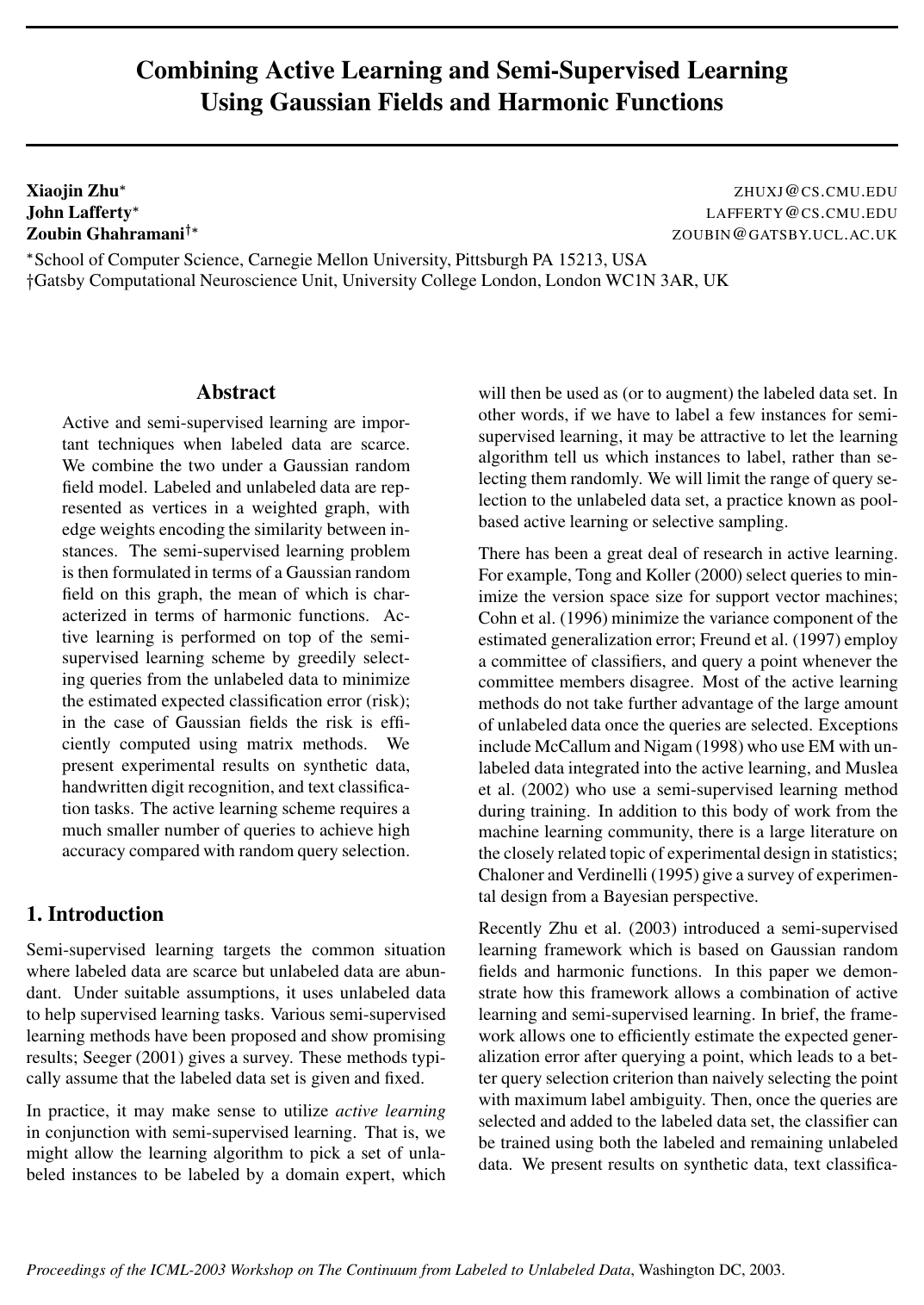
Combining active learning and semi-supervised learning using Gaussian fields and harmonic functions
Xiaojin Zhu, Zoubin Ghahramani, John Lafferty
Why you should read this
Proposes an active learning framework integrated with Gaussian random fields and harmonic energy minimization, enabling efficient closed-form estimation of expected classification risk to select optimal queries from unlabeled data without costly retraining.
Active and semi-supervised learning are important techniques when labeled data are scarce. We combine the two under a Gaussian random field model. Labeled and unlabeled data are represented as vertices in a weighted graph, with edge weights encoding the similarity between instances. The semi-supervised learning problem is then formulated in terms of a Gaussian random field on this graph, the mean of which is characterized in terms of harmonic functions. Active learning is performed on top of the semi-supervised learning scheme by greedily selecting queries from the unlabeled data to minimize the estimated expected classification error (risk); in the case of Gaussian fields the risk is efficiently computed using matrix methods. We present experimental results on synthetic data, handwritten digit recognition, and text classification tasks. The active learning scheme requires a much smaller number of queries to achieve high accuracy compared with random query selection.
Added
2026-09-11
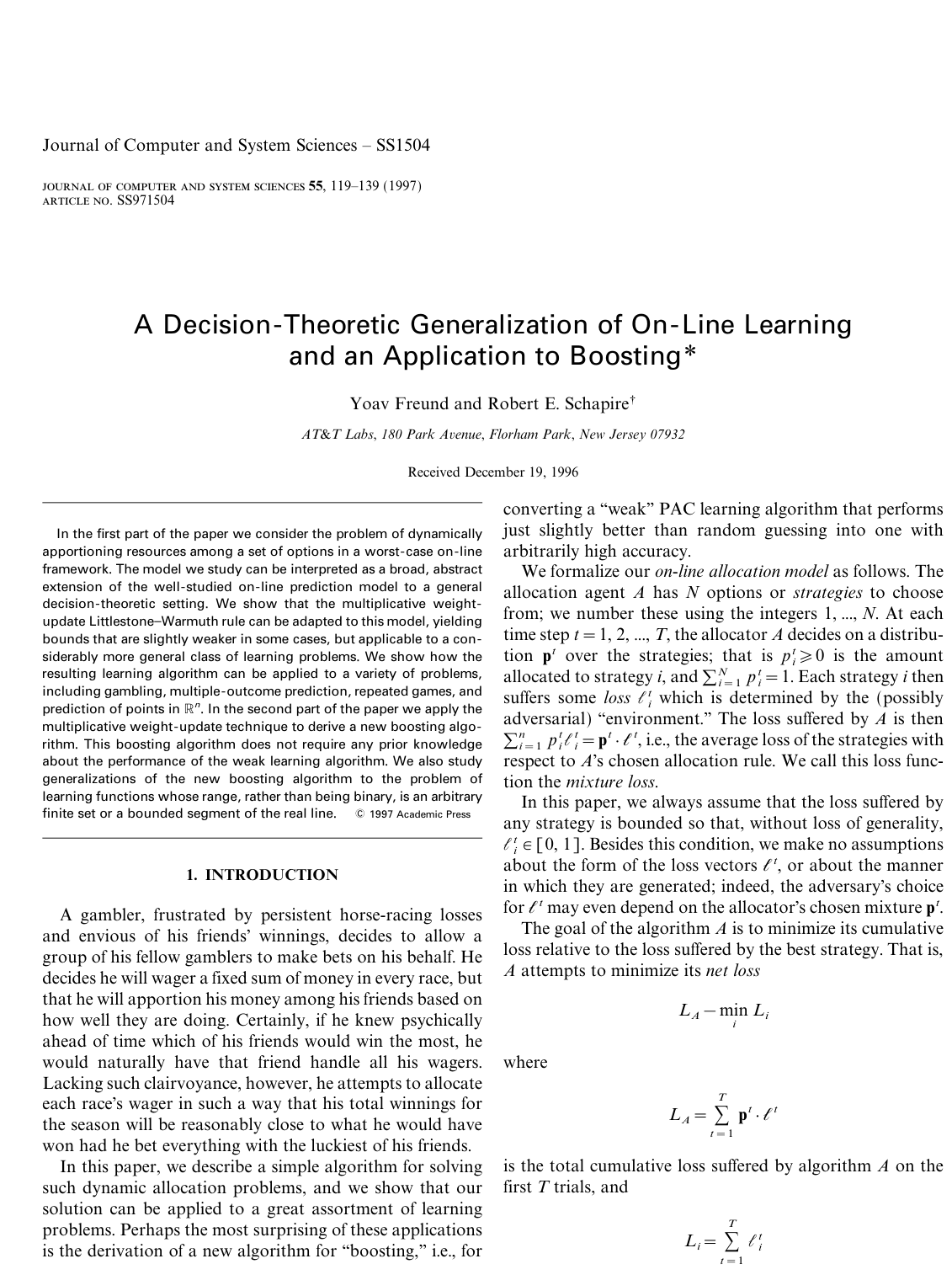
A Decision-Theoretic Generalization of On-Line Learning and an Application to Boosting
Yoav Freund, Robert E. Schapire
Why you should read this
Presents the AdaBoost algorithm that guarantees exponentially decaying error rates by sequentially combining weak learners into a strong classifier.
In the first part of the paper we consider the problem of dynamically apportioning resources among a set of options in a worst-case on-line framework. The model we study can be interpreted as a broad, abstract extension of the well-studied on-line prediction model to a general decision-theoretic setting. We show that the multiplicative weight-update Littlestone–Warmuth rule can be adapted to this model, yielding bounds that are slightly weaker in some cases, but applicable to a considerably more general class of learning problems. We show how the resulting learning algorithm can be applied to a variety of problems, including gambling, multiple-outcome prediction, repeated games, and prediction of points in R^n. In the second part of the paper we apply the multiplicative weight-update technique to derive a new boosting algorithm. This boosting algorithm does not require any prior knowledge about the performance of the weak learning algorithm. We also study generalizations of the new boosting algorithm to the problem of learning functions whose range, rather than being binary, is an arbitrary finite set or a bounded segment of the real line.
Added
2026-05-14