
keyword
Gaussian noise
Gaussian noise is statistical noise whose probability density function is equal to that of the normal or Gaussian distribution, meaning that the random values the noise can take follow a symmetric bell-shaped curve defined by a mean and variance. In signal processing, computer vision, and machine learning, it commonly represents independent, additive perturbations arising from natural physical processes, such as thermal fluctuations in electronic sensors and transmission channels. Due to the central limit theorem, the cumulative effect of many small, independent random disturbances often converges to a Gaussian distribution, making it the standard baseline model for corruptions such as additive white Gaussian noise. Beyond modeling real-world distortions in signal and image restoration, Gaussian noise is also synthetically injected into algorithms to perform regularization, preserve differential privacy, or drive generative processes in probabilistic diffusion models.
9 items
The Price of Differential Privacy under Continual Observation
Palak Jain, Sofya Raskhodnikova, Satchit Sivakumar, Adam D. Smith
Why you should read this
Proves that fundamental tasks like MaxSum and SumSelect require polynomial error in the stream length under continual observation, establishing tight lower and upper bounds that reveal an exponential separation between continual release and standard batch differential privacy.
We study the accuracy of differentially private mechanisms in the continual release model. A continual release mechanism receives a sequence of T inputs and must output a sequence of T outputs, one for each input, that approximates some function of the inputs while maintaining differential privacy for the entire sequence, even for inputs that arrive later. The standard approach to achieving differential privacy in the continual release model is to use the binary tree mechanism of Chan, Shi, and Song (2010) and Dwork, Naor, Pitassi, and Roth (2010), which gives an additive error of O(log T) for counting queries. We show that the binary tree mechanism is optimal for counting queries in the continual release model, up to constant factors in the error, by proving a lower bound of Ω(log T). Our lower bound is the first to show that the binary tree mechanism is optimal for any class of queries in the continual release model. Our techniques also yield lower bounds for the related problems of differentially private streaming and pan-private algorithms for counting queries. Our lower bound for the continual release model is based on a new method for analyzing the privacy of mechanisms that use correlated randomness, which may be of independent interest.
Added
2026-10-03
Image Denoising and Inpainting with Deep Neural Networks
Junyuan Xie, Linli Xu, Enhong Chen
Why you should read this
Proposes stacked sparse denoising auto-encoders with a specialized training scheme to perform blind image inpainting and denoising, enabling the automatic removal of complex corruptions such as superimposed text without prior mask information.
We present a novel approach to low-level vision problems that combines sparse coding and deep networks pre-trained with denoising auto-encoder (DA). We propose an alternative training scheme that successfully adapts DA, originally designed for unsupervised feature learning, to the tasks of image denoising and blind inpainting. Our method's performance in the image denoising task is comparable to that of KSVD which is a widely used sparse coding technique. More importantly, in blind image inpainting task, the proposed method provides solutions to some complex problems that have not been tackled before. Specifically, we can automatically remove complex patterns like superimposed text from an image, rather than simple patterns like pixels missing at random. Moreover, the proposed method does not need the information regarding the region that requires inpainting to be given a priori. Experimental results demonstrate the effectiveness of the proposed method in the tasks of image denoising and blind inpainting. We also show that our new training scheme for DA is more effective and can improve the performance of unsupervised feature learning.
Added
2026-09-25
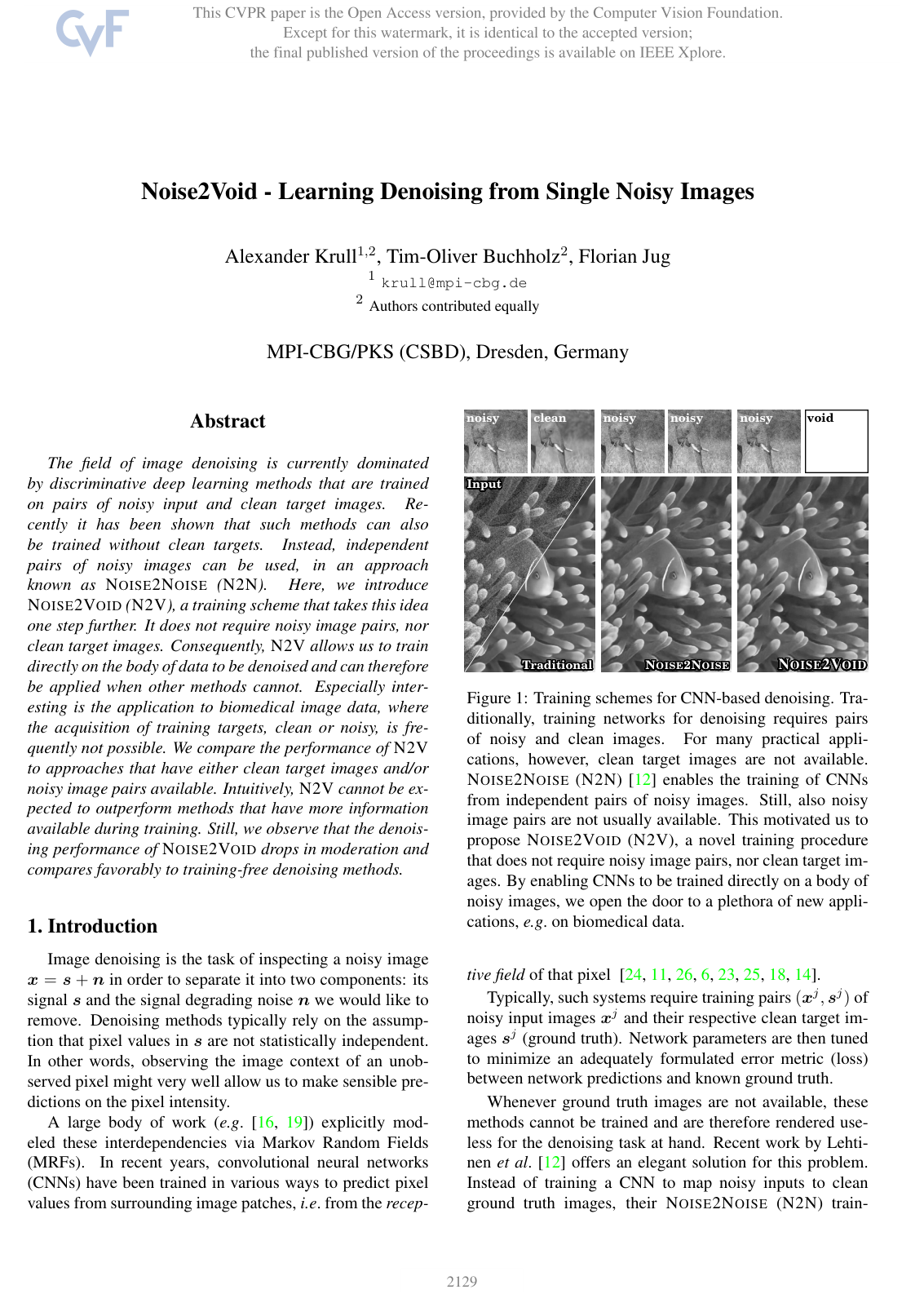
Noise2Void - Learning Denoising From Single Noisy Images
Alexander Krull, Tim-Oliver Buchholz, Florian Jug
Why you should read this
Introduces Noise2Void, a training scheme that trains deep neural networks for image denoising using only individual noisy images, eliminating the need for clean targets or paired data in domains such as biomedical microscopy.
The field of image denoising is currently dominated by discriminative deep learning methods that are trained on pairs of noisy input and clean target images. Recently it has been shown that such methods can also be trained without clean targets. Instead, independent pairs of noisy images can be used, in an approach known as Noise2Noise (N2N). Here, we introduce Noise2Void (N2V), a training scheme that takes this idea one step further. It does not require noisy image pairs, nor clean target images. Consequently, N2V allows us to train directly on the body of data to be denoised and can therefore be applied when other methods cannot. Especially interesting is the application to biomedical image data, where the acquisition of training targets, clean or noisy, is frequently not possible. We compare the performance of N2V to approaches that have either clean target images and/or noisy image pairs available. Intuitively, N2V cannot be expected to outperform methods that have more information available during training. Still, we observe that the denoising performance of Noise2Void drops in moderation and compares favorably to training-free denoising methods.
Added
2026-09-24
Enhancing The Reliability of Out-of-distribution Image Detection in Neural Networks
Shiyu Liang, Yixuan Li, R. Srikant
Why you should read this
Proposes ODIN, a post-hoc method that significantly lowers false positive rates in out-of-distribution image detection using only temperature scaling and small input perturbations without retraining the neural network.
We consider the problem of detecting out-of-distribution images in neural networks. We propose ODIN, a simple and effective method that does not require any change to a pre-trained neural network. Our method is based on the observation that using temperature scaling and adding small perturbations to the input can separate the softmax score distributions between in- and out-of-distribution images, allowing for more effective detection. We show in a series of experiments that ODIN is compatible with diverse network architectures and datasets. It consistently outperforms the baseline approach by a large margin, establishing a new state-of-the-art performance on this task. For example, ODIN reduces the false positive rate from the baseline 34.7% to 4.3% on the DenseNet (applied to CIFAR-10) when the true positive rate is 95%.
Added
2026-09-14
SmoothGrad: removing noise by adding noise
Daniel Smilkov, Nikhil Thorat, Been Kim, Fernanda Viégas, Martin Wattenberg
Why you should read this
Proposes SmoothGrad, a simple method that cleans up noisy gradient-based sensitivity maps by averaging the gradients of randomly perturbed inputs, producing clearer visual explanations of deep learning predictions.
Explaining the output of a deep network remains a challenge. In the case of an image classifier, one type of explanation is to identify pixels that strongly influence the final decision. A starting point for this strategy is the gradient of the class score function with respect to the input image. This gradient can be interpreted as a sensitivity map, and there are several techniques that elaborate on this basic idea. This paper makes two contributions: it introduces SmoothGrad, a simple method that can help visually sharpen gradient-based sensitivity maps, and it discusses lessons in the visualization of these maps. We publish the code for our experiments and a website with our results.
Added
2026-09-14
Beyond a Gaussian Denoiser: Residual Learning of Deep CNN for Image Denoising
Kai Zhang, Wangmeng Zuo, Yunjin Chen, Deyu Meng, Lei Zhang
Why you should read this
Introduces DnCNN, a deep convolutional neural network that combines residual learning and batch normalization to perform blind Gaussian image denoising with unknown noise levels and generalize across tasks like super-resolution and JPEG deblocking.
Discriminative model learning for image denoising has been recently attracting considerable attentions due to its favorable denoising performance. In this paper, we take one step forward by investigating the construction of feed-forward denoising convolutional neural networks (DnCNNs) to embrace the progress in very deep architecture, learning algorithm, and regularization method into image denoising. Specifically, residual learning and batch normalization are utilized to speed up the training process as well as boost the denoising performance. Different from the existing discriminative denoising models which usually train a specific model for additive white Gaussian noise (AWGN) at a certain noise level, our DnCNN model is able to handle Gaussian denoising with unknown noise level (i.e., blind Gaussian denoising). With the residual learning strategy, DnCNN implicitly removes the latent clean image in the hidden layers. This property motivates us to train a single DnCNN model to tackle with several general image denoising tasks such as Gaussian denoising, single image super-resolution and JPEG image deblocking. Our extensive experiments demonstrate that our DnCNN model can not only exhibit high effectiveness in several general image denoising tasks, but also be efficiently implemented by benefiting from GPU computing.
Added
2026-09-09
Intriguing properties of neural networks
Christian Szegedy, Wojciech Zaremba, Ilya Sutskever, Joan Bruna, Dumitru Erhan, Ian Goodfellow, Rob Fergus
Why you should read this
Introduces adversarial examples—slightly tweaked images that fool neural networks while remaining imperceptible to humans—and reveals that these vulnerabilities are shared across differently trained networks, exposing fundamental blind spots in how deep learning models process information.
Deep neural networks are highly expressive models that have recently achieved state of the art performance on speech and visual recognition tasks. While their expressiveness is the reason they succeed, it also causes them to learn uninterpretable solutions that could have counter-intuitive properties. In this paper we report two such properties. First, we find that there is no distinction between individual high level units and random linear combinations of high level units, according to various methods of unit analysis. It suggests that it is the space, rather than the individual units, that contains of the semantic information in the high layers of neural networks. Second, we find that deep neural networks learn input-output mappings that are fairly discontinuous to a significant extend. We can cause the network to misclassify an image by applying a certain imperceptible perturbation, which is found by maximizing the network's prediction error. In addition, the specific nature of these perturbations is not a random artifact of learning: the same perturbation can cause a different network, that was trained on a different subset of the dataset, to misclassify the same input.
Added
2026-02-21
Keeping Neural Networks Simple by Minimizing the Description Length of the Weights
Geoffrey E. Hinton, Drew van Camp
Why you should read this
Reveals that neural network weights can paradoxically become cheaper to communicate when you make them noisier, providing a principled information-theoretic framework for preventing overfitting that goes beyond simple weight decay by explicitly optimizing how much information each weight truly needs.
Supervised neural networks generalize well if there is much less information in the weights than there is in the output vectors of the training cases. So during learning, it is important to keep the weights simple by penalizing the amount of information they contain. The amount of information in a weight can be controlled by adding Gaussian noise and the noise level can be adapted during learning to optimize the trade-off between the expected squared error of the network and the amount of information in the weights. We describe a method of computing the derivatives of the expected squared error and of the amount of information in the noisy weights in a network that contains a layer of non-linear hidden units. Provided the output units are linear, the exact derivatives can be computed efficiently without time-consuming Monte Carlo simulations. The idea of minimizing the amount of information that is required to communicate the weights of a neural network leads to a number of interesting schemes for encoding the weights
Added
2026-02-21
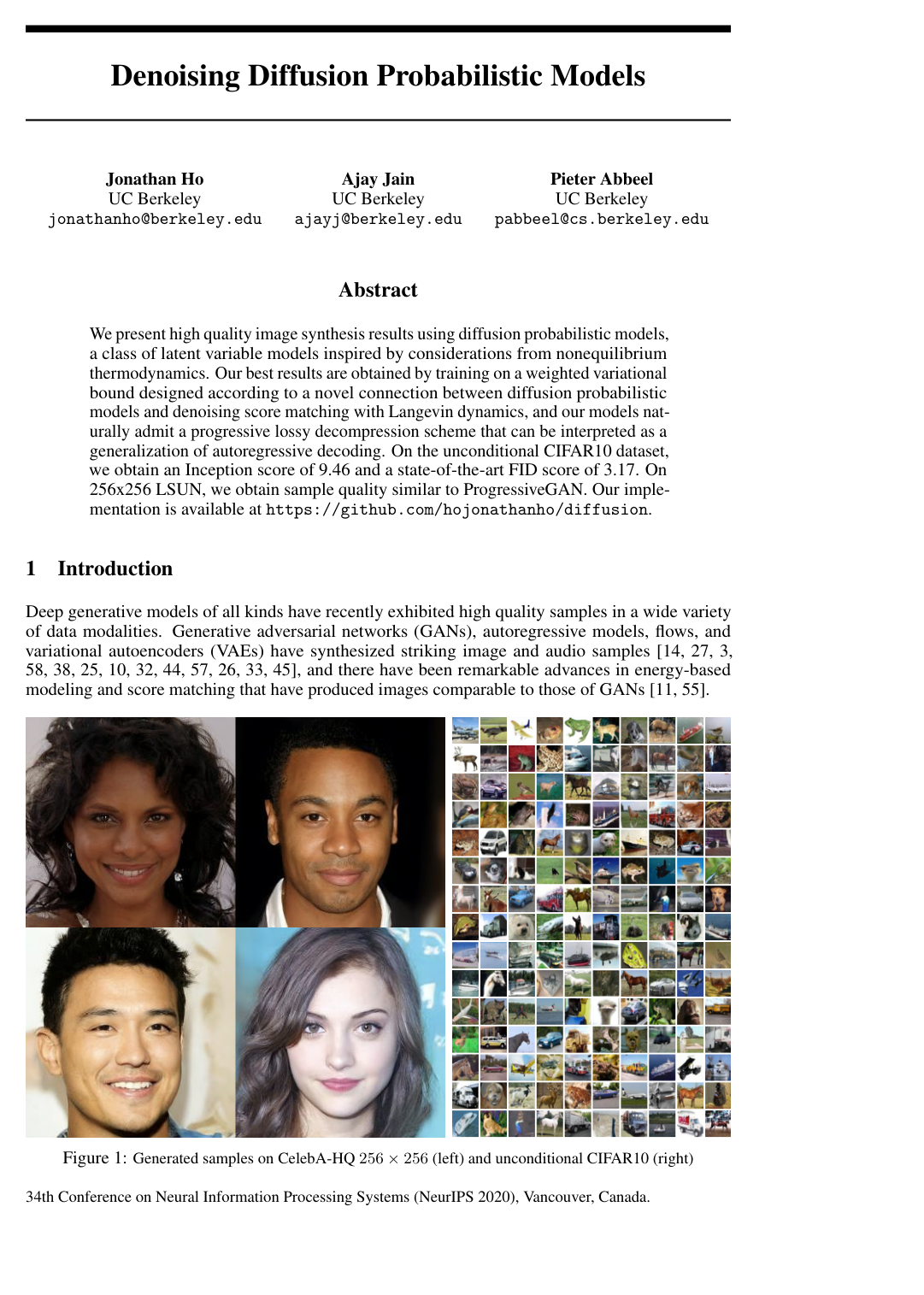
Denoising Diffusion Probabilistic Models
Jonathan Ho, Ajay Jain, Pieter Abbeel
Why you should read this
Establishes diffusion models as state-of-the-art for high-fidelity image generation. The iterative noise reversal process became the technical backbone of modern text-to-image systems like DALL-E and Stable Diffusion.
We present high quality image synthesis results using diffusion probabilistic models, a class of latent variable models inspired by considerations from nonequilibrium thermodynamics. Our best results are obtained by training on a weighted variational bound designed according to a novel connection between diffusion probabilistic models and denoising score matching with Langevin dynamics, and our models naturally admit a progressive lossy decompression scheme that can be interpreted as a generalization of autoregressive decoding. On the unconditional CIFAR10 dataset, we obtain an Inception score of 9.46 and a state-of-the-art FID score of 3.17. On 256x256 LSUN, we obtain sample quality similar to ProgressiveGAN. Our implementation is available at this https URL
Added
2026-02-21