
keyword
Gaussian kernels
A Gaussian kernel, commonly referred to as a radial basis function kernel, is a mathematical function that measures the similarity between two points based on the squared Euclidean distance between them, scaled by an exponential decay. In statistics, machine learning, and image processing, it enables linear algorithms to operate in an implicit, infinite-dimensional feature space without explicitly calculating the high-dimensional coordinates of the data. The kernel assigns a maximum similarity value of one to identical points and smoothly decreases toward zero as the distance between points grows. Its behavior is controlled by a bandwidth or scale parameter that determines the spread and reach of the similarity metric, making it widely useful for nonlinear classification, regression, density estimation, mode seeking, and spatial filtering tasks.
6 items
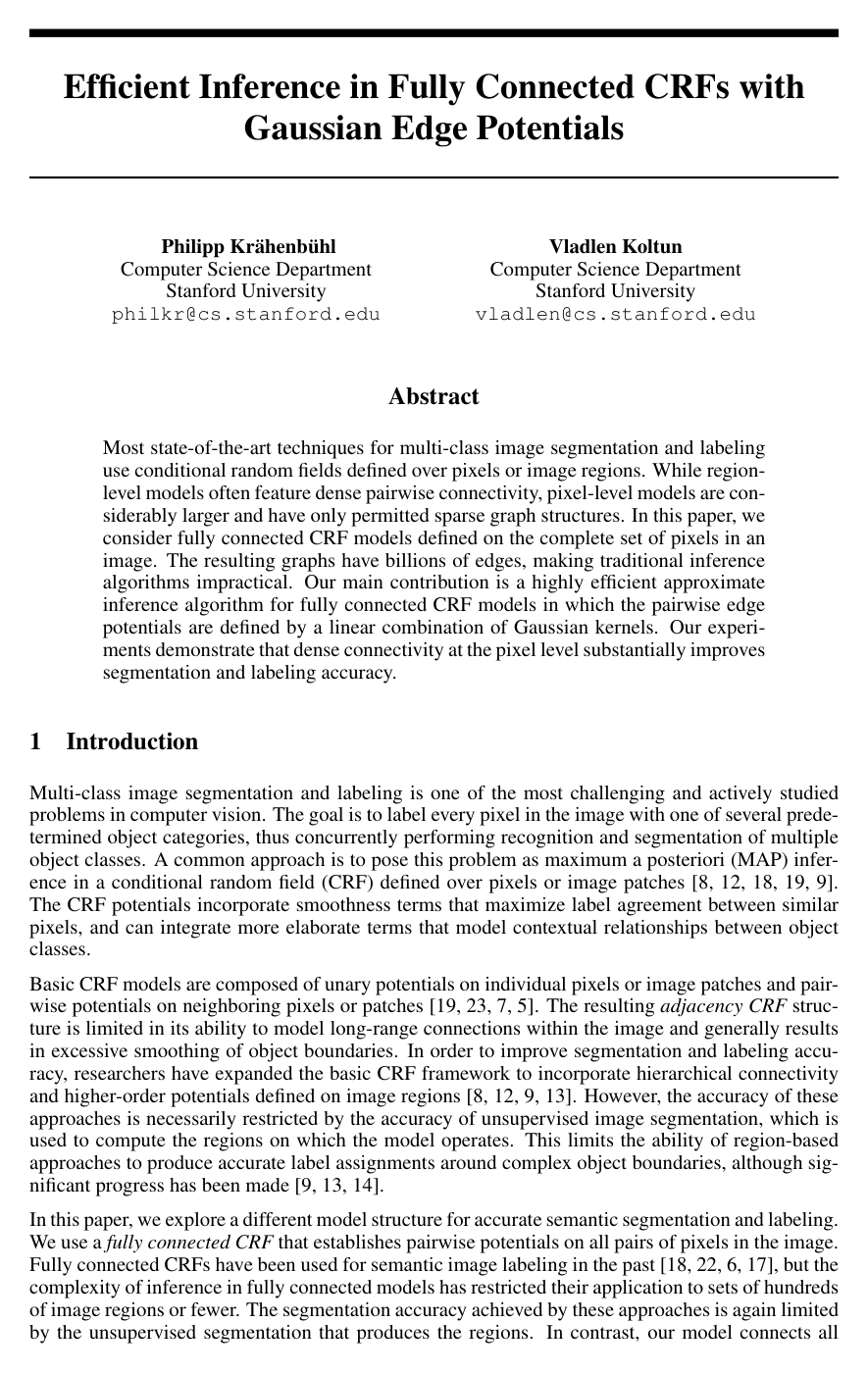
Efficient Inference in Fully Connected CRFs with Gaussian Edge Potentials
Philipp Krähenbühl, Vladlen Koltun
Why you should read this
Demonstrates a highly efficient approximate inference algorithm that makes fully connected conditional random fields practical for pixel-level image segmentation and labeling.
Most state-of-the-art techniques for multi-class image segmentation and labeling use conditional random fields defined over pixels or image regions. While region-level models often feature dense pairwise connectivity, pixel-level models are considerably larger and have only permitted sparse graph structures. In this paper, we consider fully connected CRF models defined on the complete set of pixels in an image. The resulting graphs have billions of edges, making traditional inference algorithms impractical. Our main contribution is a highly efficient approximate inference algorithm for fully connected CRF models in which the pairwise edge potentials are defined by a linear combination of Gaussian kernels. Our experiments demonstrate that dense connectivity at the pixel level substantially improves segmentation and labeling accuracy.
Added
2026-10-03
License
Published with permission
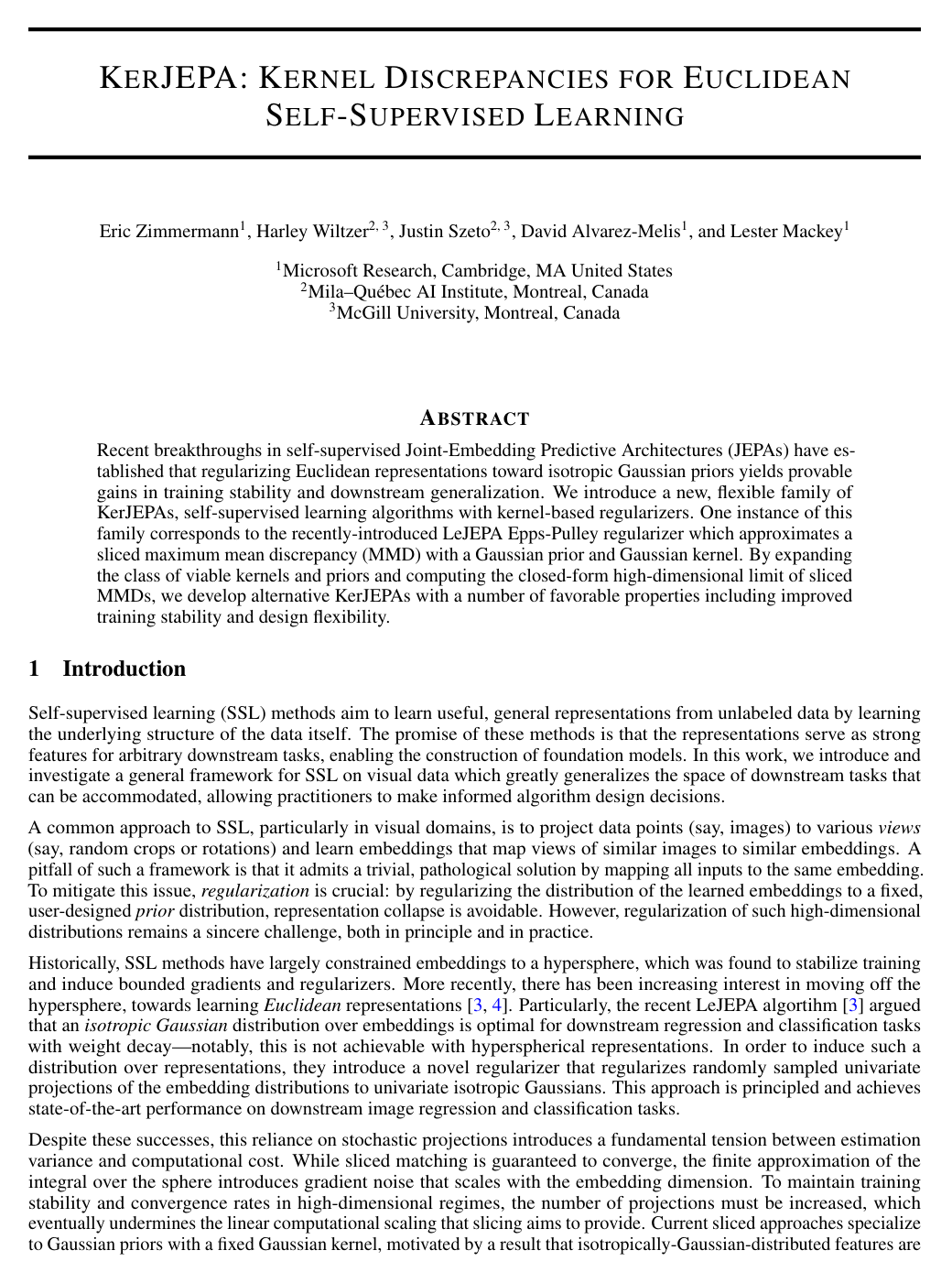
KerJEPA: Kernel Discrepancies for Euclidean Self-Supervised Learning
Eric Zimmermann, Eric Zimmermann, Harley Wiltzer, Justin Szeto, David Alvarez-Melis, Lester Mackey
Why you should read this
Proposes a flexible family of kernel-regularized Joint-Embedding Predictive Architectures that uses closed-form limits of sliced maximum mean discrepancies to improve training stability and design flexibility in self-supervised learning.
Recent breakthroughs in self-supervised Joint-Embedding Predictive Architectures (JEPAs) have established that regularizing Euclidean representations toward isotropic Gaussian priors yields provable gains in training stability and downstream generalization. We introduce a new, flexible family of KerJEPAs, self-supervised learning algorithms with kernel-based regularizers. One instance of this family corresponds to the recently-introduced LeJEPA Epps-Pulley regularizer which approximates a sliced maximum mean discrepancy (MMD) with a Gaussian prior and Gaussian kernel. By expanding the class of viable kernels and priors and computing the closed-form high-dimensional limit of sliced MMDs, we develop alternative KerJEPAs with a number of favorable properties including improved training stability and design flexibility.
Added
2026-09-30
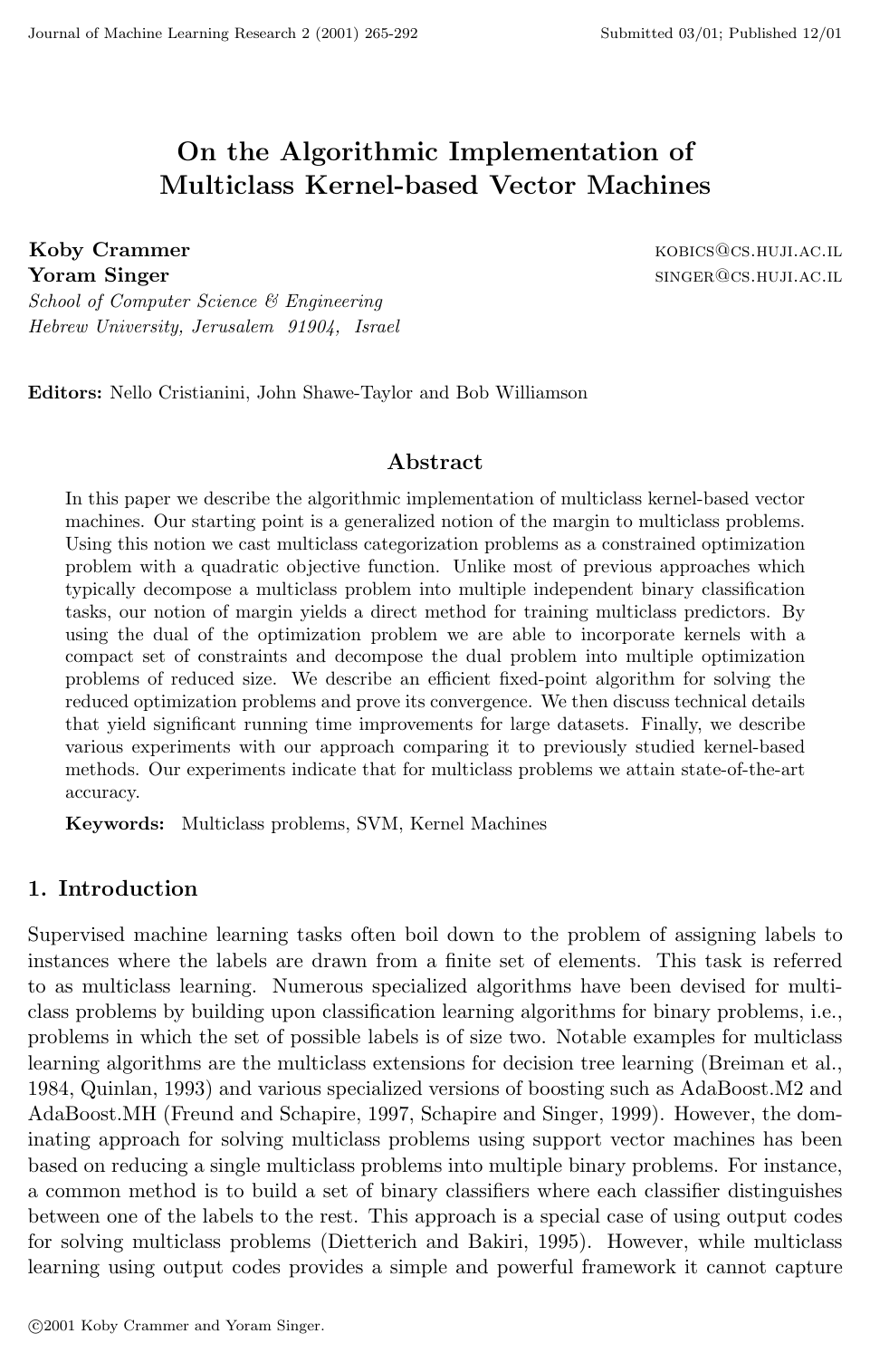
On the Algorithmic Implementation of Multiclass Kernel-based Vector Machines
Koby Crammer, Yoram Singer
Why you should read this
Develops a direct multiclass support vector machine framework based on a generalized margin that reduces large-scale quadratic optimization into small, single-example subproblems solved via a provably convergent fixed-point algorithm.
In this paper we describe the algorithmic implementation of multiclass kernel-based vector machines. Our starting point is a generalized notion of the margin to multiclass problems. Using this notion we cast multiclass categorization problems as a constrained optimization problem with a quadratic objective function. Unlike most of previous approaches which typically decompose a multiclass problem into multiple independent binary classification tasks, our notion of margin yields a direct method for training multiclass predictors. By using the dual of the optimization problem we are able to incorporate kernels with a compact set of constraints and decompose the dual problem into multiple optimization problems of reduced size. We describe an efficient fixed-point algorithm for solving the reduced optimization problems and prove its convergence. We then discuss technical details that yield significant running time improvements for large datasets. Finally, we describe various experiments with our approach comparing it to previously studied kernel-based methods. Our experiments indicate that for multiclass problems we attain state-of-the-art accuracy.
Added
2026-09-15
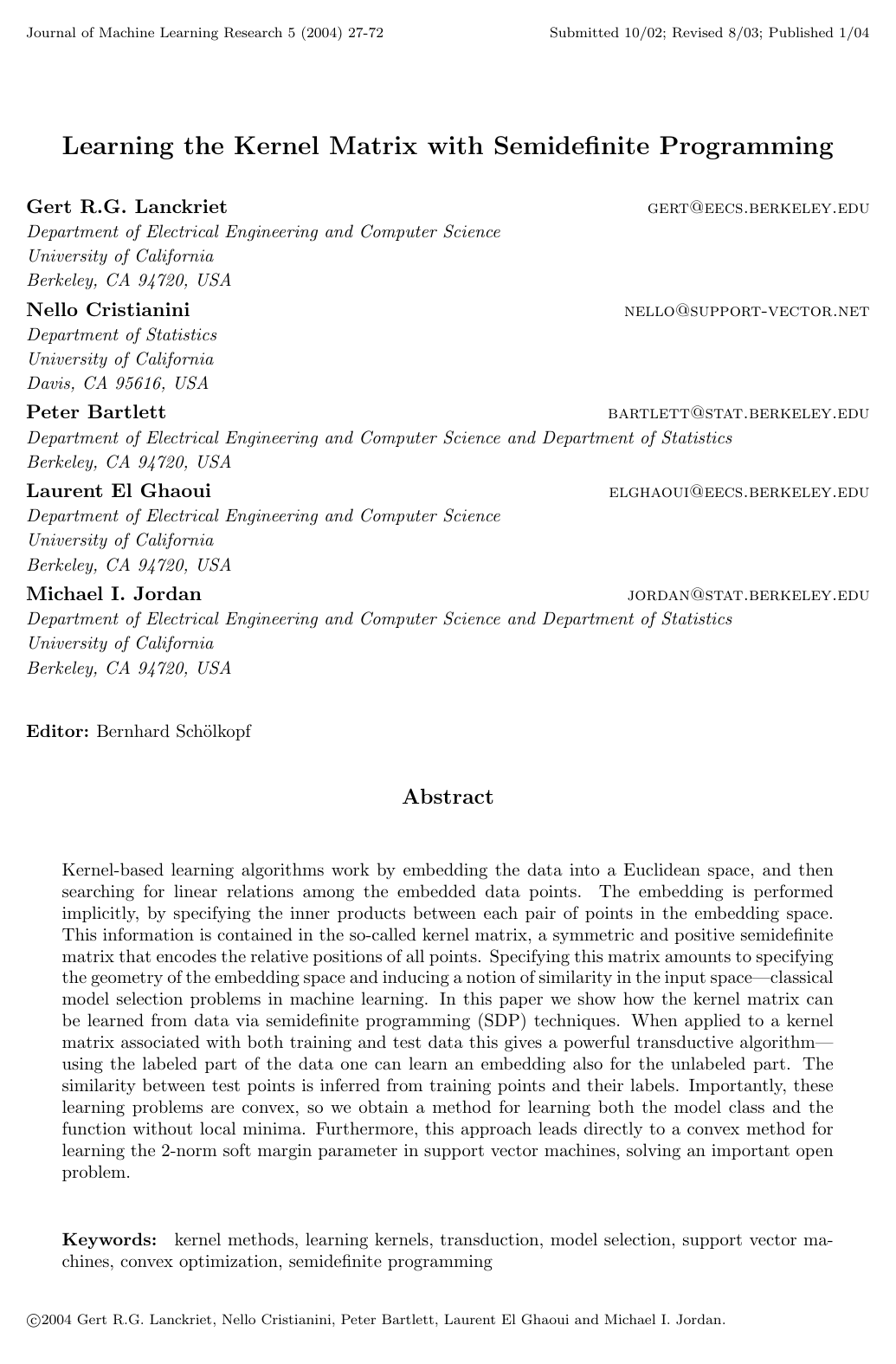
Learning the Kernel Matrix with Semidefinite Programming
Gert R. G. Lanckriet, N. Cristianini, P. Bartlett, L. Ghaoui, Michael I. Jordan
Why you should read this
Shows how semidefinite programming can learn convex kernel matrices, transductive embeddings, and support-vector-machine parameters without local minima.
Kernel-based learning algorithms work by embedding the data into a Euclidean space, and then searching for linear relations among the embedded data points. The embedding is performed implicitly, by specifying the inner products between each pair of points in the embedding space. This information is contained in the so-called kernel matrix, a symmetric and positive semidefinite matrix that encodes the relative positions of all points. Specifying this matrix amounts to specifying the geometry of the embedding space and inducing a notion of similarity in the input space—classical model selection problems in machine learning. In this paper we show how the kernel matrix can be learned from data via semidefinite programming (SDP) techniques. When applied to a kernel matrix associated with both training and test data this gives a powerful transductive algorithm—using the labeled part of the data one can learn an embedding also for the unlabeled part. The similarity between test points is inferred from training points and their labels. Importantly, these learning problems are convex, so we obtain a method for learning both the model class and the function without local minima. Furthermore, this approach leads directly to a convex method for learning the 2-norm soft margin parameter in support vector machines, solving an important open problem.
Added
2026-09-14
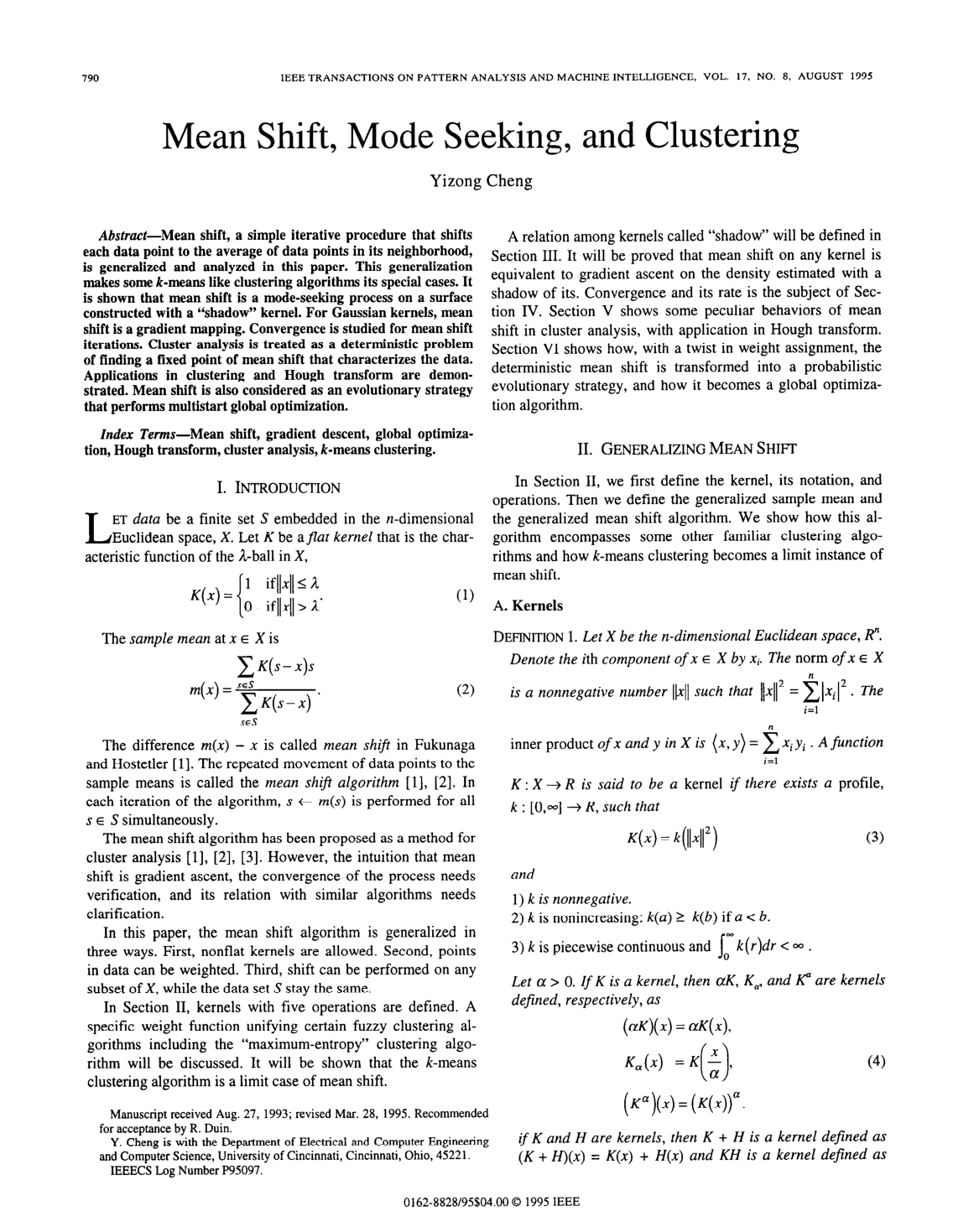
Mean Shift, Mode Seeking, and Clustering
Yizong Cheng
Why you should read this
Establishes a rigorous theoretical foundation for the generalized mean shift algorithm by proving it acts as adaptive-step gradient ascent on kernel density surfaces, analyzing its convergence, and showing how k-means clustering emerges as a limiting case.
Mean shift, a simple iterative procedure that shifts each data point to the average of data points in its neighborhood, is generalized and analyzed in this paper. This generalization makes some k-means like clustering algorithms its special cases. It is shown that mean shift is a mode-seeking process on a surface constructed with a “shadow” kernel. For Gaussian kernels, mean shift is a gradient mapping. Convergence is studied for mean shift iterations. Cluster analysis is treated as a deterministic problem of finding a fixed point of mean shift that characterizes the data. Applications in clustering and Hough transform are demonstrated. Mean shift is also considered as an evolutionary strategy that performs multistart global optimization.
Added
2026-09-10
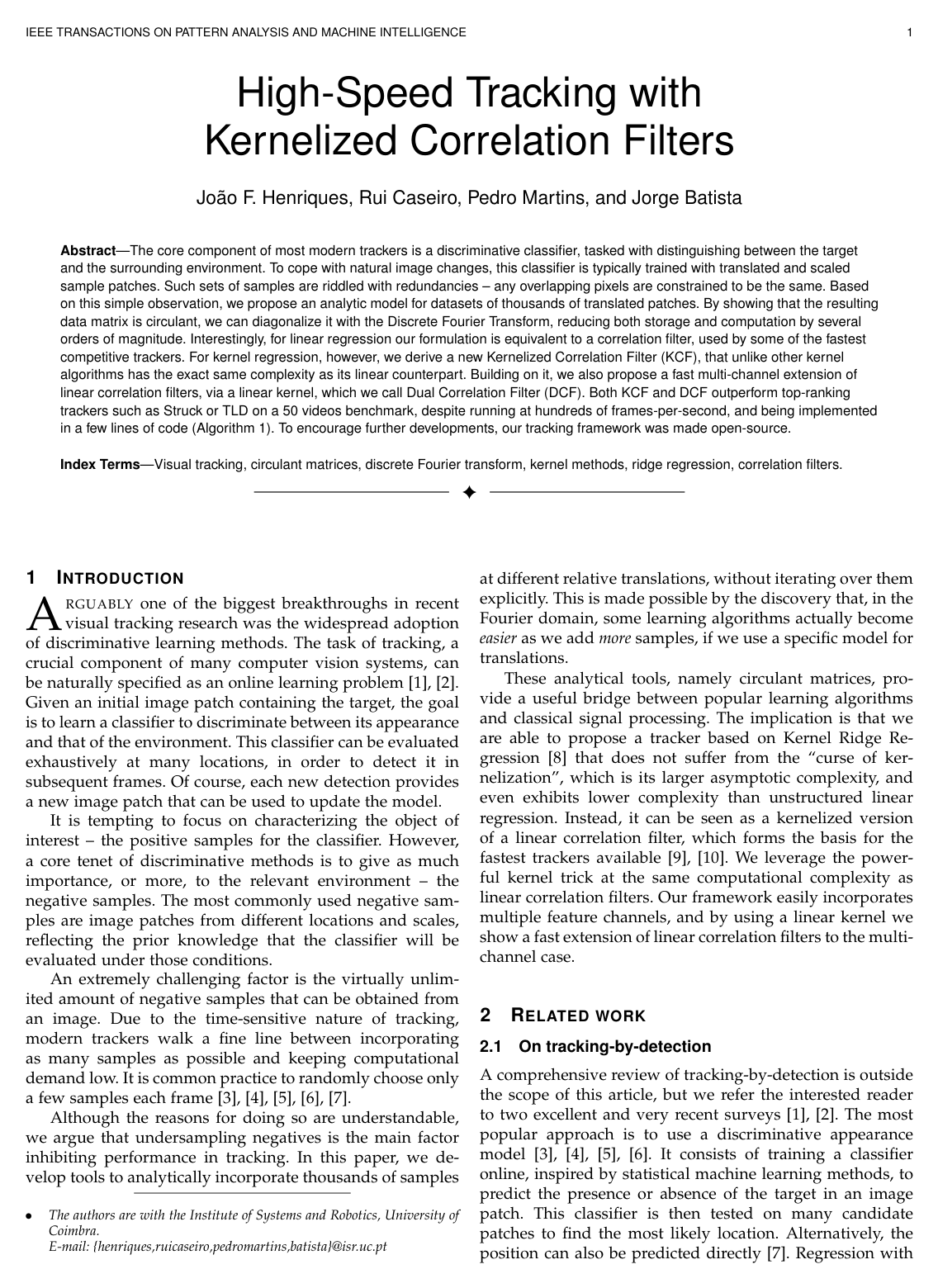
High-Speed Tracking with Kernelized Correlation Filters
João F. Henriques, Rui Caseiro, Pedro Martins, Jorge Batista
Why you should read this
Introduces Kernelized Correlation Filters, a visual tracking framework that leverages circulant matrices and the Discrete Fourier Transform to train kernel classifiers at hundreds of frames per second with state-of-the-art accuracy.
The core component of most modern trackers is a discriminative classifier, tasked with distinguishing between the target and the surrounding environment. To cope with natural image changes, this classifier is typically trained with translated and scaled sample patches. Such sets of samples are riddled with redundancies -- any overlapping pixels are constrained to be the same. Based on this simple observation, we propose an analytic model for datasets of thousands of translated patches. By showing that the resulting data matrix is circulant, we can diagonalize it with the Discrete Fourier Transform, reducing both storage and computation by several orders of magnitude. Interestingly, for linear regression our formulation is equivalent to a correlation filter, used by some of the fastest competitive trackers. For kernel regression, however, we derive a new Kernelized Correlation Filter (KCF), that unlike other kernel algorithms has the exact same complexity as its linear counterpart. Building on it, we also propose a fast multi-channel extension of linear correlation filters, via a linear kernel, which we call Dual Correlation Filter (DCF). Both KCF and DCF outperform top-ranking trackers such as Struck or TLD on a 50 videos benchmark, despite running at hundreds of frames-per-second, and being implemented in a few lines of code (Algorithm 1). To encourage further developments, our tracking framework was made open-source.
Added
2026-09-09