
keyword
fractal dimensionality
Fractal dimensionality is a metric that quantifies the geometric complexity and structural irregularity of a pattern, object, or dataset by measuring how its level of detail changes across different scales. Unlike standard topological dimensions that are restricted to whole integers, fractal dimensionality can take on non-integer values, reflecting the extent to which an irregular, self-similar, or fragmented structure fills the space that contains it. In mathematics, physics, and data science, this concept is commonly computed using methods such as the box-counting dimension, Hausdorff dimension, or correlation dimension. It provides a fundamental measure for assessing the intrinsic complexity of high-dimensional data distributions, quantifying chaotic behavior in dynamical systems, and describing the intricate geometry of strange attractors.
2 items
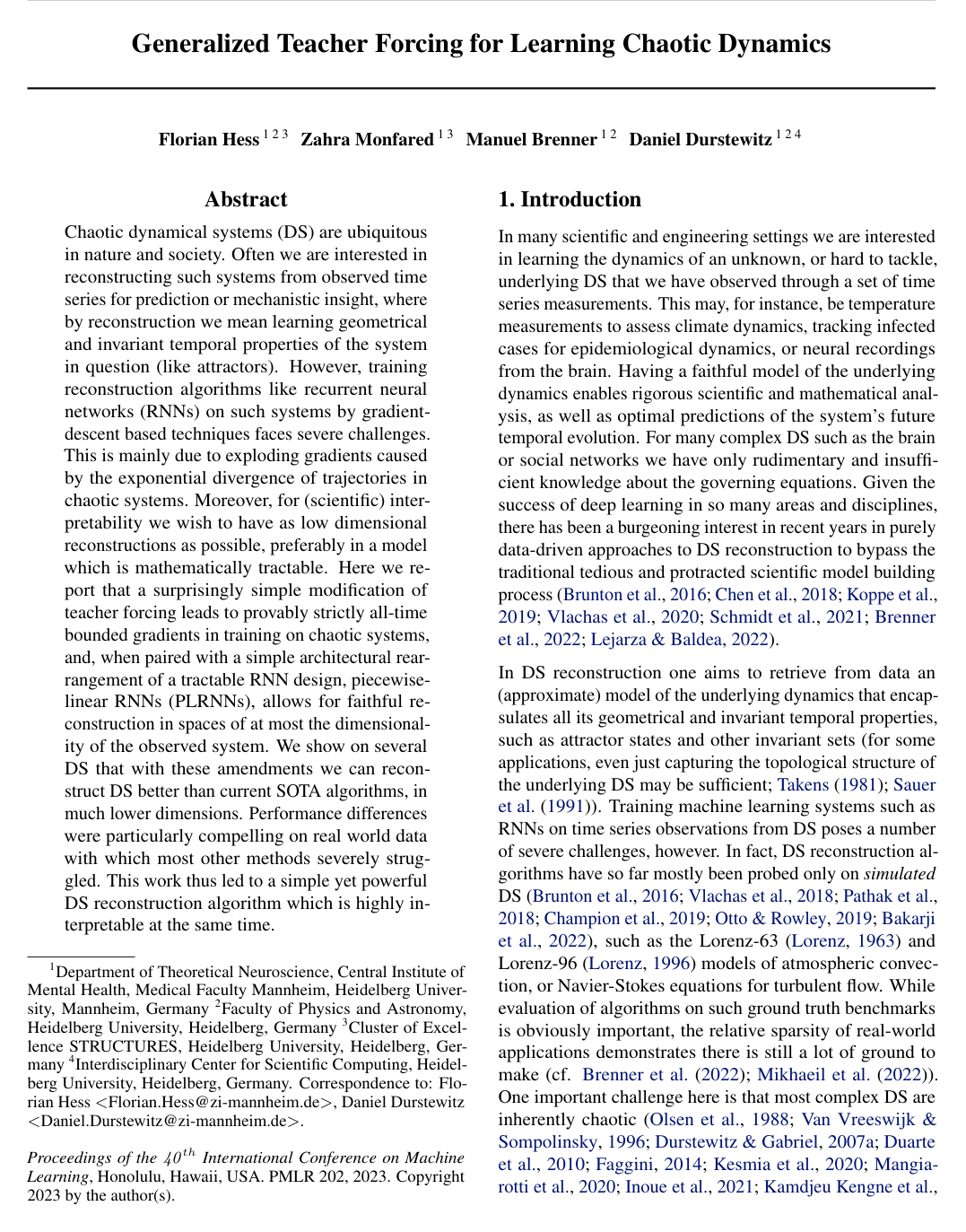
Generalized Teacher Forcing for Learning Chaotic Dynamics
Florian Hess, Zahra Monfared, Manuel Brenner, Daniel Durstewitz
Why you should read this
Proves that a generalized teacher forcing scheme strictly bounds loss gradients during training on chaotic systems, enabling piecewise-linear recurrent neural networks to achieve state-of-the-art dynamical system reconstruction in minimal state dimensions.
Chaotic dynamical systems (DS) are ubiquitous in nature and society. Often we are interested in reconstructing such systems from observed time series for prediction or mechanistic insight, where by reconstruction we mean learning geometrical and invariant temporal properties of the system in question (like attractors). However, training reconstruction algorithms like recurrent neural networks (RNNs) on such systems by gradient-descent based techniques faces severe challenges. This is mainly due to exploding gradients caused by the exponential divergence of trajectories in chaotic systems. Moreover, for (scientific) interpretability we wish to have as low dimensional reconstructions as possible, preferably in a model which is mathematically tractable. Here we report that a surprisingly simple modification of teacher forcing leads to provably strictly all-time bounded gradients in training on chaotic systems, and, when paired with a simple architectural rearrangement of a tractable RNN design, piecewise-linear RNNs (PLRNNs), allows for faithful reconstruction in spaces of at most the dimensionality of the observed system. We show on several DS that with these amendments we can reconstruct DS better than current SOTA algorithms, in much lower dimensions. Performance differences were particularly compelling on real world data with which most other methods severely struggled. This work thus led to a simple yet powerful DS reconstruction algorithm which is highly interpretable at the same time.
Added
2026-09-26
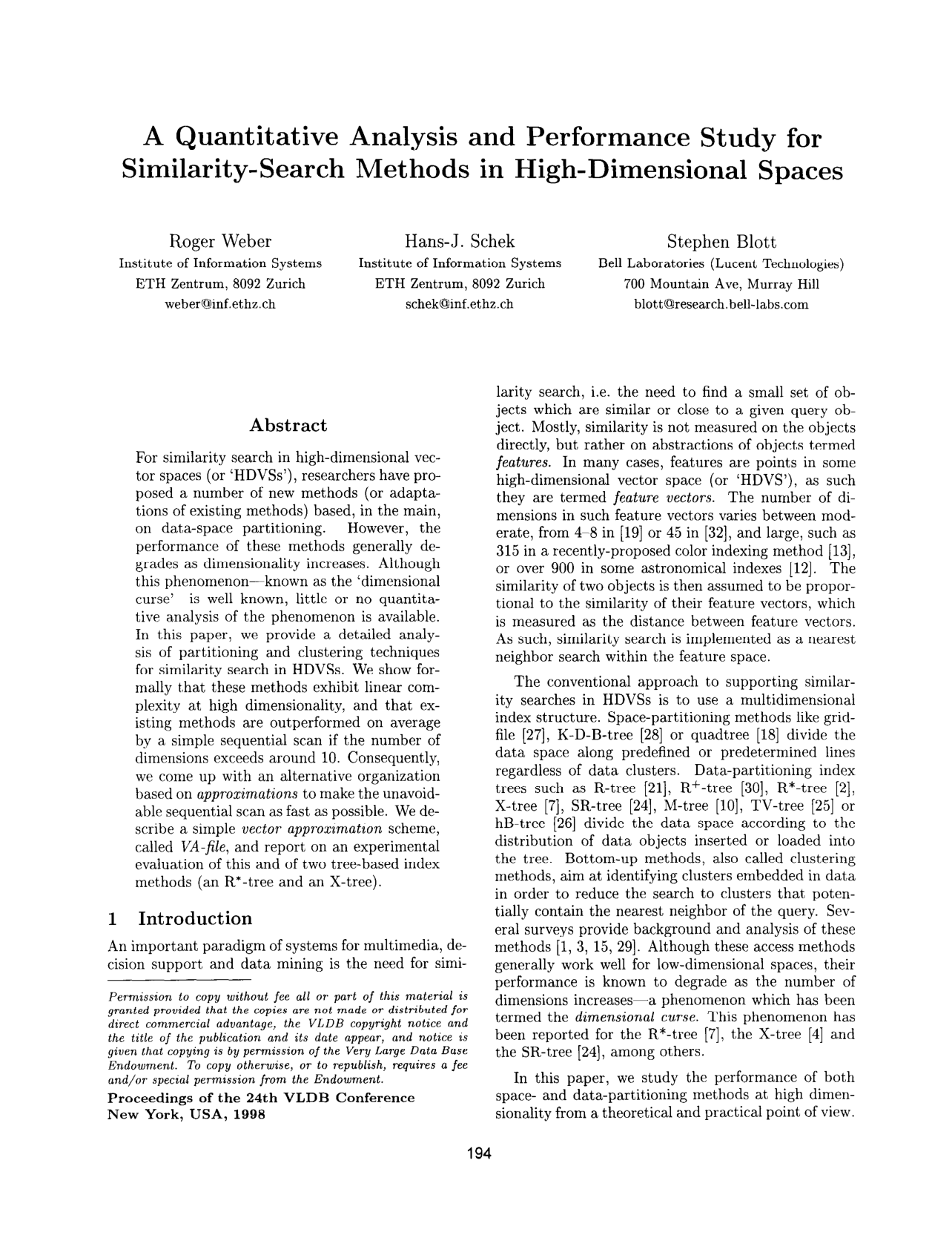
A Quantitative Analysis and Performance Study for Similarity-Search Methods in High-Dimensional Spaces
Roger Weber, Hans-J. Schek, Stephen Blott
Why you should read this
Proves that conventional tree-based indexing structures degenerate into linear scans beyond ten dimensions and introduces the Vector Approximation File to dramatically accelerate similarity search in high-dimensional vector spaces.
For similarity search in high-dimensional vector spaces (or ‘HDVSs’), researchers have proposed a number of new methods (or adaptations of existing methods) based, in the main, on data-space partitioning. However, the performance of these methods generally degrades as dimensionality increases. Although this phenomenon—known as the ‘dimensional curse’ is well known, little or no quantitative analysis of the phenomenon is available. In this paper, we provide a detailed analysis of partitioning and clustering techniques for similarity search in HDVSs. We show formally that these methods exhibit linear complexity at high dimensionality, and that existing methods are outperformed on average by a simple sequential scan if the number of dimensions exceeds around 10. Consequently, we come up with an alternative organization based on approximations to make the unavoidable sequential scan as fast as possible. We describe a simple vector approximation scheme, called VA-file, and report on an experimental evaluation of this and of two tree-based index methods (an R*-tree and an X-tree).
Added
2026-09-18