
keyword
foundation models
A foundation model is a large artificial intelligence model trained on vast, broad datasets at scale that can be adapted to perform a wide variety of downstream tasks. Typically developed through self-supervised learning on massive quantities of unstructured data, these systems learn generalized representations across modalities such as text, imagery, audio, and code. Rather than training separate, specialized systems for individual problems from scratch, developers utilize foundation models as a shared base that can be customized for specific applications through fine-tuning, prompting, or task-specific guidance. Because of their scale and versatility, foundation models serve as the underlying architecture for modern generative and reasoning tools, while also introducing critical challenges regarding safety, alignment, computational demands, and the systemic propagation of errors across adapted downstream systems.
9 items
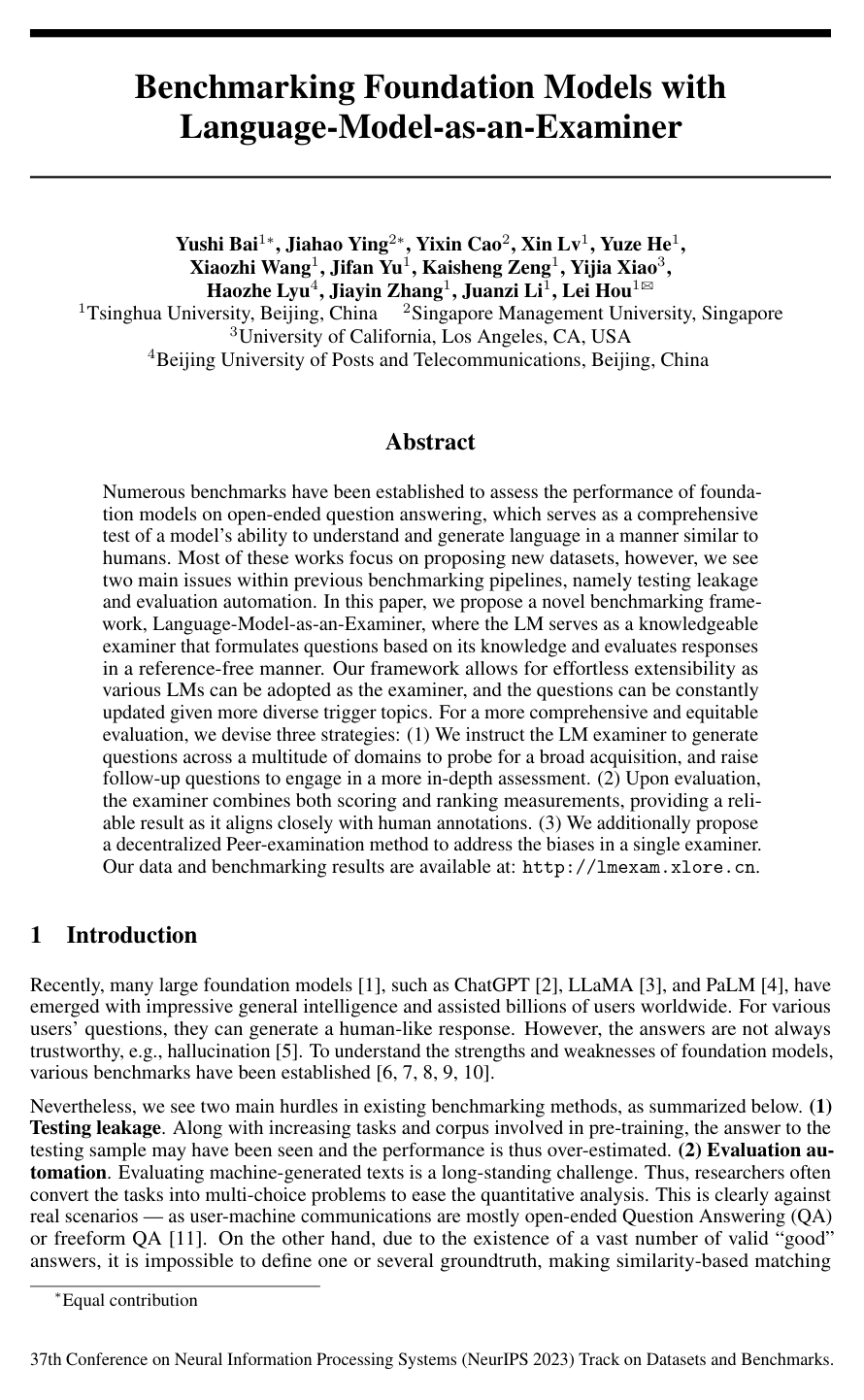
Benchmarking Foundation Models with Language-Model-as-an-Examiner
Yushi Bai, Jiahao Ying, Yixin Cao, Xin Lv, Yuze He, Xiaozhi Wang, Jifan Yu, Kaisheng Zeng, Yijia Xiao, Haozhe Lyu, Jiayin Zhang, Juanzi Li, Lei Hou
Why you should read this
Proposes a reference-free evaluation framework that uses language models to dynamically generate open-ended questions across diverse domains and assess peer models through multi-round questioning, effectively resolving test data leakage and single-evaluator bias.
Numerous benchmarks have been established to assess the performance of foundation models on open-ended question answering, which serves as a comprehensive test of a model’s ability to understand and generate language in a manner similar to humans. Most of these works focus on proposing new datasets, however, we see two main issues within previous benchmarking pipelines, namely testing leakage and evaluation automation. In this paper, we propose a novel benchmarking framework, Language-Model-as-an-Examiner, where the LM serves as a knowledgeable examiner that formulates questions based on its knowledge and evaluates responses in a reference-free manner. Our framework allows for effortless extensibility as various LMs can be adopted as the examiner, and the questions can be constantly updated given more diverse trigger topics. For a more comprehensive and equitable evaluation, we devise three strategies: (1) We instruct the LM examiner to generate questions across a multitude of domains to probe for a broad acquisition, and raise follow-up questions to engage in a more in-depth assessment. (2) Upon evaluation, the examiner combines both scoring and ranking measurements, providing a reliable result as it aligns closely with human annotations. (3) We additionally propose a decentralized Peer-examination method to address the biases in a single examiner. Our data and benchmarking results are available at: http://lmexam.xlore.cn.
Added
2026-10-05
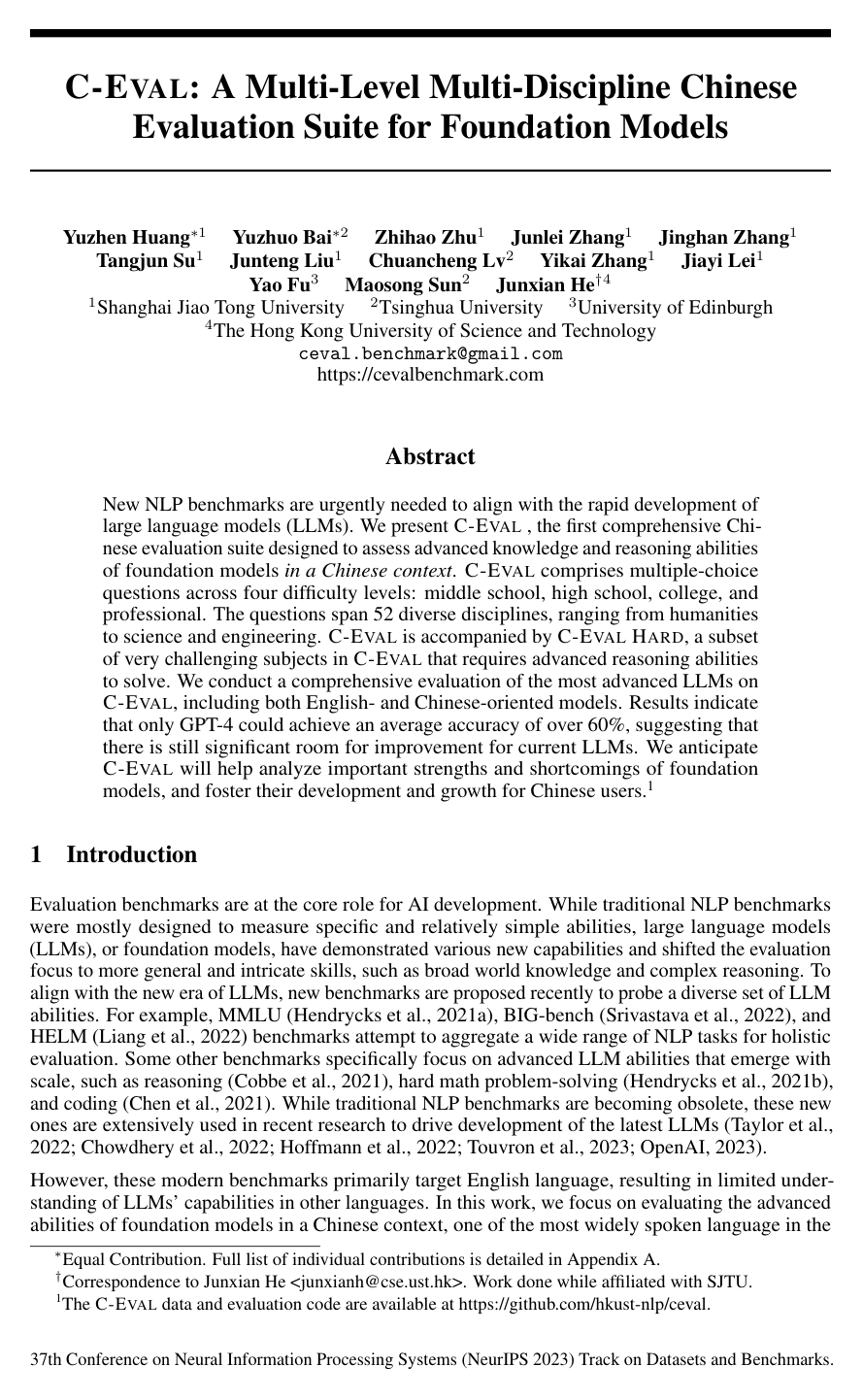
C-Eval: A Multi-Level Multi-Discipline Chinese Evaluation Suite for Foundation Models
Yuzhen Huang, Yuzhuo Bai, Zhihao Zhu, Junlei Zhang, Jinghan Zhang, Tangjun Su, Junteng Liu, Chuancheng Lv, Yikai Zhang, Jiayi Lei, Yao Fu, Maosong Sun, Junxian He
Why you should read this
Introduces C-Eval, a standardized benchmark spanning 52 disciplines and four difficulty levels to evaluate advanced Chinese knowledge and reasoning in foundation models, exposing critical capability gaps in leading systems.
New NLP benchmarks are urgently needed to align with the rapid development of large language models (LLMs). We present C-Eval, the first comprehensive Chinese evaluation suite designed to assess advanced knowledge and reasoning abilities of foundation models in a Chinese context. C-Eval comprises multiple-choice questions across four difficulty levels: middle school, high school, college, and professional. The questions span 52 diverse disciplines, ranging from humanities to science and engineering. C-Eval is accompanied by C-Eval Hard, a subset of very challenging subjects in C-Eval that requires advanced reasoning abilities to solve. We conduct a comprehensive evaluation of the most advanced LLMs on C-Eval, including both English- and Chinese-oriented models. Results indicate that only GPT-4 could achieve an average accuracy of over 60%, suggesting that there is still significant room for improvement for current LLMs. We anticipate C-Eval will help analyze important strengths and shortcomings of foundation models, and foster their development and growth for Chinese users.
Added
2026-10-05
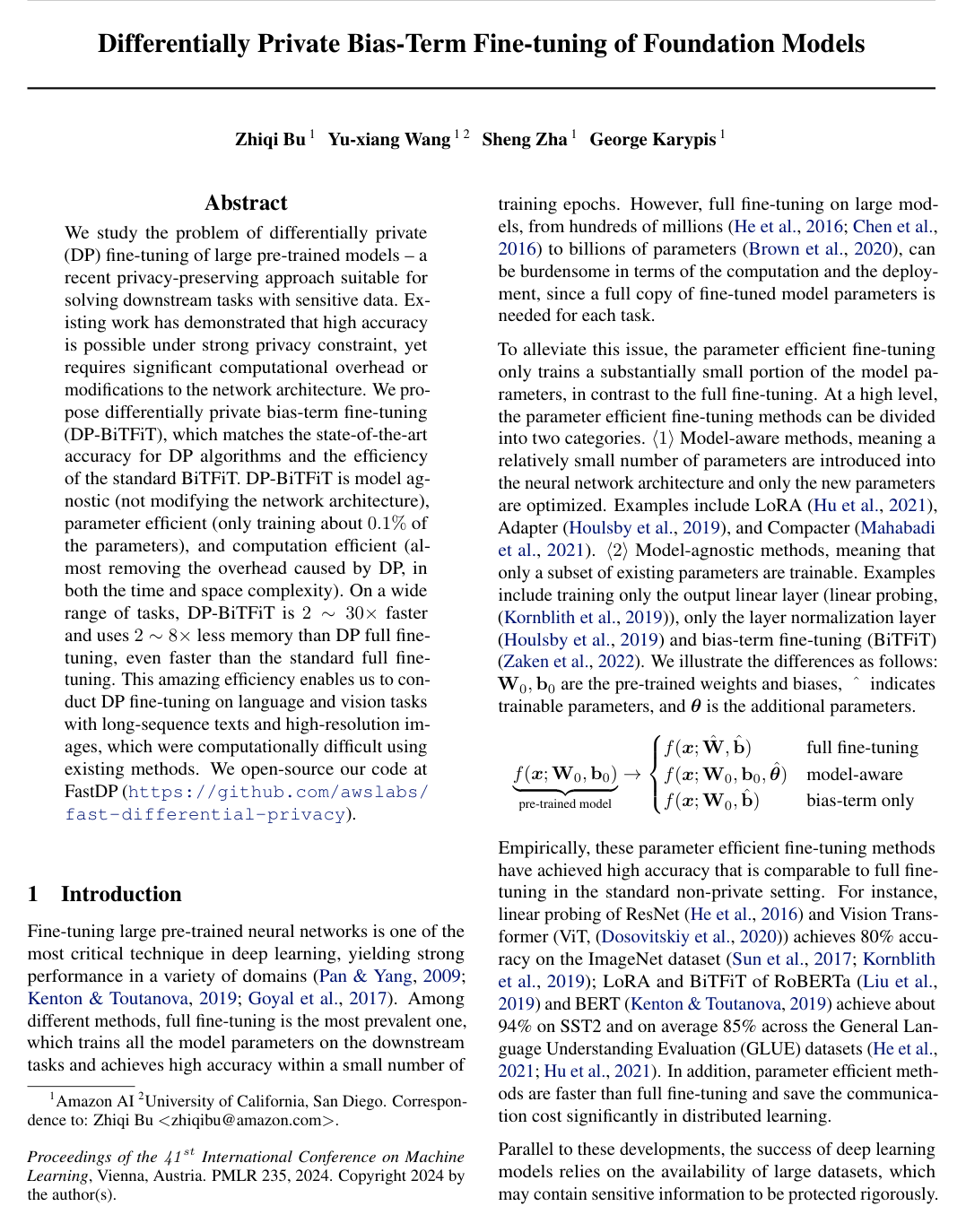
Differentially Private Bias-Term Fine-tuning of Foundation Models
Zhiqi Bu, Yu-Xiang Wang, Sheng Zha, George Karypis
Why you should read this
Proposes a differentially private bias-term fine-tuning method that updates only 0.1% of parameters to drastically cut memory and computational overhead, matching state-of-the-art accuracy while enabling practical private fine-tuning on high-resolution vision and long-sequence language tasks.
We study the problem of differentially private (DP) fine-tuning of large pre-trained models – a recent privacy-preserving approach suitable for solving downstream tasks with sensitive data. Existing work has demonstrated that high accuracy is possible under strong privacy constraint, yet requires significant computational overhead or modifications to the network architecture. We propose differentially private bias-term fine-tuning (DP-BiTFiT), which matches the state-of-the-art accuracy for DP algorithms and the efficiency of the standard BiTFiT. DP-BiTFiT is model agnostic (not modifying the network architecture), parameter efficient (only training about 0.1% of the parameters), and computation efficient (almost removing the overhead caused by DP, in both the time and space complexity). On a wide range of tasks, DP-BiTFiT is 2 ∼ 30× faster and uses 2 ∼ 8× less memory than DP full fine-tuning, even faster than the standard full fine-tuning. This amazing efficiency enables us to conduct DP fine-tuning on language and vision tasks with long-sequence texts and high-resolution images, which were computationally difficult using existing methods. We open-source our code at FastDP (https://github.com/awslabs/fast-differential-privacy).
Added
2026-10-03
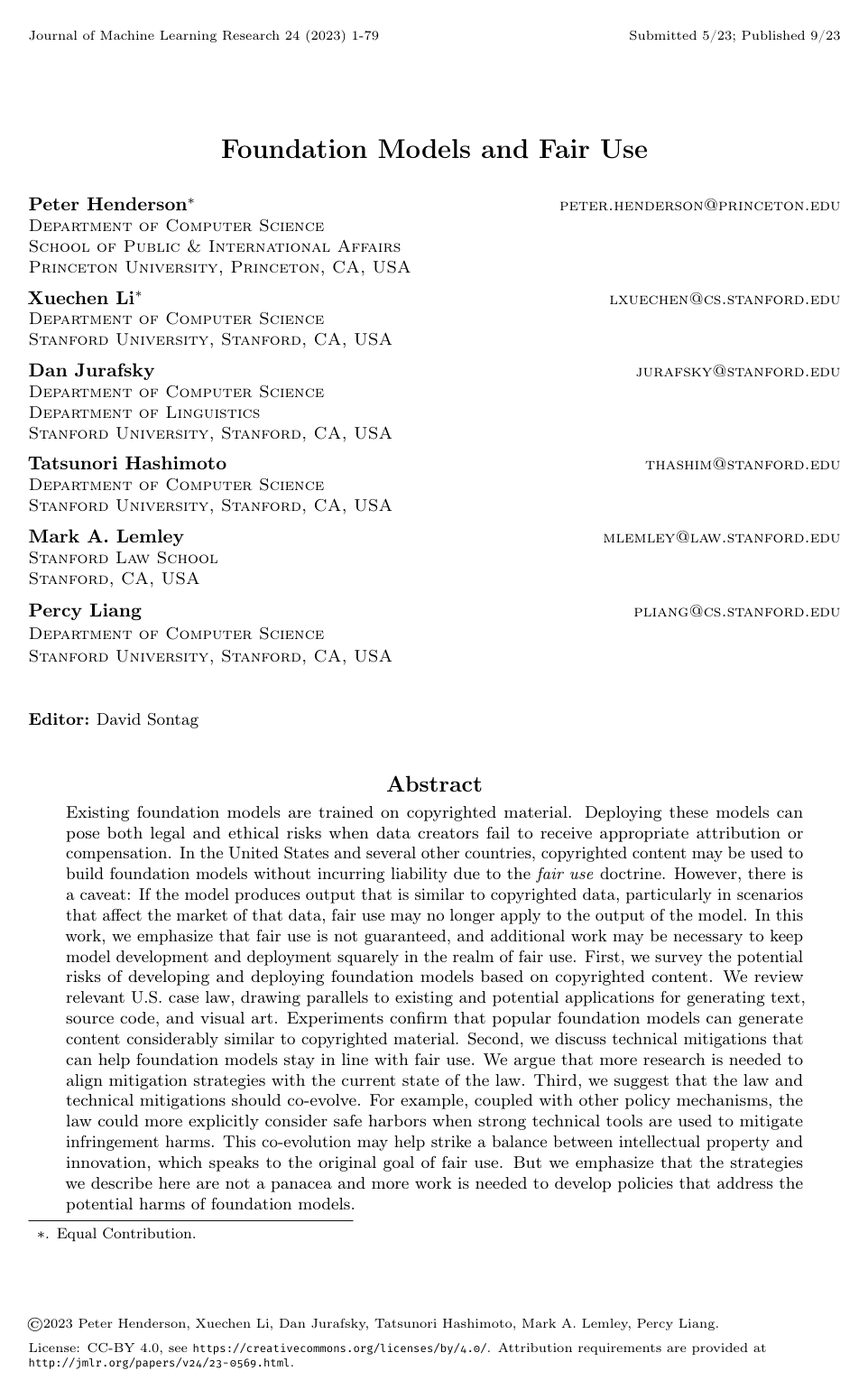
Foundation Models and Fair Use
Peter Henderson, Xuechen Li, Dan Jurafsky, Tatsunori Hashimoto, Mark A. Lemley, Percy Liang
Why you should read this
Examines the legal risks of training foundation models on copyrighted data under United States fair use law and proposes technical mitigation strategies alongside policy safe harbors to prevent copyright infringement in generative outputs.
Existing foundation models are trained on copyrighted material. Deploying these models can pose both legal and ethical risks when data creators fail to receive appropriate attribution or compensation. In the United States and several other countries, copyrighted content may be used to build foundation models without incurring liability due to the fair use doctrine. However, there is a caveat: If the model produces output that is similar to copyrighted data, particularly in scenarios that affect the market of that data, fair use may no longer apply to the output of the model. In this work, we emphasize that fair use is not guaranteed, and additional work may be necessary to keep model development and deployment squarely in the realm of fair use. First, we survey the potential risks of developing and deploying foundation models based on copyrighted content. We review relevant U.S. case law, drawing parallels to existing and potential applications for generating text, source code, and visual art. Experiments confirm that popular foundation models can generate content considerably similar to copyrighted material. Second, we discuss technical mitigations that can help foundation models stay in line with fair use. We argue that more research is needed to align mitigation strategies with the current state of the law. Third, we suggest that the law and technical mitigations should co-evolve. For example, coupled with other policy mechanisms, the law could more explicitly consider safe harbors when strong technical tools are used to mitigate infringement harms. This co-evolution may help strike a balance between intellectual property and innovation, which speaks to the original goal of fair use. But we emphasize that the strategies we describe here are not a panacea and more work is needed to develop policies that address the potential harms of foundation models.
Added
2026-09-30
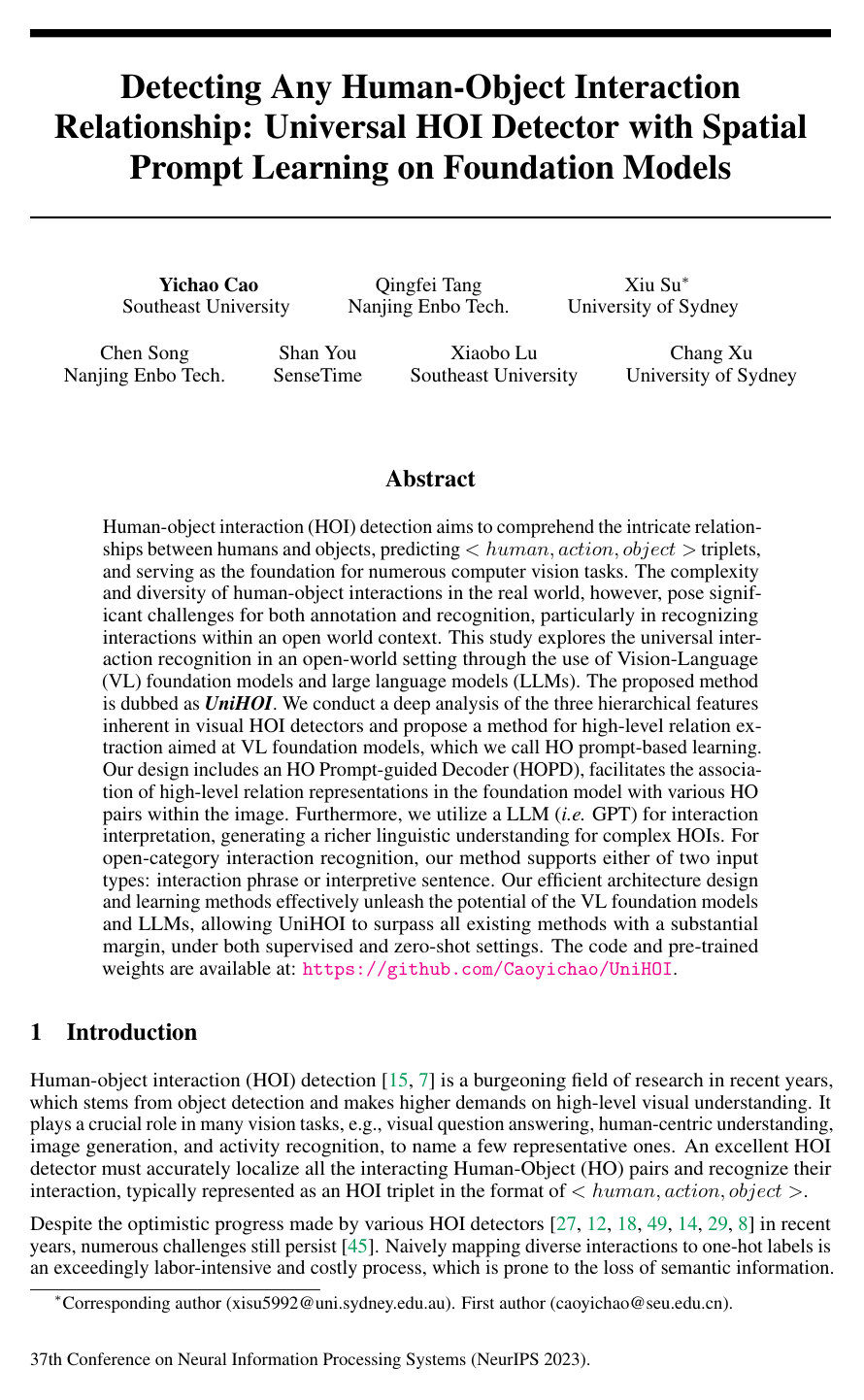
Detecting Any Human-Object Interaction Relationship: Universal HOI Detector with Spatial Prompt Learning on Foundation Models
Yichao Cao, Qingfei Tang, Xiu Su, Song Chen, Shan You, Xiaobo Lu, Chang Xu
Why you should read this
Proposes UniHOI, a framework that integrates vision-language foundation models with language-model-generated knowledge via spatial prompt learning to advance open-world and zero-shot human-object interaction detection.
Human-object interaction (HOI) detection aims to comprehend the intricate relationships between humans and objects, predicting < human, action, object > triplets, and serving as the foundation for numerous computer vision tasks. The complexity and diversity of human-object interactions in the real world, however, pose significant challenges for both annotation and recognition, particularly in recognizing interactions within an open world context. This study explores the universal interaction recognition in an open-world setting through the use of Vision-Language (VL) foundation models and large language models (LLMs). The proposed method is dubbed as UniHOI. We conduct a deep analysis of the three hierarchical features inherent in visual HOI detectors and propose a method for high-level relation extraction aimed at VL foundation models, which we call HO prompt-based learning. Our design includes an HO Prompt-guided Decoder (HOPD), facilitates the association of high-level relation representations in the foundation model with various HO pairs within the image. Furthermore, we utilize a LLM (i.e. GPT) for interaction interpretation, generating a richer linguistic understanding for complex HOIs. For open-category interaction recognition, our method supports either of two input types: interaction phrase or interpretive sentence. Our efficient architecture design and learning methods effectively unleash the potential of the VL foundation models and LLMs, allowing UniHOI to surpass all existing methods with a substantial margin, under both supervised and zero-shot settings. The code and pre-trained weights are available at: https://github.com/Caoyichao/UniHOI.
Added
2026-09-26
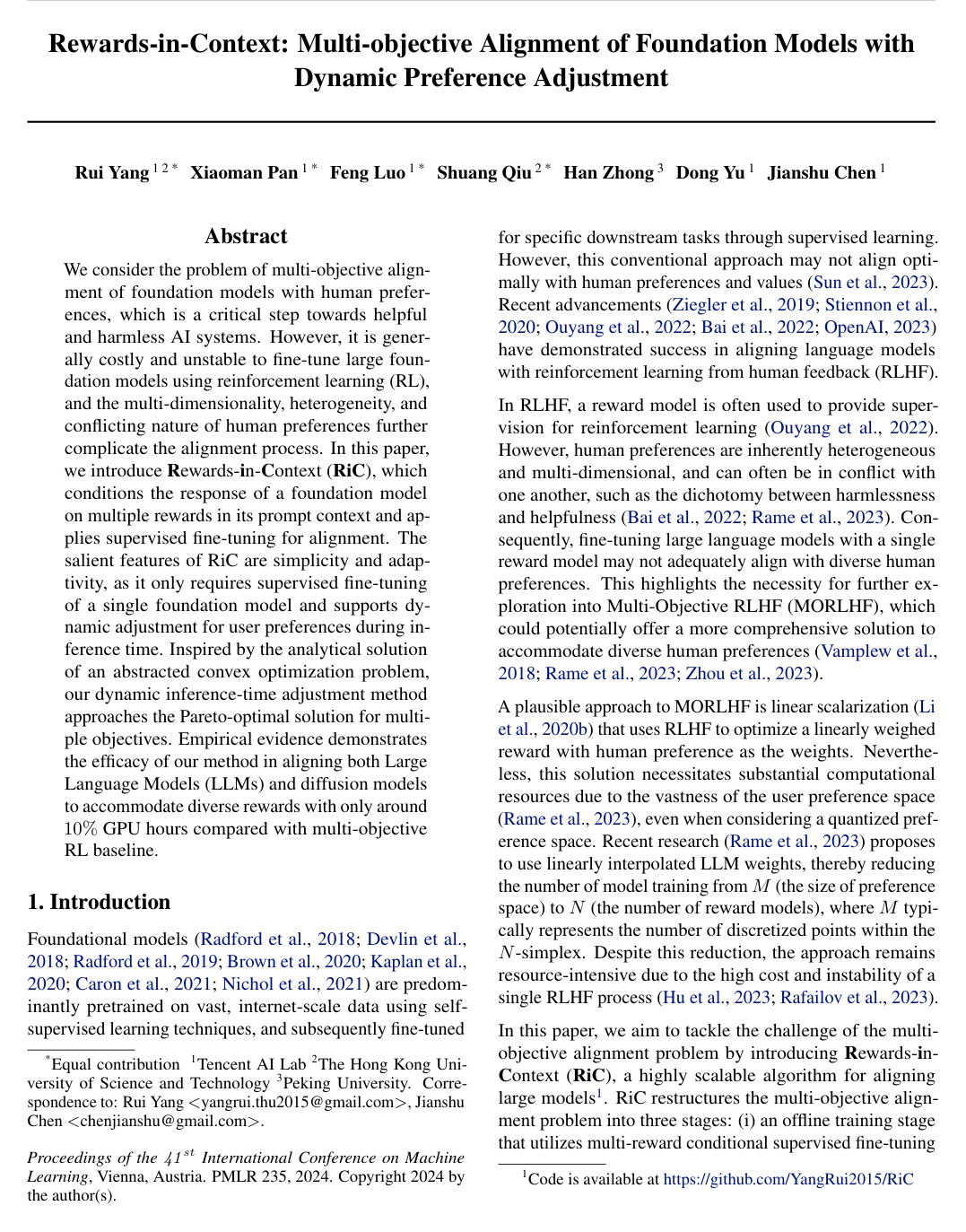
Rewards-in-Context: Multi-objective Alignment of Foundation Models with Dynamic Preference Adjustment
Rui Yang, Xiaoman Pan, Feng Luo, Shuang Qiu, Han Zhong, Dong Yu, Jianshu Chen
Why you should read this
Presents Rewards-in-Context, an efficient alignment method that conditions foundation models on multiple reward values via supervised fine-tuning, achieving Pareto-optimal multi-objective adaptation at inference time using only ten percent of the compute required by reinforcement learning baselines.
We consider the problem of multi-objective alignment of foundation models with human preferences, which is a critical step towards helpful and harmless AI systems. However, it is generally costly and unstable to fine-tune large foundation models using reinforcement learning (RL), and the multi-dimensionality, heterogeneity, and conflicting nature of human preferences further complicate the alignment process. In this paper, we introduce Rewards-in-Context (RiC), which conditions the response of a foundation model on multiple rewards in its prompt context and applies supervised fine-tuning for alignment. The salient features of RiC are simplicity and adaptivity, as it only requires supervised fine-tuning of a single foundation model and supports dynamic adjustment for user preferences during inference time. Inspired by the analytical solution of an abstracted convex optimization problem, our dynamic inference-time adjustment method approaches the Pareto-optimal solution for multiple objectives. Empirical evidence demonstrates the efficacy of our method in aligning both Large Language Models (LLMs) and diffusion models to accommodate diverse rewards with only around 10% GPU hours compared with multi-objective RL baseline.
Added
2026-09-26
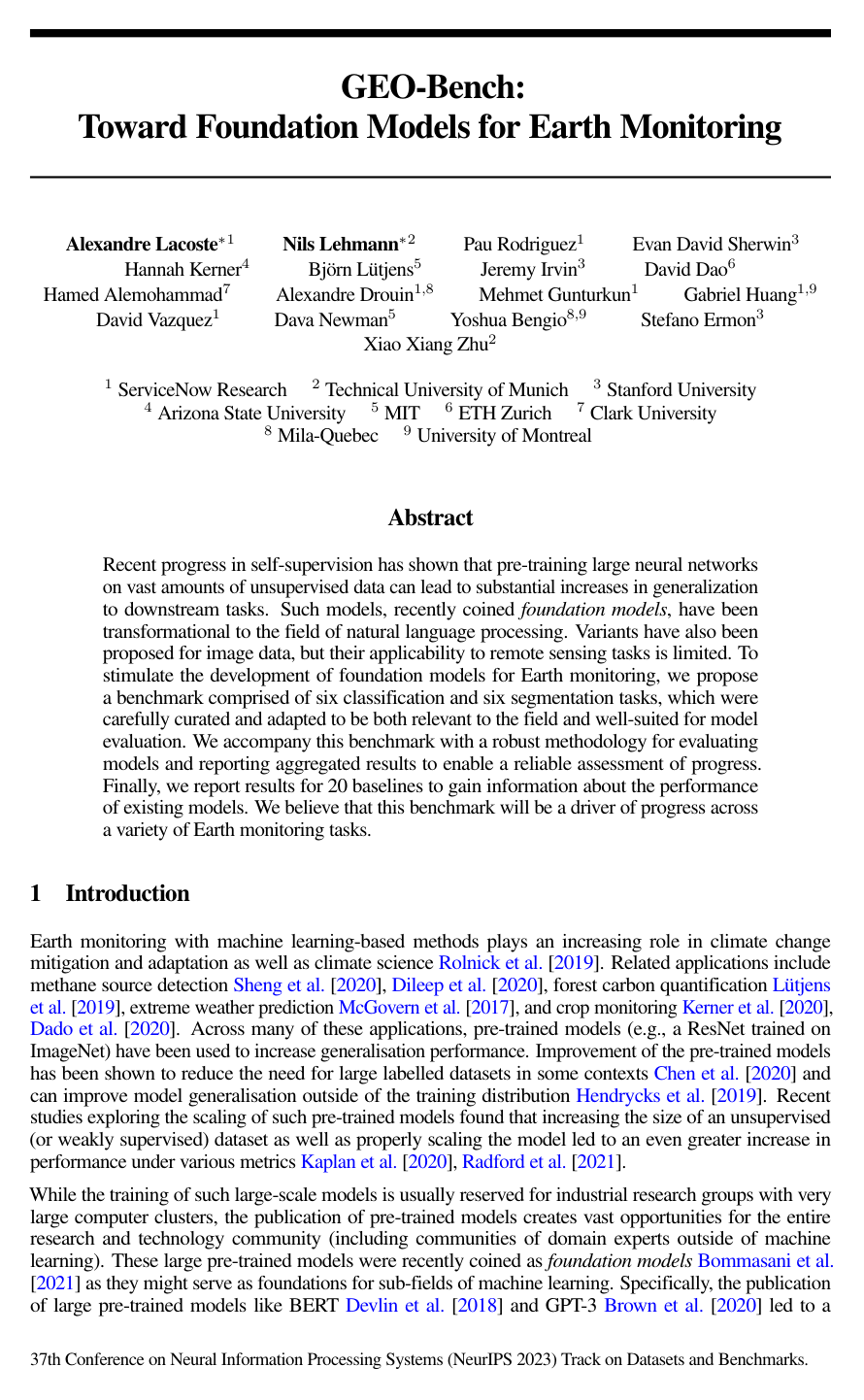
GEO-Bench: Toward Foundation Models for Earth Monitoring
Alexandre Lacoste, Nils Lehmann, Pau Rodríguez, Evan D. Sherwin, Hannah Kerner, Björn Lütjens, Jeremy Irvin, David Dao, Hamed Alemohammad, Alexandre Drouin, Mehmet Gunturkun, Gabriel Huang, David Vázquez, Dava J. Newman, Yoshua Bengio, Stefano Ermon, Xiaoxiang Zhu
Why you should read this
Introduces GEO-Bench, a standardized benchmark of twelve classification and segmentation tasks alongside twenty baseline evaluations to accelerate the development and reliable assessment of foundation models for satellite Earth monitoring.
Recent progress in self-supervision has shown that pre-training large neural networks on vast amounts of unsupervised data can lead to substantial increases in generalization to downstream tasks. Such models, recently coined foundation models, have been transformational to the field of natural language processing. Variants have also been proposed for image data, but their applicability to remote sensing tasks is limited. To stimulate the development of foundation models for Earth monitoring, we propose a benchmark comprised of six classification and six segmentation tasks, which were carefully curated and adapted to be both relevant to the field and well-suited for model evaluation. We accompany this benchmark with a robust methodology for evaluating models and reporting aggregated results to enable a reliable assessment of progress. Finally, we report results for 20 baselines to gain information about the performance of existing models. We believe that this benchmark will be a driver of progress across a variety of Earth monitoring tasks.
Added
2026-09-26
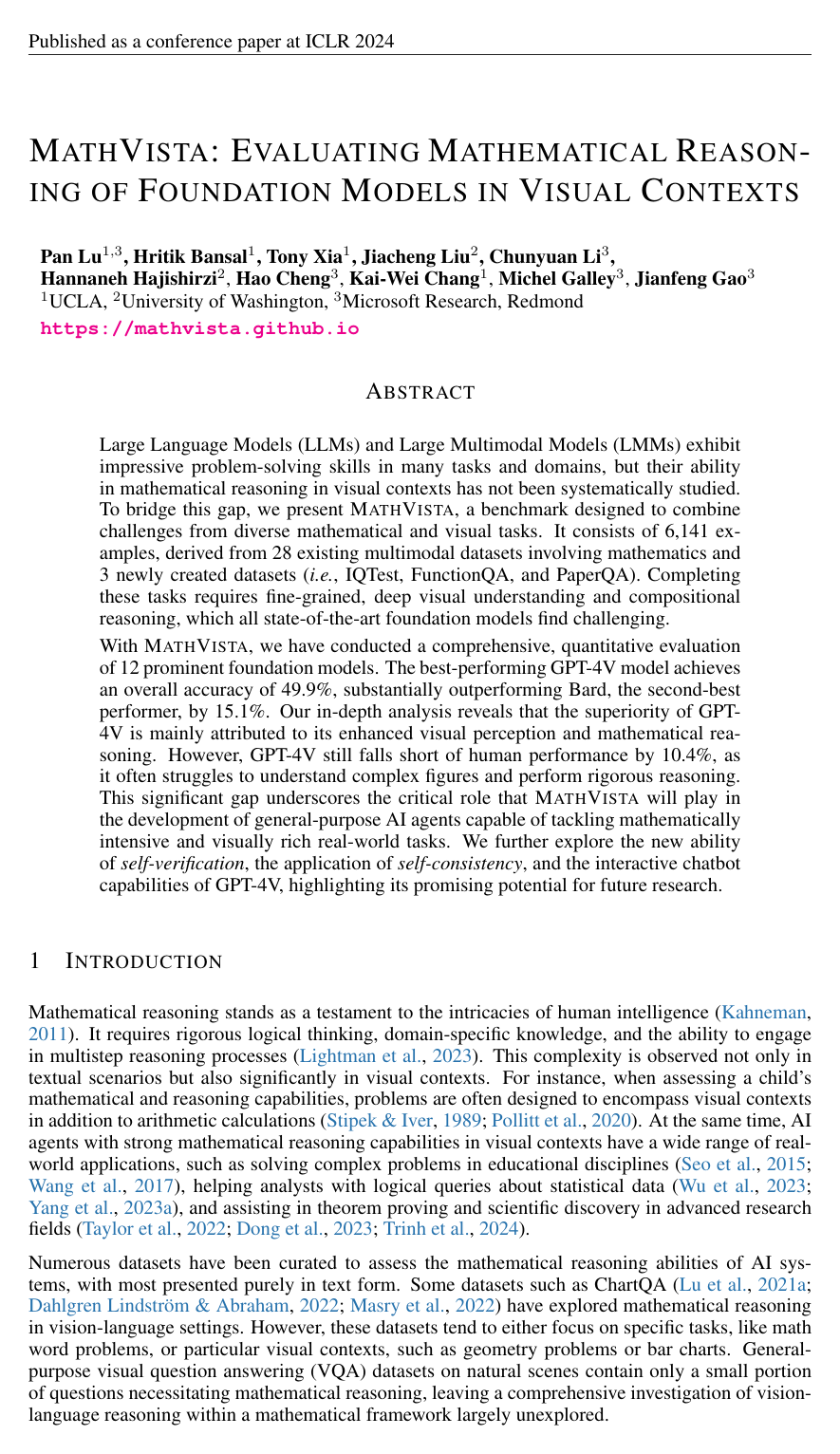
MathVista: Evaluating Mathematical Reasoning of Foundation Models in Visual Contexts
Pan Lu, Hritik Bansal, Tony Xia, Jiacheng Liu, Chun-yue Li, Hannaneh Hajishirzi, Hao Cheng, Kai-Wei Chang, Michel Galley, Jianfeng Gao
Why you should read this
Presents MathVista, a 6,141-example benchmark for assessing mathematical reasoning in visual contexts, revealing that leading multimodal models like GPT-4V still trail human performance on complex visual problem-solving.
Large Language Models (LLMs) and Large Multimodal Models (LMMs) exhibit impressive problem-solving skills in many tasks and domains, but their ability in mathematical reasoning in visual contexts has not been systematically studied. To bridge this gap, we present MathVista, a benchmark designed to combine challenges from diverse mathematical and visual tasks. It consists of 6,141 examples, derived from 28 existing multimodal datasets involving mathematics and 3 newly created datasets (i.e., IQTest, FunctionQA, and PaperQA). Completing these tasks requires fine-grained, deep visual understanding and compositional reasoning, which all state-of-the-art foundation models find challenging. With MathVista, we have conducted a comprehensive, quantitative evaluation of 12 prominent foundation models. The best-performing GPT-4V model achieves an overall accuracy of 49.9%, substantially outperforming Bard, the second-best performer, by 15.1%. Our in-depth analysis reveals that the superiority of GPT-4V is mainly attributed to its enhanced visual perception and mathematical reasoning. However, GPT-4V still falls short of human performance by 10.4%, as it often struggles to understand complex figures and perform rigorous reasoning. This significant gap underscores the critical role that MathVista will play in the development of general-purpose AI agents capable of tackling mathematically intensive and visually rich real-world tasks. We further explore the new ability of self-verification, the application of self-consistency, and the interactive chatbot capabilities of GPT-4V, highlighting its promising potential for future research. The project is available at this https URL.
Added
2026-09-18
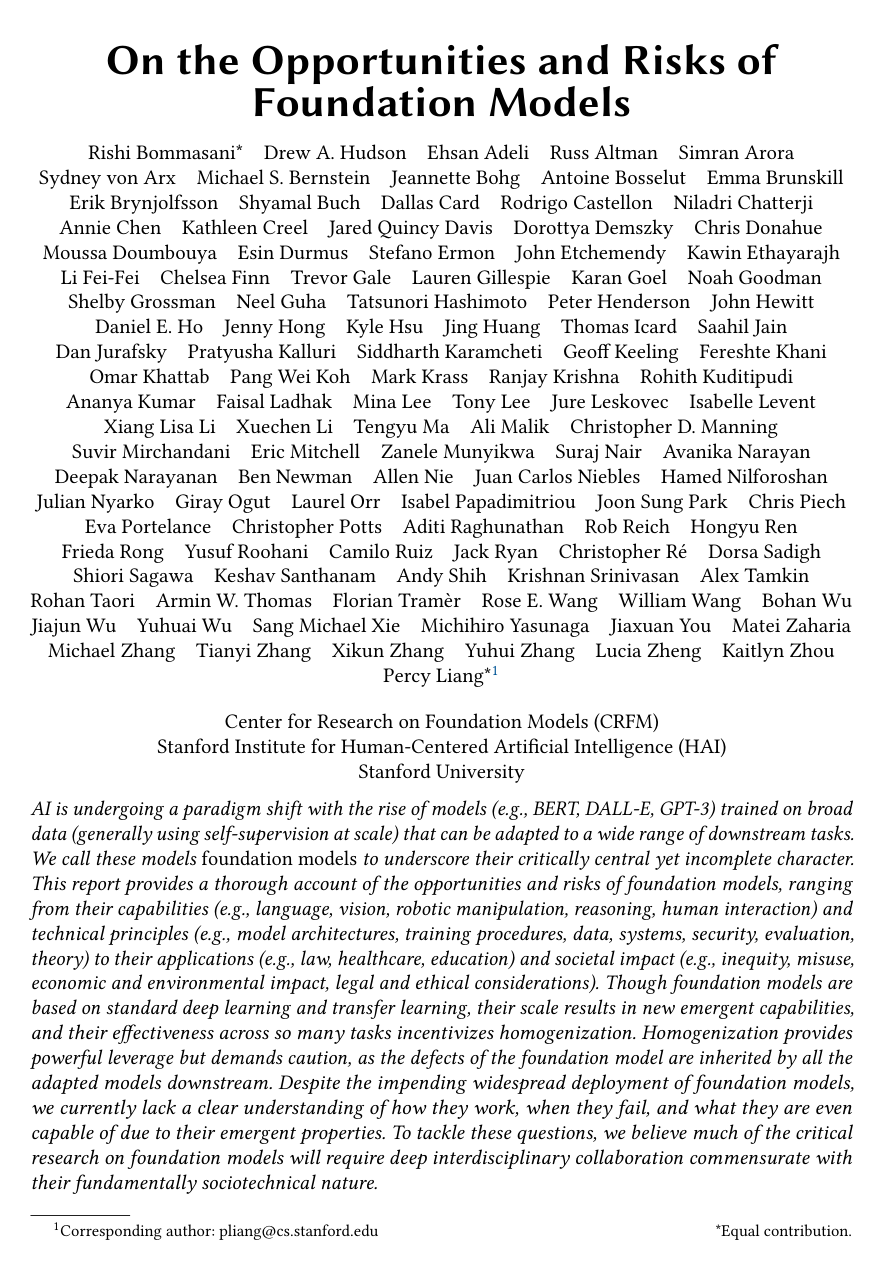
On the Opportunities and Risks of Foundation Models
Rishi Bommasani, Drew A. Hudson, Ehsan Adeli, Russ Altman, Simran Arora, Sydney von Arx, Michael S. Bernstein, Jeannette Bohg, Antoine Bosselut, Emma Brunskill, Erik Brynjolfsson, Shyamal Buch, Dallas Card, Rodrigo Castellon, Niladri Chatterji, Annie Chen, Kathleen Creel, Jared Quincy Davis, Dora Demszky, Chris Donahue, Moussa Doumbouya, Esin Durmus, Stefano Ermon, John Etchemendy, Kawin Ethayarajh, Li Fei-Fei, Chelsea Finn, Trevor Gale, Lauren Gillespie, Karan Goel, Noah Goodman, Shelby Grossman, Neel Guha, Tatsunori Hashimoto, Peter Henderson, John Hewitt, Daniel E. Ho, Jenny Hong, Kyle Hsu, Jing Huang, Thomas Icard, Saahil Jain, Dan Jurafsky, Pratyusha Kalluri, Siddharth Karamcheti, Geoff Keeling, Fereshte Khani, Omar Khattab, Pang Wei Koh, Mark Krass, Ranjay Krishna, Rohith Kuditipudi, Ananya Kumar, Faisal Ladhak, Mina Lee, Tony Lee, Jure Leskovec, Isabelle Levent, Xiang Lisa Li, Xuechen Li, Tengyu Ma, Ali Malik, Christopher D. Manning, Suvir Mirchandani, Eric Mitchell, Zanele Munyikwa, Suraj Nair, Avanika Narayan, Deepak Narayanan, Ben Newman, Allen Nie, Juan Carlos Niebles, Hamed Nilforoshan, Julian Nyarko, Giray Ogut, Laurel Orr, Isabel Papadimitriou, Joon Sung Park, Chris Piech, Eva Portelance, Christopher Potts, Aditi Raghunathan, Rob Reich, Hongyu Ren, Frieda Rong, Yusuf Roohani, Camilo Ruiz, Jack Ryan, Christopher Ré, Dorsa Sadigh, Shiori Sagawa, Keshav Santhanam, Andy Shih, Krishnan Srinivasan, Alex Tamkin, Rohan Taori, Armin W. Thomas, Florian Tramèr, Rose E. Wang, William Wang, Bohan Wu, Jiajun Wu, Yuhuai Wu, Sang Michael Xie, Michihiro Yasunaga, Jiaxuan You, Matei Zaharia, Michael Zhang, Tianyi Zhang, Xikun Zhang, Yuhui Zhang, Lucia Zheng, Kaitlyn Zhou, Percy Liang
Why you should read this
Defines the paradigm of foundation models to systematically examine how large-scale pretrained systems yield emergent capabilities while concentrating technical, legal, and societal risks across downstream applications.
AI is undergoing a paradigm shift with the rise of models (e.g., BERT, DALL-E, GPT-3) that are trained on broad data at scale and are adaptable to a wide range of downstream tasks. We call these models foundation models to underscore their critically central yet incomplete character. This report provides a thorough account of the opportunities and risks of foundation models, ranging from their capabilities (e.g., language, vision, robotics, reasoning, human interaction) and technical principles(e.g., model architectures, training procedures, data, systems, security, evaluation, theory) to their applications (e.g., law, healthcare, education) and societal impact (e.g., inequity, misuse, economic and environmental impact, legal and ethical considerations). Though foundation models are based on standard deep learning and transfer learning, their scale results in new emergent capabilities,and their effectiveness across so many tasks incentivizes homogenization. Homogenization provides powerful leverage but demands caution, as the defects of the foundation model are inherited by all the adapted models downstream. Despite the impending widespread deployment of foundation models, we currently lack a clear understanding of how they work, when they fail, and what they are even capable of due to their emergent properties. To tackle these questions, we believe much of the critical research on foundation models will require deep interdisciplinary collaboration commensurate with their fundamentally sociotechnical nature.
Added
2026-09-14