
keyword
forecasting accuracy
Forecasting accuracy is a measure of how closely a predictive model or method estimates future outcomes compared to the actual observed values over a given time horizon. In time series forecasting and statistical modeling, it quantifies the degree of proximity between point forecasts and true realized data, commonly assessed using error metrics such as mean absolute error, root mean squared error, mean absolute percentage error, and scaled error measures. Higher forecasting accuracy indicates smaller discrepancies between predicted values and actual occurrences, serving as a primary benchmark for comparing statistical and machine learning models, optimizing predictive algorithms, and supporting operational planning, resource allocation, and strategic decision-making.
3 items
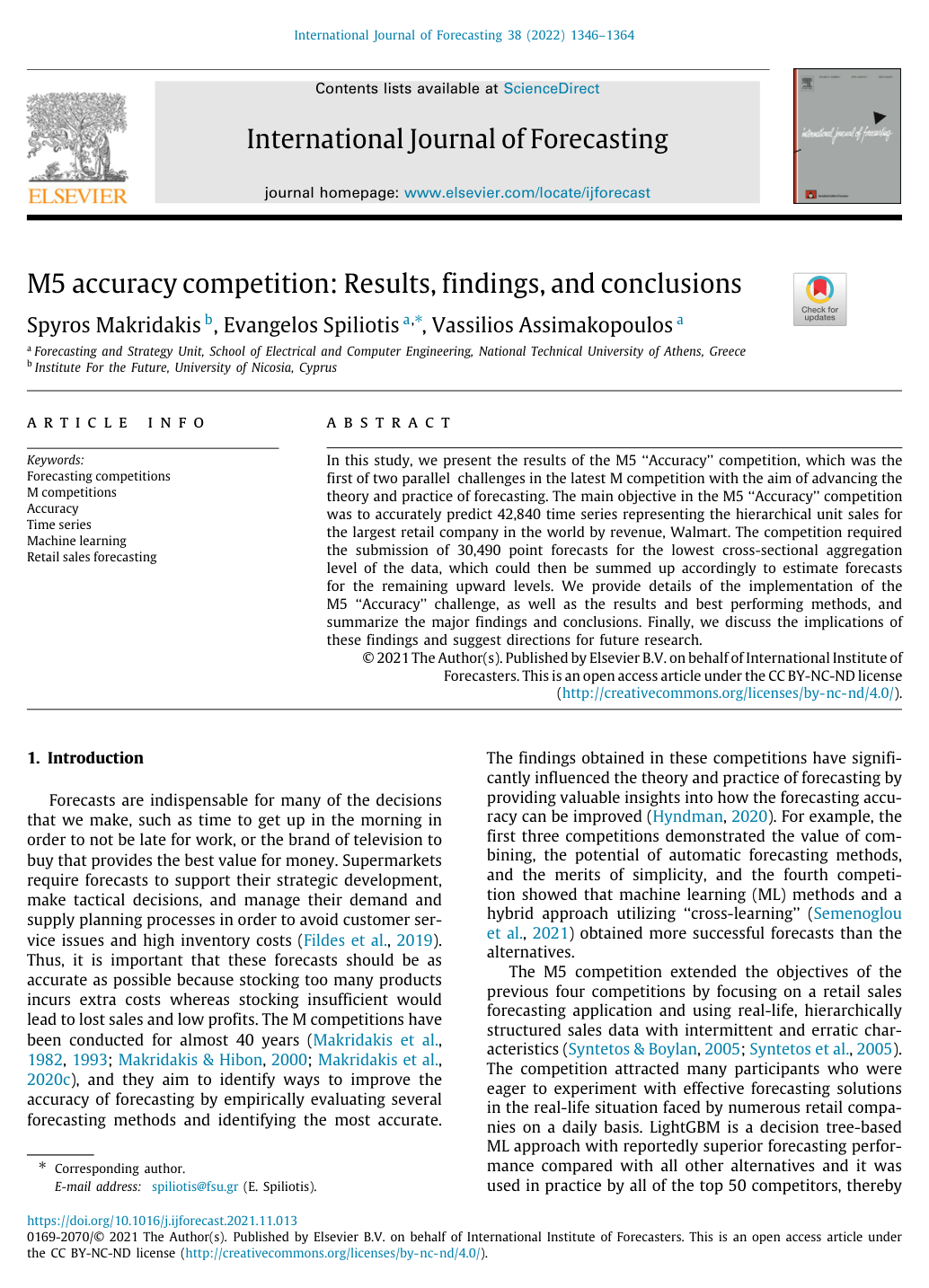
M5 accuracy competition: Results, findings, and conclusions
Spyros Makridakis, Evangelos Spiliotis, Vassilios Assimakopoulos
Why you should read this
Evaluates machine learning and statistical methods applied to retail sales forecasting to determine the most accurate techniques for hierarchical data.
In this study, we present the results of the M5 "Accuracy" competition, which was the first of two parallel challenges in the latest M competition with the aim of advancing the theory and practice of forecasting. The main objective in the M5 "Accuracy" competition was to accurately predict 42,840 time series representing the hierarchical unit sales for the largest retail company in the world by revenue, Walmart.
Added
2026-10-03
License
Published with permission
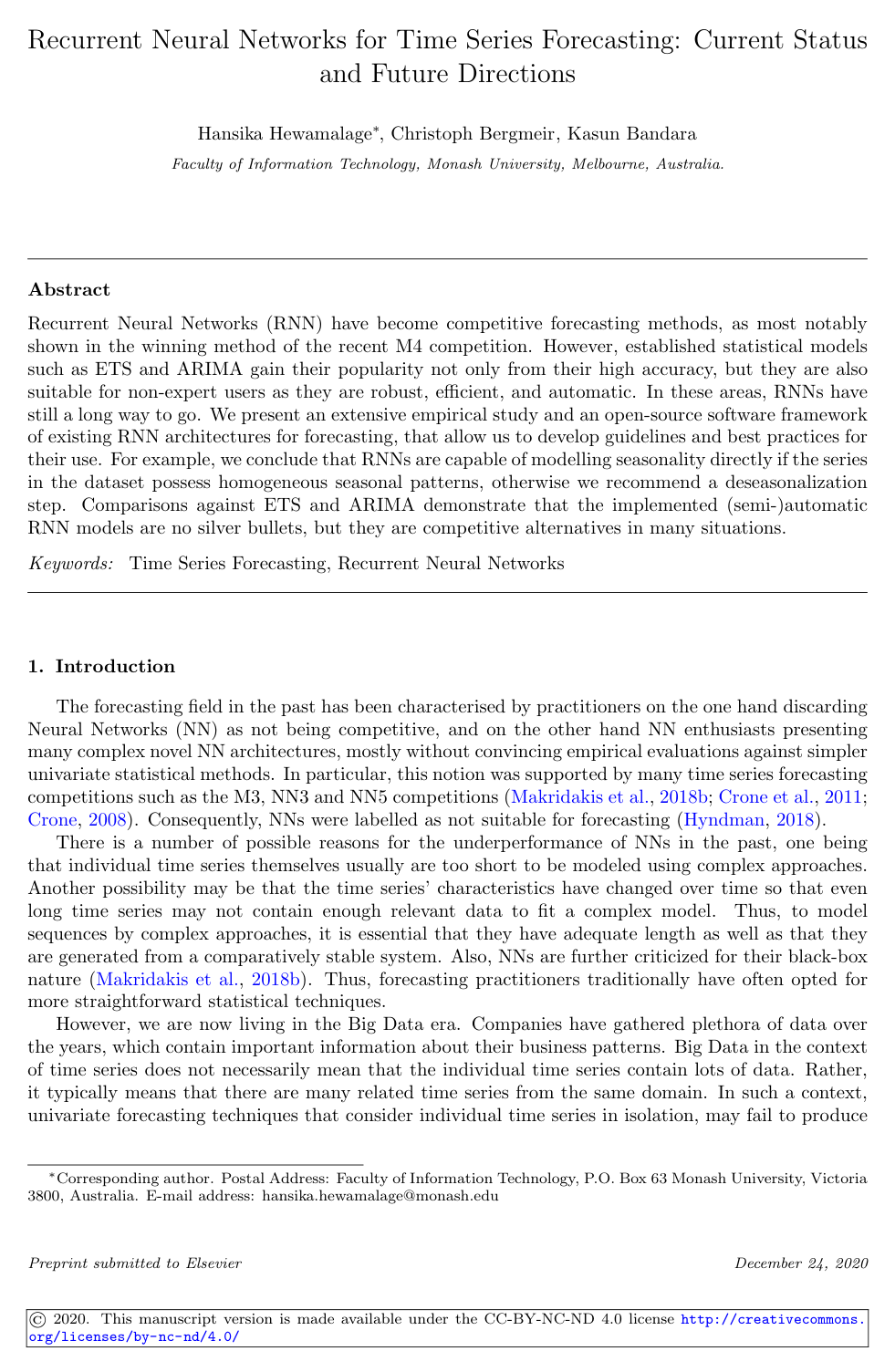
Recurrent Neural Networks for Time Series Forecasting: Current Status and Future Directions
Hansika Hewamalage, Christoph Bergmeir, Kasun Bandara
Why you should read this
Establishes practical guidelines and an open-source framework for time series forecasting with recurrent neural networks through extensive empirical comparisons against standard statistical baselines like ARIMA and ETS.
Recurrent Neural Networks (RNN) have become competitive forecasting methods, as most notably shown in the winning method of the recent M4 competition. However, established statistical models such as ETS and ARIMA gain their popularity not only from their high accuracy, but they are also suitable for non-expert users as they are robust, efficient, and automatic. In these areas, RNNs have still a long way to go. We present an extensive empirical study and an open-source software framework of existing RNN architectures for forecasting, that allow us to develop guidelines and best practices for their use. For example, we conclude that RNNs are capable of modelling seasonality directly if the series in the dataset possess homogeneous seasonal patterns, otherwise we recommend a deseasonalization step. Comparisons against ETS and ARIMA demonstrate that the implemented (semi-)automatic RNN models are no silver bullets, but they are competitive alternatives in many situations.
Added
2026-09-25
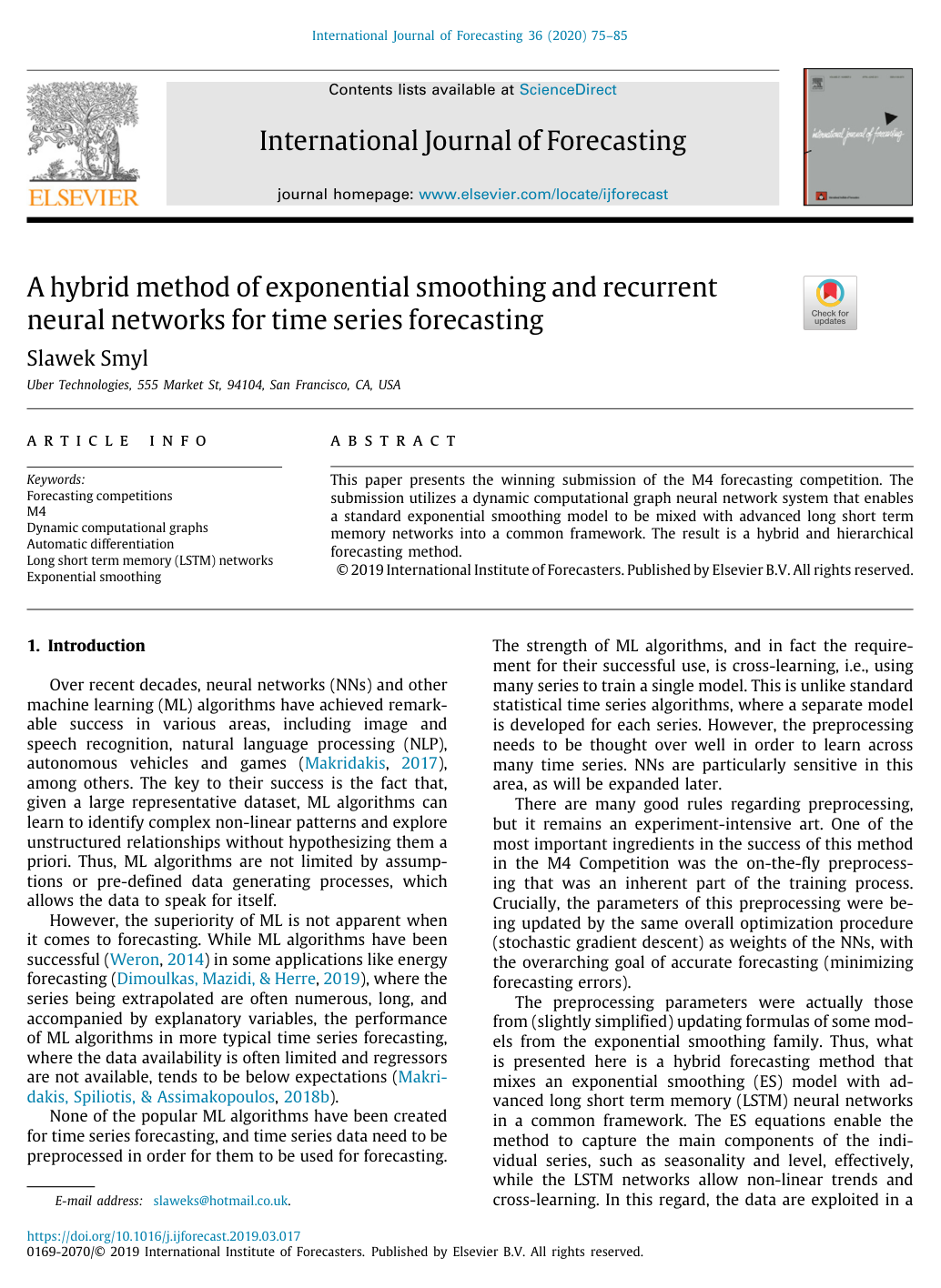
A hybrid method of exponential smoothing and recurrent neural networks for time series forecasting
Slawek Smyl
Why you should read this
Details the innovative neural architecture that won the monumental M4 competition by strategically pairing interpretable exponential smoothing equations with non-linear recurrent networks.
Abstract This paper presents the winning submission of the M4 forecasting competition. The submission utilizes a dynamic computational graph neural network system that enables a standard exponential smoothing model to be mixed with advanced long short term memory networks into a common framework. The result is a hybrid and hierarchical forecasting method.
Added
2026-06-27