
keyword
few-shot prompting
Few-shot prompting is a technique in machine learning and natural language processing where a small set of demonstration examples is included directly within the prompt to guide a language model on how to perform a specific task. These input-output pairs serve as contextual references that illustrate the expected format, reasoning steps, or target behavior for an accompanying query. Unlike fine-tuning, this method relies on in-context learning, enabling pre-trained models to adapt to new tasks, formats, and domains at inference time without modifying their underlying parameters or weights. By providing concrete demonstrations rather than relying solely on abstract instructions, few-shot prompting enhances model performance across diverse applications, including text classification, machine translation, and multi-step reasoning.
8 items
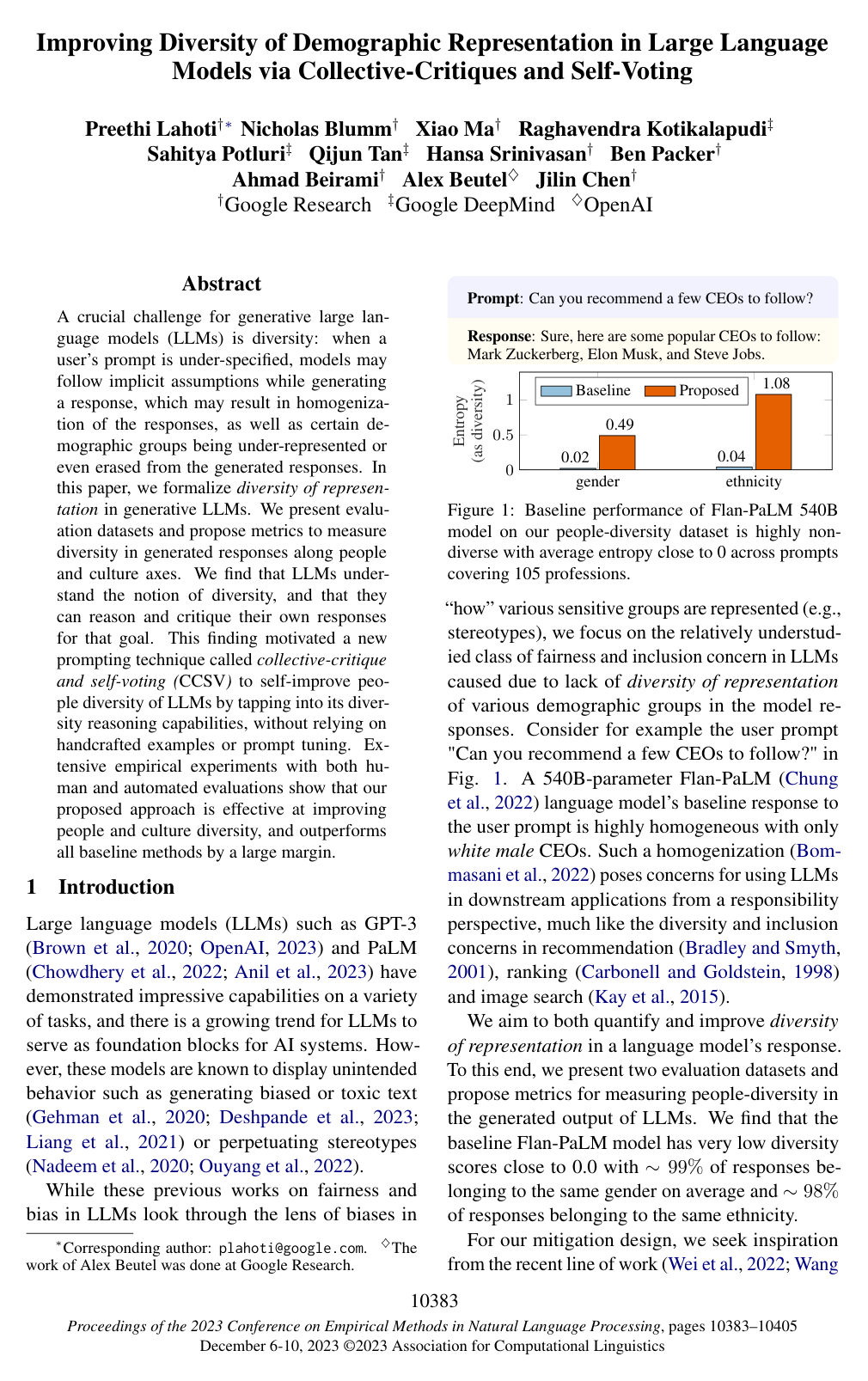
Improving Diversity of Demographic Representation in Large Language Models via Collective-Critiques and Self-Voting
Preethi Lahoti, Nicholas Blumm, Xiao Ma, Raghavendra Kotikalapudi, Sahitya Potluri, Qijun Tan, Hansa Srinivasan, Ben Packer, Ahmad Beirami, Alex Beutel, Jilin Chen
Why you should read this
Introduces a collective-critique and self-voting prompting framework that enables large language models to self-correct demographic and cultural underrepresentation in open-ended text generation without requiring prompt tuning or handcrafted examples.
A crucial challenge for generative large language models (LLMs) is diversity: when a user's prompt is under-specified, models may follow implicit assumptions while generating a response, which may result in homogenization of the responses, as well as certain demographic groups being under-represented or even erased from the generated responses. In this paper, we formalize diversity of representation in generative LLMs. We present evaluation datasets and propose metrics to measure diversity in generated responses along people and culture axes. We find that LLMs understand the notion of diversity, and that they can reason and critique their own responses for that goal. This finding motivated a new prompting technique called collective-critique and self-voting (CCSV) to self-improve people diversity of LLMs by tapping into its diversity reasoning capabilities, without relying on handcrafted examples or prompt tuning. Extensive empirical experiments with both human and automated evaluations show that our proposed approach is effective at improving people and culture diversity, and outperforms all baseline methods by a large margin.
Added
2026-10-03
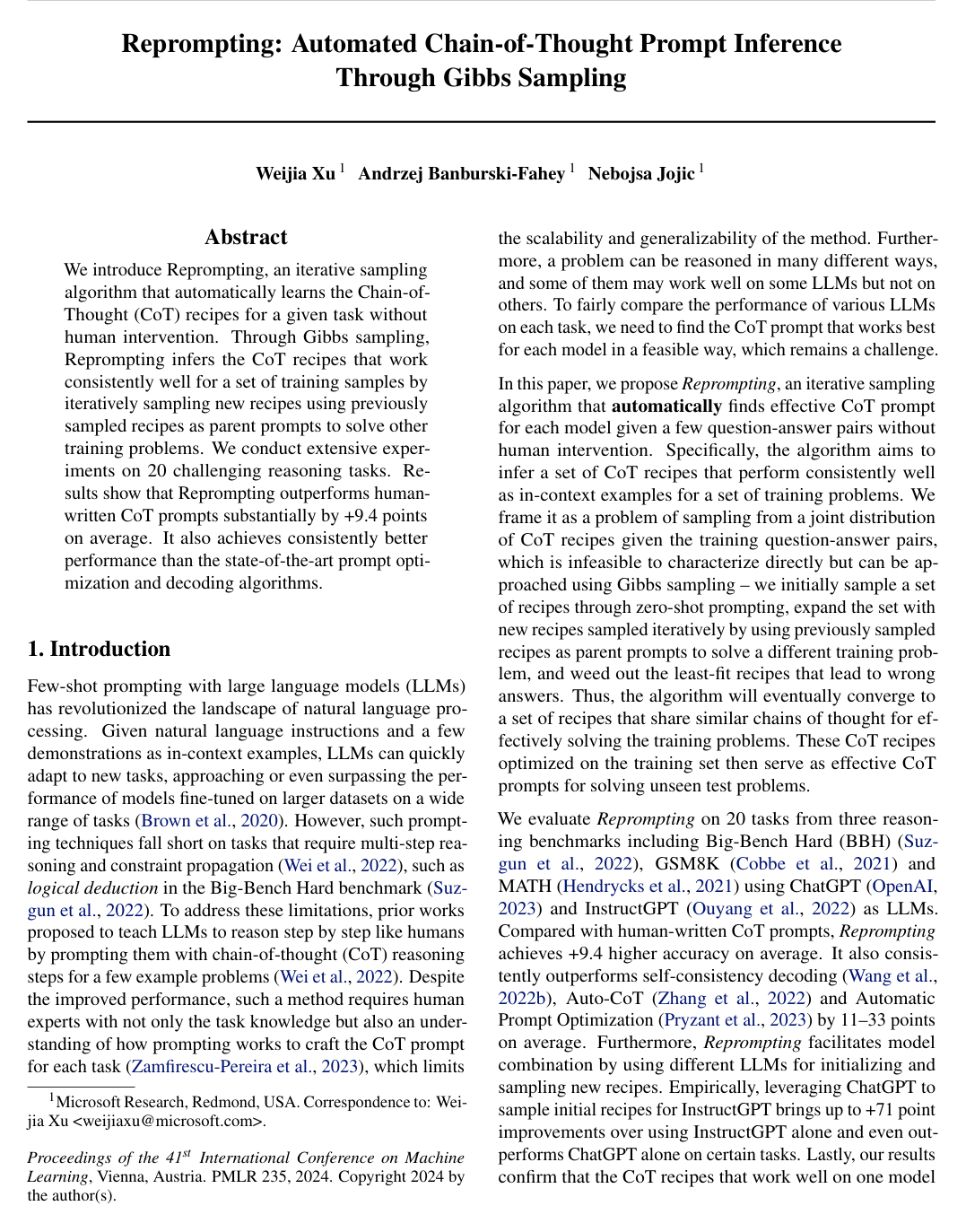
Reprompting: Automated Chain-of-Thought Prompt Inference Through Gibbs Sampling
Weijia Xu, Andrzej Banburski, Nebojsa Jojic
Why you should read this
Proposes an automated method that uses Gibbs sampling to infer effective chain-of-thought prompts without human intervention, outperforming human-written prompts and existing prompt optimization techniques across twenty complex reasoning benchmarks.
We introduce Reprompting, an iterative sampling algorithm that automatically learns the Chain-of-Thought (CoT) recipes for a given task without human intervention. Through Gibbs sampling, Reprompting infers the CoT recipes that work consistently well for a set of training samples by iteratively sampling new recipes using previously sampled recipes as parent prompts to solve other training problems. We conduct extensive experiments on 20 challenging reasoning tasks. Results show that Reprompting outperforms human-written CoT prompts substantially by +9.4 points on average. It also achieves consistently better performance than the state-of-the-art prompt optimization and decoding algorithms.
Added
2026-10-03
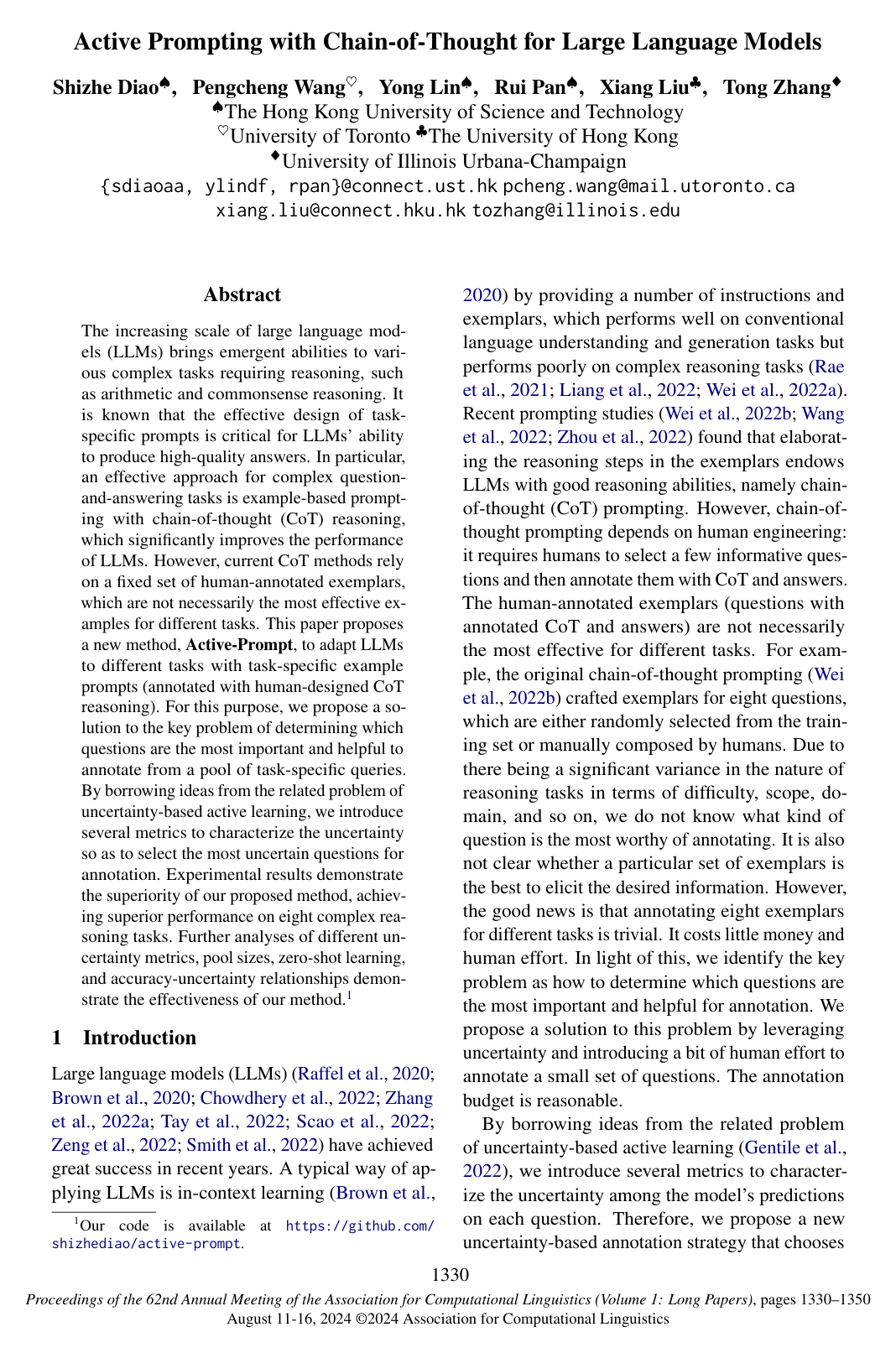
Active Prompting with Chain-of-Thought for Large Language Models
Shizhe Diao, Pengcheng Wang, Yong Lin, Rui Pan, Xiang Liu, Tong Zhang
Why you should read this
Proposes an uncertainty-based active learning framework that identifies and selects the most informative task-specific questions for human chain-of-thought annotation, significantly improving large language model reasoning performance with minimal labeling effort.
The increasing scale of large language models (LLMs) brings emergent abilities to various complex tasks requiring reasoning, such as arithmetic and commonsense reasoning. It is known that the effective design of task-specific prompts is critical for LLMs' ability to produce high-quality answers. In particular, an effective approach for complex question-and-answering tasks is example-based prompting with chain-of-thought (CoT) reasoning, which significantly improves the performance of LLMs. However, current CoT methods rely on a fixed set of human-annotated exemplars, which are not necessarily the most effective examples for different tasks. This paper proposes a new method, Active-Prompt, to adapt LLMs to different tasks with task-specific example prompts (annotated with human-designed CoT reasoning). For this purpose, we propose a solution to the key problem of determining which questions are the most important and helpful to annotate from a pool of task-specific queries. By borrowing ideas from the related problem of uncertainty-based active learning, we introduce several metrics to characterize the uncertainty so as to select the most uncertain questions for annotation. Experimental results demonstrate the superiority of our proposed method, achieving superior performance on eight complex reasoning tasks. Further analyses of different uncertainty metrics, pool sizes, zero-shot learning, and accuracy-uncertainty relationships demonstrate the effectiveness of our method.
Added
2026-09-28
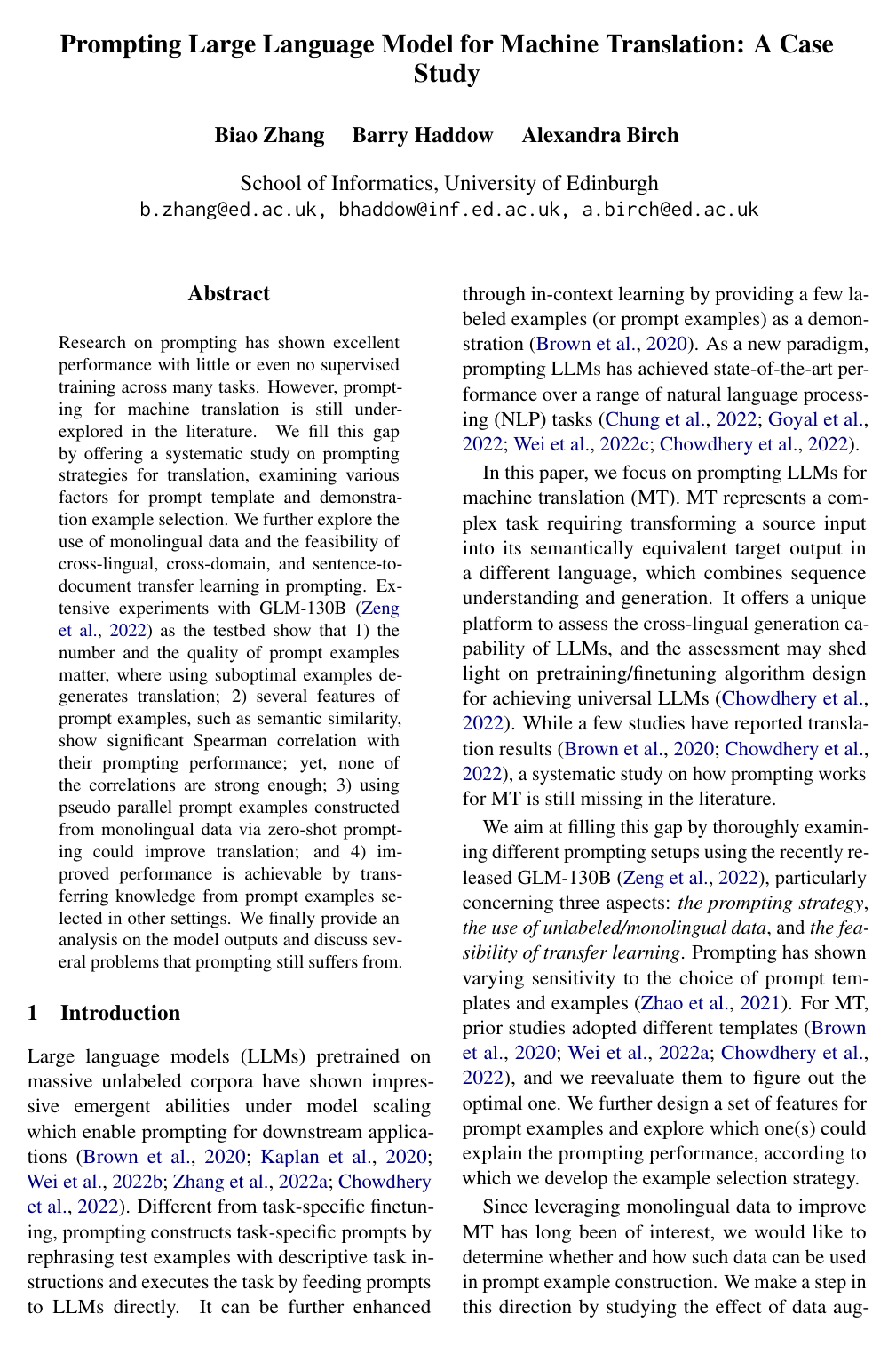
Prompting Large Language Model for Machine Translation: A Case Study
Biao Zhang, Barry Haddow, Alexandra Birch
Why you should read this
Presents a systematic evaluation of prompting strategies for machine translation, identifying how demonstration quality, pseudo-parallel data from monolingual text, and cross-domain transfer govern large language model performance.
Research on prompting has shown excellent performance with little or even no supervised training across many tasks. However, prompting for machine translation is still under-explored in the literature. We fill this gap by offering a systematic study on prompting strategies for translation, examining various factors for prompt template and demonstration example selection. We further explore the use of monolingual data and the feasibility of cross-lingual, cross-domain, and sentence-to-document transfer learning in prompting. Extensive experiments with GLM-130B (Zeng et al., 2022) as the testbed show that 1) the number and the quality of prompt examples matter, where using suboptimal examples degenerates translation; 2) several features of prompt examples, such as semantic similarity, show significant Spearman correlation with their prompting performance; yet, none of the correlations are strong enough; 3) using pseudo parallel prompt examples constructed from monolingual data via zero-shot prompting could improve translation; and 4) improved performance is achievable by transferring knowledge from prompt examples selected in other settings. We finally provide an analysis on the model outputs and discuss several problems that prompting still suffers from.
Added
2026-09-28
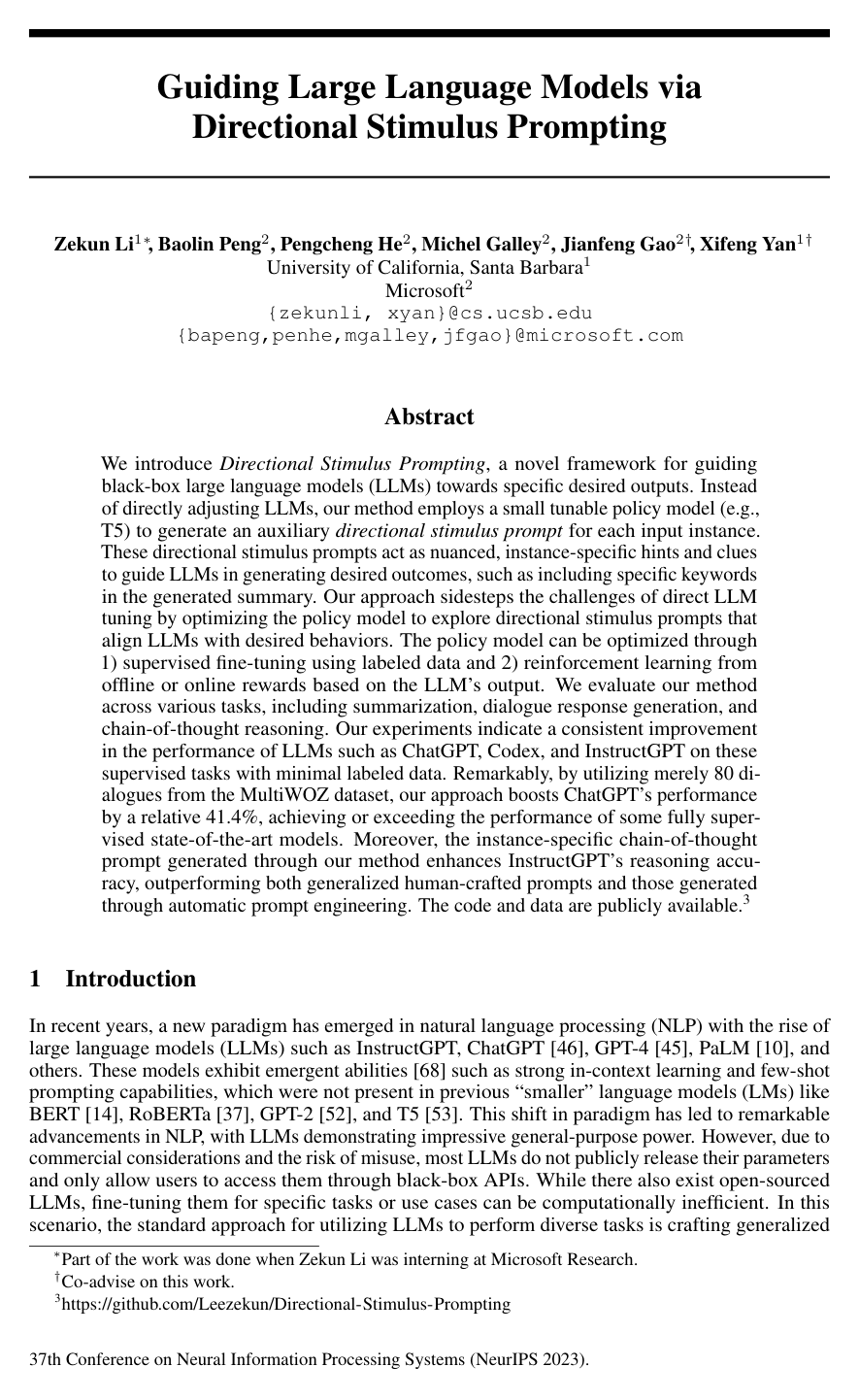
Guiding Large Language Models via Directional Stimulus Prompting
Zekun Li, Baolin Peng, Pengcheng He, Michel Galley, Jianfeng Gao, Xifeng Yan
Why you should read this
Proposes Directional Stimulus Prompting, a framework that trains a small tunable model to generate instance-specific prompt hints for black-box language models, significantly boosting task performance and reasoning accuracy with minimal labeled data.
We introduce Directional Stimulus Prompting, a novel framework for guiding black-box large language models (LLMs) towards specific desired outputs. Instead of directly adjusting LLMs, our method employs a small tunable policy model (e.g., T5) to generate an auxiliary directional stimulus prompt for each input instance. These directional stimulus prompts act as nuanced, instance-specific hints and clues to guide LLMs in generating desired outcomes, such as including specific keywords in the generated summary. Our approach sidesteps the challenges of direct LLM tuning by optimizing the policy model to explore directional stimulus prompts that align LLMs with desired behaviors. The policy model can be optimized through 1) supervised fine-tuning using labeled data and 2) reinforcement learning from offline or online rewards based on the LLM’s output. We evaluate our method across various tasks, including summarization, dialogue response generation, and chain-of-thought reasoning. Our experiments indicate a consistent improvement in the performance of LLMs such as ChatGPT, Codex, and InstructGPT on these supervised tasks with minimal labeled data. Remarkably, by utilizing merely 80 dialogues from the MultiWOZ dataset, our approach boosts ChatGPT’s performance by a relative 41.4%, achieving or exceeding the performance of some fully supervised state-of-the-art models. Moreover, the instance-specific chain-of-thought prompt generated through our method enhances InstructGPT’s reasoning accuracy, outperforming both generalized human-crafted prompts and those generated through automatic prompt engineering. The code and data are publicly available.
Added
2026-09-26
Memory-assisted prompt editing to improve GPT-3 after deployment
Aman Madaan, Niket Tandon, Peter Clark, Yiming Yang
Why you should read this
Proposes an interactive framework that pairs deployed large language models with an external memory of user feedback to dynamically update prompts and correct instruction misunderstandings without costly retraining.
Large LMs such as GPT-3, while powerful, are not immune to mistakes, but are prohibitively costly to retrain. One failure mode is misinterpreting a user’s instruction (e.g., GPT-3 interpreting "What word is similar to good?" to mean a homonym, while the user intended a synonym). Our goal is to allow users to correct such errors directly through interaction – without retraining. Our approach pairs GPT-3 with a growing memory of cases where the model misunderstood the user’s intent and was provided with feedback, clarifying the instruction. Given a new query, our memory-enhanced GPT-3 uses feedback from similar, prior queries to enrich the prompt. Through simple proof-of-concept experiments, we show how a (simulated) user can interactively teach a deployed GPT-3, doubling its accuracy on basic lexical tasks (e.g., generate a synonym) where users query in different, novel (often misunderstood) ways. In such scenarios, memory helps avoid repeating similar past mistakes. Our simple idea is a first step towards strengthening deployed models, potentially broadening their utility.
Added
2026-09-26
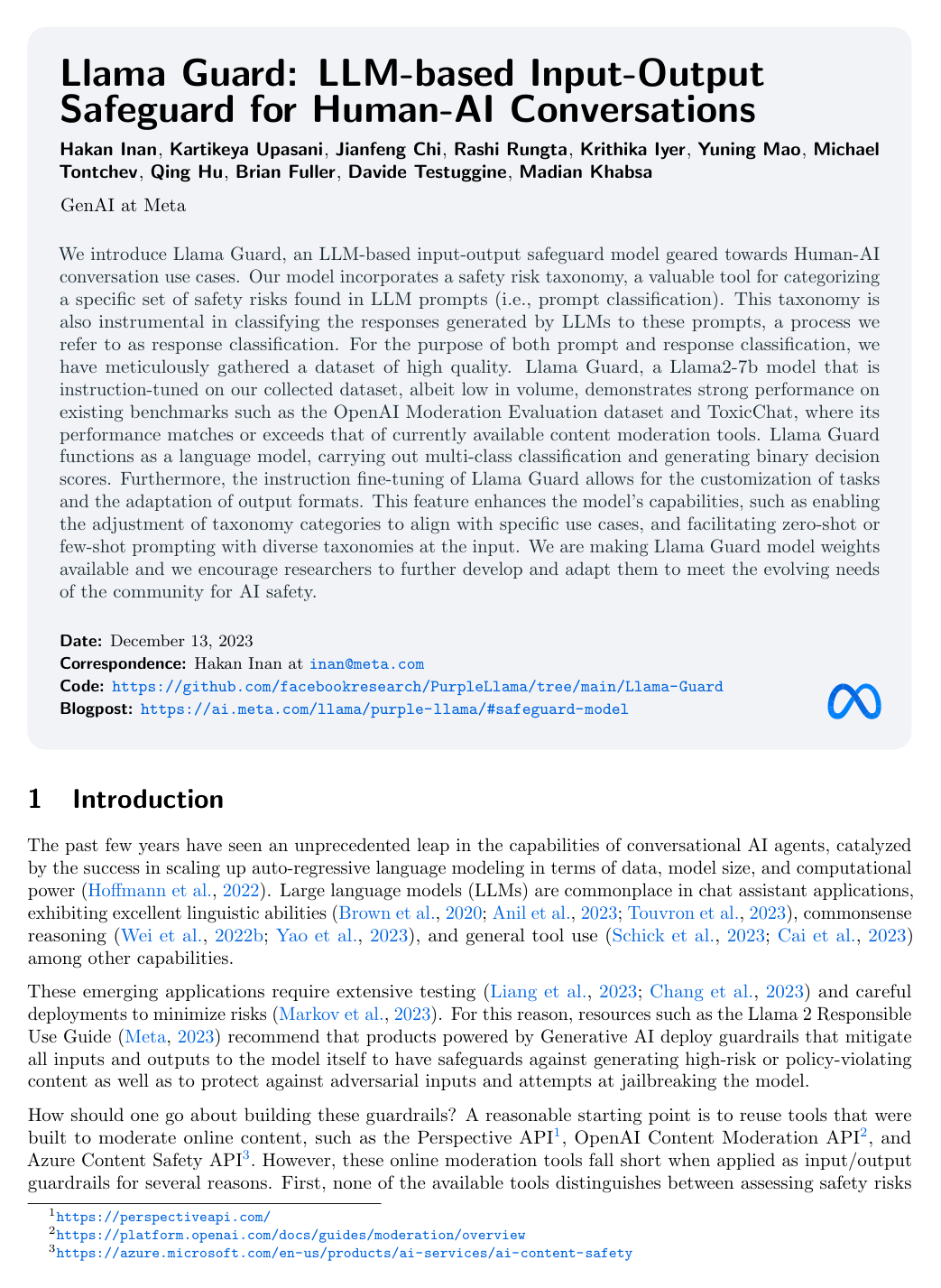
Llama Guard: LLM-based Input-Output Safeguard for Human-AI Conversations
Hakan Inan, Kartikeya Upasani, Jianfeng Chi, Rashi Rungta, Krithika Iyer, Yuning Mao, Michael Tontchev, Qing Hu, Brian Fuller, Davide Testuggine, Madian Khabsa
Why you should read this
Introduces Llama Guard, an open instruction-tuned model that classifies safety risks in both user prompts and model responses, matching commercial moderation baselines while enabling straightforward adaptation to custom safety taxonomies.
We introduce Llama Guard, an LLM-based input-output safeguard model geared towards Human-AI conversation use cases. Our model incorporates a safety risk taxonomy, a valuable tool for categorizing a specific set of safety risks found in LLM prompts (i.e., prompt classification). This taxonomy is also instrumental in classifying the responses generated by LLMs to these prompts, a process we refer to as response classification. For the purpose of both prompt and response classification, we have meticulously gathered a dataset of high quality. Llama Guard, a Llama2-7b model that is instruction-tuned on our collected dataset, albeit low in volume, demonstrates strong performance on existing benchmarks such as the OpenAI Moderation Evaluation dataset and ToxicChat, where its performance matches or exceeds that of currently available content moderation tools. Llama Guard functions as a language model, carrying out multi-class classification and generating binary decision scores. Furthermore, the instruction fine-tuning of Llama Guard allows for the customization of tasks and the adaptation of output formats. This feature enhances the model's capabilities, such as enabling the adjustment of taxonomy categories to align with specific use cases, and facilitating zero-shot or few-shot prompting with diverse taxonomies at the input. We are making Llama Guard model weights available and we encourage researchers to further develop and adapt them to meet the evolving needs of the community for AI safety.
Added
2026-09-25
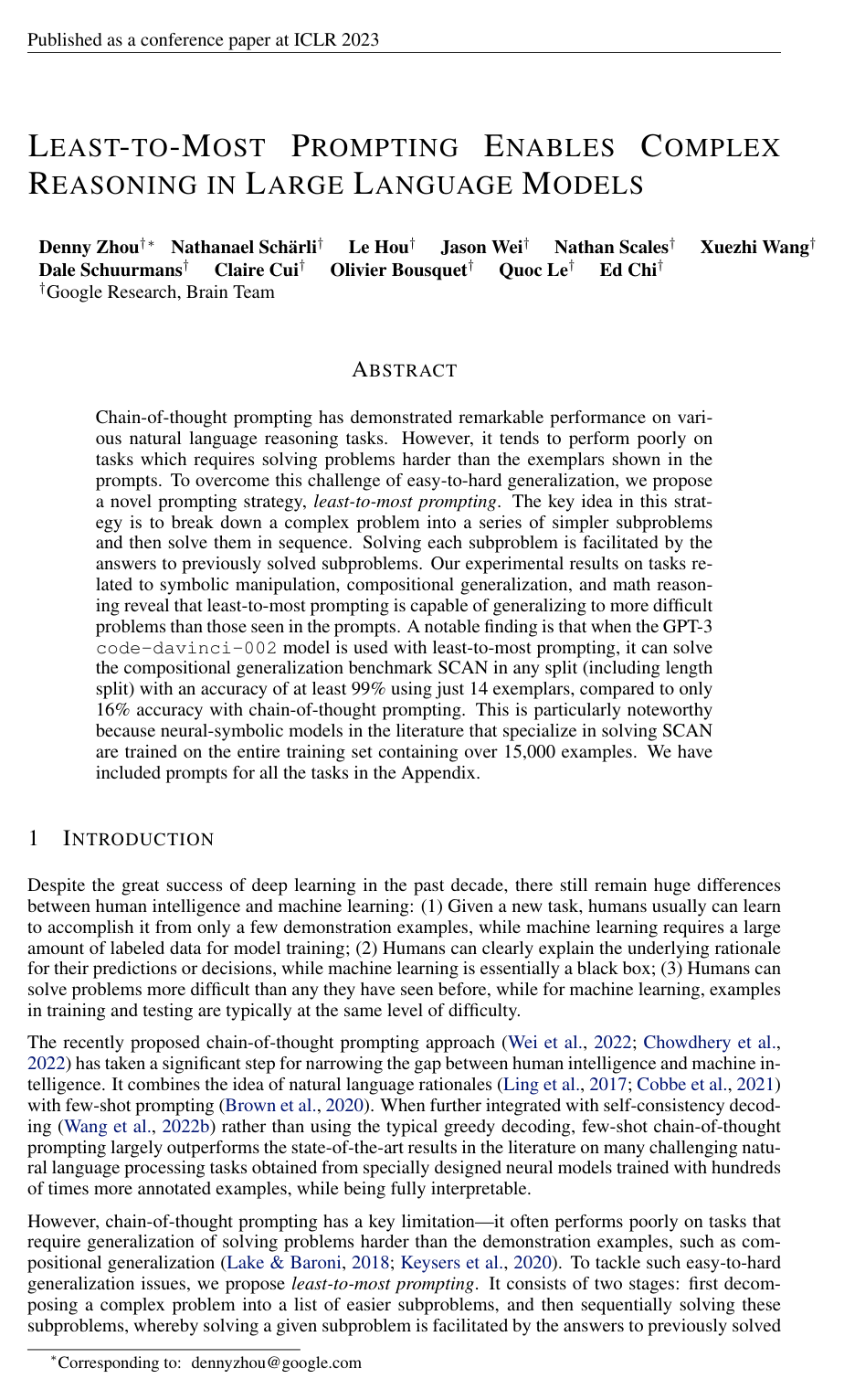
Least-to-Most Prompting Enables Complex Reasoning in Large Language Models
Denny Zhou, Nathanael Scharli, Le Hou, Jason Wei, Nathan Scales, Xuezhi Wang, Dale Schuurmans, Olivier Bousquet, Quoc Le, Ed H. Chi
Why you should read this
Introduces least-to-most prompting, a strategy that decomposes complex problems into sequential subproblems to enable large language models to generalize to harder tasks than those in prompt exemplars, boosting SCAN benchmark accuracy from 16% to 99% with only 14 examples.
Chain-of-thought prompting has demonstrated remarkable performance on various natural language reasoning tasks. However, it tends to perform poorly on tasks which requires solving problems harder than the exemplars shown in the prompts. To overcome this challenge of easy-to-hard generalization, we propose a novel prompting strategy, least-to-most prompting. The key idea in this strategy is to break down a complex problem into a series of simpler subproblems and then solve them in sequence. Solving each subproblem is facilitated by the answers to previously solved subproblems. Our experimental results on tasks related to symbolic manipulation, compositional generalization, and math reasoning reveal that least-to-most prompting is capable of generalizing to more difficult problems than those seen in the prompts. A notable finding is that when the GPT-3 code-davinci-002 model is used with least-to-most prompting, it can solve the compositional generalization benchmark SCAN in any split (including length split) with an accuracy of at least 99% using just 14 exemplars, compared to only 16% accuracy with chain-of-thought prompting. This is particularly noteworthy because neural-symbolic models in the literature that specialize in solving SCAN are trained on the entire training set containing over 15,000 examples. We have included prompts for all the tasks in the Appendix.
Added
2026-09-18