
keyword
feature matching
Feature matching is the process of identifying and pairing corresponding points or visual elements across two or more images depicting the same scene or object. In computer vision, it typically occurs after interest points or key visual regions have been detected and converted into mathematical descriptors that summarize local appearance and geometry. Matching algorithms evaluate the similarity between these descriptor vectors using distance metrics, graph-based optimization, or learned correspondence networks to establish valid pairs while rejecting outliers caused by noise, occlusions, or extreme viewpoint variations. Establishing these accurate correspondences serves as a foundational step in various spatial computing and image analysis tasks, including camera pose estimation, three-dimensional scene reconstruction, visual localization, image stitching, and image retrieval.
5 items
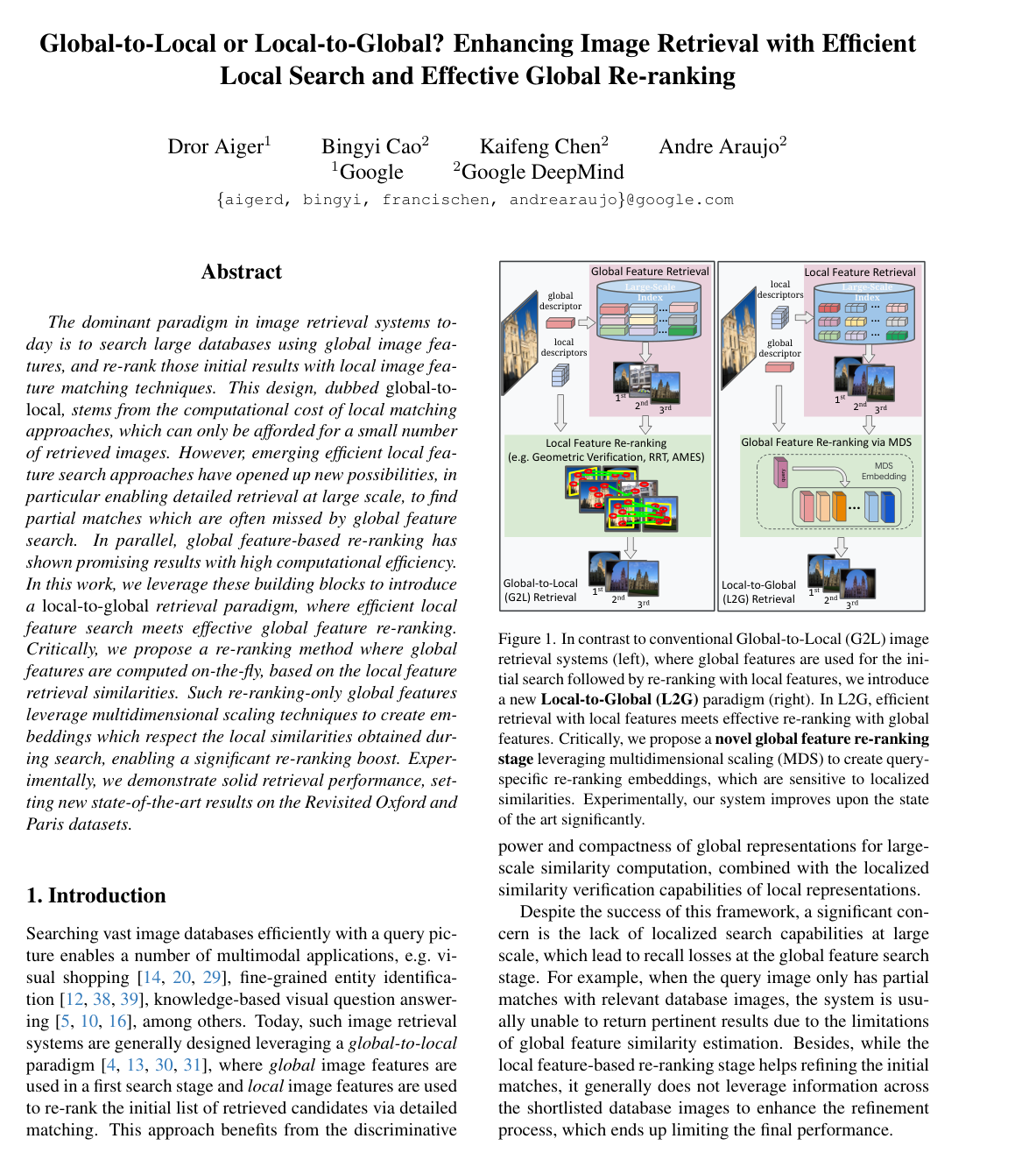
Global-to-Local or Local-to-Global? Enhancing Image Retrieval with Efficient Local Search and Effective Global Re-ranking
Dror Aiger, Bingyi Cao, Andre Araujo, Kaifeng Chen
Why you should read this
Inverts the standard image retrieval workflow by using scalable local feature search for initial candidate retrieval and multidimensional scaling to build query-time global embeddings for fast, highly accurate re-ranking on benchmark datasets.
The dominant paradigm in image retrieval systems today is to search large databases using global image features, and re-rank those initial results with local image feature matching techniques. This design, dubbed global-to-local, stems from the computational cost of local matching approaches, which can only be afforded for a small number of retrieved images. However, emerging efficient local feature search approaches have opened up new possibilities, in particular enabling detailed retrieval at large scale, to find partial matches which are often missed by global feature search. In parallel, global feature-based re-ranking has shown promising results with high computational efficiency. In this work, we leverage these building blocks to introduce a local-to-global retrieval paradigm, where efficient local feature search meets effective global feature re-ranking. Critically, we propose a re-ranking method where global features are computed on-the-fly, based on the local feature retrieval similarities. Such re-ranking-only global features leverage multidimensional scaling techniques to create embeddings which respect the local similarities obtained during search, enabling a significant re-ranking boost. Experimentally, we demonstrate solid retrieval performance, setting new state-of-the-art results on the Revisited Oxford and Paris datasets.
Added
2026-09-29
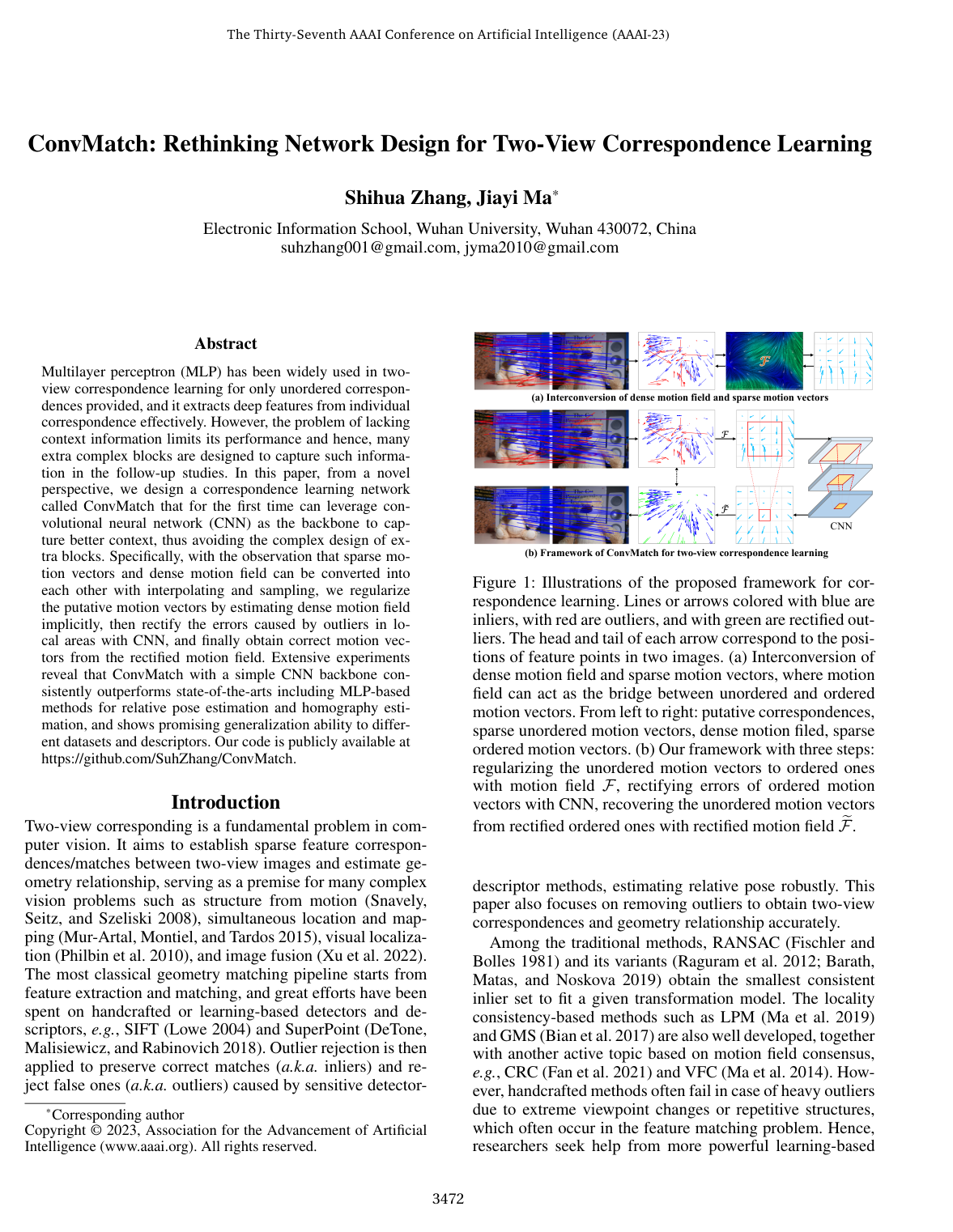
ConvMatch: Rethinking Network Design for Two-View Correspondence Learning
Shihua Zhang, Jiayi Ma
Why you should read this
Proposes ConvMatch, a framework that bridges unordered point correspondences with dense motion fields to enable CNN backbones to directly capture spatial context for outlier rejection in two-view geometry estimation.
Multilayer perceptron (MLP) has been widely used in two-view correspondence learning for only unordered correspondences provided, and it extracts deep features from individual correspondence effectively. However, the problem of lacking context information limits its performance and hence, many extra complex blocks are designed to capture such information in the follow-up studies. In this paper, from a novel perspective, we design a correspondence learning network called ConvMatch that for the first time can leverage convolutional neural network (CNN) as the backbone to capture better context, thus avoiding the complex design of extra blocks. Specifically, with the observation that sparse motion vectors and dense motion field can be converted into each other with interpolating and sampling, we regularize the putative motion vectors by estimating dense motion field implicitly, then rectify the errors caused by outliers in local areas with CNN, and finally obtain correct motion vectors from the rectified motion field. Extensive experiments reveal that ConvMatch with a simple CNN backbone consistently outperforms state-of-the-arts including MLP-based methods for relative pose estimation and homography estimation, and shows promising generalization ability to different datasets and descriptors. Our code is publicly available at https://github.com/SuhZhang/ConvMatch.
Added
2026-09-26
Building Rome in a day
Sameer Agarwal, Noah Snavely, Ian Simon, Steven M. Seitz, Richard Szeliski
Why you should read this
Demonstrates a highly parallel structure-from-motion pipeline that reconstructs city-scale 3D models from 150,000 Internet photos in under a day.
We present a system that can match and reconstruct 3D scenes from extremely large collections of photographs such as those found by searching for a given city (e.g., Rome) on Internet photo sharing sites. Our system uses a collection of novel parallel distributed matching and reconstruction algorithms, designed to maximize parallelism at each stage in the pipeline and minimize serialization bottlenecks. It is designed to scale gracefully with both the size of the problem and the amount of available computation. We have experimented with a variety of alternative algorithms at each stage of the pipeline and report on which ones work best in a parallel computing environment. Our experimental results demonstrate that it is now possible to reconstruct cities consisting of 150K images in less than a day on a cluster with 500 compute cores.
Added
2026-09-14
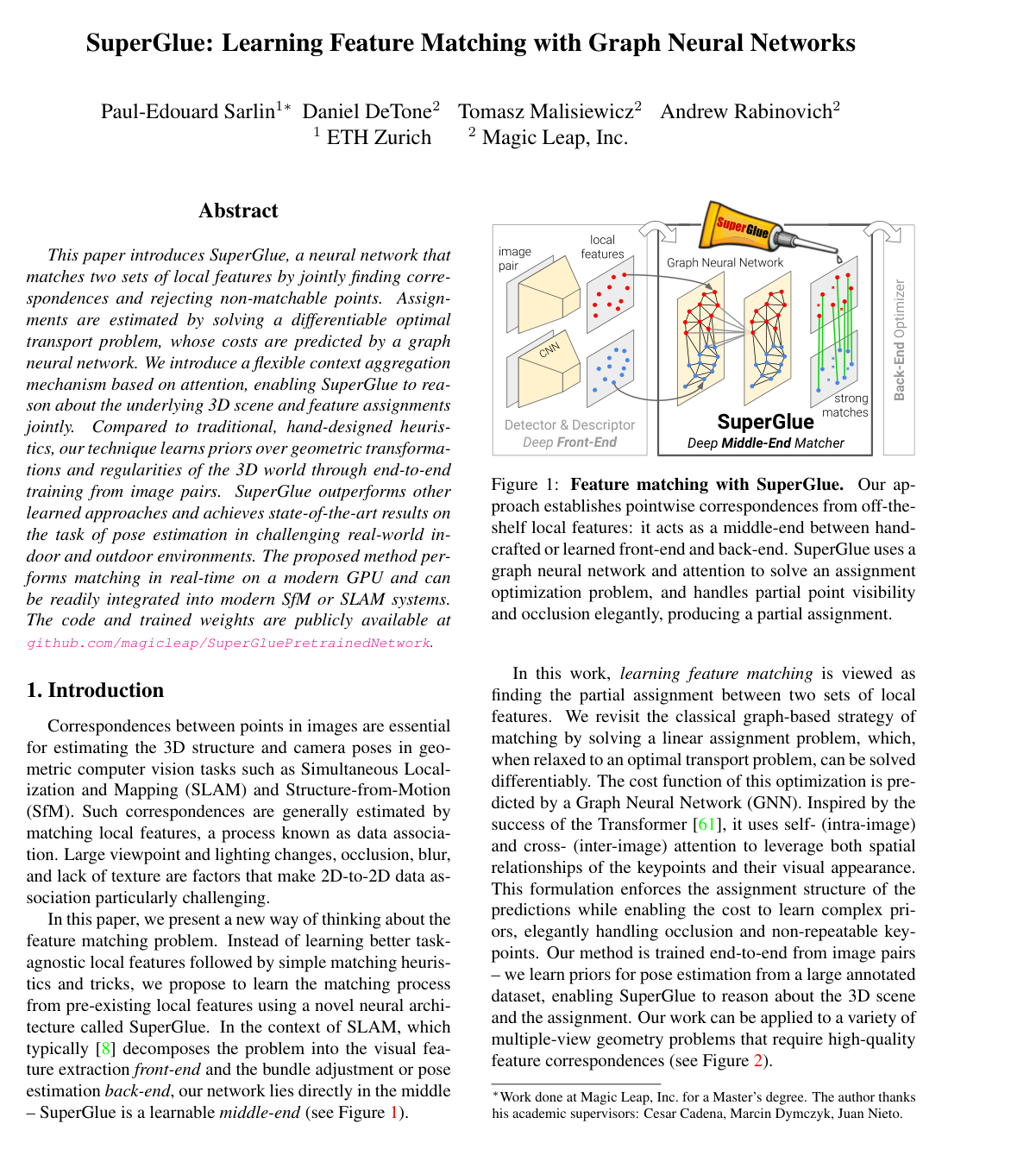
SuperGlue: Learning Feature Matching With Graph Neural Networks
Paul-Edouard Sarlin, Daniel DeTone, Tomasz Malisiewicz, Andrew Rabinovich
Why you should read this
Introduces SuperGlue, an attention-based graph neural network that solves differentiable optimal transport to match local image features and reject non-matchable points in real time for 3D pose estimation.
This paper introduces SuperGlue, a neural network that matches two sets of local features by jointly finding correspondences and rejecting non-matchable points. Assignments are estimated by solving a differentiable optimal transport problem, whose costs are predicted by a graph neural network. We introduce a flexible context aggregation mechanism based on attention, enabling SuperGlue to reason about the underlying 3D scene and feature assignments jointly. Compared to traditional, hand-designed heuristics, our technique learns priors over geometric transformations and regularities of the 3D world through end-to-end training from image pairs. SuperGlue outperforms other learned approaches and achieves state-of-the-art results on the task of pose estimation in challenging real-world indoor and outdoor environments. The proposed method performs matching in real-time on a modern GPU and can be readily integrated into modern SfM or SLAM systems. The code and trained weights are publicly available at this https URL.
Added
2026-09-14
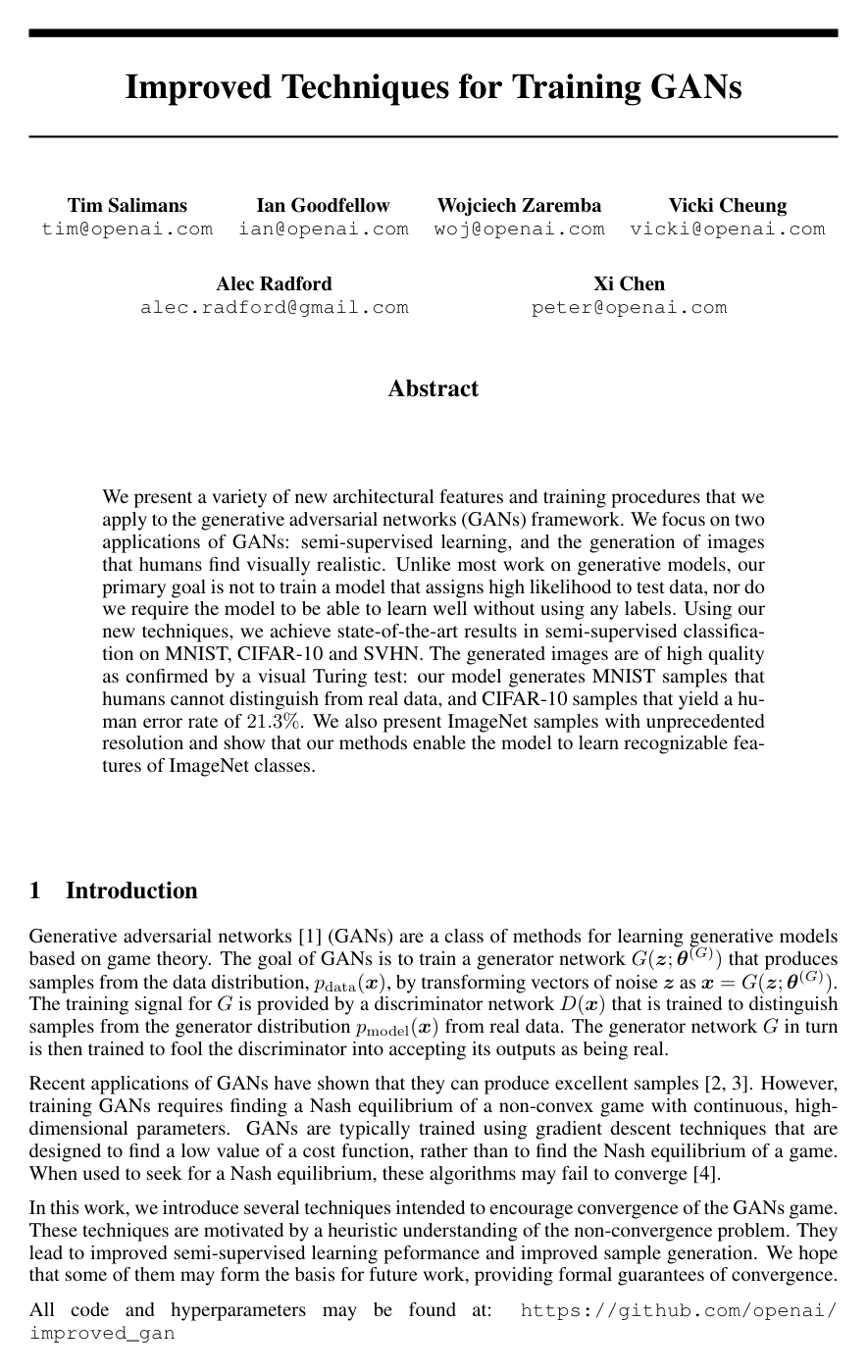
Improved Techniques for Training GANs
Tim Salimans, Ian Goodfellow, Wojciech Zaremba, Vicki Cheung, Alec Radford, Xi Chen
Why you should read this
Introduces the Inception Score and heuristic stabilization techniques like feature matching to address non-convergence.
We present a variety of new architectural features and training procedures that we apply to the generative adversarial networks (GANs) framework. We focus on two applications of GANs: semi-supervised learning, and the generation of images that humans find visually realistic. Unlike most work on generative models, our primary goal is not to train a model that assigns high likelihood to test data, nor do we require the model to be able to learn well without using any labels. Using our new techniques, we achieve state-of-the-art results in semi-supervised classification on MNIST, CIFAR-10 and SVHN. The generated images are of high quality as confirmed by a visual Turing test: our model generates MNIST samples that humans cannot distinguish from real data, and CIFAR-10 samples that yield a human error rate of 21.3%. We also present ImageNet samples with unprecedented resolution and show that our methods enable the model to learn recognizable features of ImageNet classes.
Added
2026-02-21