Built independently by an author, for readers. Read the story and support ChapterPal

keyword

Feature Fusion Attention Network

A Feature Fusion Attention Network is a deep learning architecture designed for image restoration tasks, such as single-image dehazing, by adaptively integrating multi-scale visual features through attention mechanisms. The network typically employs attention modules that combine channel attention with pixel-level spatial attention, allowing it to dynamically assign greater importance to highly informative feature channels and unevenly degraded image regions. By combining these attention mechanisms with local residual learning structures, the architecture enables less critical or low-frequency information to bypass deep processing layers while adaptively weighting and merging shallow and deep representations. This selective fusion of features across different levels enhances the network capacity to effectively remove visual artifacts and reconstruct clean, high-fidelity images.

1 item

FFA-Net: Feature Fusion Attention Network for Single Image Dehazing

FFA-Net: Feature Fusion Attention Network for Single Image Dehazing

Xu Qin, Zhiling Wang, Yuanchao Bai, Xiaodong Xie, Huizhu Jia

OrganizationsBeihang UniversityPeking University

Why you should read this

Proposes FFA-Net, an end-to-end dehazing network that integrates channel and pixel attention with multi-level feature fusion, raising benchmark indoor PSNR from 30.23 dB to 36.39 dB.

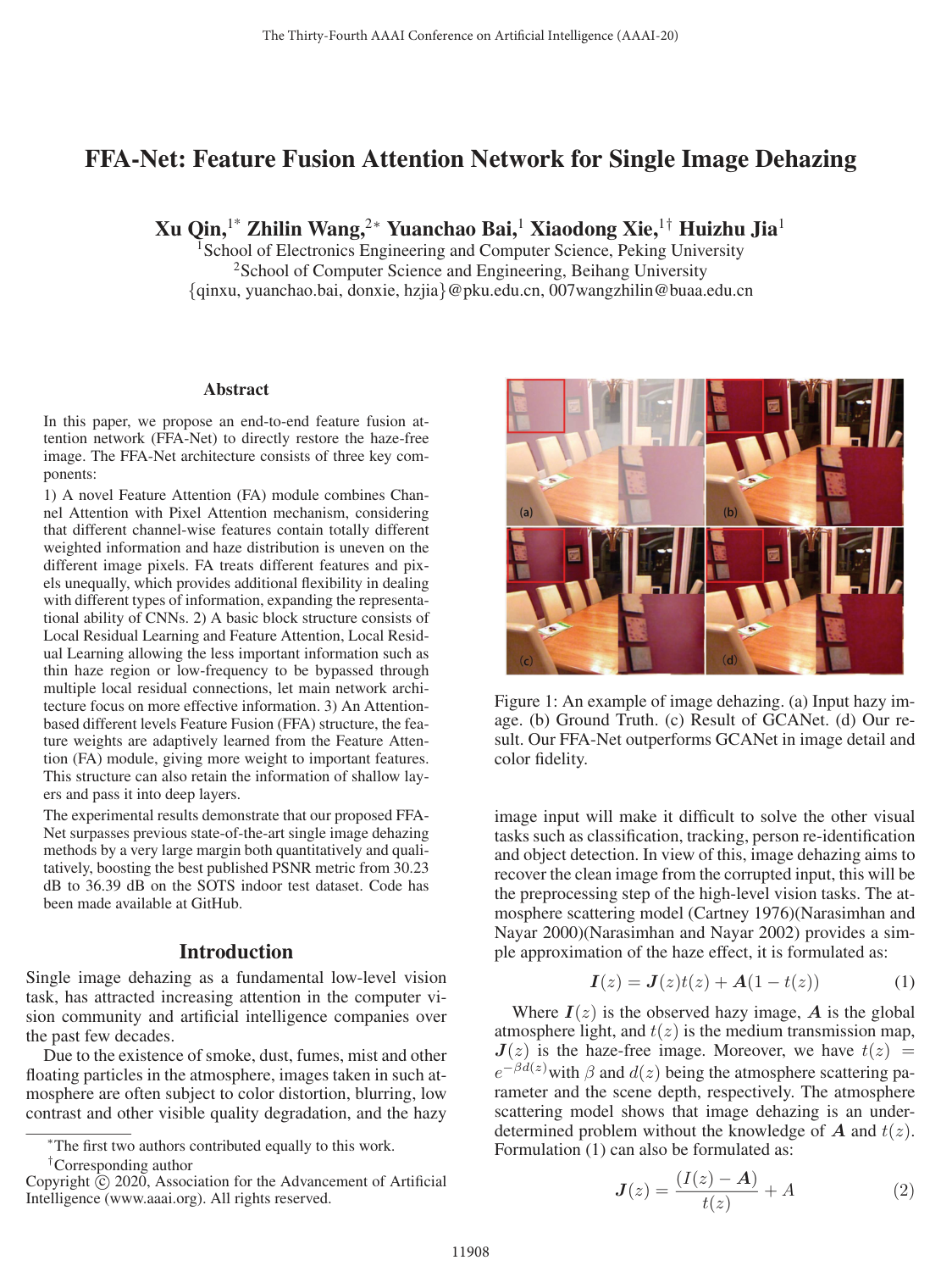
In this paper, we propose an end-to-end feature fusion at-tention network (FFA-Net) to directly restore the haze-free image. The FFA-Net architecture consists of three key components: 1) A novel Feature Attention (FA) module combines Channel Attention with Pixel Attention mechanism, considering that different channel-wise features contain totally different weighted information and haze distribution is uneven on the different image pixels. FA treats different features and pixels unequally, which provides additional flexibility in dealing with different types of information, expanding the representational ability of CNNs. 2) A basic block structure consists of Local Residual Learning and Feature Attention, Local Residual Learning allowing the less important information such as thin haze region or low-frequency to be bypassed through multiple local residual connections, let main network architecture focus on more effective information. 3) An Attention-based different levels Feature Fusion (FFA) structure, the feature weights are adaptively learned from the Feature Attention (FA) module, giving more weight to important features. This structure can also retain the information of shallow layers and pass it into deep layers. The experimental results demonstrate that our proposed FFA-Net surpasses previous state-of-the-art single image dehazing methods by a very large margin both quantitatively and qualitatively, boosting the best published PSNR metric from 30.23db to 36.39db on the SOTS indoor test dataset. Code has been made available at GitHub.

Added

2026-09-17