
keyword
fastText embeddings
FastText embeddings are vector representations of words learned by a model that represents each word using character n-grams as well as the whole word. Because words with shared character sequences contribute related information, fastText can produce representations for rare or unseen words from their subword units.
2 items
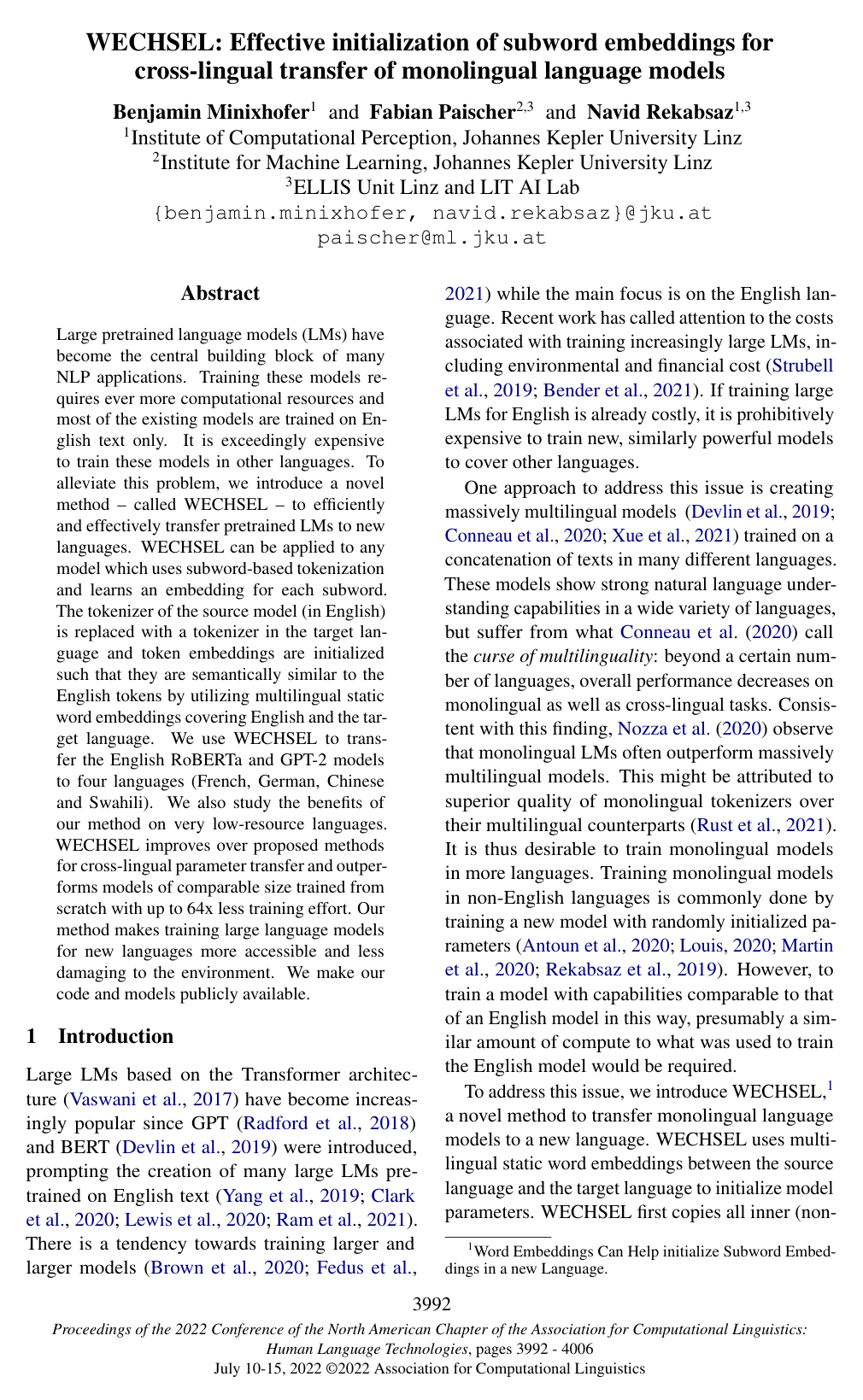
WECHSEL: Effective initialization of subword embeddings for cross-lingual transfer of monolingual language models
Benjamin Minixhofer, Fabian Paischer, Navid Rekabsaz
Why you should read this
Presents WECHSEL, an efficient method that transfers English language models to new languages by initializing target subword embeddings via multilingual static word vectors, outperforming models trained from scratch while reducing training compute by up to 64x.
Large pretrained language models (LMs) have become the central building block of many NLP applications. Training these models requires ever more computational resources and most of the existing models are trained on English text only. It is exceedingly expensive to train these models in other languages. To alleviate this problem, we introduce a novel method – called WECHSEL – to efficiently and effectively transfer pretrained LMs to new languages. WECHSEL can be applied to any model which uses subword-based tokenization and learns an embedding for each subword. The tokenizer of the source model (in English) is replaced with a tokenizer in the target language and token embeddings are initialized such that they are semantically similar to the English tokens by utilizing multilingual static word embeddings covering English and the target language. We use WECHSEL to transfer the English RoBERTa and GPT-2 models to four languages (French, German, Chinese and Swahili). We also study the benefits of our method on very low-resource languages. WECHSEL improves over proposed methods for cross-lingual parameter transfer and outperforms models of comparable size trained from scratch with up to 64x less training effort. Our method makes training large language models for new languages more accessible and less damaging to the environment. We make our code and models publicly available.
Added
2026-10-01
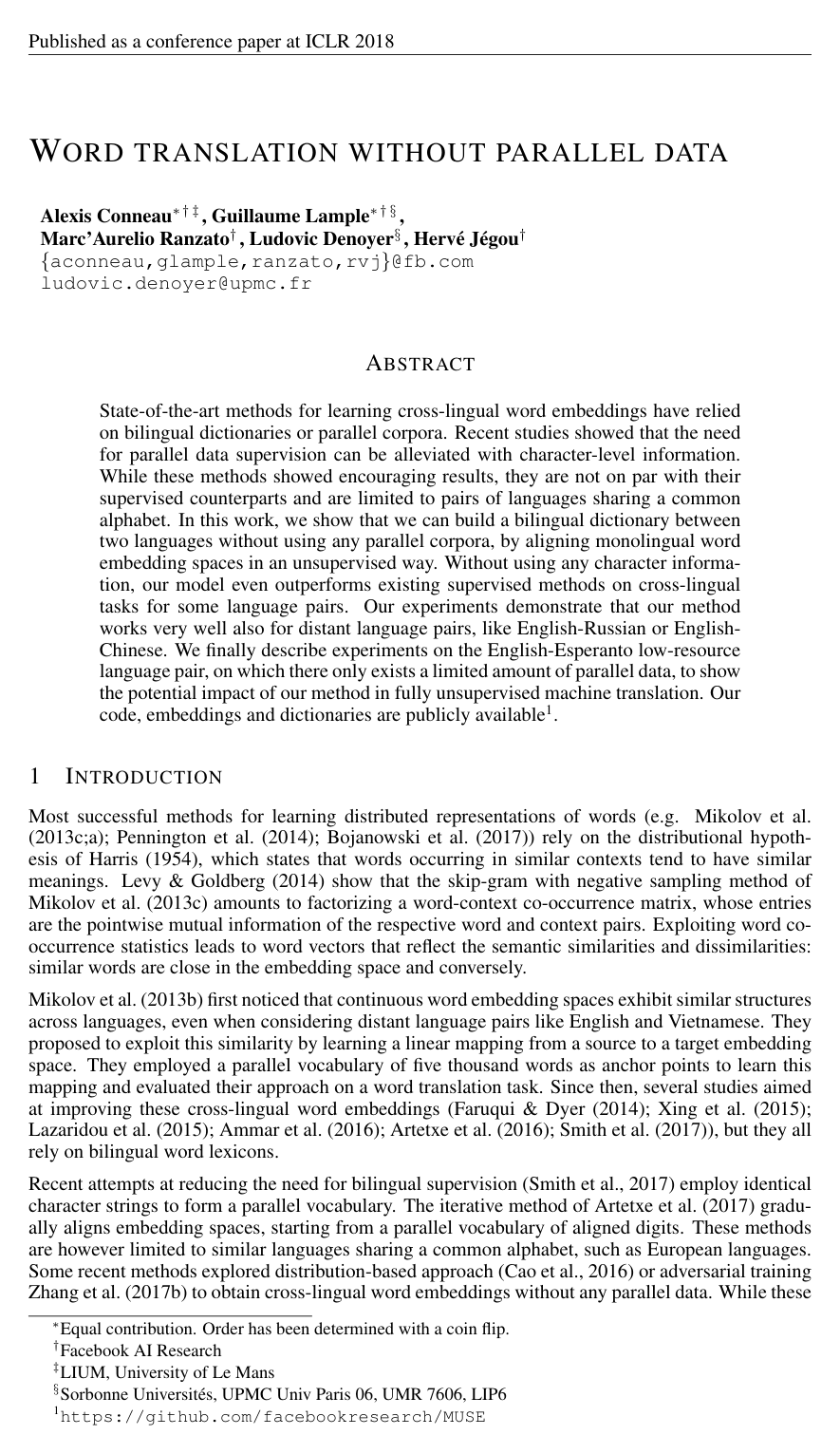
Word Translation Without Parallel Data
Alexis Conneau, Guillaume Lample, Marc'Aurelio Ranzato, Ludovic Denoyer, Hervé Jégou
Why you should read this
Presents an unsupervised method for aligning monolingual word embeddings that builds accurate bilingual dictionaries without parallel data or shared alphabets, matching or outperforming supervised approaches across distant language pairs.
State-of-the-art methods for learning cross-lingual word embeddings have relied on bilingual dictionaries or parallel corpora. Recent studies showed that the need for parallel data supervision can be alleviated with character-level information. While these methods showed encouraging results, they are not on par with their supervised counterparts and are limited to pairs of languages sharing a common alphabet. In this work, we show that we can build a bilingual dictionary between two languages without using any parallel corpora, by aligning monolingual word embedding spaces in an unsupervised way. Without using any character information, our model even outperforms existing supervised methods on cross-lingual tasks for some language pairs. Our experiments demonstrate that our method works very well also for distant language pairs, like English-Russian or English-Chinese. We finally describe experiments on the English-Esperanto low-resource language pair, on which there only exists a limited amount of parallel data, to show the potential impact of our method in fully unsupervised machine translation. Our code, embeddings and dictionaries are publicly available.
Added
2026-09-19