
keyword
false presuppositions
A false presupposition is an implicit or explicit background assumption embedded within an utterance, question, or statement that is factually incorrect or whose truth conditions fail to hold. In linguistics, philosophy of language, and computational linguistics, a presupposition represents information taken for granted as true rather than asserted directly. When an inquiry contains a false presupposition, any direct answer can inadvertently validate an untruthful premise, which requires an interlocutor or an information processing system to detect the flawed underlying premise and explicitly reject or correct it rather than attempting to generate a standard response.
2 items
CREPE: Open-Domain Question Answering with False Presuppositions
Xinyan Yu, Sewon Min, Luke Zettlemoyer, Hannaneh Hajishirzi
Why you should read this
Introduces CREPE, a benchmark derived from real-world online forum inquiries, to evaluate and improve how open-domain question answering systems detect flawed premises in user questions and generate factual corrections.
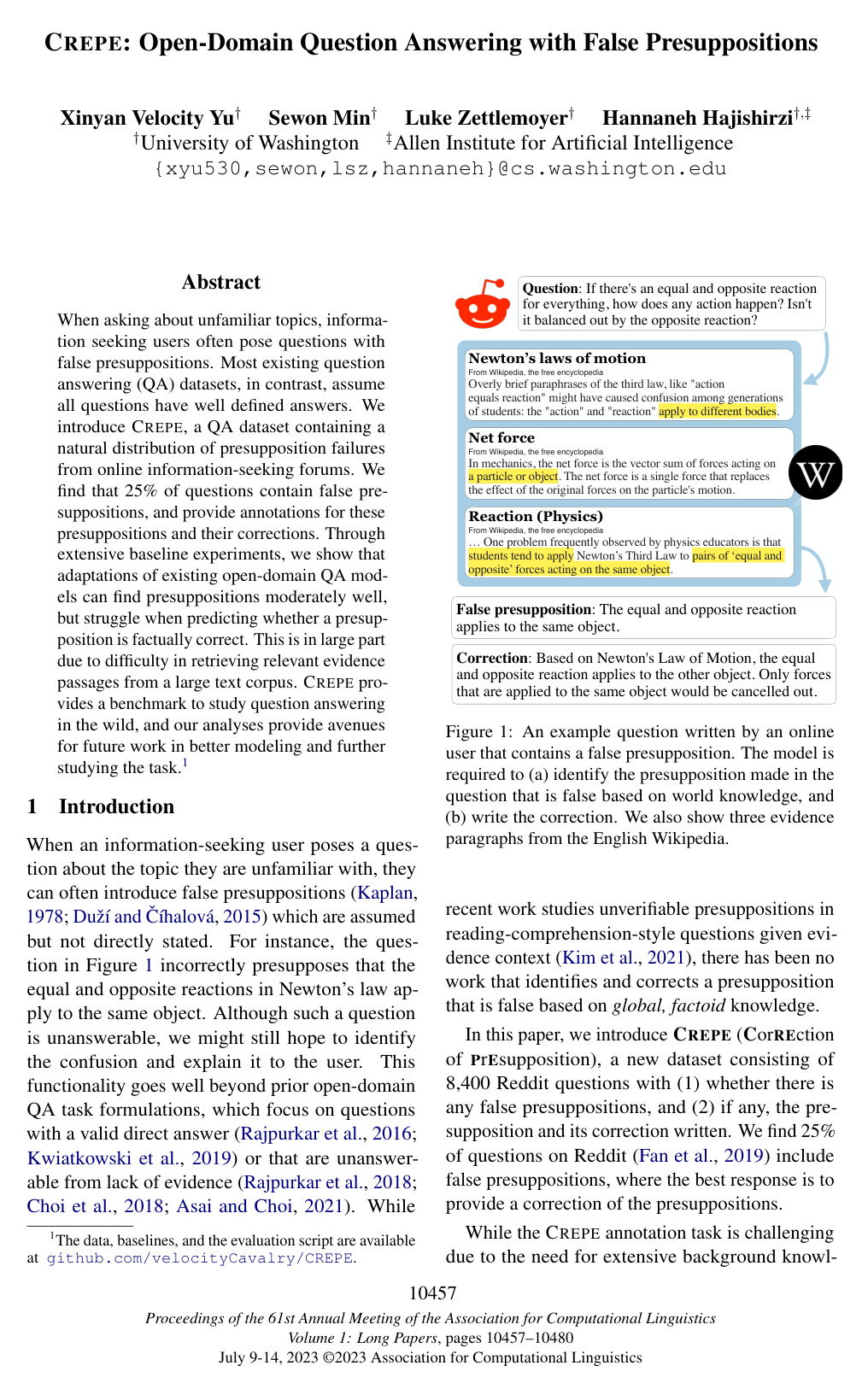
While there has been significant progress towards open-domain (document-based) question answering (QA), current QA systems cannot model false presuppositions within questions---questions containing unwarranted assumptions whose truth conditions do not hold within their context. For example, given "What is the name of Taylor Swift's sister?", while humans recognize its problematic nature, most QA models proceed under false premises by providing negative responses rather than acknowledging them explicitly. In order to build QA systems which handle such cases robustly, we introduce CREPE, a large-scale openly licensed collection of over 15k human-written free-form questions based upon Wikipedia entities and passages where one third of these have answers in their annotations indicating they contain false presuppositions. We provide extensive empirical analyses showing that state-of-the-art retrieval-augmented LM approaches fail dramatically when compared against trivial baselines trained specially for handling unmasked contexts. Through our investigation into components responsible for detecting improper presuppositional elements within input texts along with answer generation strategies once identified,
Added
2026-10-02
How Language Model Hallucinations Can Snowball
Muru Zhang, Ofir Press, William Merrill, Alisa Liu, Noah A. Smith
Why you should read this
Reveals that large language models frequently invent false justifications to maintain consistency with their own earlier mistakes, generating secondary errors that they are otherwise capable of correctly identifying as false in isolation.
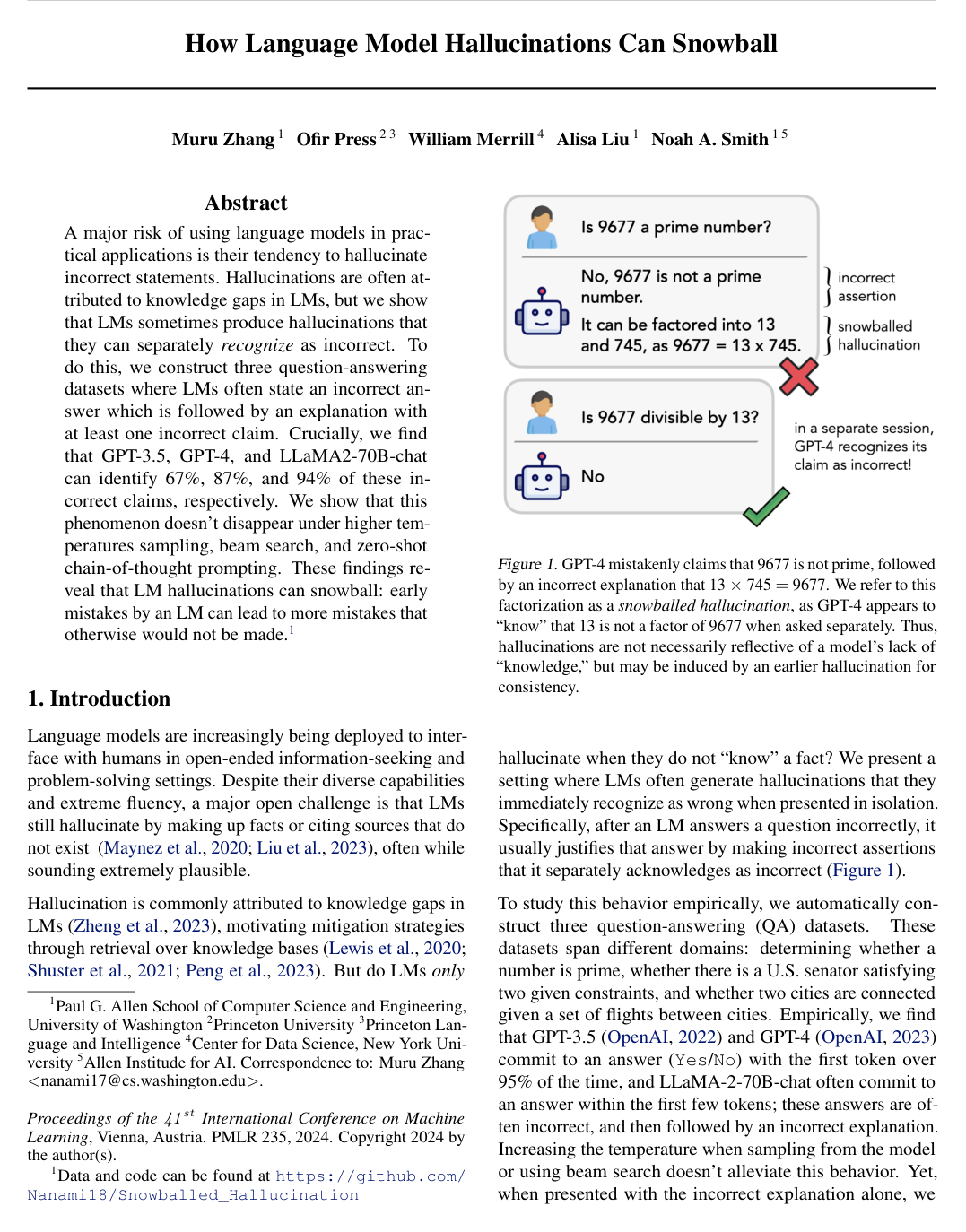
A major risk of using language models in practical applications is their tendency to hallucinate incorrect statements. Hallucinations are often attributed to knowledge gaps in LMs, but we show that LMs sometimes produce hallucinations that they can separately recognize as incorrect. To do this, we construct three question-answering datasets where LMs often state an incorrect answer which is followed by an explanation with at least one incorrect claim. Crucially, we find that GPT-3.5, GPT-4, and LLaMA2-70B-chat can identify 67%, 87%, and 94% of these incorrect claims, respectively. We show that this phenomenon doesn’t disappear under higher temperatures sampling, beam search, and zero-shot chain-of-thought prompting. These findings reveal that LM hallucinations can snowball: early mistakes by an LM can lead to more mistakes that otherwise would not be made.
Added
2026-09-28