
keyword
fair representations
Fair representations are data representations designed to support useful predictions while reducing information about protected characteristics, such as race or gender, that could contribute to discriminatory outcomes. They aim to preserve relevant information about the task while enabling similar individuals to be treated similarly and reducing unfair disparities between groups.
5 items
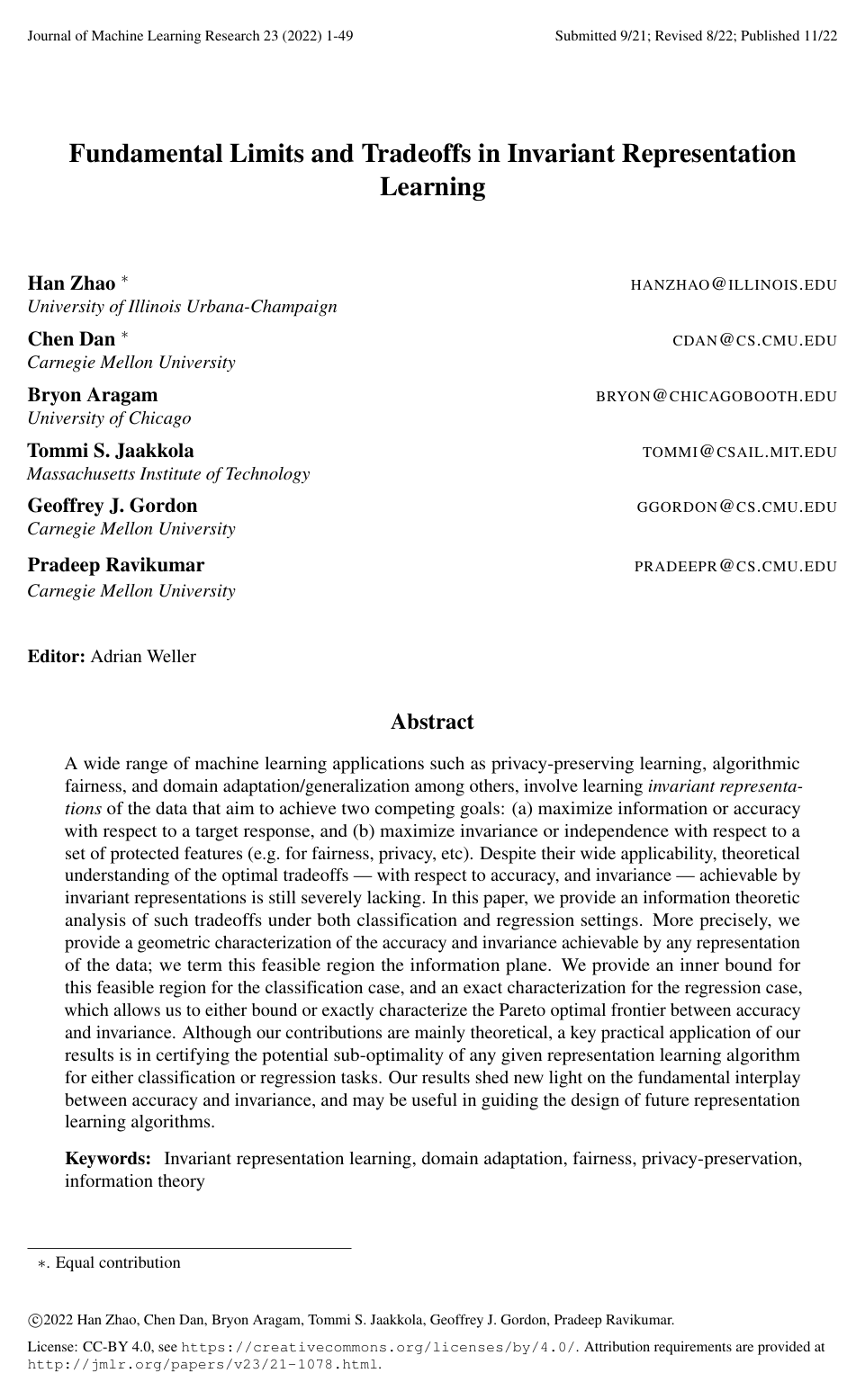
Fundamental Limits and Tradeoffs in Invariant Representation Learning
Han Zhao, Chen Dan, Bryon Aragam, Tommi S. Jaakkola, Geoffrey J. Gordon, Pradeep Ravikumar
Why you should read this
Establishes an information-theoretic framework that bounds the achievable tradeoffs between predictive accuracy and feature invariance across classification and regression tasks, providing a method to certify the suboptimality of representation learning algorithms.
A wide range of machine learning applications such as privacy-preserving learning, algorithmic fairness, and domain adaptation/generalization among others, involve learning invariant representations of the data that aim to achieve two competing goals: (a) maximize information or accuracy with respect to a target response, and (b) maximize invariance or independence with respect to a set of protected features (e.g. for fairness, privacy, etc). Despite their wide applicability, theoretical understanding of the optimal tradeoffs — with respect to accuracy, and invariance — achievable by invariant representations is still severely lacking. In this paper, we provide an information theoretic analysis of such tradeoffs under both classification and regression settings. More precisely, we provide a geometric characterization of the accuracy and invariance achievable by any representation of the data; we term this feasible region the information plane. We provide an inner bound for this feasible region for the classification case, and an exact characterization for the regression case, which allows us to either bound or exactly characterize the Pareto optimal frontier between accuracy and invariance. Although our contributions are mainly theoretical, a key practical application of our results is in certifying the potential sub-optimality of any given representation learning algorithm for either classification or regression tasks. Our results shed new light on the fundamental interplay between accuracy and invariance, and may be useful in guiding the design of future representation learning algorithms.
Added
2026-10-03
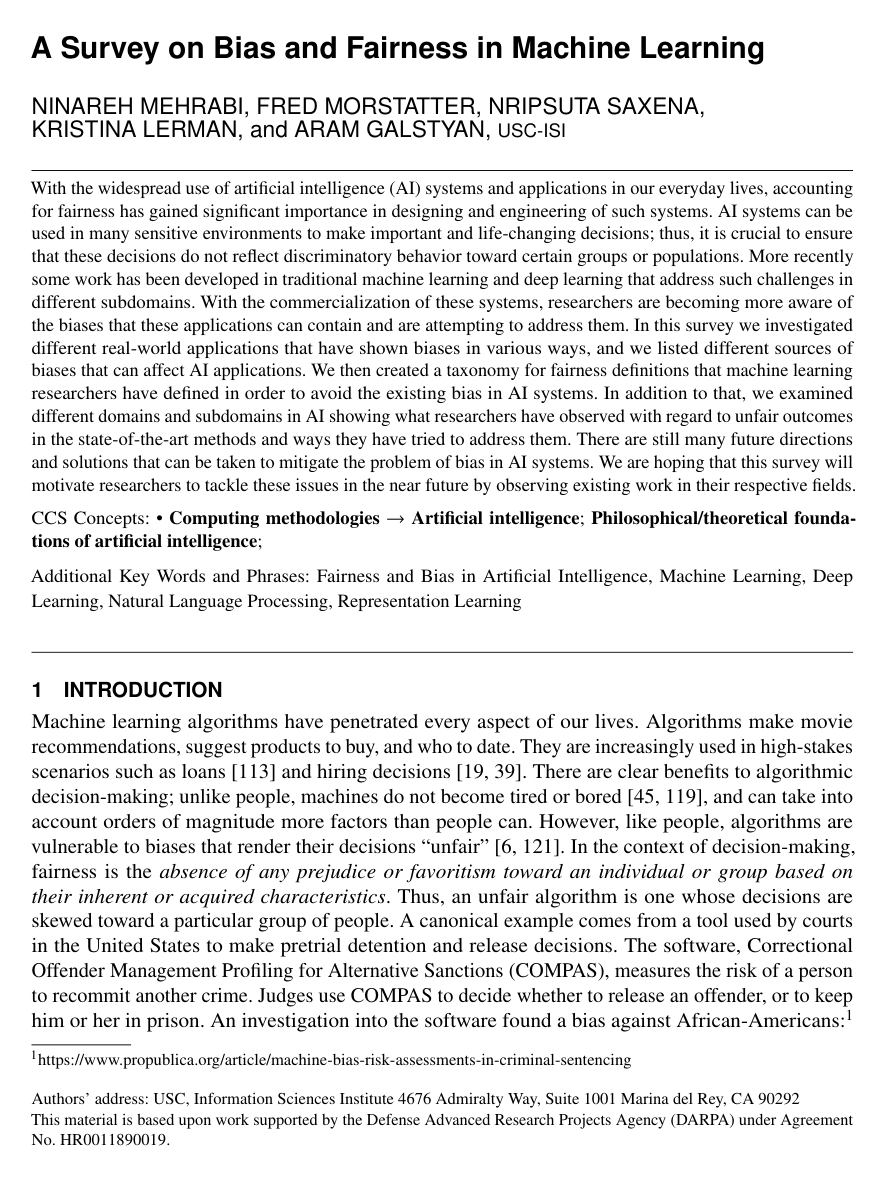
A Survey on Bias and Fairness in Machine Learning
Ninareh Mehrabi, Fred Morstatter, Nripsuta Saxena, Kristina Lerman, Aram Galstyan
Why you should read this
Categorizes the sources of bias throughout the machine learning pipeline and establishes a structured taxonomy of mathematical fairness definitions and mitigation strategies across real-world artificial intelligence applications.
With the widespread use of AI systems and applications in our everyday lives, it is important to take fairness issues into consideration while designing and engineering these types of systems. Such systems can be used in many sensitive environments to make important and life-changing decisions; thus, it is crucial to ensure that the decisions do not reflect discriminatory behavior toward certain groups or populations. We have recently seen work in machine learning, natural language processing, and deep learning that addresses such challenges in different subdomains. With the commercialization of these systems, researchers are becoming aware of the biases that these applications can contain and have attempted to address them. In this survey we investigated different real-world applications that have shown biases in various ways, and we listed different sources of biases that can affect AI applications. We then created a taxonomy for fairness definitions that machine learning researchers have defined in order to avoid the existing bias in AI systems. In addition to that, we examined different domains and subdomains in AI showing what researchers have observed with regard to unfair outcomes in the state-of-the-art methods and how they have tried to address them. There are still many future directions and solutions that can be taken to mitigate the problem of bias in AI systems. We are hoping that this survey will motivate researchers to tackle these issues in the near future by observing existing work in their respective fields.
Added
2026-09-16
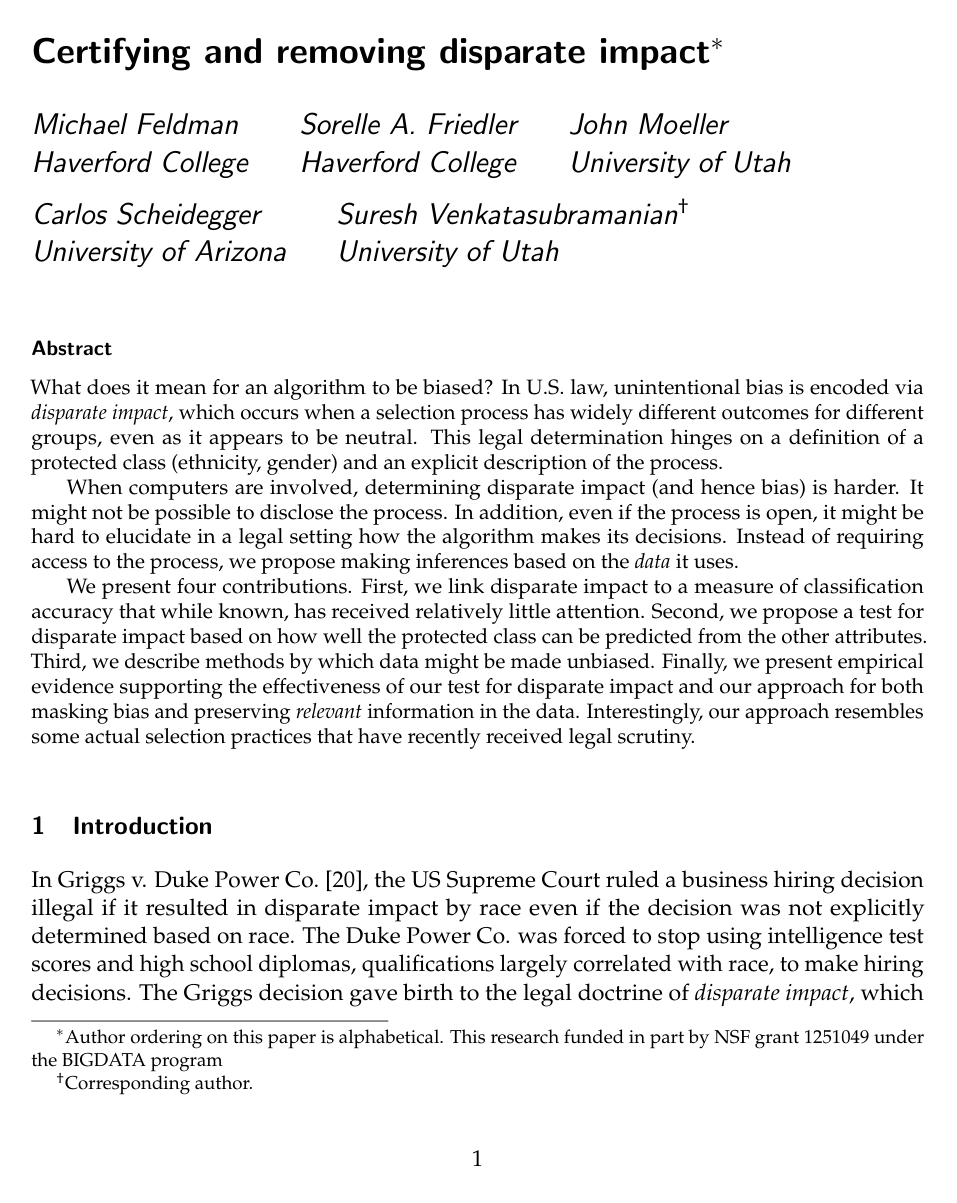
Certifying and Removing Disparate Impact
Michael Feldman, Sorelle Friedler, John Moeller, Carlos Scheidegger, Suresh Venkatasubramanian
Why you should read this
Develops a mathematical framework linking legal disparate impact to machine learning, offering practical techniques to detect discriminatory information leakage and repair training datasets while preserving predictive utility.
What does it mean for an algorithm to be biased? In U.S. law, unintentional bias is encoded via disparate impact, which occurs when a selection process has widely different outcomes for different groups, even as it appears to be neutral. This legal determination hinges on a definition of a protected class (ethnicity, gender, religious practice) and an explicit description of the process. When the process is implemented using computers, determining disparate impact (and hence bias) is harder. It might not be possible to disclose the process. In addition, even if the process is open, it might be hard to elucidate in a legal setting how the algorithm makes its decisions. Instead of requiring access to the algorithm, we propose making inferences based on the data the algorithm uses. We make four contributions to this problem. First, we link the legal notion of disparate impact to a measure of classification accuracy that while known, has received relatively little attention. Second, we propose a test for disparate impact based on analyzing the information leakage of the protected class from the other data attributes. Third, we describe methods by which data might be made unbiased. Finally, we present empirical evidence supporting the effectiveness of our test for disparate impact and our approach for both masking bias and preserving relevant information in the data. Interestingly, our approach resembles some actual selection practices that have recently received legal scrutiny.
Added
2026-09-15
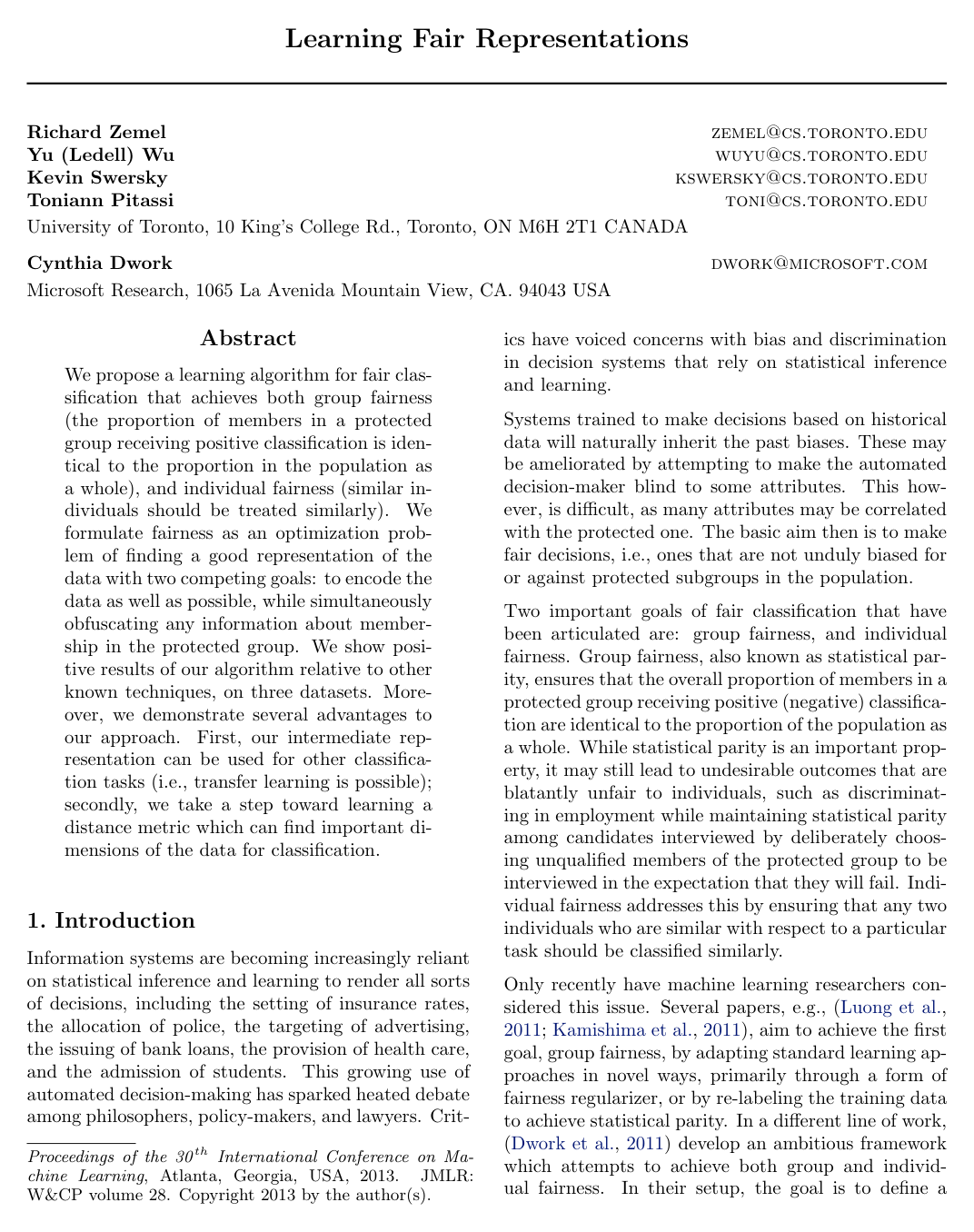
Learning Fair Representations
Richard Zemel, Yu (Ledell) Wu, Kevin Swersky, Toniann Pitassi, Cynthia Dwork
Why you should read this
Introduces a novel optimization framework to learn intermediate data representations that satisfy both group and individual fairness constraints while maintaining classification accuracy.
We propose a learning algorithm for fair classification that achieves both group fairness (the proportion of members in a protected group receiving positive classification is identical to the proportion in the population as a whole), and individual fairness (similar individuals should be treated similarly). We formulate fairness as an optimization problem of finding a good representation of the data with two competing goals: to encode the data as well as possible, while simultaneously obfuscating any information about membership in the protected group.
Added
2026-06-06
License
Published with permission
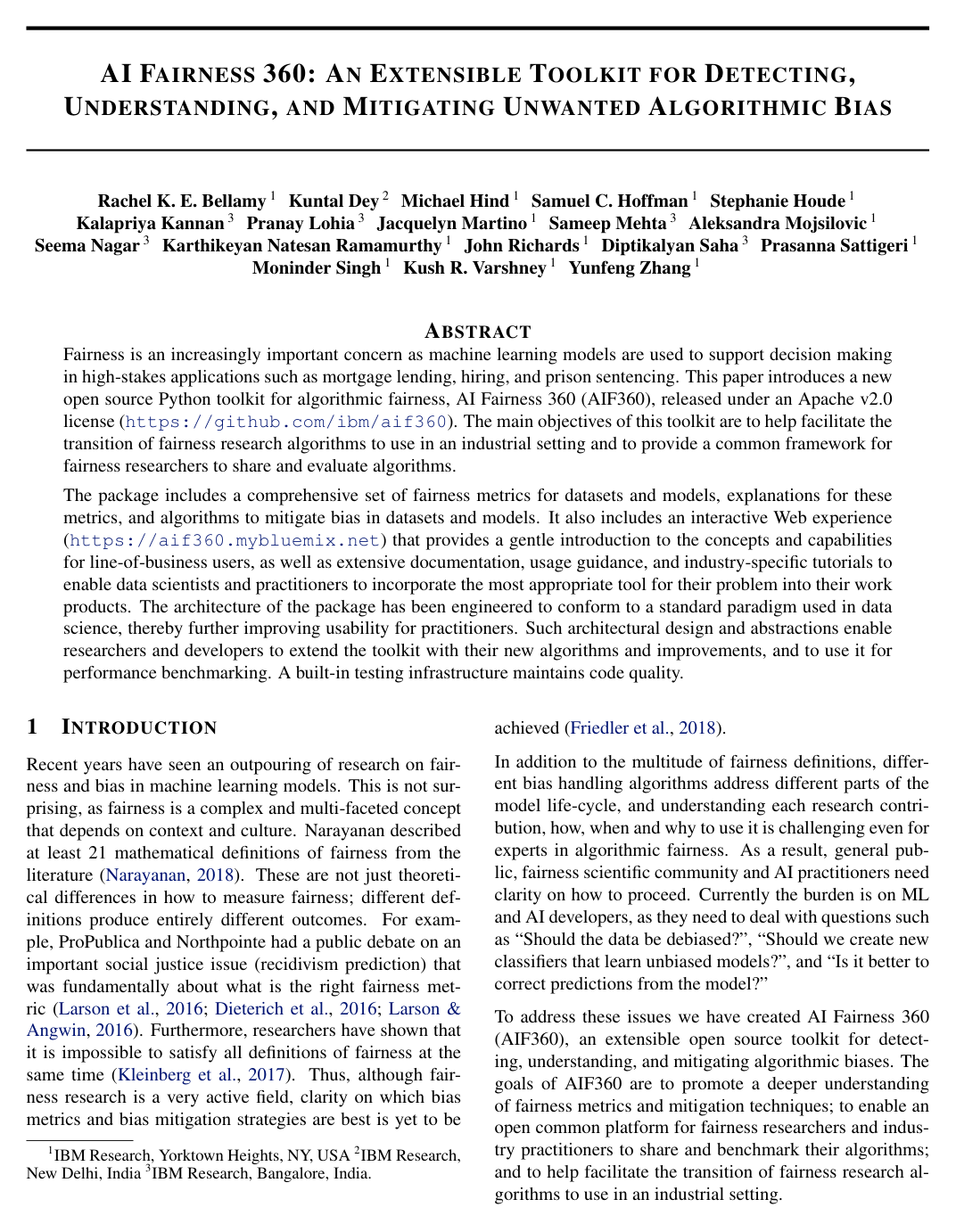
AI Fairness 360: An extensible toolkit for detecting and mitigating algorithmic bias
Rachel Bellamy, Kuntal Dey, Michael Hind, Samuel C. Hoffman, Stephanie Houde, Kalapriya Kannan, Pranay Lohia, Jacquelyn Martino, Sameep Mehta, Aleksandra Mojsilović, Seema Nagar, Karthikeyan Natesan Ramamurthy, John T. Richards, Diptikalyan Saha, Prasanna Sattigeri, Moninder Singh, Kush R. Varshney, Yunfeng Zhang
Why you should read this
Details a comprehensive open-source library that operationalizes theoretical fairness metrics and state-of-the-art mitigation algorithms for immediate practical engineering applications.
Fairness is an increasingly important concern as machine learning models are used to support decision making in high-stakes applications such as mortgage lending, hiring, and prison sentencing. This paper introduces a new open source Python toolkit for algorithmic fairness, AI Fairness 360 (AIF360), released under an Apache v2.0 license [this https URL](https://github.com/ibm/aif360). The main objectives of this toolkit are to help facilitate the transition of fairness research algorithms to use in an industrial setting and to provide a common framework for fairness researchers to share and evaluate algorithms. The package includes a comprehensive set of fairness metrics for datasets and models, explanations for these metrics, and algorithms to mitigate bias in datasets and models. It also includes an interactive Web experience that provides a gentle introduction to the concepts and capabilities for line-of-business users, as well as extensive documentation, usage guidance, and industry-specific tutorials to enable data scientists and practitioners to incorporate the most appropriate tool for their problem into their work products. The architecture of the package has been engineered to conform to a standard paradigm used in data science, thereby further improving usability for practitioners. Such architectural design and abstractions enable researchers and developers to extend the toolkit with their new algorithms and improvements, and to use it for performance benchmarking. A built-in testing infrastructure maintains code quality.
Added
2026-06-02