
keyword
factual knowledge
Factual knowledge is objective, verifiable information about the real world that describes specific entities, concepts, properties, and their relationships. Unlike procedural knowledge, which governs how tasks are performed, or linguistic competency, which dictates grammar and syntax, factual knowledge centers on established truths, historical events, scientific data, and identifiable entity associations that can be independently validated. In information science and artificial intelligence, factual knowledge is commonly formalized as structured representations, such as subject-relation-object triplets in knowledge graphs, or encoded implicitly within the parameters of computational models to support accurate information retrieval, question answering, and fact verification.
13 items
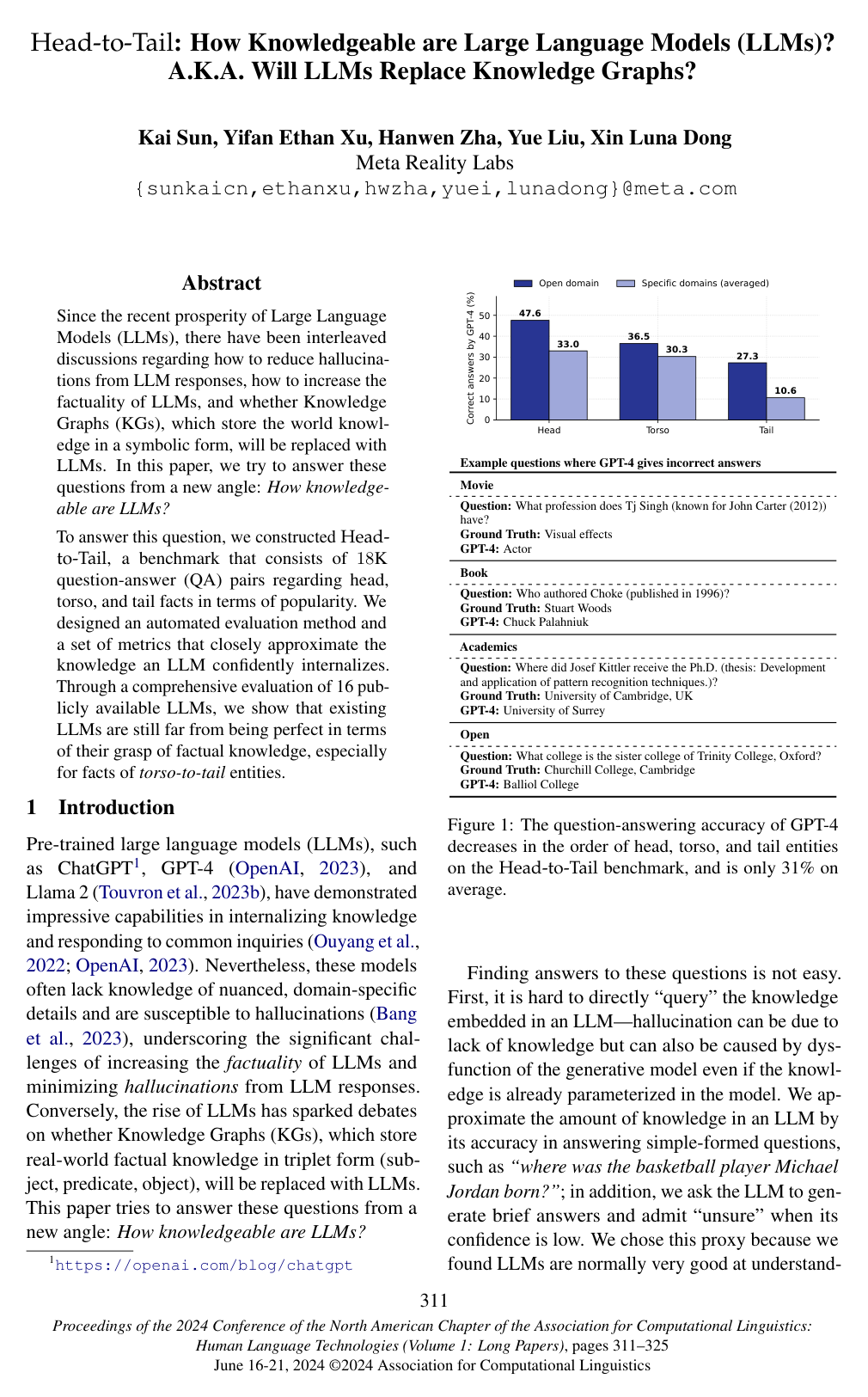
Head-to-Tail: How Knowledgeable are Large Language Models (LLMs)? A.K.A. Will LLMs Replace Knowledge Graphs?
Kai Sun, Yifan Ethan Xu, Hanwen Zha, Yue Liu, Xin Luna Dong
Why you should read this
Introduces the Head-to-Tail benchmark across 18,000 question-answer pairs to evaluate how well 16 large language models retain head, torso, and tail facts, revealing steep accuracy drops on less popular entities and demonstrating the continued necessity of structured knowledge graphs.
Since the recent prosperity of Large Language Models (LLMs), there have been interleaved discussions regarding how to reduce hallucinations from LLM responses, how to increase the factuality of LLMs, and whether Knowledge Graphs (KGs), which store the world knowledge in a symbolic form, will be replaced with LLMs. In this paper, we try to answer these questions from a new angle: How knowledgeable are LLMs? To answer this question, we constructed Head-to-Tail, a benchmark that consists of 18K question-answer (QA) pairs regarding head, torso, and tail facts in terms of popularity. We designed an automated evaluation method and a set of metrics that closely approximate the knowledge an LLM confidently internalizes. Through a comprehensive evaluation of 16 publicly available LLMs, we show that existing LLMs are still far from being perfect in terms of their grasp of factual knowledge, especially for facts of torso-to-tail entities.
Added
2026-10-05
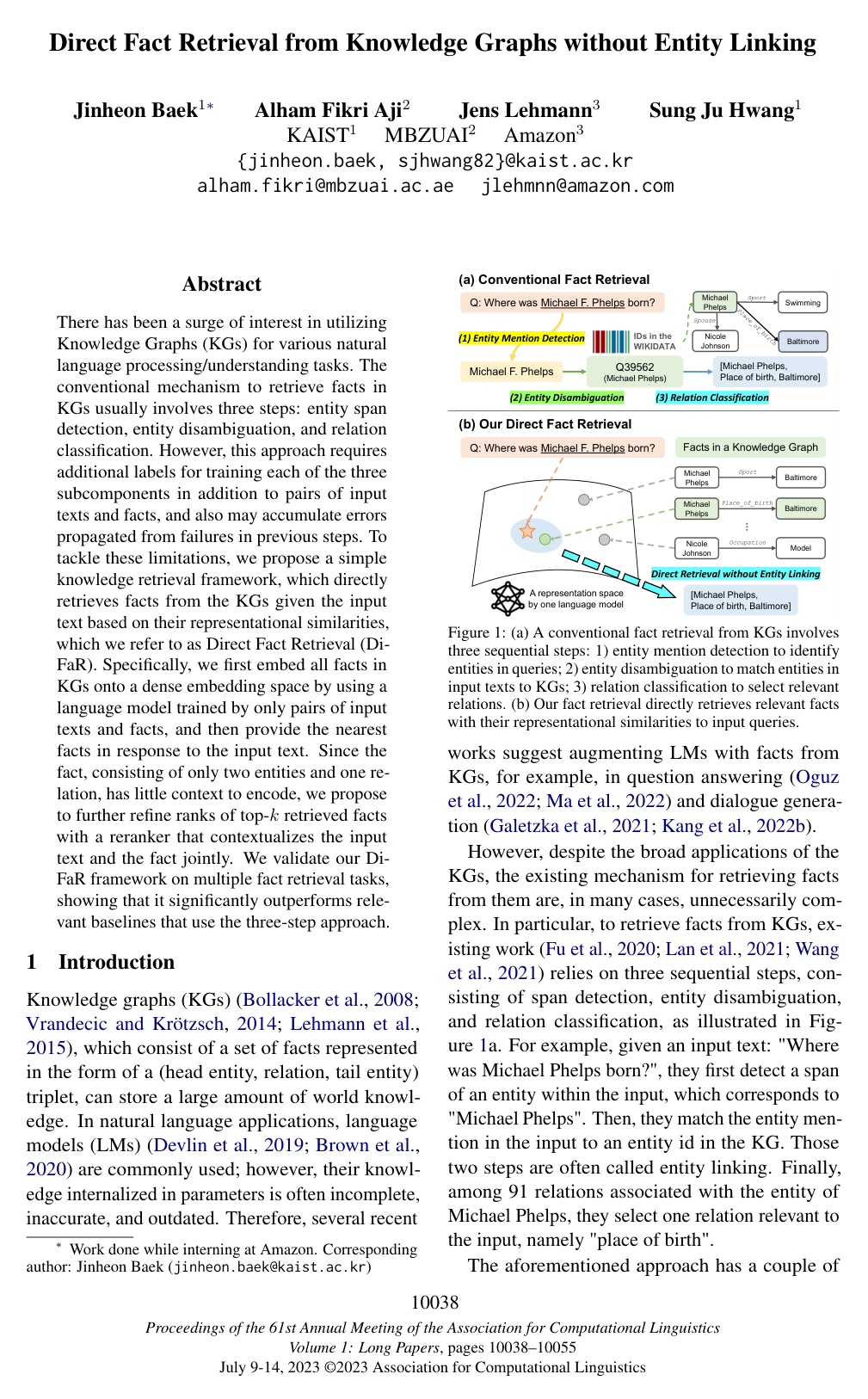
Direct Fact Retrieval from Knowledge Graphs without Entity Linking
Jinheon Baek, Alham Fikri Aji, Jens Lehmann, Sung Ju Hwang
Why you should read this
Proposes a dense retrieval framework that directly matches text queries to knowledge graph facts in a shared embedding space, eliminating the need for multistage entity linking pipelines and their intermediate supervision labels.
There has been a surge of interest in utilizing Knowledge Graphs (KGs) for various natural language processing/understanding tasks. The conventional mechanism to retrieve facts in KGs usually involves three steps: entity span detection, entity disambiguation, and relation classification. However, this approach requires additional labels for training each of the three subcomponents in addition to pairs of input texts and facts, and also may accumulate errors propagated from failures in previous steps. To tackle these limitations, we propose a simple knowledge retrieval framework, which directly retrieves facts from the KGs given the input text based on their representational similarities, which we refer to as Direct Fact Retrieval (DiFaR). Specifically, we first embed all facts in KGs onto a dense embedding space by using a language model trained by only pairs of input texts and facts, and then provide the nearest facts in response to the input text. Since the fact, consisting of only two entities and one relation, has little context to encode, we propose to further refine ranks of top-k retrieved facts with a reranker that contextualizes the input text and the fact jointly. We validate our DiFaR framework on multiple fact retrieval tasks, showing that it significantly outperforms relevant baselines that use the three-step approach.
Added
2026-10-05
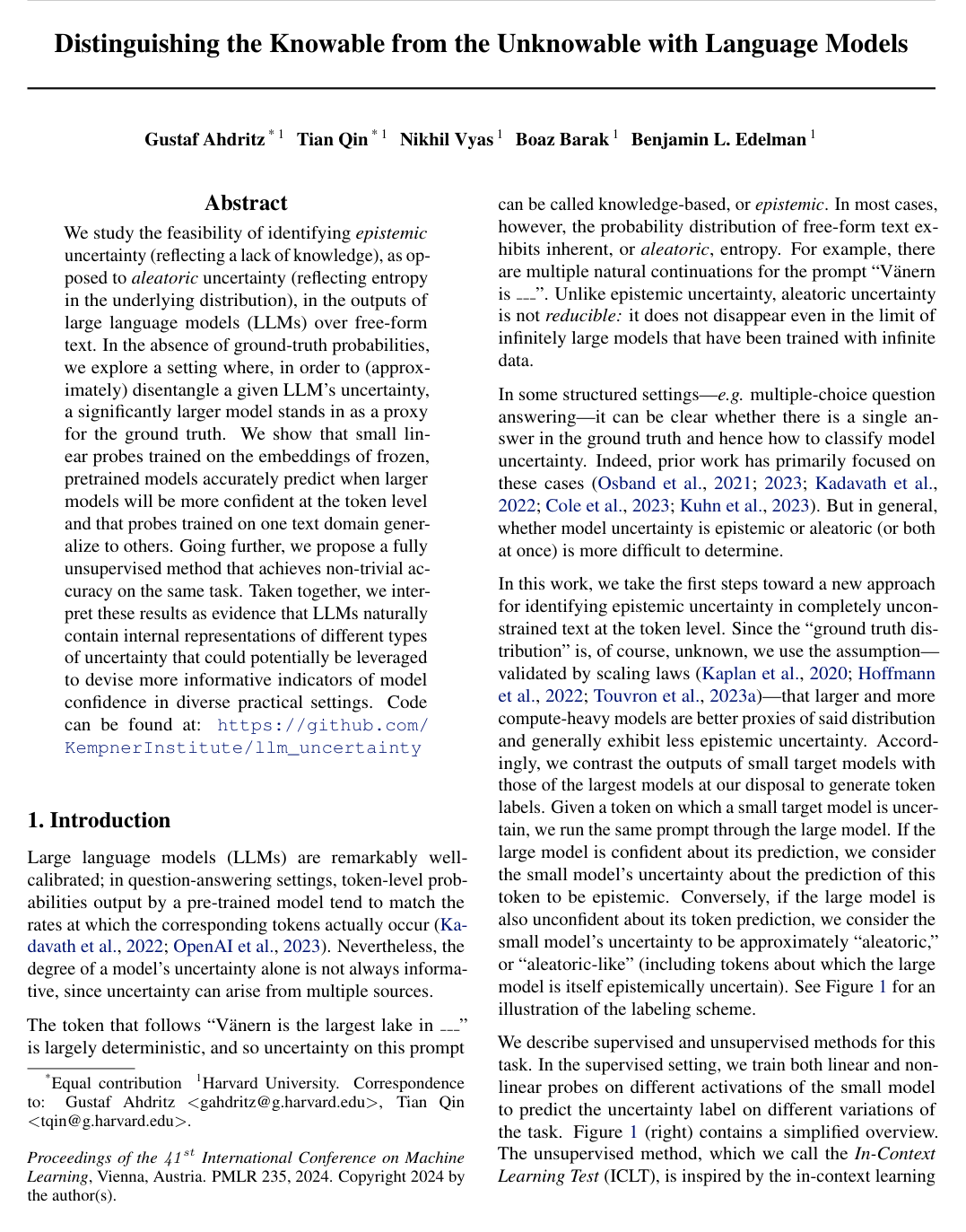
Distinguishing the Knowable from the Unknowable with Language Models
Gustaf Ahdritz, Tian Qin, Nikhil Vyas, Boaz Barak, Benjamin L. Edelman
Why you should read this
Demonstrates that language models internally separate reducible epistemic uncertainty from inherent aleatoric entropy, enabling simple probes and unsupervised methods to accurately detect when an uncertain prediction is caused by a lack of knowledge rather than inherent ambiguity.
We study the feasibility of identifying epistemic uncertainty (reflecting a lack of knowledge), as opposed to aleatoric uncertainty (reflecting entropy in the underlying distribution), in the outputs of large language models (LLMs) over free-form text. In the absence of ground-truth probabilities, we explore a setting where, in order to (approximately) disentangle a given LLM’s uncertainty, a significantly larger model stands in as a proxy for the ground truth. We show that small linear probes trained on the embeddings of frozen, pretrained models accurately predict when larger models will be more confident at the token level and that probes trained on one text domain generalize to others. Going further, we propose a fully unsupervised method that achieves non-trivial accuracy on the same task. Taken together, we interpret these results as evidence that LLMs naturally contain internal representations of different types of uncertainty that could potentially be leveraged to devise more informative indicators of model confidence in diverse practical settings. Code can be found at: https://github.com/KempnerInstitute/llm_uncertainty
Added
2026-10-05
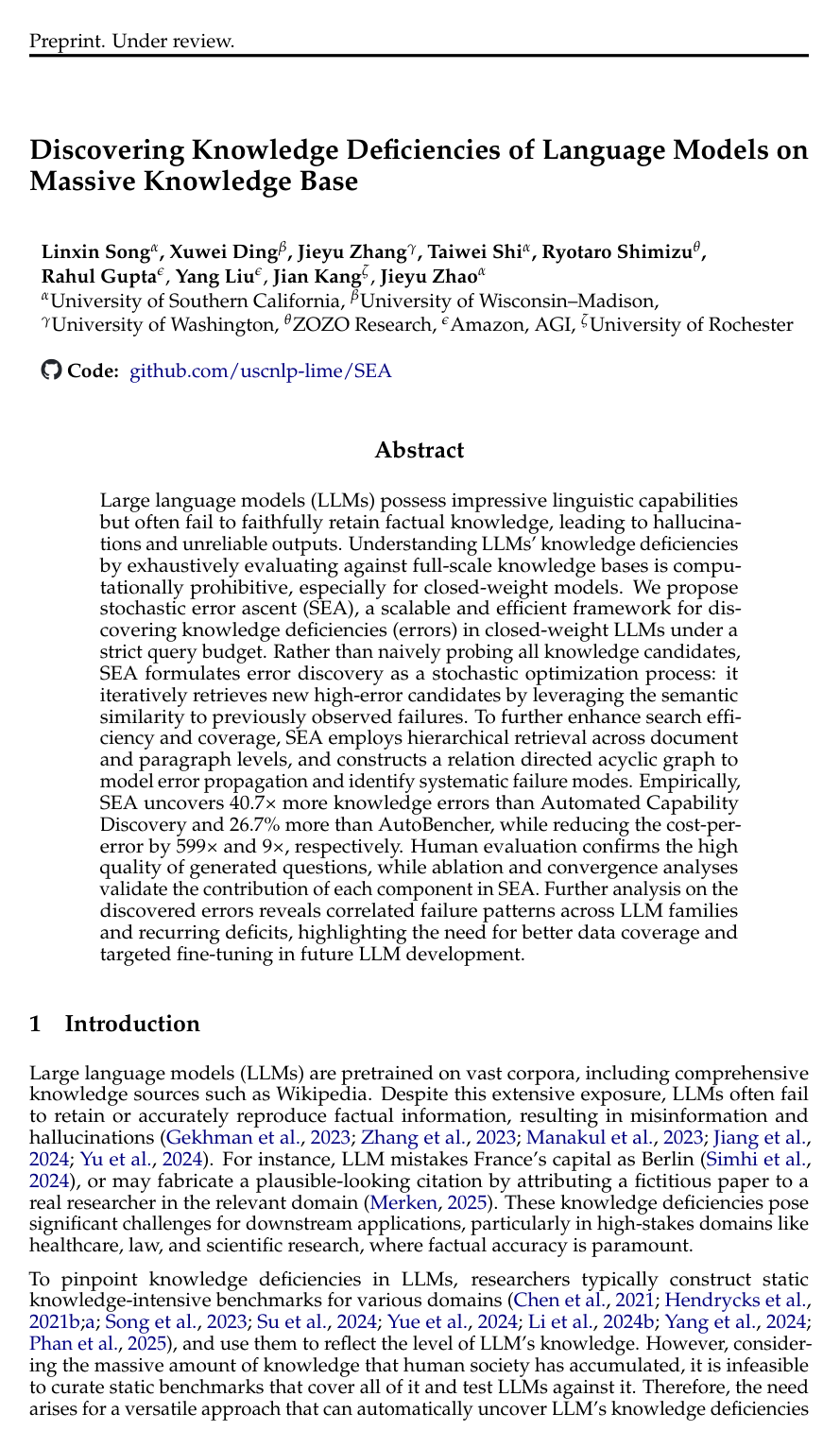
Discovering Knowledge Deficiencies of Language Models on Massive Knowledge Base
Linxin Song, Xuwei Ding, Jieyu Zhang, Taiwei Shi, Ryotaro Shimizu, Rahul Gupta, Yang Liu, Jian Kang, Jie-Yu Zhao
Why you should read this
Proposes stochastic error ascent, a scalable framework that treats knowledge failure discovery in closed-weight language models as an optimization problem, uncovering up to forty times more factual errors across massive knowledge bases while drastically reducing query costs.
Large language models (LLMs) possess impressive linguistic capabilities but often fail to faithfully retain factual knowledge, leading to hallucinations and unreliable outputs. Understanding LLMs' knowledge deficiencies by exhaustively evaluating against full-scale knowledge bases is computationally prohibitive, especially for closed-weight models. We propose stochastic error ascent (SEA), a scalable and efficient framework for discovering knowledge deficiencies (errors) in closed-weight LLMs under a strict query budget. Rather than naively probing all knowledge candidates, SEA formulates error discovery as a stochastic optimization process: it iteratively retrieves new high-error candidates by leveraging the semantic similarity to previously observed failures. To further enhance search efficiency and coverage, SEA employs hierarchical retrieval across document and paragraph levels, and constructs a relation directed acyclic graph to model error propagation and identify systematic failure modes. Empirically, SEA uncovers 40.7x more knowledge errors than Automated Capability Discovery and 26.7% more than AutoBencher, while reducing the cost-per-error by 599x and 9x, respectively. Human evaluation confirms the high quality of generated questions, while ablation and convergence analyses validate the contribution of each component in SEA. Further analysis on the discovered errors reveals correlated failure patterns across LLM families and recurring deficits, highlighting the need for better data coverage and targeted fine-tuning in future LLM development.
Added
2026-10-05
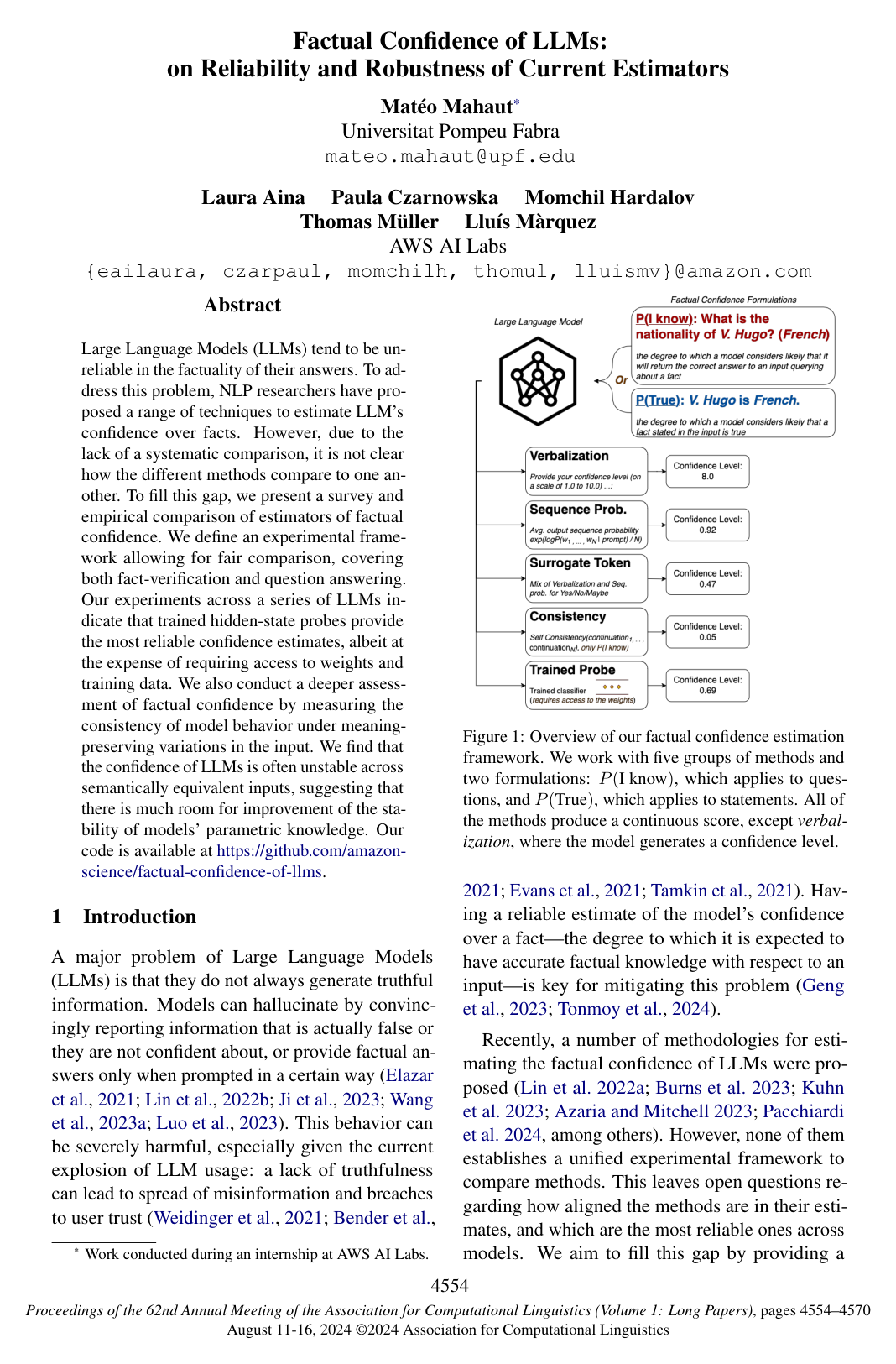
Factual Confidence of LLMs: on Reliability and Robustness of Current Estimators
Matéo Mahaut, Laura Aina, Paula Czarnowska, Momchil Hardalov, Thomas Müller, Lluís Màrquez
Why you should read this
Evaluates five major families of factual confidence estimators across multiple large language models and tasks, revealing that internal hidden-state probes achieve superior reliability while exposing how easily model confidence fluctuates across semantically equivalent prompts.
Large Language Models (LLMs) tend to be unreliable in the factuality of their answers. To address this problem, NLP researchers have proposed a range of techniques to estimate LLM’s confidence over facts. However, due to the lack of a systematic comparison, it is not clear how the different methods compare to one another. To fill this gap, we present a survey and empirical comparison of estimators of factual confidence. We define an experimental framework allowing for fair comparison, covering both fact-verification and question answering. Our experiments across a series of LLMs indicate that trained hidden-state probes provide the most reliable confidence estimates, albeit at the expense of requiring access to weights and training data. We also conduct a deeper assessment of factual confidence by measuring the consistency of model behavior under meaning-preserving variations in the input. We find that the confidence of LLMs is often unstable across semantically equivalent inputs, suggesting that there is much room for improvement of the stability of models’ parametric knowledge. Our code is available at https://github.com/amazon-science/factual-confidence-of-llms.
Added
2026-10-03
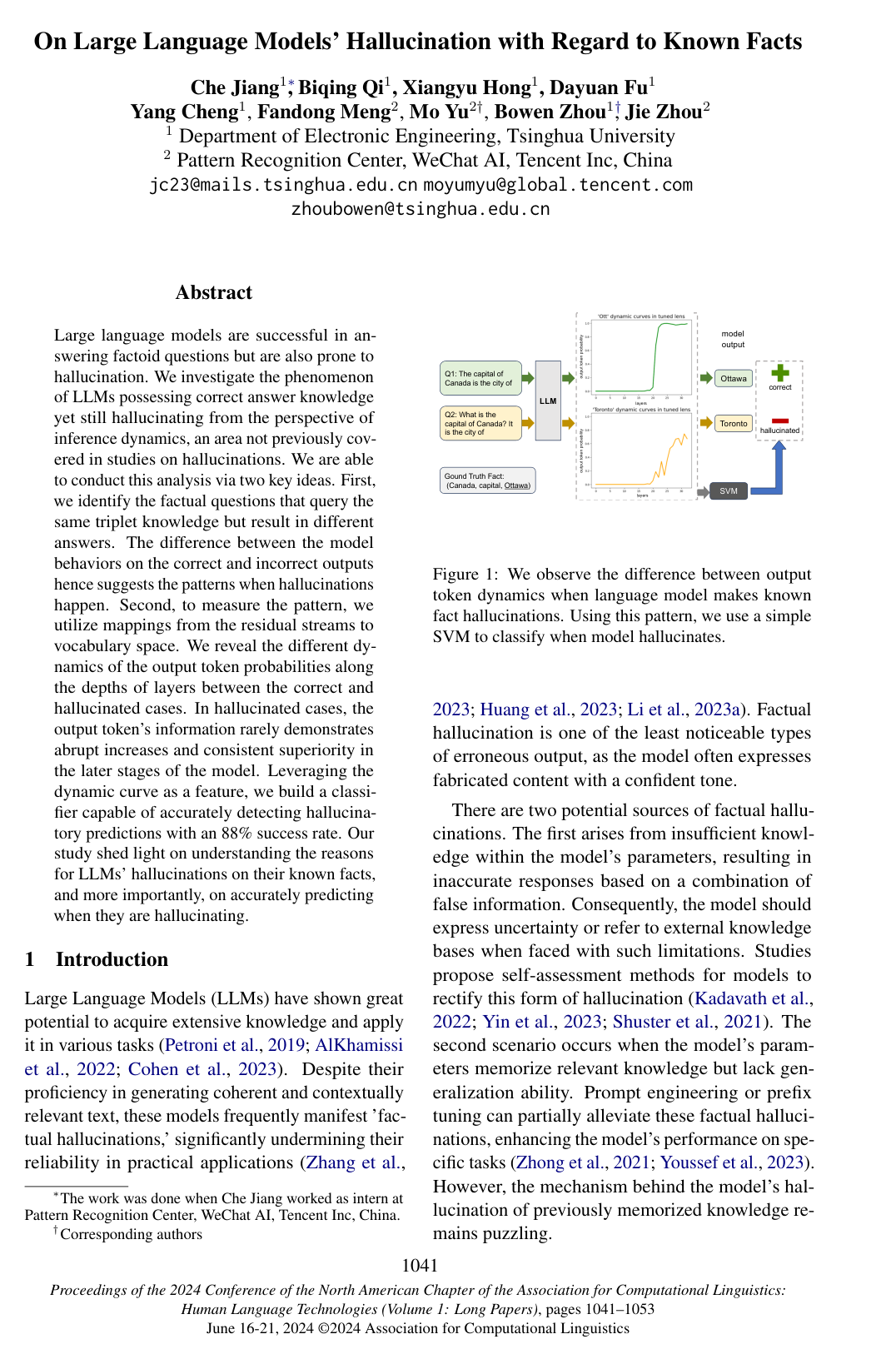
On Large Language Models' Hallucination with Regard to Known Facts
Che Jiang, Biqing Qi, Xiangyu Hong, Dayuan Fu, Yang Cheng, Fandong Meng, Mo Yu, Bowen Zhou, Jie Zhou
Why you should read this
Reveals distinct token probability trajectories across model layers during failed knowledge recall, enabling an 88% accurate classifier for detecting when large language models hallucinate facts they actually know.
Large language models are successful in answering factoid questions but are also prone to hallucination. We investigate the phenomenon of LLMs possessing correct answer knowledge yet still hallucinating from the perspective of inference dynamics, an area not previously covered in studies on hallucinations. We are able to conduct this analysis via two key ideas. First, we identify the factual questions that query the same triplet knowledge but result in different answers. The difference between the model behaviors on the correct and incorrect outputs hence suggests the patterns when hallucinations happen. Second, to measure the pattern, we utilize mappings from the residual streams to vocabulary space. We reveal the different dynamics of the output token probabilities along the depths of layers between the correct and hallucinated cases. In hallucinated cases, the output token’s information rarely demonstrates abrupt increases and consistent superiority in the later stages of the model. Leveraging the dynamic curve as a feature, we build a classifier capable of accurately detecting hallucinatory predictions with an 88% success rate. Our study shed light on understanding the reasons for LLMs’ hallucinations on their known facts, and more importantly, on accurately predicting when they are hallucinating.
Added
2026-10-03
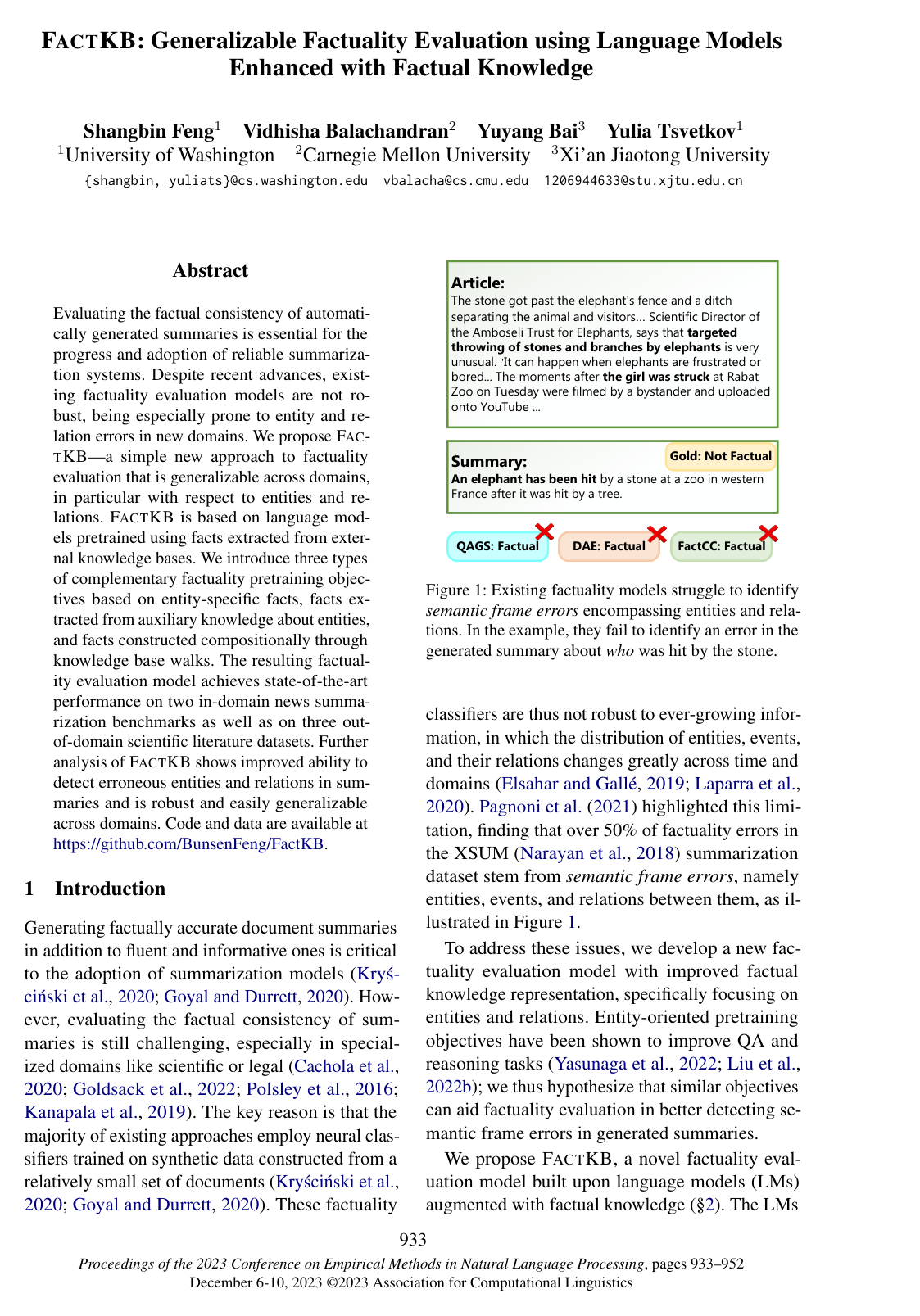
FactKB: Generalizable Factuality Evaluation using Language Models Enhanced with Factual Knowledge
Shangbin Feng, Vidhisha Balachandran, Yuyang Bai, Yulia Tsvetkov
Why you should read this
Proposes FactKB, a factuality evaluation framework that pretrains language models on structured knowledge base facts to effectively detect entity and relation errors in generated summaries across diverse domains.
Evaluating the factual consistency of automatically generated summaries is essential for the progress and adoption of reliable summarization systems. Despite recent advances, existing factuality evaluation models are not robust, being especially prone to entity and relation errors in new domains. We propose FACTKB—a simple new approach to factuality evaluation that is generalizable across domains, in particular with respect to entities and relations. FACTKB is based on language models pretrained using facts extracted from external knowledge bases. We introduce three types of complementary factuality pretraining objectives based on entity-specific facts, facts extracted from auxiliary knowledge about entities, and facts constructed compositionally through knowledge base walks. The resulting factuality evaluation model achieves state-of-the-art performance on two in-domain news summarization benchmarks as well as on three out-of-domain scientific literature datasets. Further analysis of FACTKB shows improved ability to detect erroneous entities and relations in summaries and is robust and easily generalizable across domains. Code and data are available at https://github.com/BunsenFeng/FactKB.
Added
2026-10-02
Instruction-tuned Language Models are Better Knowledge Learners
Zhengbao Jiang, Zhiqing Sun, Weijia Shi, Pedro Rodríguez, Chunting Zhou, Graham Neubig, Xi Victoria Lin, Wen-tau Yih, Srini Iyer
Why you should read this
Proposes pre-instruction-tuning to train language models on question-answer pairs before continued pre-training on new documents, significantly improving their ability to retain and accurately answer questions about newly acquired factual knowledge.
In order for large language model (LLM)-based assistants to effectively adapt to evolving information needs, it must be possible to update their factual knowledge through continued training on new data. The standard recipe for doing so involves continued pre-training on new documents followed by instruction-tuning on question-answer (QA) pairs. However, we find that LLMs trained with this recipe struggle to answer questions, even though the perplexity of documents is minimized. We found that QA pairs are generally straightforward, while documents are more complex, weaving many factual statements together in an intricate manner. Therefore, we hypothesize that it is beneficial to expose LLMs to QA pairs before continued pre-training on documents so that the process of encoding knowledge from complex documents takes into account how this knowledge is accessed through questions. Based on this, we propose pre-instruction-tuning (PIT), a method that instruction-tunes on questions prior to training on documents. This contrasts with standard instruction-tuning, which learns how to extract knowledge after training on documents. Extensive experiments and ablation studies demonstrate that PIT significantly enhances the ability of LLMs to absorb knowledge from new documents, outperforming standard instruction-tuning by 17.8%.
Added
2026-10-02
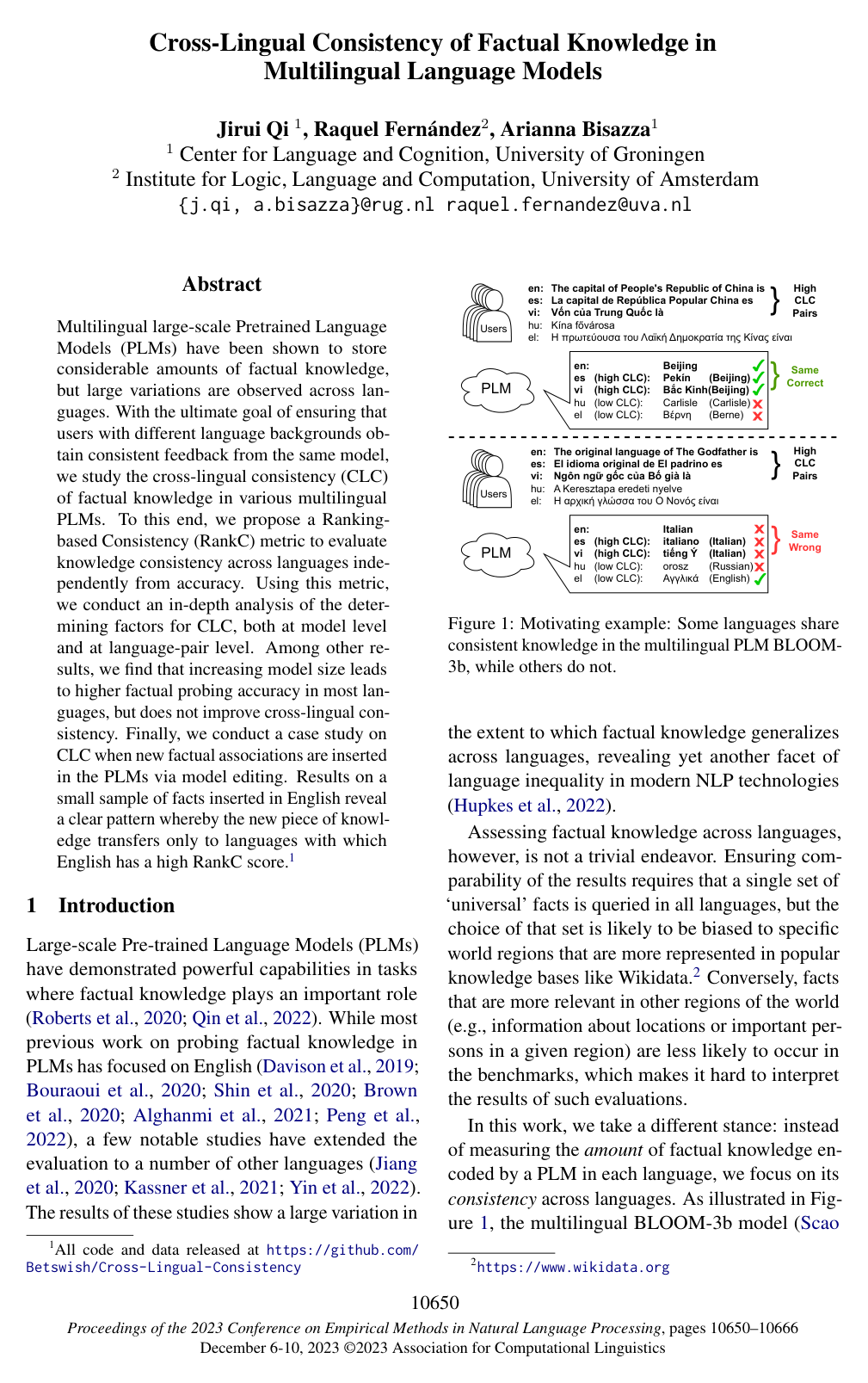
Cross-Lingual Consistency of Factual Knowledge in Multilingual Language Models
Jirui Qi, Raquel Fernández, Arianna Bisazza
Why you should read this
Introduces a ranking-based consistency metric and a multi-parallel benchmark to evaluate factual knowledge alignment across languages in multilingual language models, showing that scaling model size fails to improve cross-lingual consistency and that consistency scores predict whether edited facts transfer across languages.
Multilingual large-scale Pretrained Language Models (PLMs) have been shown to store considerable amounts of factual knowledge, but large variations are observed across languages. With the ultimate goal of ensuring that users with different language backgrounds obtain consistent feedback from the same model, we study the cross-lingual consistency (CLC) of factual knowledge in various multilingual PLMs. To this end, we propose a Ranking-based Consistency (RankC) metric to evaluate knowledge consistency across languages independently from accuracy. Using this metric, we conduct an in-depth analysis of the determining factors for CLC, both at model level and at language-pair level. Among other results, we find that increasing model size leads to higher factual probing accuracy in most languages, but does not improve cross-lingual consistency. Finally, we conduct a case study on CLC when new factual associations are inserted in the PLMs via model editing. Results on a small sample of facts inserted in English reveal a clear pattern whereby the new piece of knowledge transfers only to languages with which English has a high RankC score.
Added
2026-10-01
Inside-Out: Hidden Factual Knowledge in LLMs
Jonathan Herzig, Eran Ofek, Hadas Orgad, Zorik Gekhman, Idan Szpektor, Roi Reichart, Yonatan Belinkov, Eyal Ben-David
Why you should read this
Demonstrates that large language models encode an average of 40% more factual knowledge internally than they express in their outputs, exposing a fundamental limitation in scaling test-time compute through repeated sampling because certain known facts are never generated.
This work presents a framework for assessing whether large language models (LLMs) encode more factual knowledge in their parameters than what they express in their outputs. While a few studies hint at this possibility, none has clearly defined or demonstrated this phenomenon. We first propose a formal definition of knowledge, quantifying it for a given question as the fraction of correct-incorrect answer pairs where the correct one is ranked higher. This gives rise to external and internal knowledge, depending on the information used to score individual answer candidates: either the model's observable token-level probabilities or its intermediate computations. Hidden knowledge arises when internal knowledge exceeds external knowledge. We then present a case study, applying this framework to three popular open-weights LLMs in a closed-book QA setup. Our results indicate that: (1) LLMs consistently encode more factual knowledge internally than what they express externally, with an average relative gap of 40%. (2) Surprisingly, some knowledge is so deeply hidden that a model can internally know an answer perfectly, yet fail to generate it even once, despite large-scale repeated sampling of 1,000 answers. This reveals fundamental limitations in the generation capabilities of LLMs, which (3) put a practical constraint on scaling test-time compute via repeated answer sampling in closed-book QA: significant performance improvements remain inaccessible because some answers are practically never sampled, yet if they were, we would be guaranteed to rank them first.
Added
2026-09-29
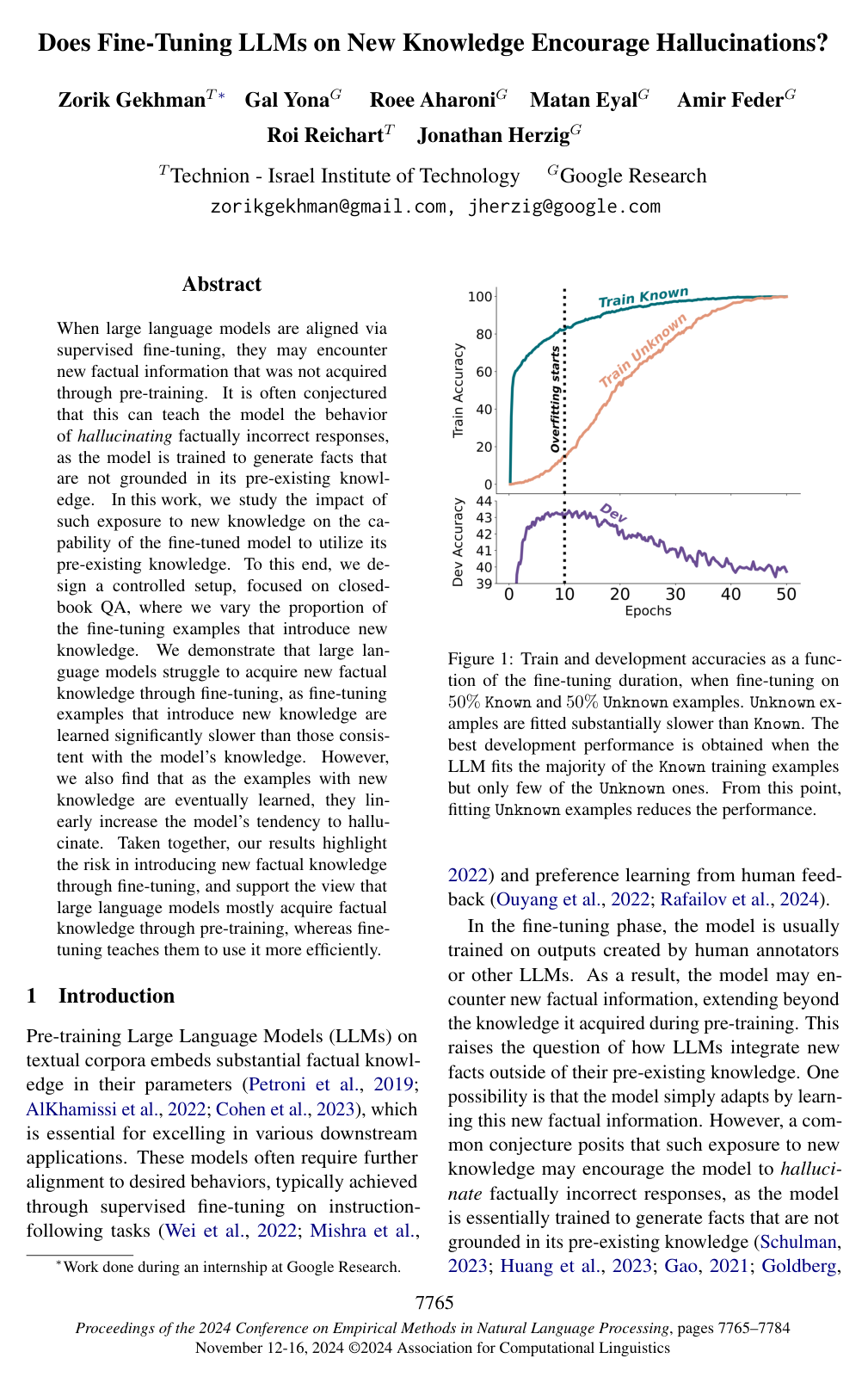
Does Fine-Tuning LLMs on New Knowledge Encourage Hallucinations?
Zorik Gekhman, Gal Yona, Roee Aharoni, Matan Eyal, Amir Feder, Roi Reichart, Jonathan Herzig
Why you should read this
Reveals that fine-tuning language models on unfamiliar factual data causes them to fit new information much slower than known facts while linearly increasing their rate of hallucinations, indicating that fine-tuning should focus on formatting existing knowledge rather than teaching new facts.
When large language models are aligned via supervised fine-tuning, they may encounter new factual information that was not acquired through pre-training. It is often conjectured that this can teach the model the behavior of hallucinating factually incorrect responses, as the model is trained to generate facts that are not grounded in its pre-existing knowledge. In this work, we study the impact of such exposure to new knowledge on the capability of the fine-tuned model to utilize its pre-existing knowledge. To this end, we design a controlled setup, focused on closed-book QA, where we vary the proportion of the fine-tuning examples that introduce new knowledge. We demonstrate that large language models struggle to acquire new factual knowledge through fine-tuning, as fine-tuning examples that introduce new knowledge are learned significantly slower than those consistent with the model's knowledge. However, we also find that as the examples with new knowledge are eventually learned, they linearly increase the model's tendency to hallucinate. Taken together, our results highlight the risk in introducing new factual knowledge through fine-tuning, and support the view that large language models mostly acquire factual knowledge through pre-training, whereas fine-tuning teaches them to use it more efficiently.
Added
2026-09-28
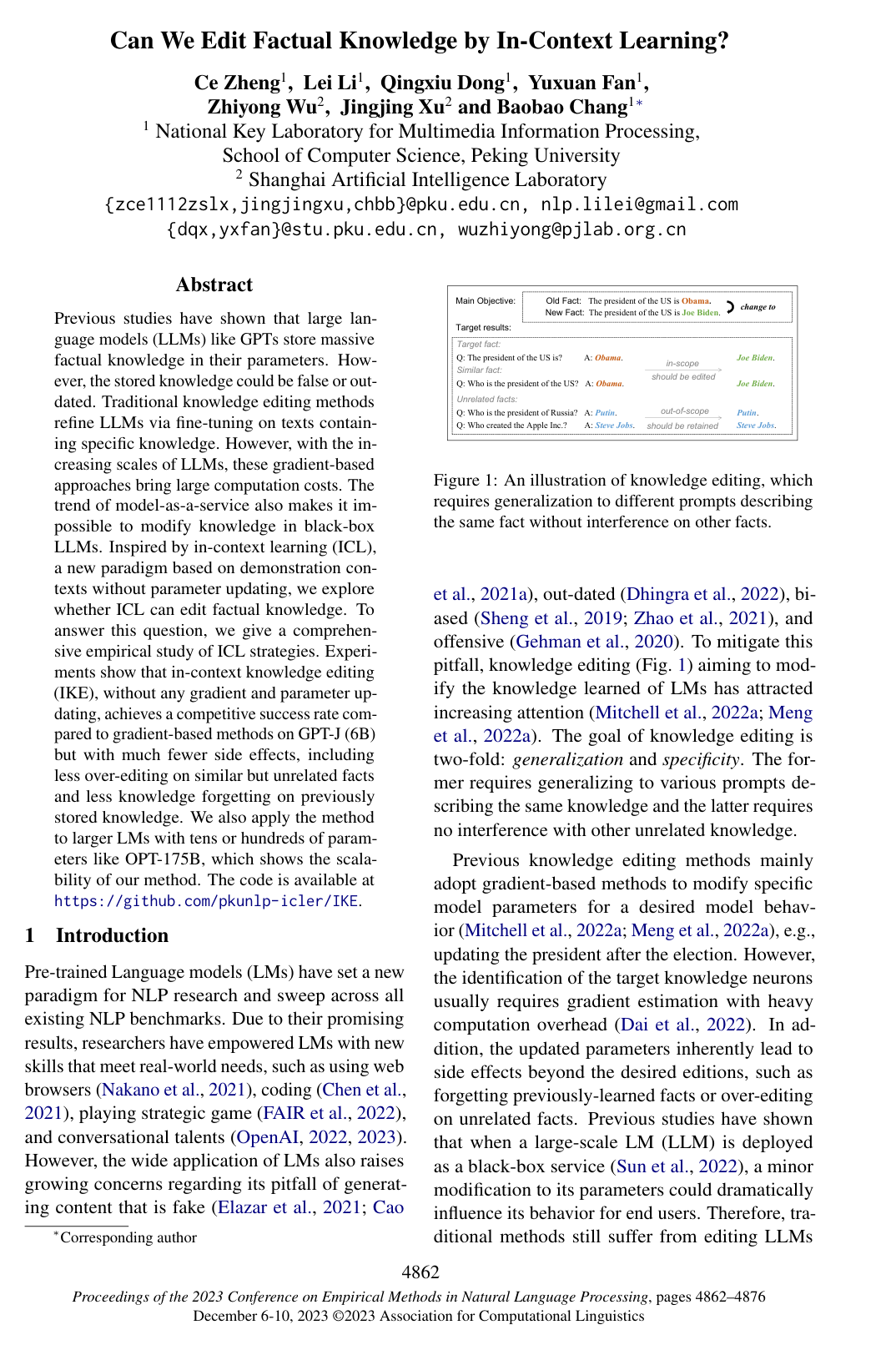
Can We Edit Factual Knowledge by In-Context Learning?
Ce Zheng, Lei Li, Qingxiu Dong, Yuxuan Fan, Zhiyong Wu, Jingjing Xu, Baobao Chang
Why you should read this
Proposes an in-context knowledge editing framework that updates facts in large language models using structured demonstration prompts, achieving competitive editing performance without costly parameter updates or catastrophic forgetting.
Previous studies have shown that large language models (LLMs) like GPTs store massive factual knowledge in their parameters. However, the stored knowledge could be false or out-dated. Traditional knowledge editing methods refine LLMs via fine-tuning on texts containing specific knowledge. However, with the increasing scales of LLMs, these gradient-based approaches bring large computation costs. The trend of model-as-a-service also makes it impossible to modify knowledge in black-box LLMs. Inspired by in-context learning (ICL), a new paradigm based on demonstration contexts without parameter updating, we explore whether ICL can edit factual knowledge. To answer this question, we give a comprehensive empirical study of ICL strategies. Experiments show that in-context knowledge editing (IKE), without any gradient and parameter updating, achieves a competitive success rate compared to gradient-based methods on GPT-J (6B) but with much fewer side effects, including less over-editing on similar but unrelated facts and less knowledge forgetting on previously stored knowledge. We also apply the method to larger LMs with tens or hundreds of parameters like OPT-175B, which shows the scalability of our method. The code is available at https://github.com/pkunlp-icler/IKE.
Added
2026-09-26
AlphaEdit: Null-Space Constrained Knowledge Editing for Language Models
Junfeng Fang, Houcheng Jiang, Kun Wang, Yunshan Ma, Shi Jie, Xiang Wang, Xiangnan He, Tat-seng Chua
Why you should read this
Introduces AlphaEdit, a novel and theoretically proven method that significantly boosts the performance of existing language model editing techniques by an average of 36.7% with just a single line of code, effectively preventing the disruption of preserved knowledge.
Large language models (LLMs) often exhibit hallucinations due to incorrect or outdated knowledge. Hence, model editing methods have emerged to enable targeted knowledge updates. To achieve this, a prevailing paradigm is the locating-then-editing approach, which first locates influential parameters and then edits them by introducing a perturbation. While effective, current studies have demonstrated that this perturbation inevitably disrupt the originally preserved knowledge within LLMs, especially in sequential editing scenarios. To address this, we introduce AlphaEdit, a novel solution that projects perturbation onto the null space of the preserved knowledge before applying it to the parameters. We theoretically prove that this projection ensures the output of post-edited LLMs remains unchanged when queried about the preserved knowledge, thereby mitigating the issue of disruption. Extensive experiments on various LLMs, including LLaMA3, GPT2-XL, and GPT-J, show that AlphaEdit boosts the performance of most locating-then-editing methods by an average of 36.7% with a single line of additional code for projection solely. Our code is available at: this https URL.
Added
2026-01-07
