
keyword
factual errors
A factual error is an inaccuracy in generated or stated text where the content contradicts verifiable real-world knowledge or conflicts directly with provided source material. In natural language processing and artificial intelligence, factual errors frequently occur as hallucinations or confabulations in text generation, abstractive summarization, and question-answering systems. These discrepancies typically manifest through the fabrication of non-existent entities, the misattribution of relations or actions between entities, numerical and temporal inaccuracies, or statements that directly negate established facts. Identifying and resolving factual errors is essential for establishing the reliability, truthfulness, and factual consistency of automated language outputs.
2 items
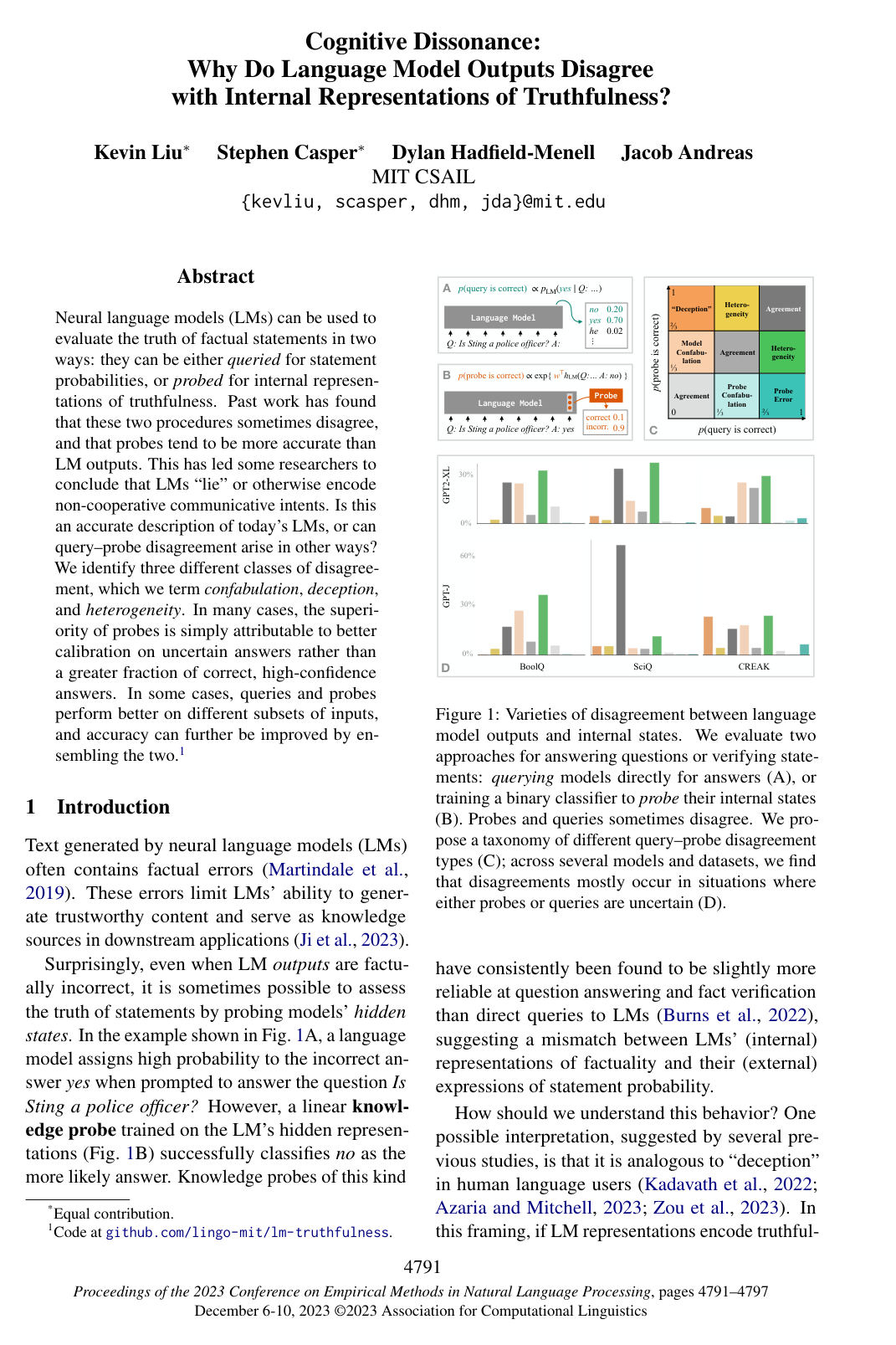
Cognitive Dissonance: Why Do Language Model Outputs Disagree with Internal Representations of Truthfulness?
Kevin Liu, Stephen Casper, Dylan Hadfield-Menell, Jacob Andreas
Why you should read this
Explains why internal probes often outperform direct language model outputs by categorizing query–probe disagreements into confabulation, deception, and heterogeneity, showing that superior probe accuracy stems primarily from better uncertainty calibration rather than intentional deception.
Neural language models (LMs) can be used to evaluate the truth of factual statements in two ways: they can be either queried for statement probabilities, or probed for internal representations of truthfulness. Past work has found that these two procedures sometimes disagree, and that probes tend to be more accurate than LM outputs. This has led some researchers to conclude that LMs “lie” or otherwise encode non-cooperative communicative intents. Is this an accurate description of today’s LMs, or can query–probe disagreement arise in other ways? We identify three different classes of disagreement, which we term confabulation, deception, and heterogeneity. In many cases, the superiority of probes is simply attributable to better calibration on uncertain answers rather than a greater fraction of correct, high-confidence answers. In some cases, queries and probes perform better on different subsets of inputs, and accuracy can further be improved by ensembling the two.¹
Added
2026-10-03
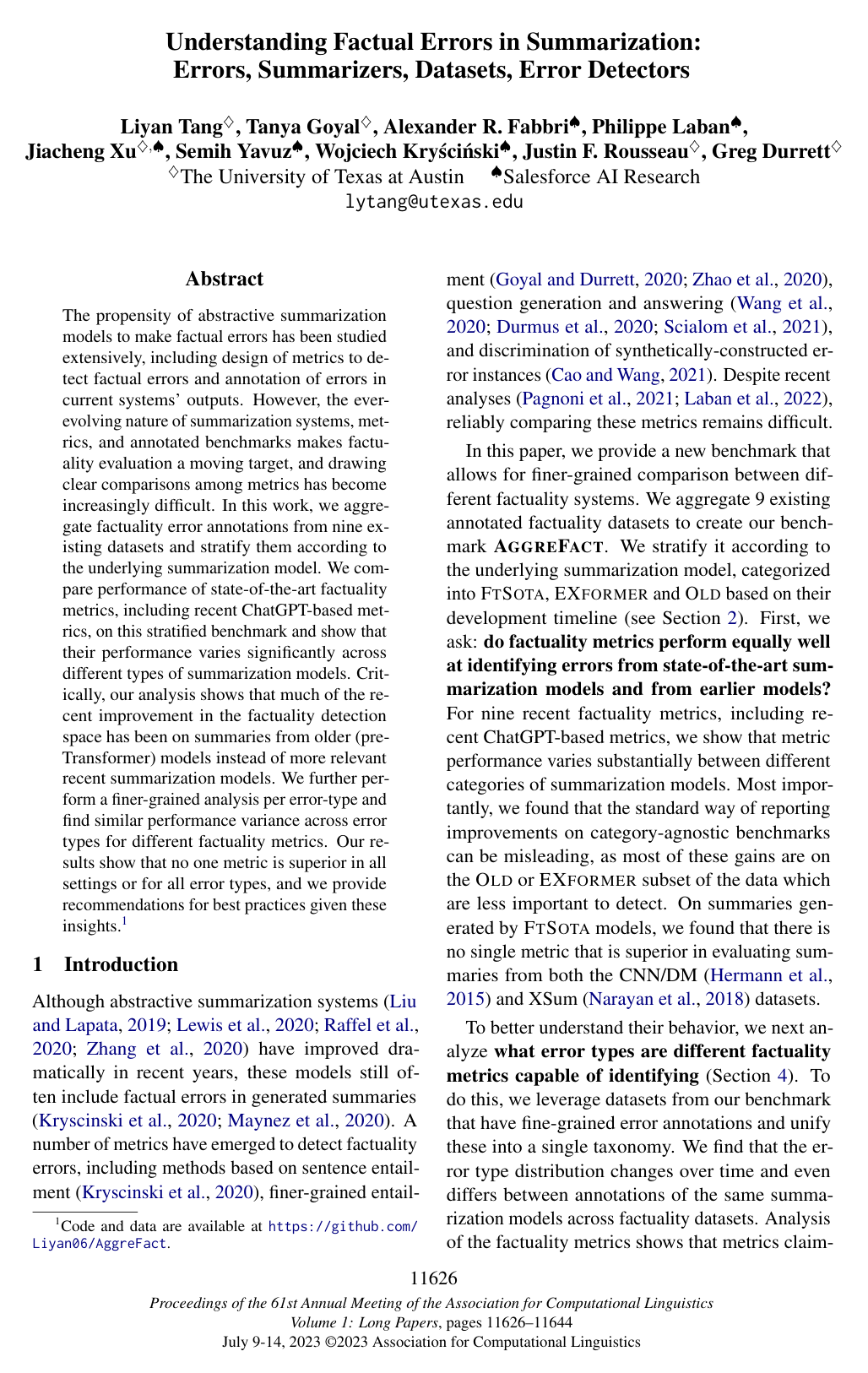
Understanding Factual Errors in Summarization: Errors, Summarizers, Datasets, Error Detectors
Liyan Tang, Tanya Goyal, Alexander R. Fabbri, Philippe Laban, Jiacheng Xu, Semih Yavuz, Wojciech Kryscinski, Justin F. Rousseau, Greg Durrett
Why you should read this
Presents the AGGREFACT benchmark to reveal that modern summarization factuality detectors largely make progress on outdated pre-Transformer outputs rather than state-of-the-art models, showing that no single metric reliably detects factual errors across model types and error categories.
The propensity of abstractive summarization models to make factual errors has been studied extensively, including design of metrics to detect factual errors and annotation of errors in current systems’ outputs. However, the ever-evolving nature of summarization systems, metrics, and annotated benchmarks makes factuality evaluation a moving target, and drawing clear comparisons among metrics has become increasingly difficult. In this work, we aggregate factuality error annotations from nine existing datasets and stratify them according to the underlying summarization model. We compare performance of state-of-the-art factuality metrics, including recent ChatGPT-based metrics, on this stratified benchmark and show that their performance varies significantly across different types of summarization models. Critically, our analysis shows that much of the recent improvement in the factuality detection space has been on summaries from older (pre-Transformer) models instead of more relevant recent summarization models. We further perform a finer-grained analysis per error-type and find similar performance variance across error types for different factuality metrics. Our results show that no one metric is superior in all settings or for all error types, and we provide recommendations for best practices given these insights.
Added
2026-10-01