
keyword
factual error detection
Factual error detection is the computational process of identifying statements, claims, or generated text segments that are objectively incorrect, unsupported, or inconsistent with verified reality or source material. In natural language processing and artificial intelligence, this task focuses on evaluating the truthfulness and fidelity of text produced by language models or human writers by locating inaccuracies such as incorrect entity attributes, erroneous relationships, or unfaithful summaries. Detection techniques typically involve cross-referencing claims against external knowledge bases, verifying generated content against source reference documents, or probing models to uncover internal logical and semantic inconsistencies.
2 items
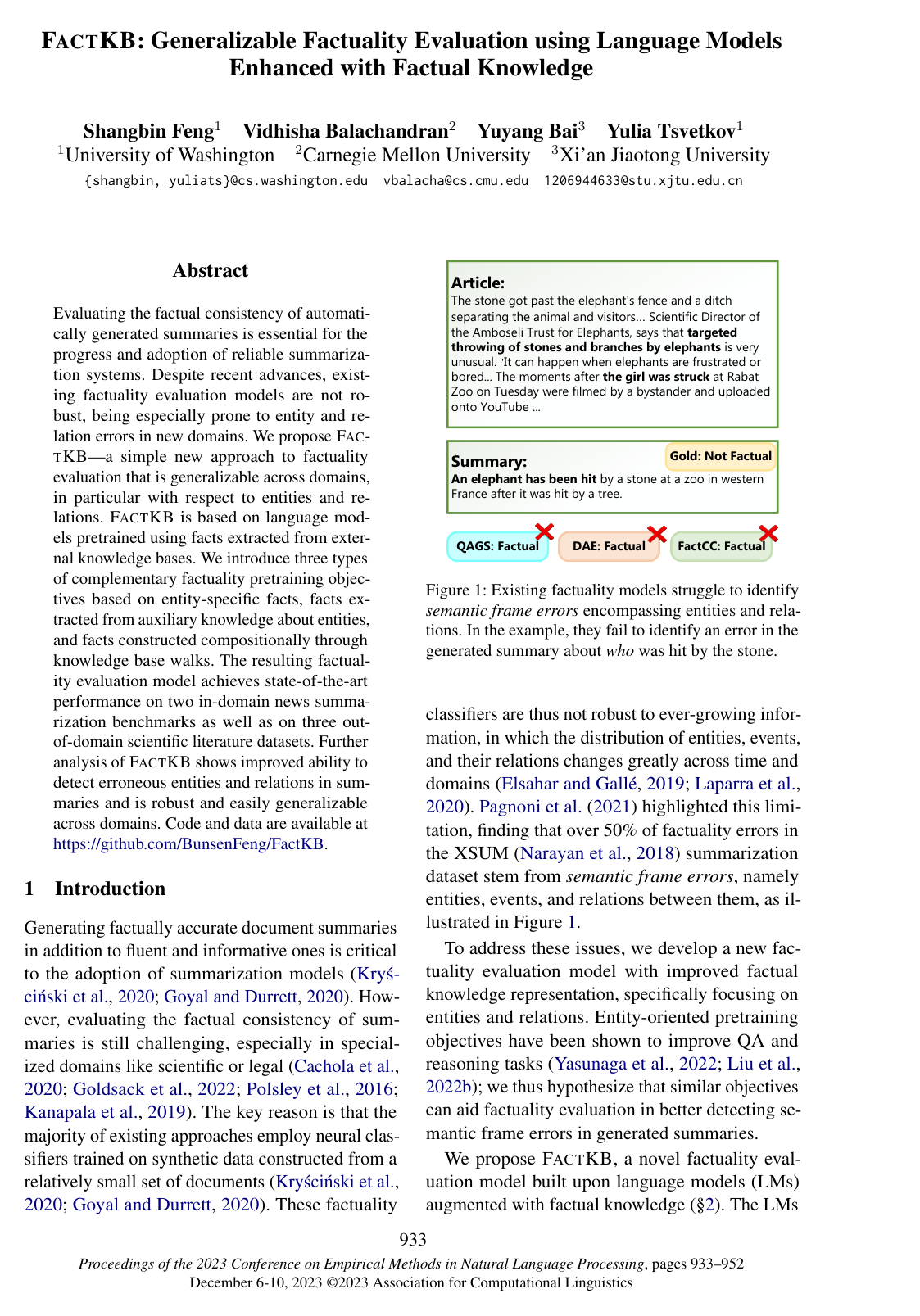
FactKB: Generalizable Factuality Evaluation using Language Models Enhanced with Factual Knowledge
Shangbin Feng, Vidhisha Balachandran, Yuyang Bai, Yulia Tsvetkov
Why you should read this
Proposes FactKB, a factuality evaluation framework that pretrains language models on structured knowledge base facts to effectively detect entity and relation errors in generated summaries across diverse domains.
Evaluating the factual consistency of automatically generated summaries is essential for the progress and adoption of reliable summarization systems. Despite recent advances, existing factuality evaluation models are not robust, being especially prone to entity and relation errors in new domains. We propose FACTKB—a simple new approach to factuality evaluation that is generalizable across domains, in particular with respect to entities and relations. FACTKB is based on language models pretrained using facts extracted from external knowledge bases. We introduce three types of complementary factuality pretraining objectives based on entity-specific facts, facts extracted from auxiliary knowledge about entities, and facts constructed compositionally through knowledge base walks. The resulting factuality evaluation model achieves state-of-the-art performance on two in-domain news summarization benchmarks as well as on three out-of-domain scientific literature datasets. Further analysis of FACTKB shows improved ability to detect erroneous entities and relations in summaries and is robust and easily generalizable across domains. Code and data are available at https://github.com/BunsenFeng/FactKB.
Added
2026-10-02
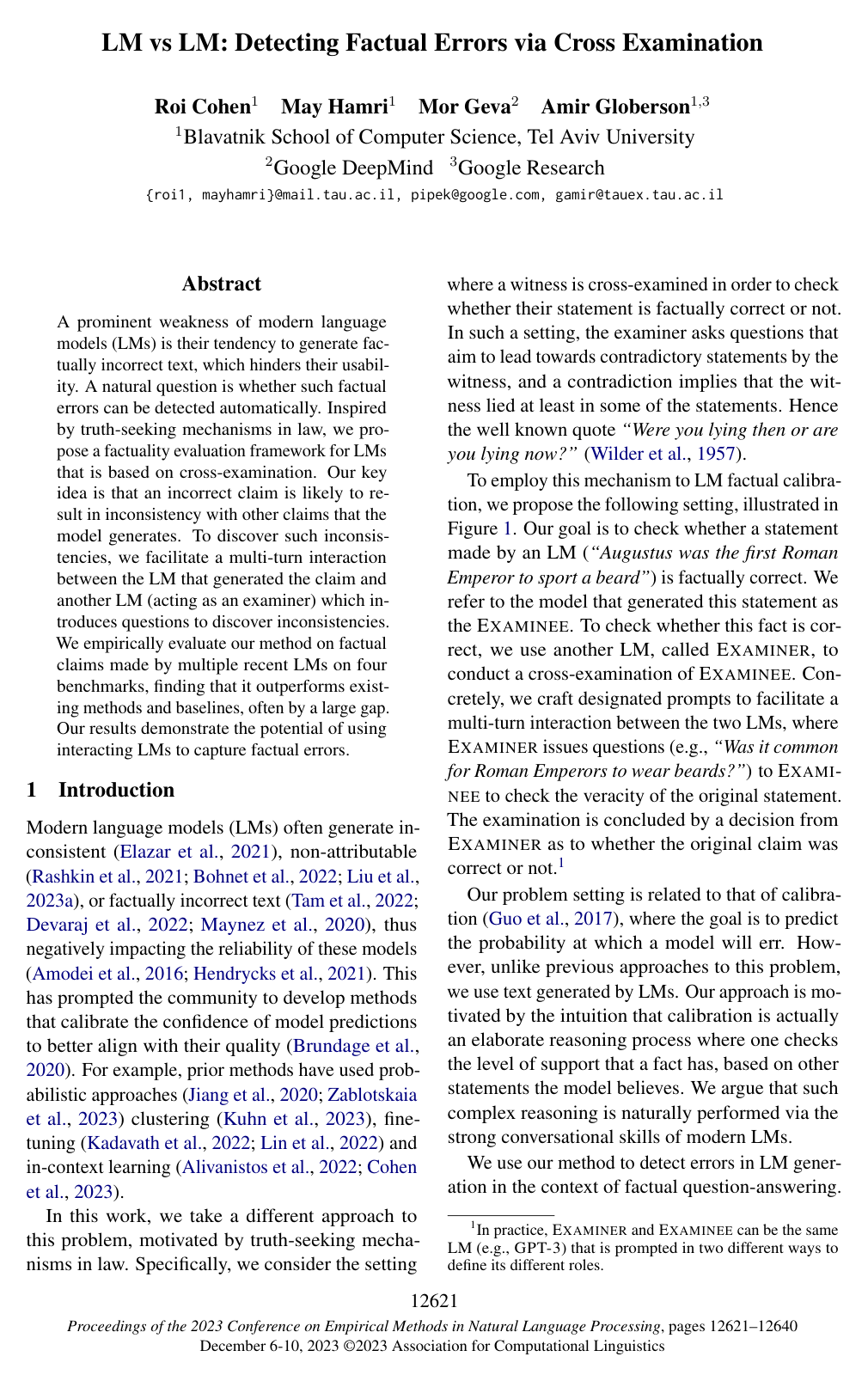
LM vs LM: Detecting Factual Errors via Cross Examination
Roi Cohen, May Hamri, Mor Geva, Amir Globerson
Why you should read this
Proposes a legal-inspired cross-examination framework where an examiner language model questions another model across multiple turns to uncover factual errors through generated inconsistencies without requiring external knowledge bases.
A prominent weakness of modern language models (LMs) is their tendency to generate factually incorrect text, which hinders their usability. A natural question is whether such factual errors can be detected automatically. Inspired by truth-seeking mechanisms in law, we propose a factuality evaluation framework for LMs that is based on cross-examination. Our key idea is that an incorrect claim is likely to result in inconsistency with other claims that the model generates. To discover such inconsistencies, we facilitate a multi-turn interaction between the LM that generated the claim and another LM (acting as an examiner) which introduces questions to discover inconsistencies. We empirically evaluate our method on factual claims made by multiple recent LMs on four benchmarks, finding that it outperforms existing methods and baselines, often by a large gap. Our results demonstrate the potential of using interacting LMs to capture factual errors.
Added
2026-09-26