
keyword
factual associations
Factual associations are structured units of relational knowledge stored within the parameters of a machine learning model, linking a subject entity to a specific attribute or target entity through a defined relation. In natural language processing, these associations represent the model's internalized real-world facts that can be recalled during inference to answer queries, such as identifying the capital of a country or the location of a landmark. Within neural network architectures like transformers, factual associations operate as learned computational mappings where internal components, including feed-forward modules and attention mechanisms, process and route information from the subject and relation to accurately predict and generate the corresponding factual attribute.
4 items
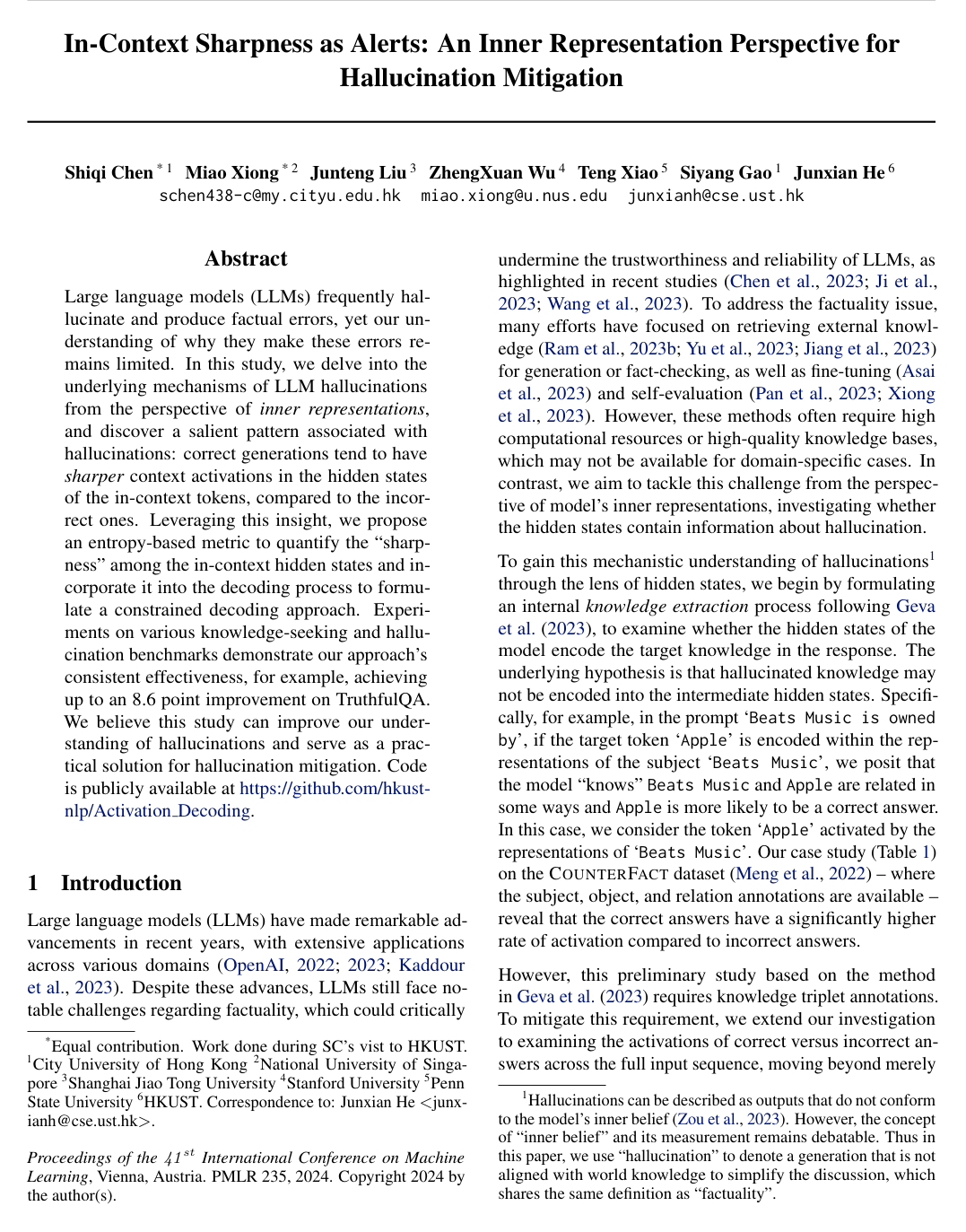
In-Context Sharpness as Alerts: An Inner Representation Perspective for Hallucination Mitigation
Shiqi Chen, Miao Xiong, Junteng Liu, Zhengxuan Wu, Teng Xiao, Siyang Gao, Junxian He
Why you should read this
Reveals that sharper in-context hidden state activations correlate with factual correctness in large language models and introduces Activation Decoding, an entropy-constrained generation method that significantly reduces hallucinations across standard question-answering benchmarks.
Large language models (LLMs) frequently hallucinate and produce factual errors, yet our understanding of why they make these errors remains limited. In this study, we delve into the underlying mechanisms of LLM hallucinations from the perspective of inner representations, and discover a salient pattern associated with hallucinations: correct generations tend to have sharper context activations in the hidden states of the in-context tokens, compared to the incorrect ones. Leveraging this insight, we propose an entropy-based metric to quantify the “sharpness” among the in-context hidden states and incorporate it into the decoding process to formulate a constrained decoding approach. Experiments on various knowledge-seeking and hallucination benchmarks demonstrate our approach’s consistent effectiveness, for example, achieving up to an 8.6 point improvement on TruthfulQA. We believe this study can improve our understanding of hallucinations and serve as a practical solution for hallucination mitigation. Code is publicly available at https://github.com/hkust-nlp/Activation_Decoding.
Added
2026-10-04
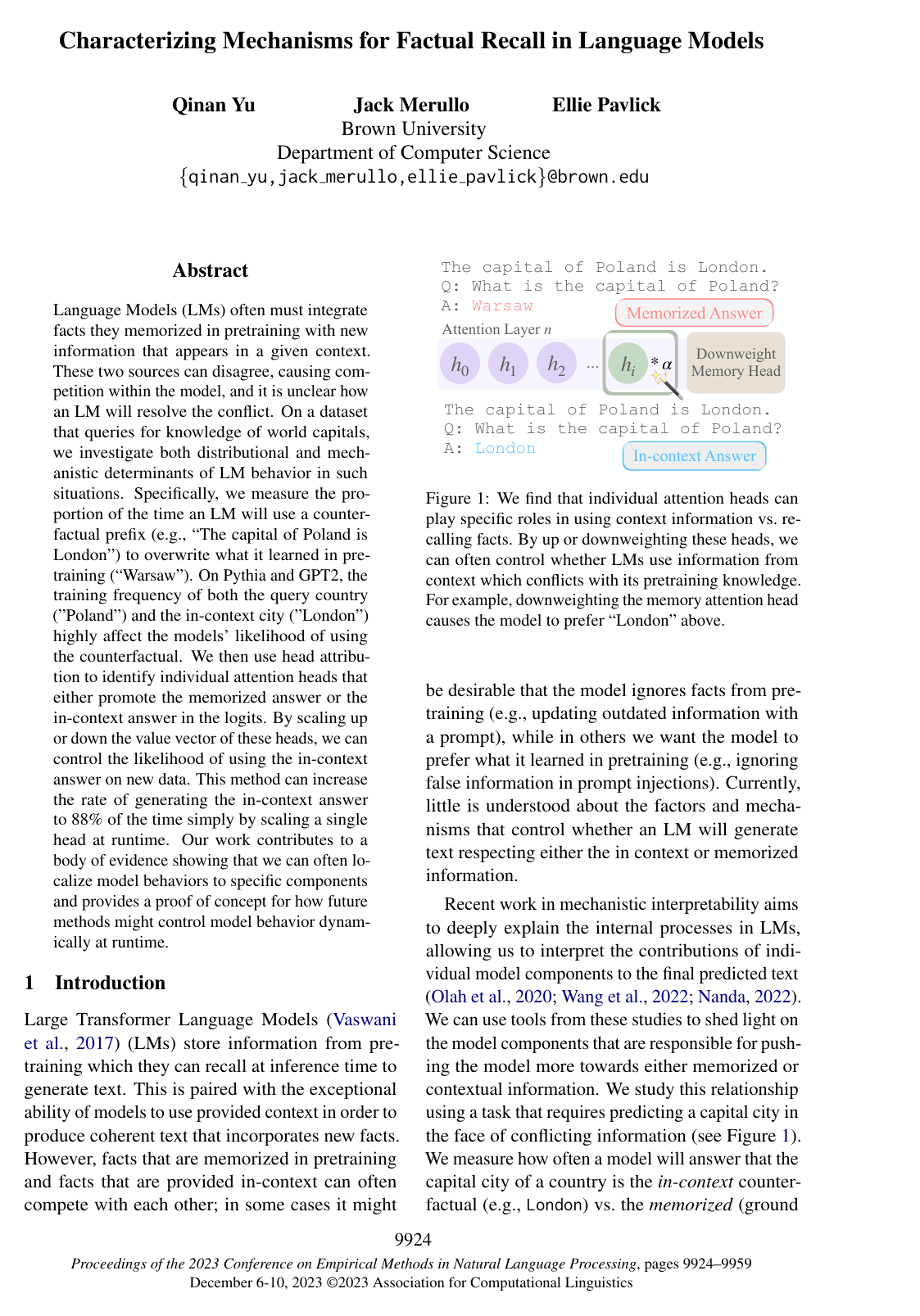
Characterizing Mechanisms for Factual Recall in Language Models
Qinan Yu, Jack Merullo, Ellie Pavlick
Why you should read this
Demonstrates that competition between memorized facts and counterfactual context in language models is governed by pretraining frequencies and can be dynamically controlled at runtime by scaling individual attention heads.
Language Models (LMs) often must integrate facts they memorized in pretraining with new information that appears in a given context. These two sources can disagree, causing competition within the model, and it is unclear how an LM will resolve the conflict. On a dataset that queries for knowledge of world capitals, we investigate both distributional and mechanistic determinants of LM behavior in such situations. Specifically, we measure the proportion of the time an LM will use a counterfactual prefix (e.g., “The capital of Poland is London”) to overwrite what it learned in pretraining (“Warsaw”). On Pythia and GPT2, the training frequency of both the query country (“Poland”) and the in-context city (“London”) highly affect the models’ likelihood of using the counterfactual. We then use head attribution to identify individual attention heads that either promote the memorized answer or the in-context answer in the logits. By scaling up or down the value vector of these heads, we can control the likelihood of using the in-context answer on new data. This method can increase the rate of generating the in-context answer to 88% of the time simply by scaling a single head at runtime. Our work contributes to a body of evidence showing that we can often localize model behaviors to specific components and provides a proof of concept for how future methods might control model behavior dynamically at runtime.
Added
2026-10-03
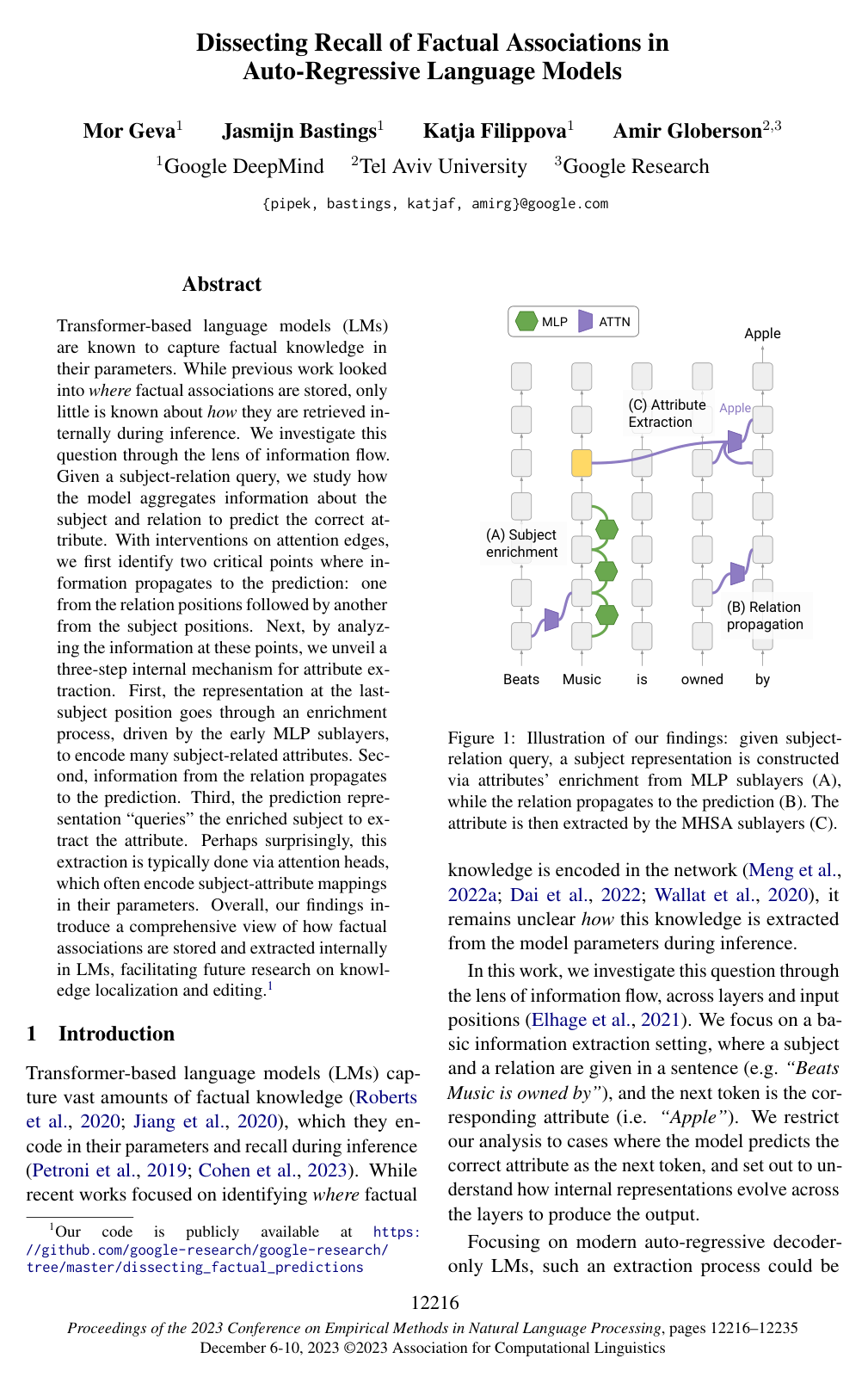
Dissecting Recall of Factual Associations in Auto-Regressive Language Models
Mor Geva, Jasmijn Bastings, Katja Filippova, Amir Globerson
Why you should read this
Reveals the step-by-step internal mechanism auto-regressive language models use to recall facts, demonstrating that early feed-forward layers enrich subject representations while upper attention heads directly extract the correct attributes.
Transformer-based language models (LMs) are known to capture factual knowledge in their parameters. While previous work looked into where factual associations are stored, only little is known about how they are retrieved internally during inference. We investigate this question through the lens of information flow. Given a subject-relation query, we study how the model aggregates information about the subject and relation to predict the correct attribute. With interventions on attention edges, we first identify two critical points where information propagates to the prediction: one from the relation positions followed by another from the subject positions. Next, by analyzing the information at these points, we unveil a three-step internal mechanism for attribute extraction. First, the representation at the last-subject position goes through an enrichment process, driven by the early MLP sublayers, to encode many subject-related attributes. Second, information from the relation propagates to the prediction. Third, the prediction representation “queries” the enriched subject to extract the attribute. Perhaps surprisingly, this extraction is typically done via attention heads, which often encode subject-attribute mappings in their parameters. Overall, our findings introduce a comprehensive view of how factual associations are stored and extracted internally in LMs, facilitating future research on knowledge localization and editing.¹
Added
2026-09-28
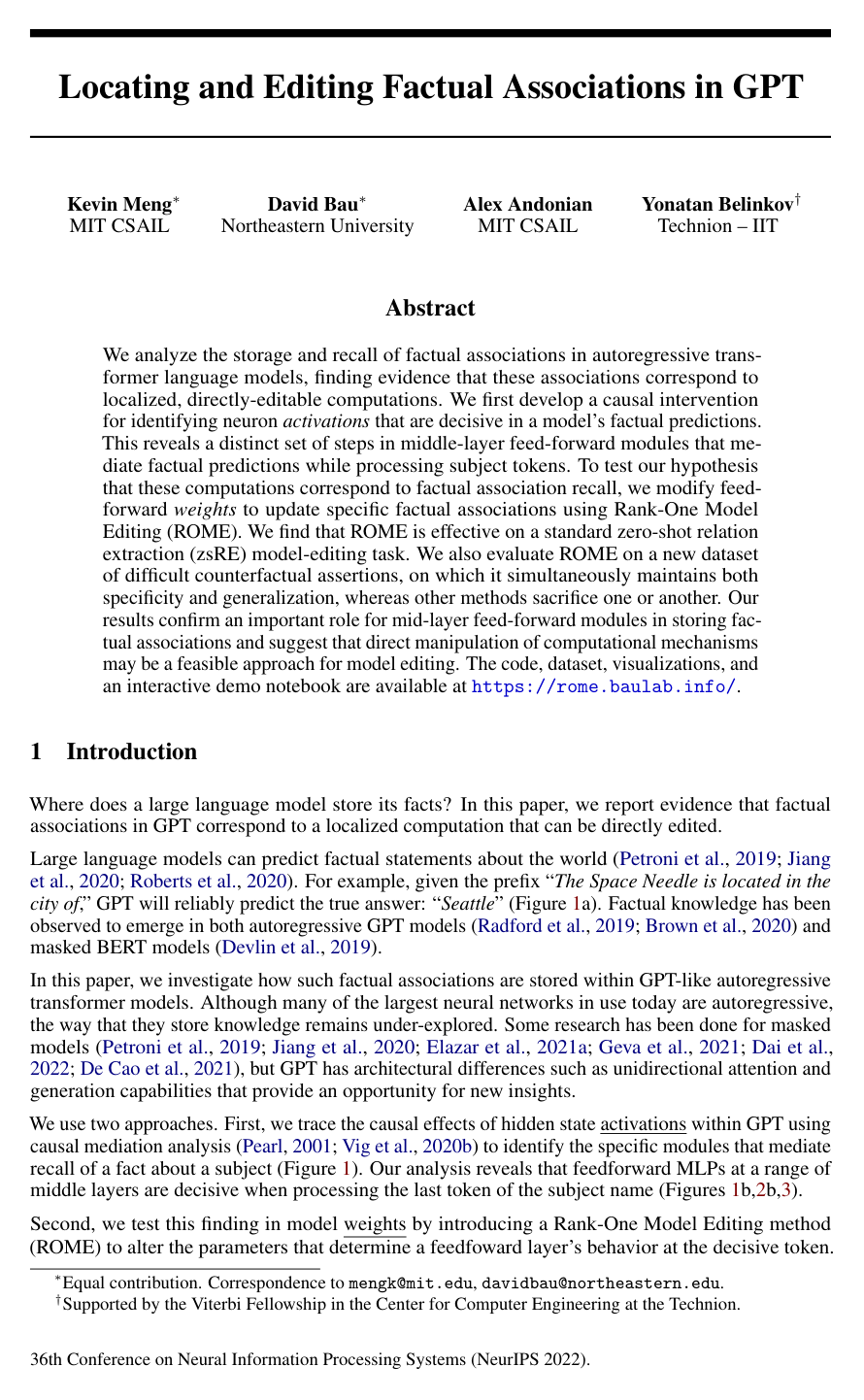
Locating and Editing Factual Associations in GPT
Kevin Meng, David Bau, A. Andonian, Yonatan Belinkov
Why you should read this
Demonstrates that factual recall in autoregressive transformers is localized to mid-layer feedforward networks and develops Rank-One Model Editing (ROME) to directly update individual stored facts without corrupting unrelated knowledge.
We analyze the storage and recall of factual associations in autoregressive transformer language models, finding evidence that these associations correspond to localized, directly-editable computations. We first develop a causal intervention for identifying neuron activations that are decisive in a model’s factual predictions. This reveals a distinct set of steps in middle-layer feed-forward modules that mediate factual predictions while processing subject tokens. To test our hypothesis that these computations correspond to factual association recall, we modify feed-forward weights to update specific factual associations using Rank-One Model Editing (ROME). We find that ROME is effective on a standard zero-shot relation extraction (zsRE) model-editing task. We also evaluate ROME on a new dataset of difficult counterfactual assertions, on which it simultaneously maintains both specificity and generalization, whereas other methods sacrifice one or another. Our results confirm an important role for mid-layer feed-forward modules in storing factual associations and suggest that direct manipulation of computational mechanisms may be a feasible approach for model editing. The code, dataset, visualizations, and an interactive demo notebook are available at https://rome.baulab.info/.
Added
2026-09-12
License
Published with permission