
keyword
facial attributes
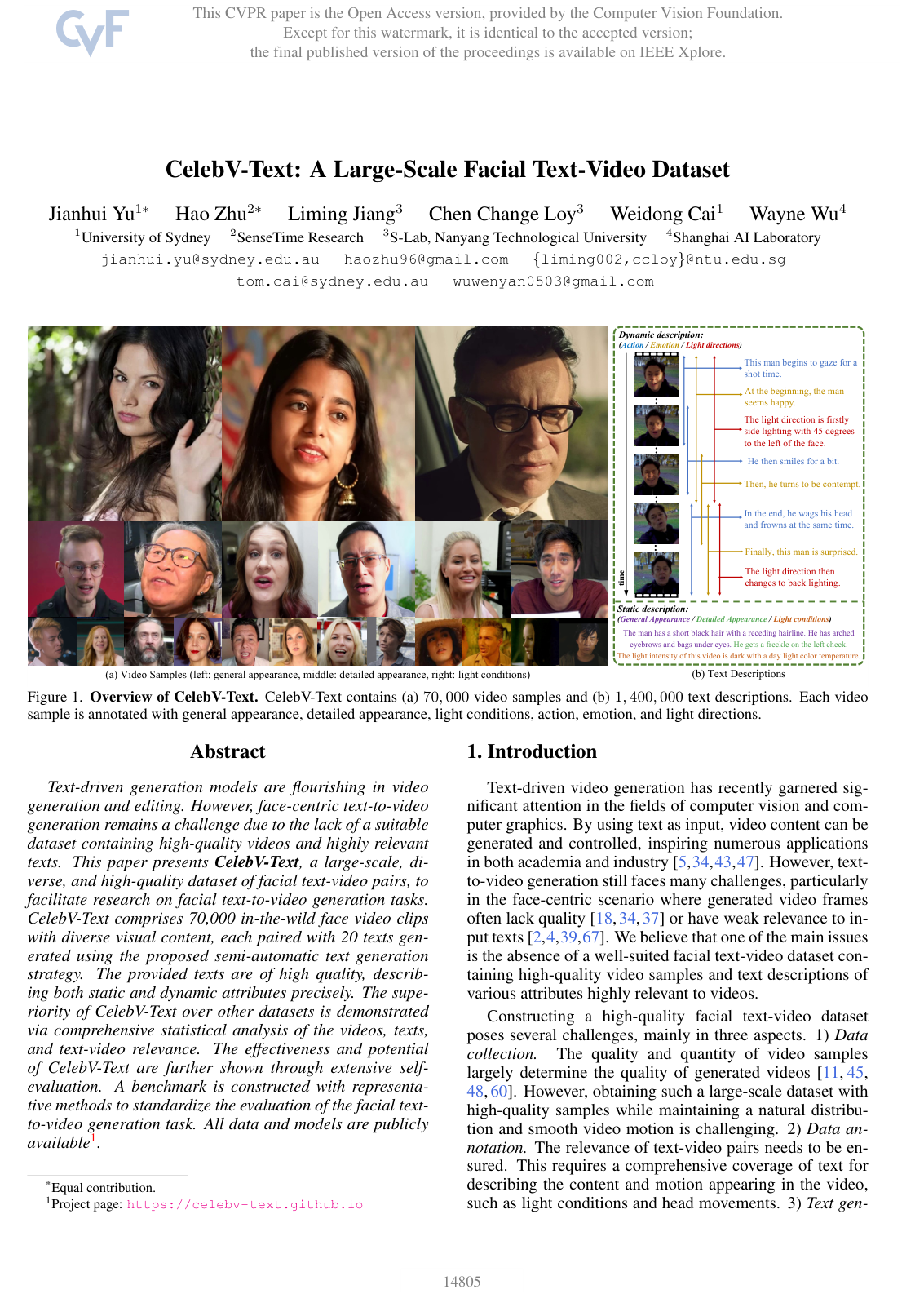
Facial attributes are observable visual traits and semantic characteristics that describe the appearance, structure, state, and identity-related qualities of a human face. In computer vision and biometric analysis, these attributes are generally categorized into static and dynamic properties. Static attributes remain relatively constant over time and encompass demographic traits such as age, sex, and ethnicity, along with distinct physical features like skin tone, eye shape, hair color, facial hair, and accessories such as eyeglasses. Dynamic attributes change over shorter intervals and include facial expressions, emotional displays, head poses, gaze directions, and mouth movements. Automated attribute recognition systems extract and interpret these descriptors from images or video sequences to support a wide range of computational tasks, including biometric authentication, video editing, generative visual modeling, and human-computer interaction.
2 items
CelebV-Text: A Large-Scale Facial Text-Video Dataset
Jianhui Yu, Hao Zhu, Liming Jiang, Chen Change Loy, Weidong Cai, Wayne Wu
Why you should read this
Presents a large-scale dataset of 70,000 in-the-wild facial video clips paired with 1.4 million detailed static and dynamic text descriptions to advance and standardize face-centric text-to-video generation.
Text-driven generation models are flourishing in video generation and editing. However, face-centric text-to-video generation remains a challenge due to the lack of a suitable dataset containing high-quality videos and highly relevant texts. This paper presents CelebV-Text, a large-scale, diverse, and high-quality dataset of facial text-video pairs, to facilitate research on facial text-to-video generation tasks. CelebV-Text comprises 70,000 in-the-wild face video clips with diverse visual content, each paired with 20 texts generated using the proposed semi-automatic text generation strategy. The provided texts are of high quality, describing both static and dynamic attributes precisely. The superiority of CelebV-Text over other datasets is demonstrated via comprehensive statistical analysis of the videos, texts, and text-video relevance. The effectiveness and potential of CelebV-Text are further shown through extensive self-evaluation. A benchmark is constructed with representative methods to standardize the evaluation of the facial text-to-video generation task. All data and models are publicly available^1.
Added
2026-09-26
Sibling-Attack: Rethinking Transferable Adversarial Attacks against Face Recognition
Zexin Li, Bangjie Yin, Taiping Yao, Junfeng Guo, Shouhong Ding, Simin Chen, Cong Liu
Why you should read this
Proposes a multi-task adversarial framework that leverages gradient information from face attribute recognition to substantially improve black-box attack transferability against commercial face recognition systems.
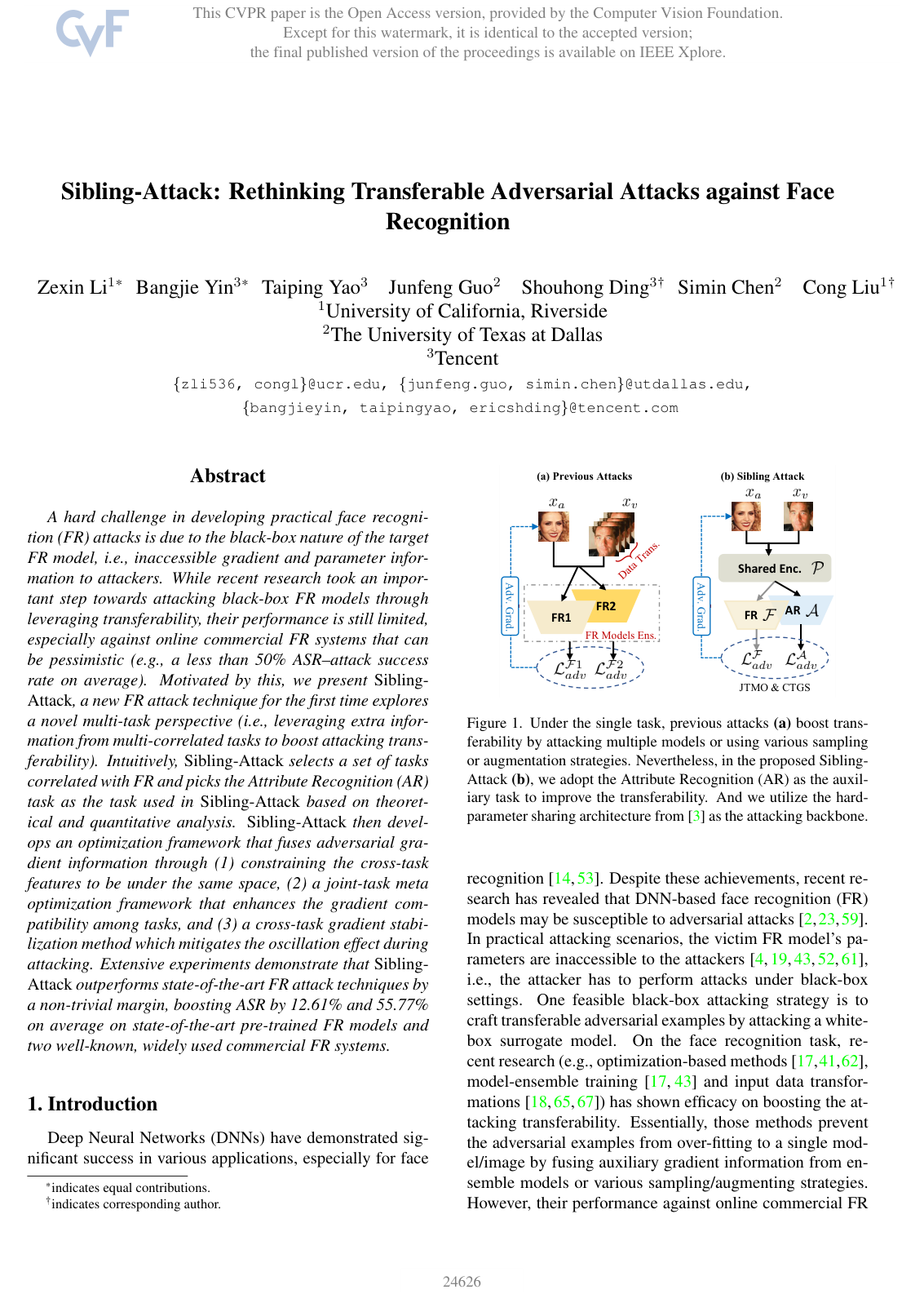
A hard challenge in developing practical face recognition (FR) attacks is due to the black-box nature of the target FR model, i.e., inaccessible gradient and parameter information to attackers. While recent research took an important step towards attacking black-box FR models through leveraging transferability, their performance is still limited, especially against online commercial FR systems that can be pessimistic (e.g., a less than 50% ASR–attack success rate on average). Motivated by this, we present Sibling-Attack, a new FR attack technique for the first time explores a novel multi-task perspective (i.e., leveraging extra information from multi-correlated tasks to boost attacking transferability). Intuitively, Sibling-Attack selects a set of tasks correlated with FR and picks the Attribute Recognition (AR) task as the task used in Sibling-Attack based on theoretical and quantitative analysis. Sibling-Attack then develops an optimization framework that fuses adversarial gradient information through (1) constraining the cross-task features to be under the same space, (2) a joint-task meta optimization framework that enhances the gradient compatibility among tasks, and (3) a cross-task gradient stabilization method which mitigates the oscillation effect during attacking. Extensive experiments demonstrate that Sibling-Attack outperforms state-of-the-art FR attack techniques by a non-trivial margin, boosting ASR by 12.61% and 55.77% on average on state-of-the-art pre-trained FR models and two well-known, widely used commercial FR systems.
Added
2026-09-26