
keyword
explanation generation
Explanation generation is the automated process by which an artificial intelligence or natural language processing system produces human-interpretable justifications, rationales, or step-by-step reasoning to explain its predictions, decisions, or outputs. This capability makes complex machine learning models more transparent by articulating why a particular conclusion was reached, commonly in the form of natural language text, formal logical deductions, or structured evidence. Within areas such as explainable artificial intelligence, question answering, and natural language inference, explanation generation is utilized to evaluate model behavior, facilitate error analysis, verify logical validity, and foster user trust in automated systems.
5 items
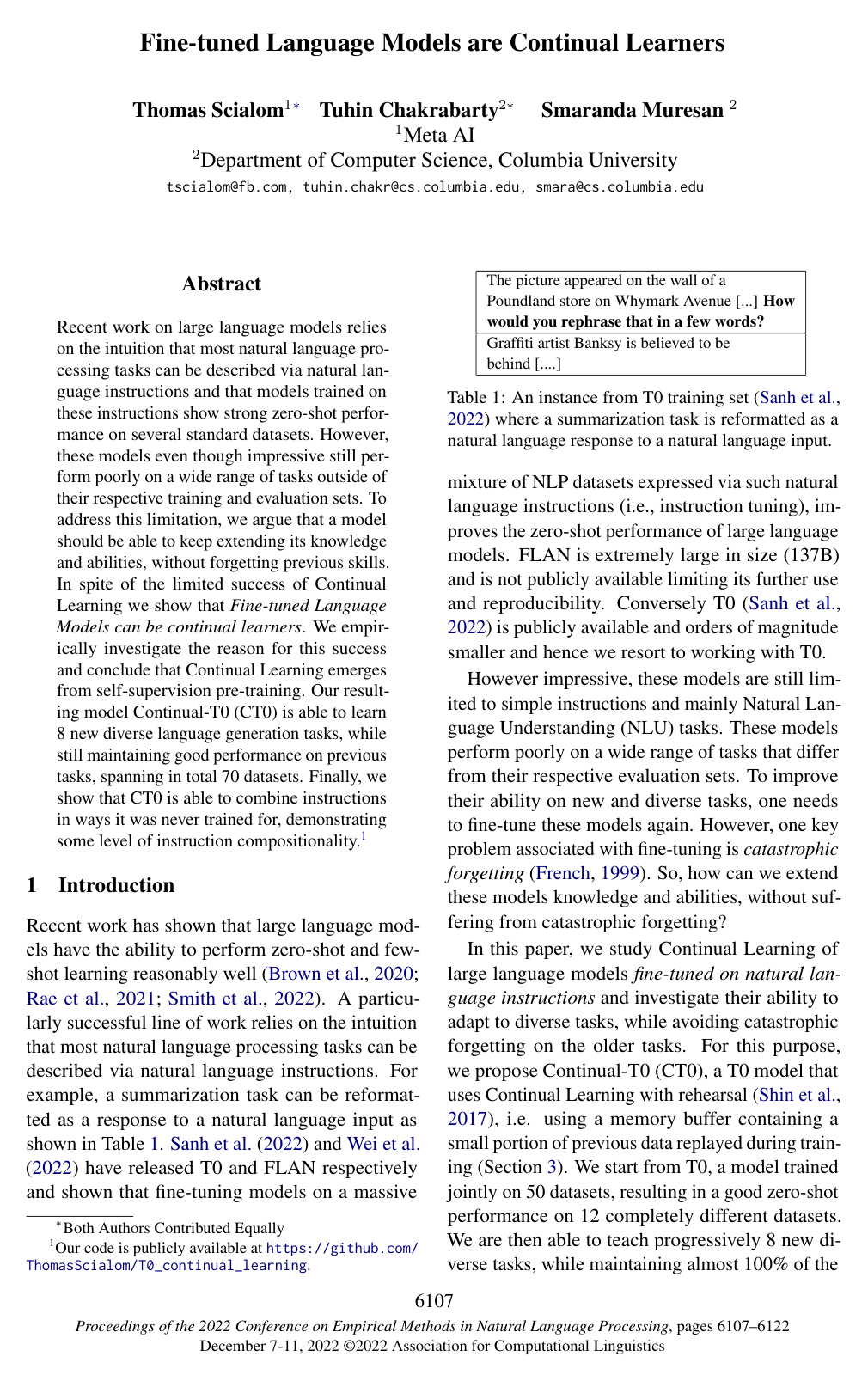
Fine-tuned Language Models are Continual Learners
Thomas Scialom, Tuhin Chakrabarty, Smaranda Muresan
Why you should read this
Demonstrates that instruction-tuned language models can sequentially acquire new generation tasks with minimal rehearsal while preventing catastrophic forgetting, identifying self-supervised pre-training as the primary driver of this capability.
Recent work on large language models relies on the intuition that most natural language processing tasks can be described via natural language instructions and that models trained on these instructions show strong zero-shot performance on several standard datasets. However, these models even though impressive still perform poorly on a wide range of tasks outside of their respective training and evaluation sets. To address this limitation, we argue that a model should be able to keep extending its knowledge and abilities, without forgetting previous skills. In spite of the limited success of Continual Learning we show that Fine-tuned Language Models can be continual learners. We empirically investigate the reason for this success and conclude that Continual Learning emerges from self-supervision pre-training. Our resulting model Continual-T0 (CT0) is able to learn 8 new diverse language generation tasks, while still maintaining good performance on previous tasks, spanning in total 70 datasets. Finally, we show that CT0 is able to combine instructions in ways it was never trained for, demonstrating some level of instruction compositionality.^1
Added
2026-10-05
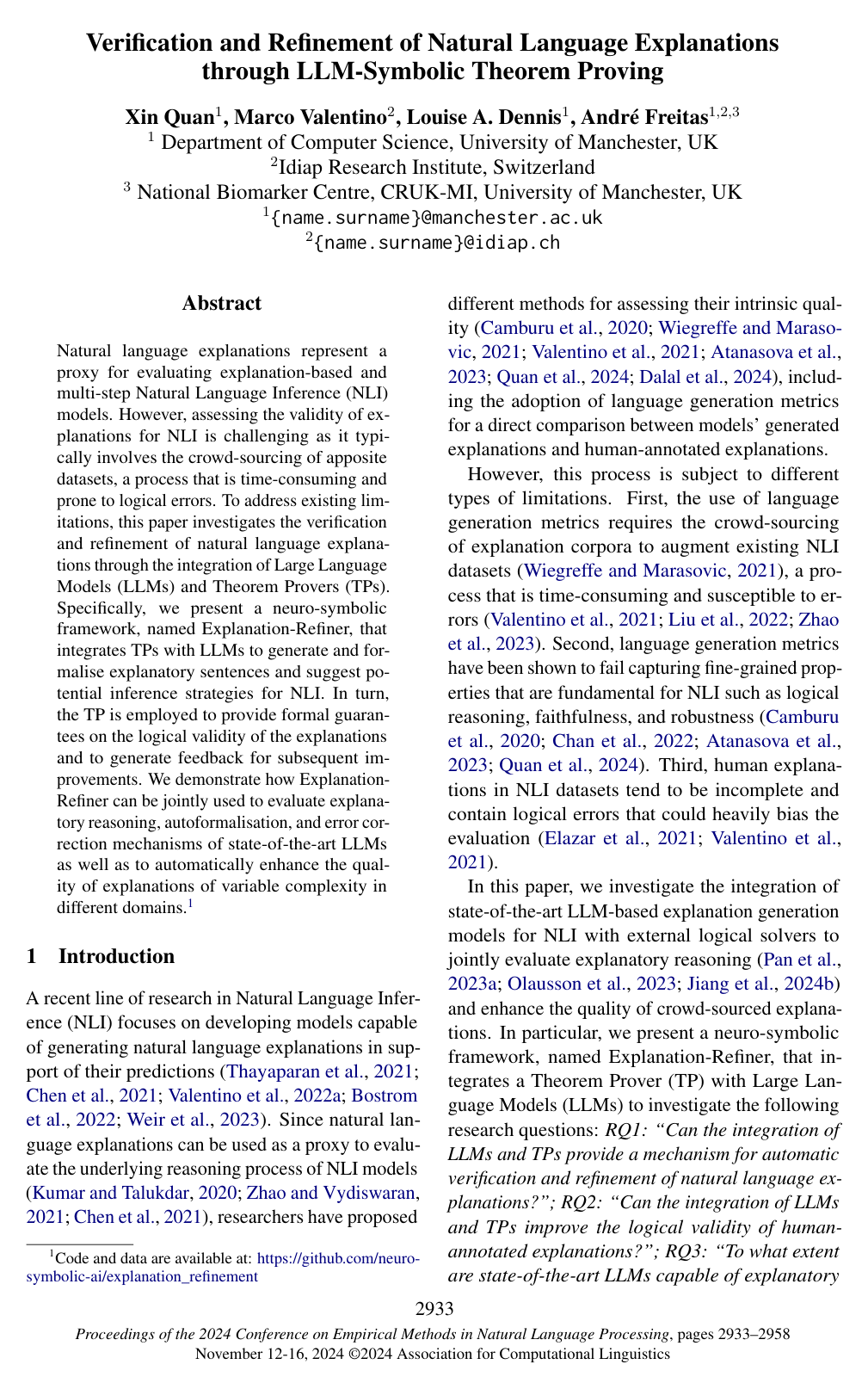
Verification and Refinement of Natural Language Explanations through LLM-Symbolic Theorem Proving
Xin Quan, Marco Valentino, Louise A. Dennis, André Freitas
Why you should read this
Proposes Explanation-Refiner, a neuro-symbolic framework that combines large language models with formal theorem provers to verify the logical validity of natural language inference explanations and iteratively repair reasoning errors through formal feedback.
Natural language explanations represent a proxy for evaluating explanation-based and multi-step Natural Language Inference (NLI) models. However, assessing the validity of explanations for NLI is challenging as it typically involves the crowd-sourcing of apposite datasets, a process that is time-consuming and prone to logical errors. To address existing limitations, this paper investigates the verification and refinement of natural language explanations through the integration of Large Language Models (LLMs) and Theorem Provers (TPs). Specifically, we present a neuro-symbolic framework, named Explanation-Refiner, that integrates TPs with LLMs to generate and formalise explanatory sentences and suggest potential inference strategies for NLI. In turn, the TP is employed to provide formal guarantees on the logical validity of the explanations and to generate feedback for subsequent improvements. We demonstrate how Explanation-Refiner can be jointly used to evaluate explanatory reasoning, automatisation, and error correction mechanisms of state-of-the-art LLMs as well as to automatically enhance the quality of explanations of variable complexity in different domains.
Added
2026-10-05
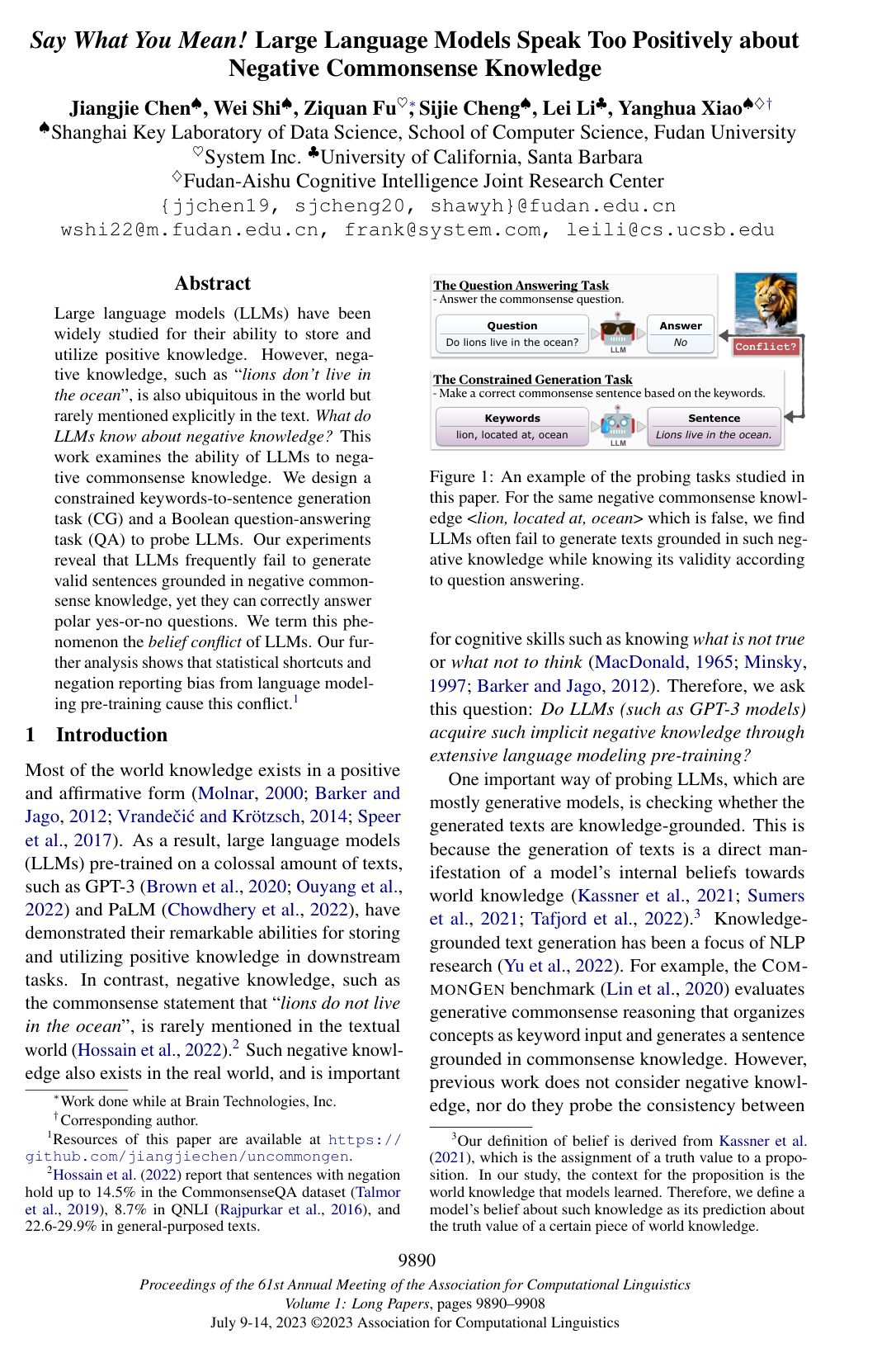
Say What You Mean! Large Language Models Speak Too Positively about Negative Commonsense Knowledge
Jiangjie Chen, Wei Shi, Ziquan Fu, Sijie Cheng, Lei Li, Yanghua Xiao
Why you should read this
Reveals a fundamental belief conflict in large language models where they correctly answer yes-or-no questions about negative commonsense facts yet fail to generate text incorporating that same negative knowledge due to pre-training reporting biases.
Large language models (LLMs) have been widely studied for their ability to store and utilize positive knowledge. However, negative knowledge, such as “lions don’t live in the ocean”, is also ubiquitous in the world but rarely mentioned explicitly in the text. What do LLMs know about negative knowledge? This work examines the ability of LLMs to negative commonsense knowledge. We design a constrained keywords-to-sentence generation task (CG) and a Boolean question-answering task (QA) to probe LLMs. Our experiments reveal that LLMs frequently fail to generate valid sentences grounded in negative commonsense knowledge, yet they can correctly answer polar yes-or-no questions. We term this phenomenon the belief conflict of LLMs. Our further analysis shows that statistical shortcuts and negation reporting bias from language modeling pre-training cause this conflict.
Added
2026-09-26
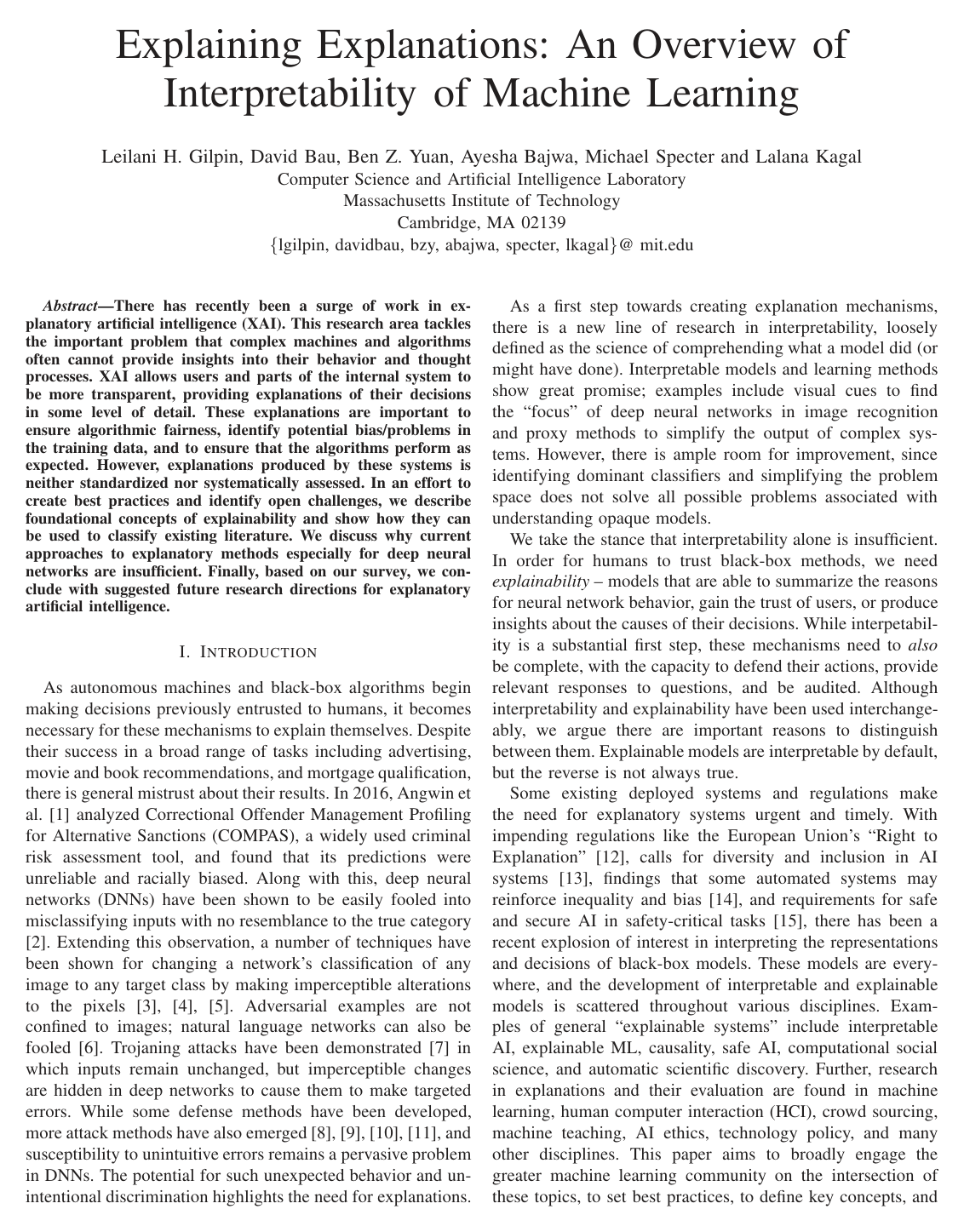
Explaining Explanations: An Overview of Interpretability of Machine Learning
Leilani H. Gilpin, David Bau, Ben Z. Yuan, Ayesha Bajwa, Michael A. Specter, Lalana Kagal
Why you should read this
Synthesizes the literature on explainable artificial intelligence by establishing a rigorous definition of interpretability, exposing the limitations of current explanation methods for deep neural networks, and defining criteria to standardize future evaluation.
There has recently been a surge of work in explanatory artificial intelligence (XAI). This research area tackles the important problem that complex machines and algorithms often cannot provide insights into their behavior and thought processes. XAI allows users and parts of the internal system to be more transparent, providing explanations of their decisions in some level of detail. These explanations are important to ensure algorithmic fairness, identify potential bias/problems in the training data, and to ensure that the algorithms perform as expected. However, explanations produced by these systems is neither standardized nor systematically assessed. In an effort to create best practices and identify open challenges, we provide our definition of explainability and show how it can be used to classify existing literature. We discuss why current approaches to explanatory methods especially for deep neural networks are insufficient. Finally, based on our survey, we conclude with suggested future research directions for explanatory artificial intelligence.
Added
2026-09-16
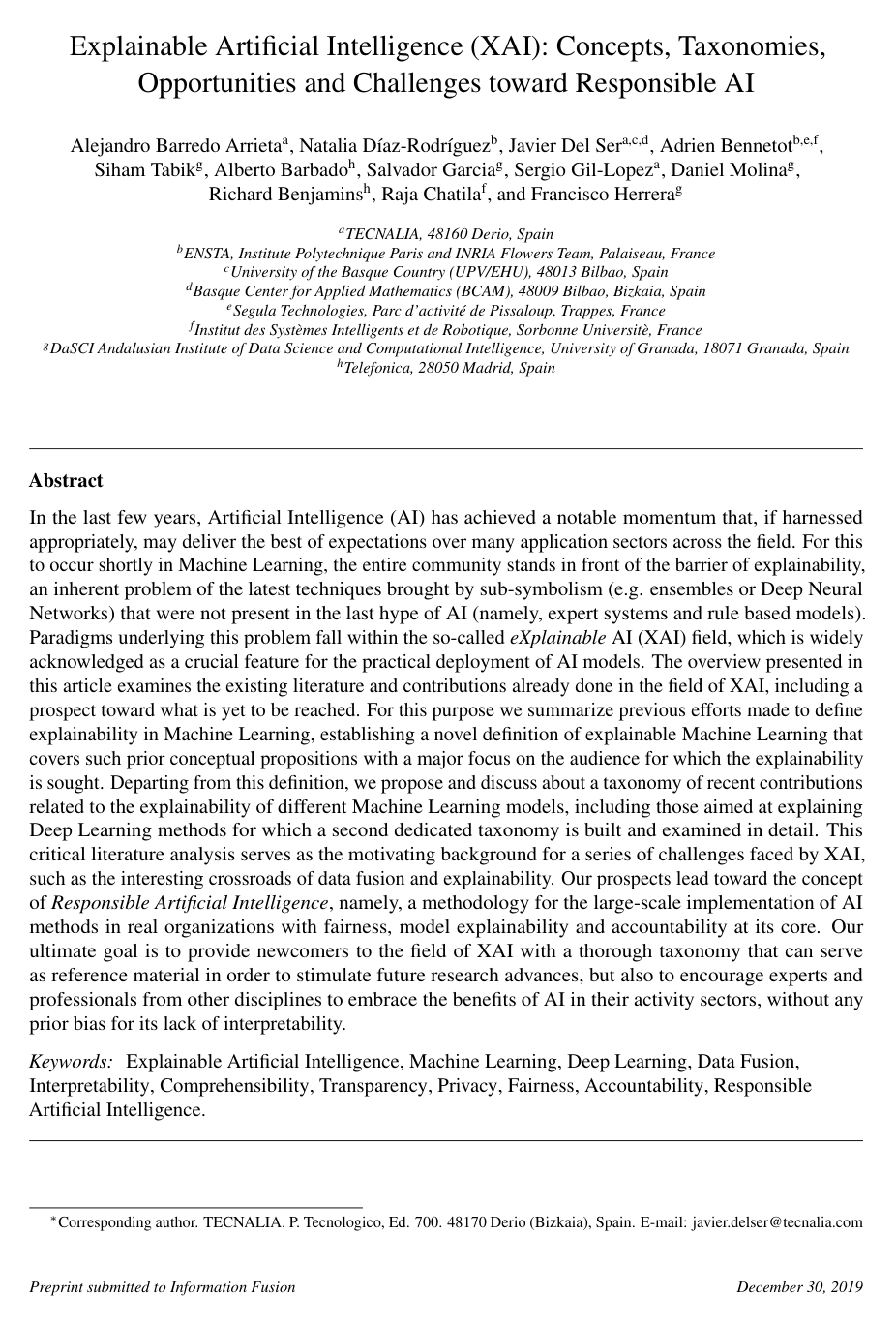
Explainable Artificial Intelligence (XAI): Concepts, Taxonomies, Opportunities and Challenges toward Responsible AI
Alejandro Barredo Arrieta, Natalia Díaz-Rodríguez, Javier Del Ser, Adrien Bennetot, Siham Tabik, Alberto Barbado, Salvador García, Sergio Gil-López, Daniel Molina, Richard Benjamins, Raja Chatila, Francisco Herrera
Why you should read this
Establishes audience-centered taxonomies for classical machine learning and deep learning interpretability while defining how explainable methods enable fair, accountable, and responsible artificial intelligence deployment.
In the last years, Artificial Intelligence (AI) has achieved a notable momentum that may deliver the best of expectations over many application sectors across the field. For this to occur, the entire community stands in front of the barrier of explainability, an inherent problem of AI techniques brought by sub-symbolism (e.g. ensembles or Deep Neural Networks) that were not present in the last hype of AI. Paradigms underlying this problem fall within the so-called eXplainable AI (XAI) field, which is acknowledged as a crucial feature for the practical deployment of AI models. This overview examines the existing literature in the field of XAI, including a prospect toward what is yet to be reached. We summarize previous efforts to define explainability in Machine Learning, establishing a novel definition that covers prior conceptual propositions with a major focus on the audience for which explainability is sought. We then propose and discuss about a taxonomy of recent contributions related to the explainability of different Machine Learning models, including those aimed at Deep Learning methods for which a second taxonomy is built. This literature analysis serves as the background for a series of challenges faced by XAI, such as the crossroads between data fusion and explainability. Our prospects lead toward the concept of Responsible Artificial Intelligence, namely, a methodology for the large-scale implementation of AI methods in real organizations with fairness, model explainability and accountability at its core. Our ultimate goal is to provide newcomers to XAI with a reference material in order to stimulate future research advances, but also to encourage experts and professionals from other disciplines to embrace the benefits of AI in their activity sectors, without any prior bias for its lack of interpretability.
Added
2026-09-09