Built independently by an author, for readers. Read the story and support ChapterPal

keyword

explanation-based prompting

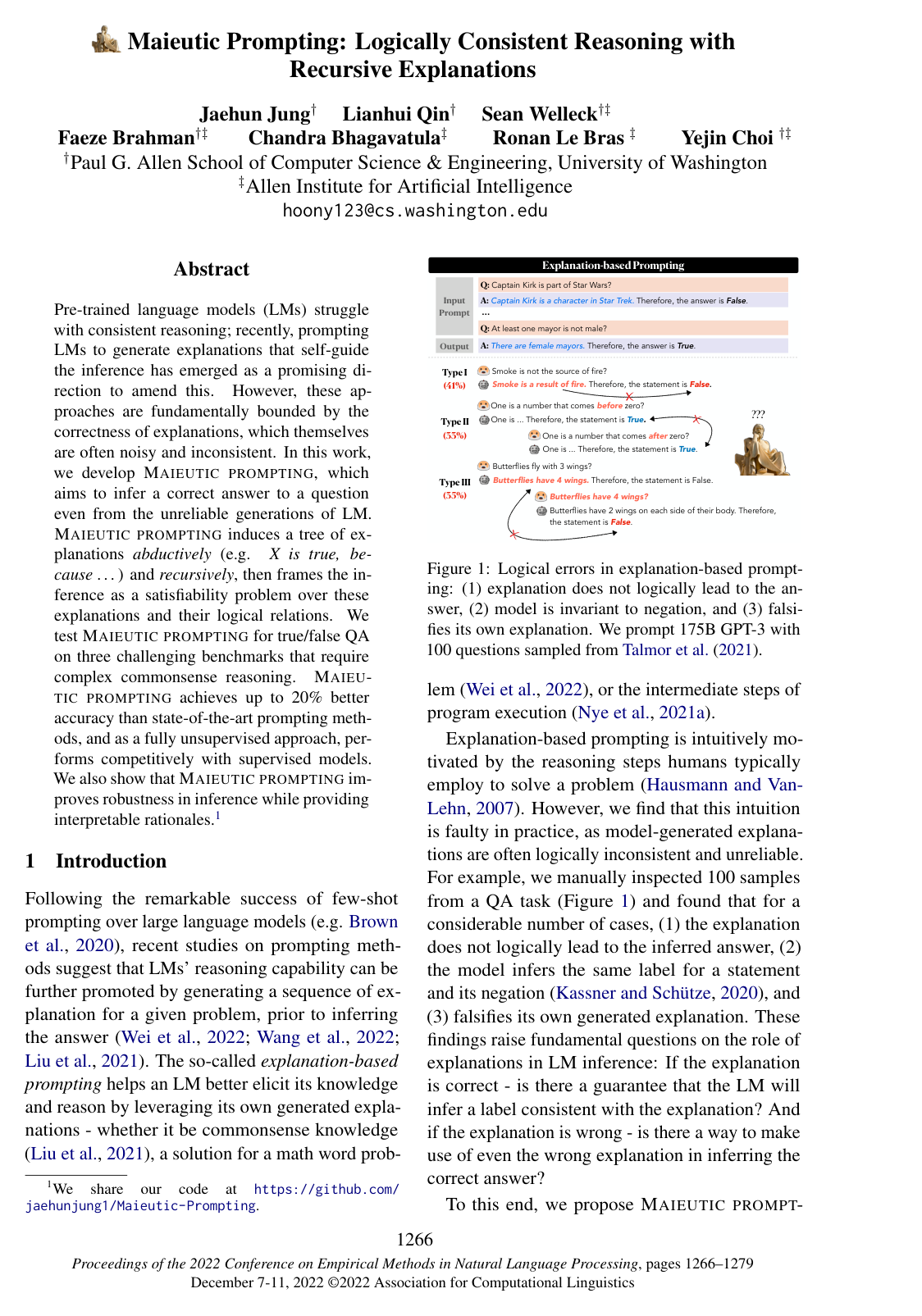
Explanation-based prompting is a prompt engineering technique in natural language processing where a language model is instructed to generate intermediate explanations, rationales, or step-by-step reasoning to guide its own inference toward a final answer. Instead of directly predicting an outcome or answer from a given input, the model explicitly articulates the intermediate logic or evidence supporting its conclusion. This approach enhances transparency by providing human-readable explanations and can improve the consistency and accuracy of language models on complex reasoning, question answering, and decision-making tasks, although the reliability of the final result depends on the factual correctness and logical coherence of the generated intermediate steps.

1 item

Maieutic Prompting: Logically Consistent Reasoning with Recursive Explanations

Maieutic Prompting: Logically Consistent Reasoning with Recursive Explanations

Jaehun Jung, Lianhui Qin, Sean Welleck, Faeze Brahman, Chandra Bhagavatula, Ronan Le Bras, Yejin Choi

OrganizationsAllen Institute for AIUniversity of Washington

Why you should read this

Proposes an unsupervised prompting method that recursively generates trees of abductive explanations and resolves their logical inconsistencies with a satisfiability solver, improving commonsense question-answering accuracy by up to 20% over standard prompting baselines.

Pre-trained language models (LMs) struggle with consistent reasoning; recently, prompting LMs to generate explanations that self-guide the inference has emerged as a promising direction to amend this. However, these approaches are fundamentally bounded by the correctness of explanations, which themselves are often noisy and inconsistent. In this work, we develop MAIEUTIC PROMPTING, which aims to infer a correct answer to a question even from the unreliable generations of LM. MAIEUTIC PROMPTING induces a tree of explanations abductively (e.g. X is true, because . . .) and recursively, then frames the inference as a satisfiability problem over these explanations and their logical relations. We test MAIEUTIC PROMPTING for true/false QA on three challenging benchmarks that require complex commonsense reasoning. MAIEUTIC PROMPTING achieves up to 20% better accuracy than state-of-the-art prompting methods, and as a fully unsupervised approach, performs competitively with supervised models. We also show that MAIEUTIC PROMPTING improves robustness in inference while providing interpretable rationales.

Added

2026-09-26