
keyword
expert routing
Expert routing is a mechanism in sparse mixture-of-experts neural network architectures that dynamically directs incoming data, such as input tokens, to a specialized subset of subnetworks called experts. Guided by a learned gating or routing algorithm, this process computes affinity scores for the input representations to select the most relevant experts to perform the computation. By activating only a small fraction of the network for any single input rather than utilizing the full set of parameters, expert routing allows large models to significantly scale total parameter capacity while preserving computational efficiency during training and inference.
2 items
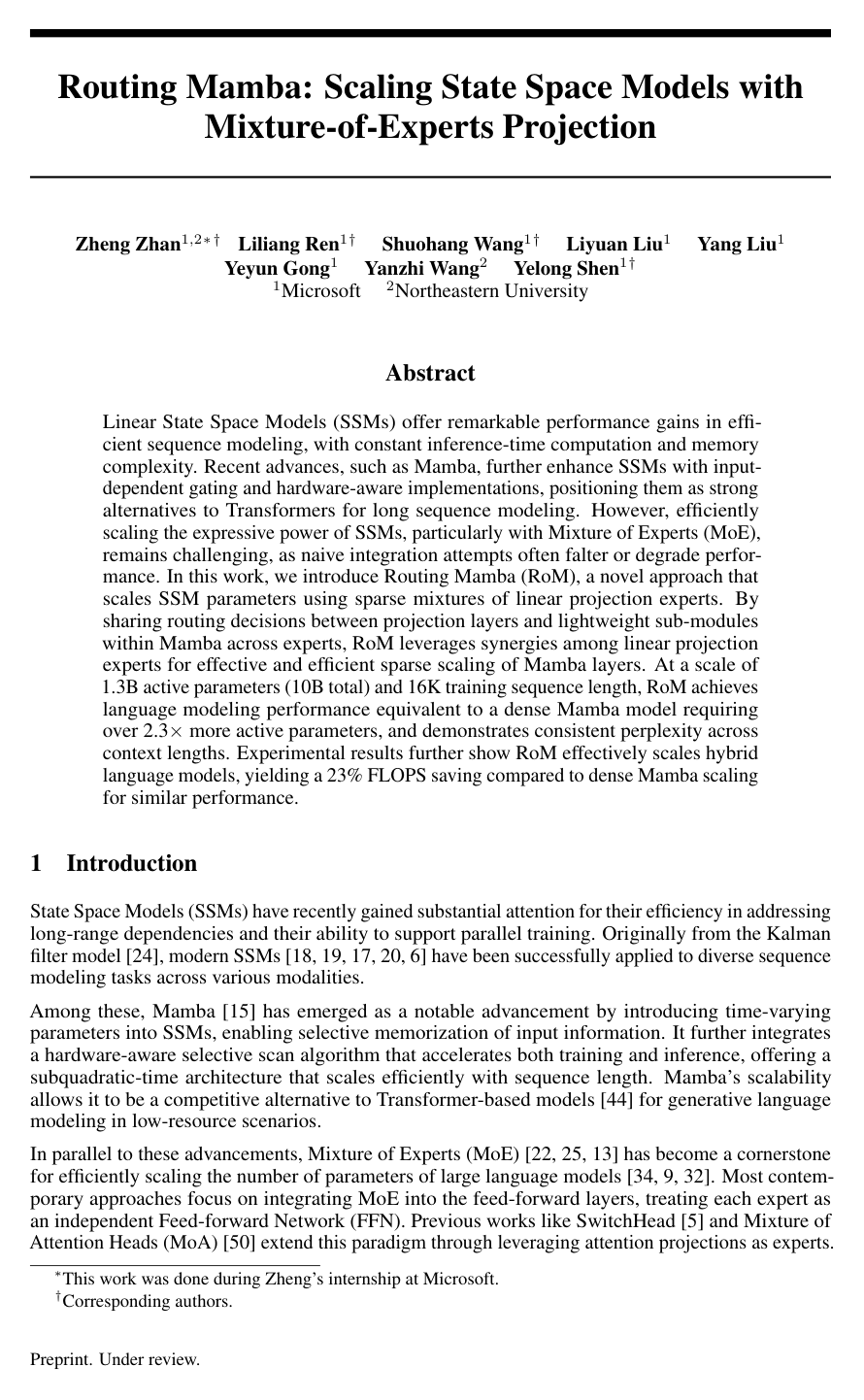
Routing Mamba: Scaling State Space Models with Mixture-of-Experts Projection
Zheng Zhan, Liliang Ren, Shuohang Wang, Liyuan Liu, Yang Liu, Yeyun Gong, Yanzhi Wang, Yelong Shen
Why you should read this
Proposes Routing Mamba, an architecture that scales state space models using sparse mixture-of-experts projections to match the language modeling performance of dense baselines while requiring 2.3 times fewer active parameters and cutting compute costs by 23 percent.
Linear State Space Models (SSMs) offer remarkable performance gains in efficient sequence modeling, with constant inference-time computation and memory complexity. Recent advances, such as Mamba, further enhance SSMs with input-dependent gating and hardware-aware implementations, positioning them as strong alternatives to Transformers for long sequence modeling. However, efficiently scaling the expressive power of SSMs, particularly with Mixture of Experts (MoE), remains challenging, as naive integration attempts often falter or degrade performance. In this work, we introduce Routing Mamba (RoM), a novel approach that scales SSM parameters using sparse mixtures of linear projection experts. By sharing routing decisions between projection layers and lightweight sub-modules within Mamba across experts, RoM leverages synergies among linear projection experts for effective and efficient sparse scaling of Mamba layers. At a scale of 1.3B active parameters (10B total) and 16K training sequence length, RoM achieves language modeling performance equivalent to a dense Mamba model requiring over 2.3x more active parameters, and demonstrates consistent perplexity across context lengths. Experimental results further show RoM effectively scales hybrid language models, yielding a 23% FLOPS saving compared to dense Mamba scaling for similar performance.
Added
2026-10-01
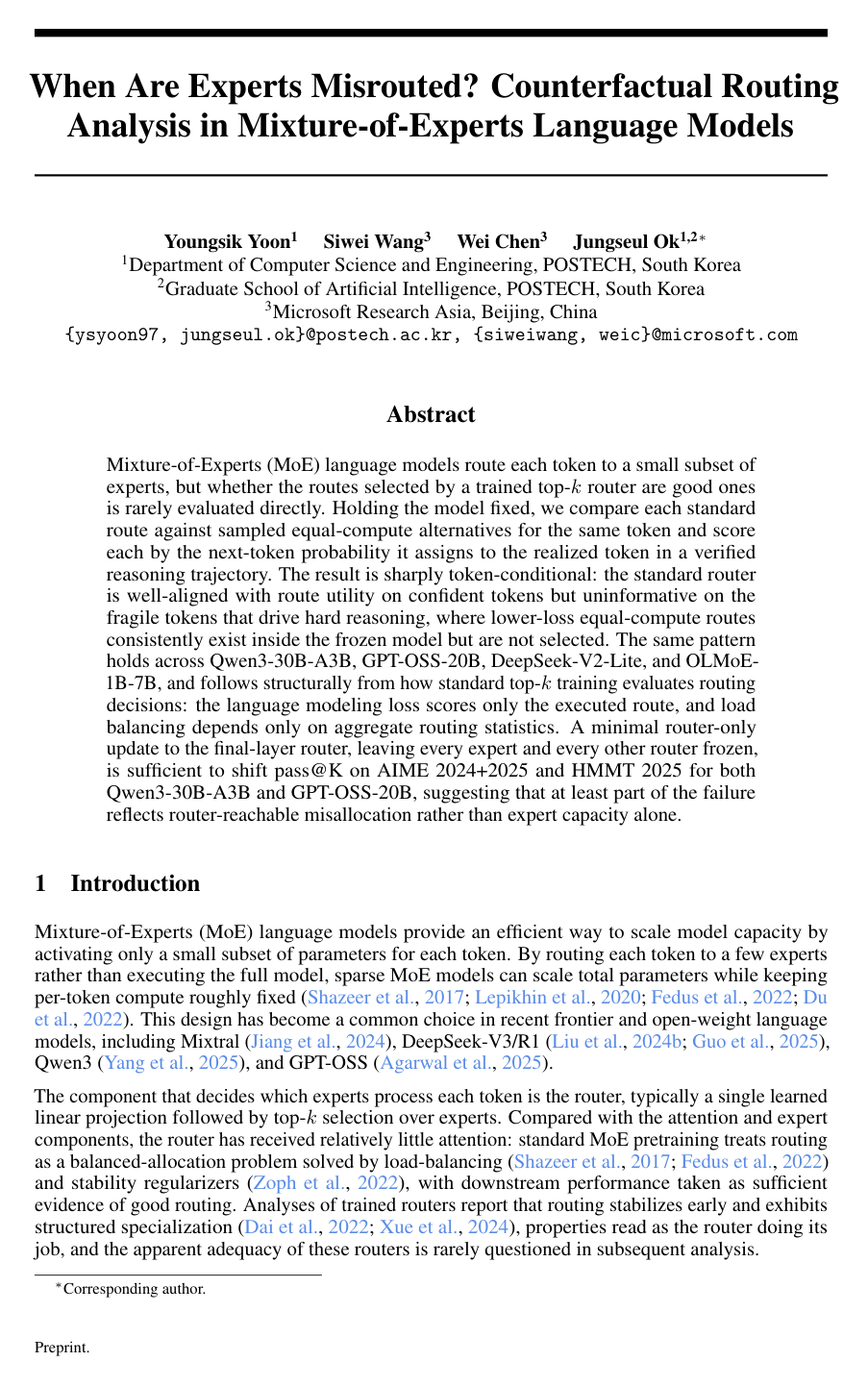
When Are Experts Misrouted? Counterfactual Routing Analysis in Mixture-of-Experts Language Models
Youngsik Yoon, Siwei Wang, Wei Chen, Jungseul Ok
Why you should read this
Reveals that mixture-of-experts routers systematically misroute the fragile tokens critical for complex reasoning, showing that updating only the final-layer router without modifying expert weights substantially improves accuracy on challenging mathematical benchmarks.
Mixture-of-Experts (MoE) language models route each token to a small subset of experts, but whether the routes selected by a trained top- router are good ones is rarely evaluated directly. Holding the model fixed, we compare each standard route against sampled equal-compute alternatives for the same token and score each by the next-token probability it assigns to the realized token in a verified reasoning trajectory. The result is sharply token-conditional: the standard router is well-aligned with route utility on confident tokens but uninformative on the fragile tokens that drive hard reasoning, where lower-loss equal-compute routes consistently exist inside the frozen model but are not selected. The same pattern holds across Qwen3-30B-A3B, GPT-OSS-20B, DeepSeek-V2-Lite, and OLMoE-1B-7B, and follows structurally from how standard top- training evaluates routing decisions: the language modeling loss scores only the executed route, and load balancing depends only on aggregate routing statistics. A minimal router-only update to the final-layer router, leaving every expert and every other router frozen, is sufficient to shift pass@K on AIME 2024+2025 and HMMT 2025 for both Qwen3-30B-A3B and GPT-OSS-20B, suggesting that at least part of the failure reflects router-reachable misallocation rather than expert capacity alone.
Added
2026-09-30