
keyword
expert parallelism
Expert parallelism is a distributed computing strategy for Mixture of Experts neural networks in which individual expert sub-networks are assigned across separate processing devices such as GPUs or TPUs. Rather than replicating all experts on every device or splitting the internal weight matrices of individual experts across hardware, each device stores and executes only a subset of complete experts. During model execution, a routing mechanism evaluates incoming input tokens and dynamically dispatches them across devices to the designated experts using all-to-all communication before aggregating the processed results back. This partitioning method significantly reduces per-device memory consumption and allows sparse, high-capacity models containing hundreds of billions or trillions of parameters to scale efficiently, frequently operating in coordination with data, tensor, and pipeline parallelism.
9 items
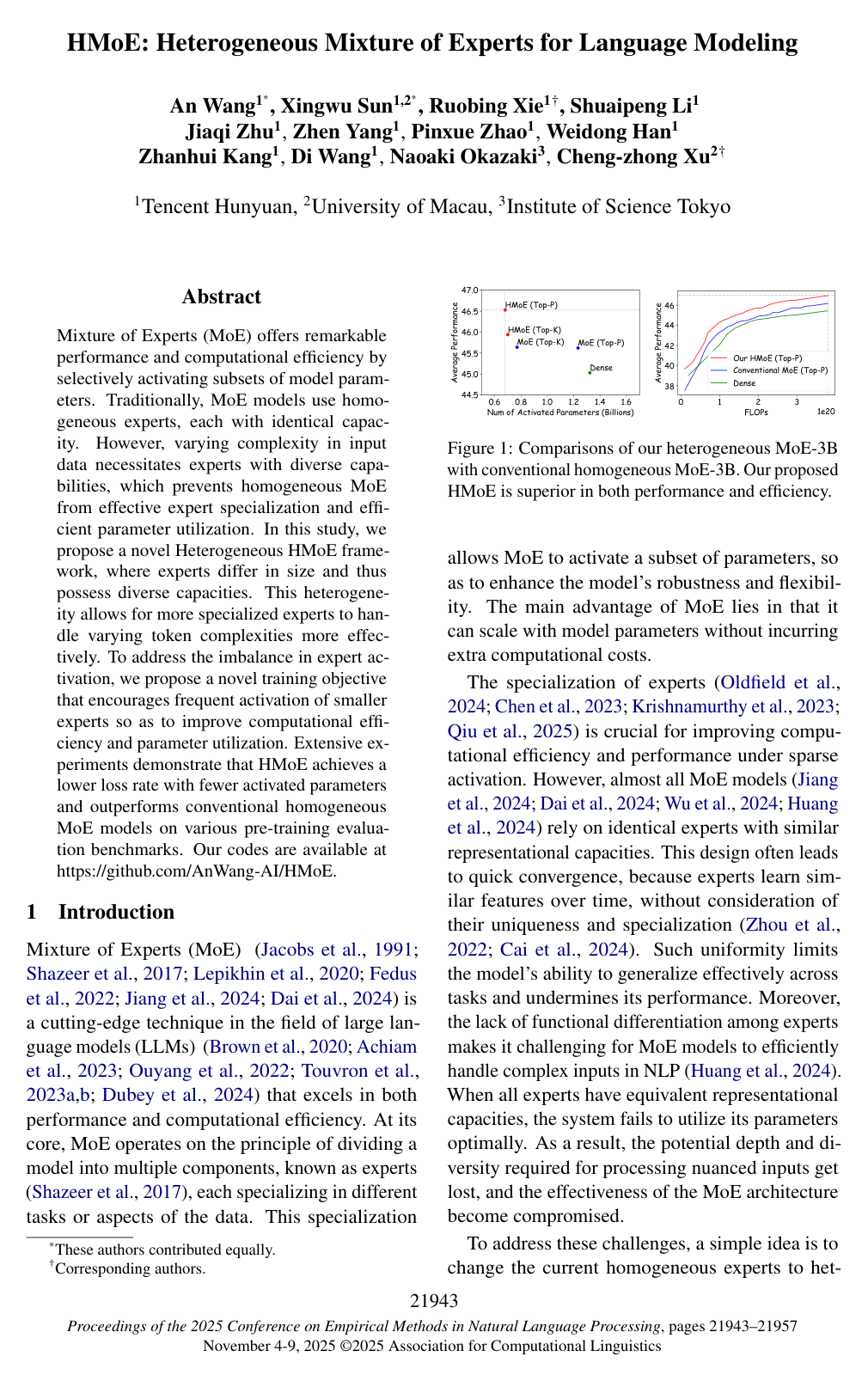
HMoE: Heterogeneous Mixture of Experts for Language Modeling
An Wang, Xingwu Sun, Ruobing Xie, Shuaipeng Li, Jiaqi Zhu, Zhen Yang, Pinxue Zhao, Weidong Han, Zhanhui Kang, Di Wang, Naoaki Okazaki, Cheng-Zhong Xu
Why you should read this
Proposes a heterogeneous Mixture of Experts framework featuring differently sized expert networks paired with a parameter-penalty loss, reducing activated parameter counts while surpassing standard homogeneous architectures across language modeling benchmarks.
Mixture of Experts (MoE) offers remarkable performance and computational efficiency by selectively activating subsets of model parameters. Traditionally, MoE models use homogeneous experts, each with identical capacity. However, varying complexity in input data necessitates experts with diverse capabilities, which prevents homogeneous MoE from effective expert specialization and efficient parameter utilization. In this study, we propose a novel Heterogeneous HMoE framework, where experts differ in size and thus possess diverse capacities. This heterogeneity allows for more specialized experts to handle varying token complexities more effectively. To address the imbalance in expert activation, we propose a novel training objective that encourages frequent activation of smaller experts so as to improve computational efficiency and parameter utilization. Extensive experiments demonstrate that HMoE achieves a lower loss rate with fewer activated parameters and outperforms conventional homogeneous MoE models on various pre-training evaluation benchmarks. Our codes are available at https://github.com/AnWang-AI/HMoE.
Added
2026-10-05
Memory-efficient NLLB-200: Language-specific Expert Pruning of a Massively Multilingual Machine Translation Model
Yeskendir Koishekenov, Alexandre Berard, Vassilina Nikoulina
Why you should read this
Proposes an inference-time pruning method that removes up to 80% of experts from the 54.5-billion-parameter NLLB-200 translation model without fine-tuning, reducing hardware requirements from multiple devices down to a single 32GB GPU while maintaining translation quality.
The recently released NLLB-200 is a set of multilingual Neural Machine Translation models that cover 202 languages. The largest model is based on a Mixture of Experts architecture and achieves SoTA results across many language pairs. It contains 54.5B parameters and requires at least four 32GB GPUs just for inference. In this work, we propose a pruning method that enables the removal of up to 80% of experts without further finetuning and with a negligible loss in translation quality, which makes it feasible to run the model on a single 32GB GPU. Further analysis suggests that our pruning metrics can identify language-specific experts.
Added
2026-10-03
Routing Mamba: Scaling State Space Models with Mixture-of-Experts Projection
Zheng Zhan, Liliang Ren, Shuohang Wang, Liyuan Liu, Yang Liu, Yeyun Gong, Yanzhi Wang, Yelong Shen
Why you should read this
Proposes Routing Mamba, an architecture that scales state space models using sparse mixture-of-experts projections to match the language modeling performance of dense baselines while requiring 2.3 times fewer active parameters and cutting compute costs by 23 percent.
Linear State Space Models (SSMs) offer remarkable performance gains in efficient sequence modeling, with constant inference-time computation and memory complexity. Recent advances, such as Mamba, further enhance SSMs with input-dependent gating and hardware-aware implementations, positioning them as strong alternatives to Transformers for long sequence modeling. However, efficiently scaling the expressive power of SSMs, particularly with Mixture of Experts (MoE), remains challenging, as naive integration attempts often falter or degrade performance. In this work, we introduce Routing Mamba (RoM), a novel approach that scales SSM parameters using sparse mixtures of linear projection experts. By sharing routing decisions between projection layers and lightweight sub-modules within Mamba across experts, RoM leverages synergies among linear projection experts for effective and efficient sparse scaling of Mamba layers. At a scale of 1.3B active parameters (10B total) and 16K training sequence length, RoM achieves language modeling performance equivalent to a dense Mamba model requiring over 2.3x more active parameters, and demonstrates consistent perplexity across context lengths. Experimental results further show RoM effectively scales hybrid language models, yielding a 23% FLOPS saving compared to dense Mamba scaling for similar performance.
Added
2026-10-01
OpenMoE: An Early Effort on Open Mixture-of-Experts Language Models
Fuzhao Xue, Zian Zheng, Yao Fu, Jinjie Ni, Zangwei Zheng, Wangchunshu Zhou, Yang You
Why you should read this
Presents an open-source suite of decoder-only Mixture-of-Experts models alongside critical empirical analyses revealing that routing decisions depend heavily on fixed token IDs rather than context and cause token dropping late in sequences.
To help the open-source community have a better understanding of Mixture-of-Experts (MoE) based large language models (LLMs), we train and release OpenMoE, a series of fully open-sourced and reproducible decoder-only MoE LLMs, ranging from 650M to 34B parameters and trained on up to over 1T tokens. Our investigation confirms that MoE-based LLMs can offer a more favorable cost-effectiveness trade-off than dense LLMs, highlighting the potential effectiveness for future LLM development. One more important contribution of this study is an in-depth analysis of the routing mechanisms within our OpenMoE models, leading to three significant findings: Context-Independent Specialization, Early Routing Learning, and Drop-towards-the-End. We discovered that routing decisions in MoE models are predominantly based on token IDs, with minimal context relevance. The token-to-expert assignments are determined early in the pre-training phase and remain largely unchanged. This imperfect routing can result in performance degradation, particularly in sequential tasks like multi-turn conversations, where tokens appearing later in a sequence are more likely to be dropped. Finally, we rethink our design based on the above-mentioned observations and analysis. To facilitate future MoE LLM development, we propose potential strategies for mitigating the issues we found and further improving off-the-shelf MoE LLM designs.
Added
2026-09-30
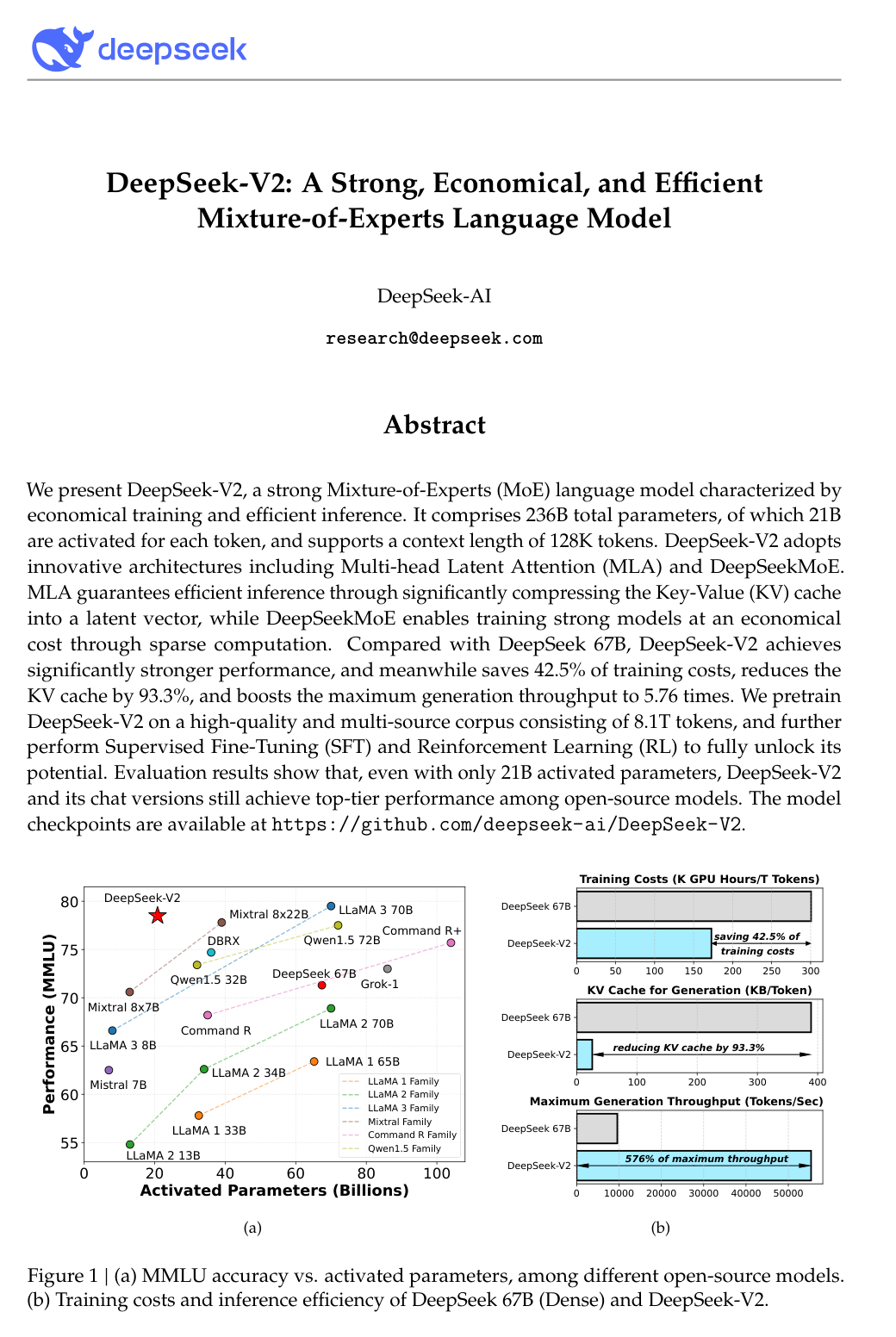
DeepSeek-V2: A Strong, Economical, and Efficient Mixture-of-Experts Language Model
Zhihong Shao, Damai Dai, Daya Guo, Zihan Wang, Huajian Xin
Why you should read this
Introduces DeepSeek-V2, a 236-billion-parameter Mixture-of-Experts model that activates only 21 billion parameters per token and uses Multi-head Latent Attention to reduce Key-Value cache memory by 93.3% while achieving top-tier open-source performance at significantly lower training and inference costs.
We present DeepSeek-V2, a strong Mixture-of-Experts (MoE) language model characterized by economical training and efficient inference. It comprises 236B total parameters, of which 21B are activated for each token, and supports a context length of 128K tokens. DeepSeek-V2 adopts innovative architectures including Multi-head Latent Attention (MLA) and DeepSeekMoE. MLA guarantees efficient inference through significantly compressing the Key-Value (KV) cache into a latent vector, while DeepSeekMoE enables training strong models at an economical cost through sparse computation. Compared with DeepSeek 67B, DeepSeek-V2 achieves significantly stronger performance, and meanwhile saves 42.5% of training costs, reduces the KV cache by 93.3%, and boosts the maximum generation throughput to 5.76 times. We pretrain DeepSeek-V2 on a high-quality and multi-source corpus consisting of 8.1T tokens, and further perform Supervised Fine-Tuning (SFT) and Reinforcement Learning (RL) to fully unlock its potential. Evaluation results show that, even with only 21B activated parameters, DeepSeek-V2 and its chat versions still achieve top-tier performance among open-source models.
Added
2026-09-25
Sparse Upcycling: Training Mixture-of-Experts from Dense Checkpoints
Aran Komatsuzaki, Joan Puigcerver, James Lee-Thorp, Carlos Riquelme Ruiz, Basil Mustafa, Joshua Ainslie, Yi Tay, Mostafa Dehghani, Neil Houlsby
Why you should read this
Presents a methodology to initialize MoE models from pre-trained dense checkpoints, significantly reducing the massive compute cost of training MoEs from scratch.
Training large, deep neural networks to convergence can be prohibitively expensive. As a result, often only a small selection of popular, dense models are reused across different contexts and tasks. Increasingly, sparsely activated models, which seek to decouple model size from computation costs, are becoming an attractive alternative to dense models. Although more efficient in terms of quality and computation cost, sparse models remain data-hungry and costly to train from scratch in the large scale regime. In this work, we propose sparse upcycling -- a simple way to reuse sunk training costs by initializing a sparsely activated Mixture-of-Experts model from a dense checkpoint. We show that sparsely upcycled T5 Base, Large, and XL language models and Vision Transformer Base and Large models, respectively, significantly outperform their dense counterparts on SuperGLUE and ImageNet, using only ~50% of the initial dense pretraining sunk cost. The upcycled models also outperform sparse models trained from scratch on 100% of the initial dense pretraining computation budget.
Added
2026-02-23
Mixtral of Experts
Albert Q. Jiang, Alexandre Sablayrolles, Antoine Roux, Arthur Mensch, Blanche Savary, Chris Bamford, Devendra Singh Chaplot, Diego de las Casas, Emma Bou Hanna, Florian Bressand, Gianna Lengyel, Guillaume Bour, Guillaume Lample, Lélio Renard Lavaud, Lucile Saulnier, Marie-Anne Lachaux, Pierre Stock, Sandeep Subramanian, Sophia Yang, Szymon Antoniak, Teven Le Scao, Théophile Gervet, Thibaut Lavril, Thomas Wang, Timothée Lacroix, William El Sayed
Why you should read this
Demonstrates how a Sparse Mixture of Experts model, Mixtral 8x7B, can significantly outperform much larger models like Llama 2 70B and GPT-3.5 across various benchmarks, especially in mathematics, code generation, and multilingual tasks, while maintaining efficient inference.
We introduce Mixtral 8x7B, a Sparse Mixture of Experts (SMoE) language model. Mixtral has the same architecture as Mistral 7B, with the difference that each layer is composed of 8 feedforward blocks (i.e. experts). For every token, at each layer, a router network selects two experts to process the current state and combine their outputs. Even though each token only sees two experts, the selected experts can be different at each timestep. As a result, each token has access to 47B parameters, but only uses 13B active parameters during inference. Mixtral was trained with a context size of 32k tokens and it outperforms or matches Llama 2 70B and GPT-3.5 across all evaluated benchmarks. In particular, Mixtral vastly outperforms Llama 2 70B on mathematics, code generation, and multilingual benchmarks. We also provide a model fine-tuned to follow instructions, Mixtral 8x7B - Instruct, that surpasses GPT-3.5 Turbo, Claude-2.1, Gemini Pro, and Llama 2 70B - chat model on human benchmarks. Both the base and instruct models are released under the Apache 2.0 license.
Added
2026-02-23

Unified Scaling Laws for Routed Language Models
Aidan Clark, Diego de las Casas, Aurelia Guy, Arthur Mensch, Michela Paganini, Jordan Hoffmann, Bogdan Damoc, Blake Hechtman, Trevor Cai, Sebastian Borgeaud, George van den Driessche, Eliza Rutherford, Tom Hennigan, Matthew Johnson, Katie Millican, Albin Cassirer, Chris Jones, Elena Buchatskaya, David Budden, Laurent Sifre, Simon Osindero, Oriol Vinyals, Jack Rae, Erich Elsen, Koray Kavukcuoglu, Karen Simonyan
Why you should read this
Presents a unified framework that quantifies how Routing Networks scale in performance based on both parameter count and computational requirements, offering a generalized understanding of large language model optimization and comparison.
The performance of a language model has been shown to be effectively modeled as a power-law in its parameter count. Here we study the scaling behaviors of Routing Networks: architectures that conditionally use only a subset of their parameters while processing an input. For these models, parameter count and computational requirement form two independent axes along which an increase leads to better performance. In this work we derive and justify scaling laws defined on these two variables which generalize those known for standard language models and describe the performance of a wide range of routing architectures trained via three different techniques. Afterwards we provide two applications of these laws: first deriving an Effective Parameter Count along which all models scale at the same rate, and then using the scaling coefficients to give a quantitative comparison of the three routing techniques considered. Our analysis derives from an extensive evaluation of Routing Networks across five orders of magnitude of size, including models with hundreds of experts and hundreds of billions of parameters.
Added
2026-02-23
ST-MoE: Designing Stable and Transferable Sparse Expert Models
Barret Zoph, Irwan Bello, Sameer Kumar, Nan Du, Yanping Huang, Jeff Dean, Noam Shazeer, William Fedus
Why you should read this
Identifies the root causes of training instabilities in massive MoE models and prescribes architectural fixes like the router z-loss.
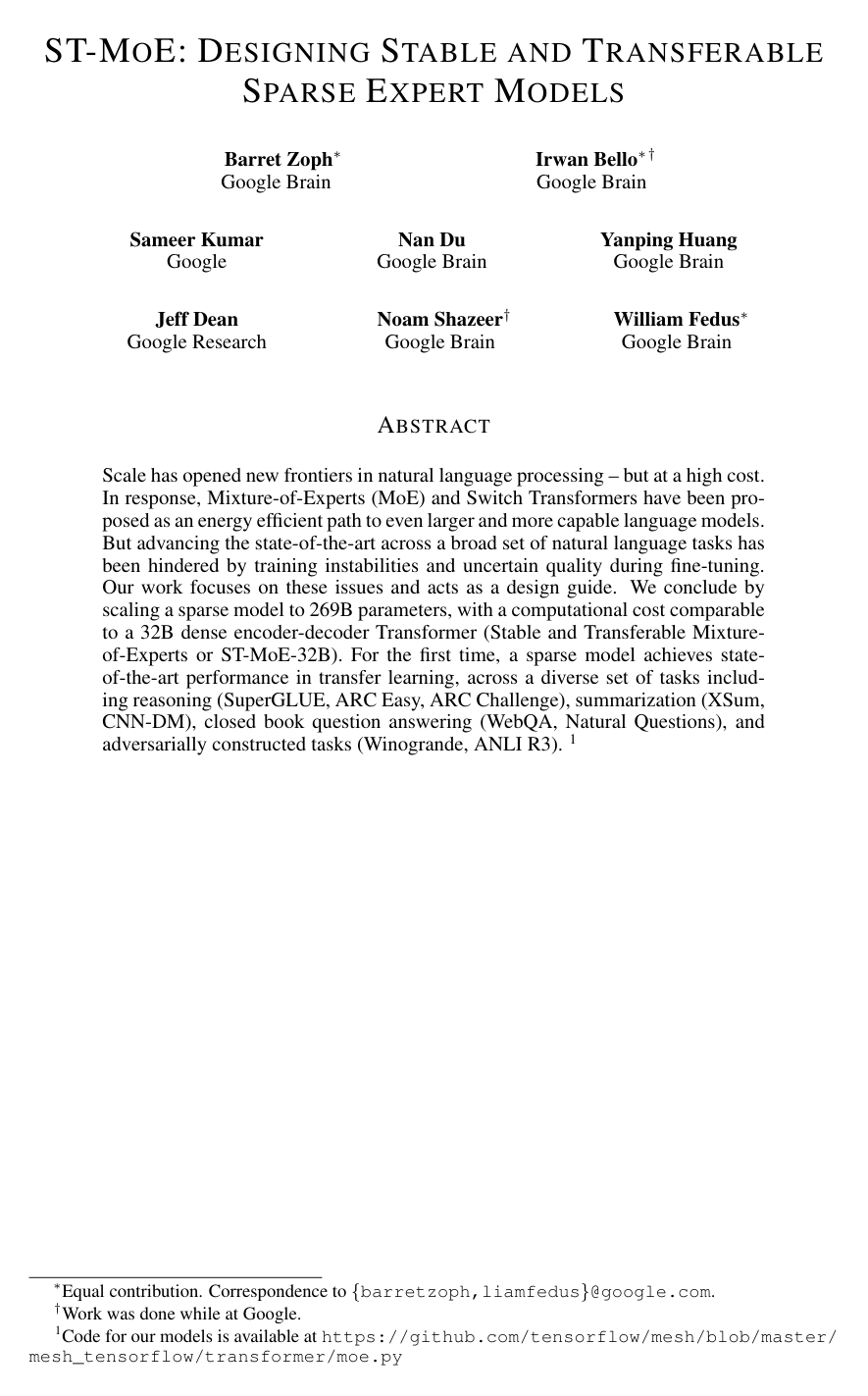
Scale has opened new frontiers in natural language processing -- but at a high cost. In response, Mixture-of-Experts (MoE) and Switch Transformers have been proposed as an energy efficient path to even larger and more capable language models. But advancing the state-of-the-art across a broad set of natural language tasks has been hindered by training instabilities and uncertain quality during fine-tuning. Our work focuses on these issues and acts as a design guide. We conclude by scaling a sparse model to 269B parameters, with a computational cost comparable to a 32B dense encoder-decoder Transformer (Stable and Transferable Mixture-of-Experts or ST-MoE-32B). For the first time, a sparse model achieves state-of-the-art performance in transfer learning, across a diverse set of tasks including reasoning (SuperGLUE, ARC Easy, ARC Challenge), summarization (XSum, CNN-DM), closed book question answering (WebQA, Natural Questions), and adversarially constructed tasks (Winogrande, ANLI R3).
Added
2026-02-23