
Built independently by an author, for readers. Read the story and support ChapterPal

keyword

evidentiality-guided generation

Evidentiality-guided generation is a natural language processing framework used in retrieval-augmented systems that incorporates the assessment of whether retrieved text passages genuinely contain supporting evidence for a target output. Rather than treating all retrieved passages as equally valid context, this approach guides the text generation process by evaluating the evidential quality of the retrieved information, often by jointly predicting passage evidentiality and generating the final response. This allows language models to better filter out irrelevant or misleading information, avoid relying on spurious correlations or memorization, and produce more reliable and factually grounded outputs across knowledge-intensive tasks such as open-domain question answering and fact verification.

1 item
Evidentiality-guided Generation for Knowledge-Intensive NLP Tasks

Evidentiality-guided Generation for Knowledge-Intensive NLP Tasks

Akari Asai, Matt Gardner, Hannaneh Hajishirzi

OrganizationsAllen Institute for AIMicrosoftUniversity of Washington

Why you should read this

Proposes a multi-task learning framework and silver-label mining method that train retrieval-augmented generators to evaluate passage evidence, preventing models from relying on spurious cues across knowledge-intensive NLP benchmarks.

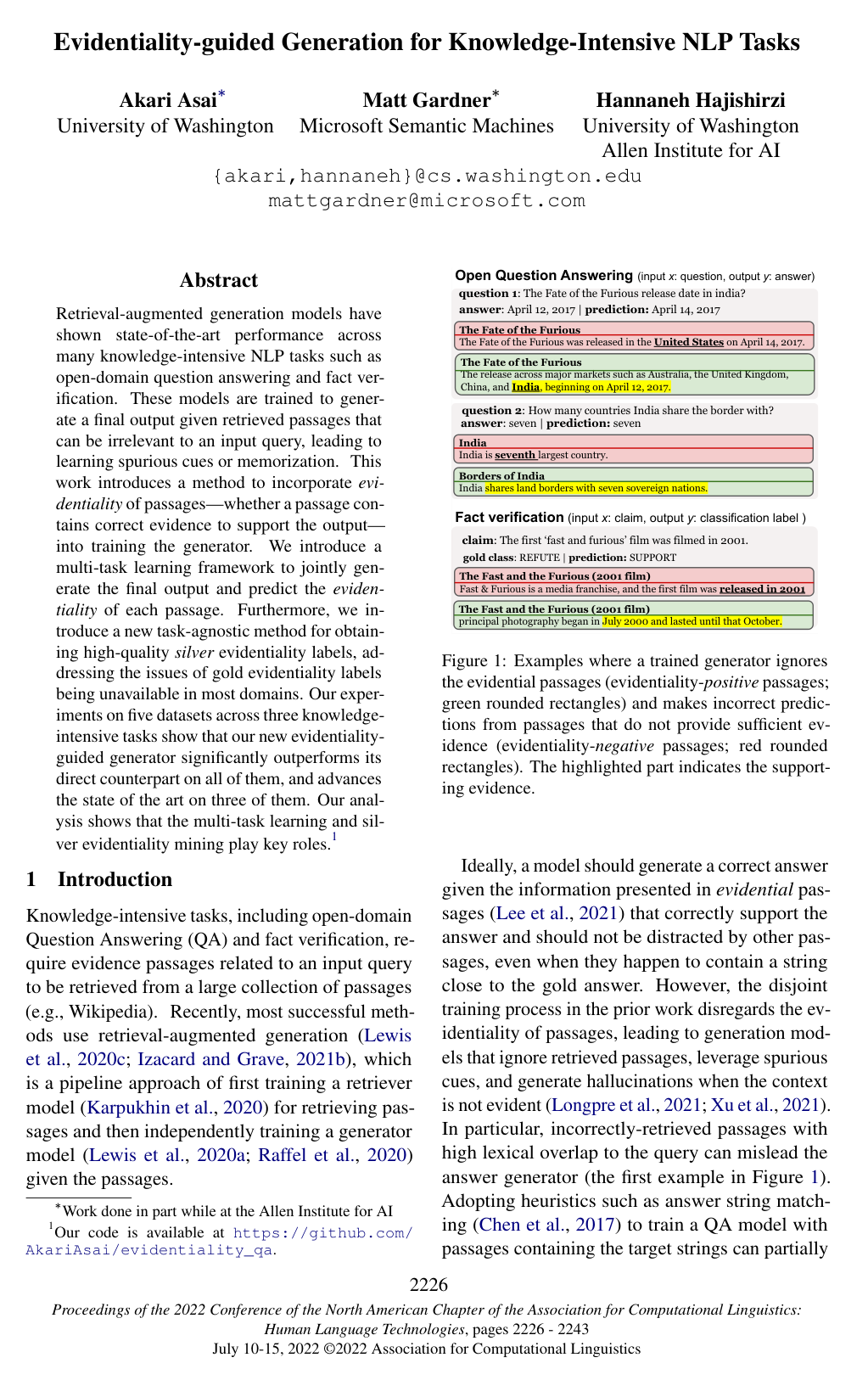
Retrieval-augmented generation models have shown state-of-the-art performance across many knowledge-intensive NLP tasks such as open-domain question answering and fact verification. These models are trained to generate a final output given retrieved passages that can be irrelevant to an input query, leading to learning spurious cues or memorization. This work introduces a method to incorporate evidentiality of passages—whether a passage contains correct evidence to support the output—into training the generator. We introduce a multi-task learning framework to jointly generate the final output and predict the evidentiality of each passage. Furthermore, we introduce a new task-agnostic method for obtaining high-quality silver evidentiality labels, addressing the issues of gold evidentiality labels being unavailable in most domains. Our experiments on five datasets across three knowledge-intensive tasks show that our new evidentiality-guided generator significantly outperforms its direct counterpart on all of them, and advances the state of the art on three of them. Our analysis shows that the multi-task learning and silver evidentiality mining play key roles.

Added

2026-09-26