
keyword
evaluation protocols
An evaluation protocol is a standardized set of procedures, rules, and conditions used to systematically assess and measure the performance, capabilities, and robustness of computational models or algorithms. It outlines the complete operational framework for testing, specifying the selection and curation of benchmark datasets, testing environments, control conditions, baseline comparisons, and the quantitative metrics used to evaluate success. By enforcing controlled and consistent experimental parameters, such as matched computational budgets, standardized input constraints, and strict separation between training and test sets, an evaluation protocol ensures reproducibility, prevents data leakage or overfitting, and verifies that observed performance gains reflect genuine functional capabilities rather than experimental artifacts.
4 items
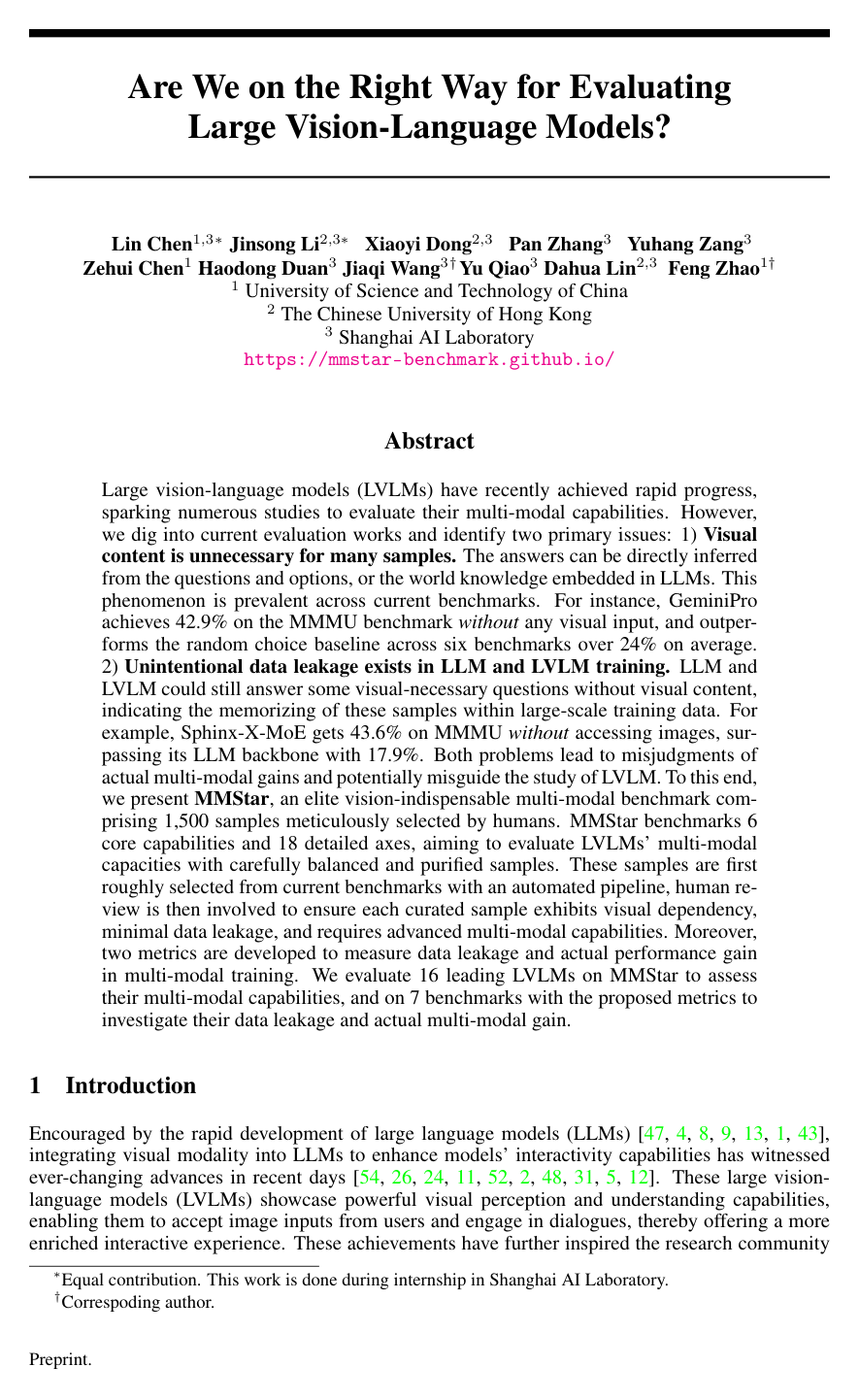
Are We on the Right Way for Evaluating Large Vision-Language Models?
Lin Chen, Jinsong Li, Xiaoyi Dong, Pan Zhang, Yuhang Zang, Zehui Chen, Haodong Duan, Jiaqi Wang, Yu Qiao, Dahua Lin, Feng Zhao
Why you should read this
Presents MMStar, a vision-indispensable benchmark of 1,500 verified samples, to solve critical evaluation flaws where vision-language models bypass visual reasoning through text shortcuts and training data leakage.
Large vision-language models (LVLMs) have recently achieved rapid progress, sparking numerous studies to evaluate their multi-modal capabilities. However, we dig into current evaluation works and identify two primary issues: 1) Visual content is unnecessary for many samples. The answers can be directly inferred from the questions and options, or the world knowledge embedded in LLMs. This phenomenon is prevalent across current benchmarks. For instance, GeminiPro achieves 42.9% on the MMMU benchmark without any visual input, and outperforms the random choice baseline across six benchmarks over 24% on average. 2) Unintentional data leakage exists in LLM and LVLM training. LLM and LVLM could still answer some visual-necessary questions without visual content, indicating the memorizing of these samples within large-scale training data. For example, Sphinx-X-MoE gets 43.6% on MMMU without accessing images, surpassing its LLM backbone with 17.9%. Both problems lead to misjudgments of actual multi-modal gains and potentially misguide the study of LVLM. To this end, we present MMStar, an elite vision-indispensable multi-modal benchmark comprising 1,500 samples meticulously selected by humans. MMStar benchmarks 6 core capabilities and 18 detailed axes, aiming to evaluate LVLMs' multi-modal capacities with carefully balanced and purified samples. These samples are first roughly selected from current benchmarks with an automated pipeline, human review is then involved to ensure each curated sample exhibits visual dependency, minimal data leakage, and requires advanced multi-modal capabilities. Moreover, two metrics are developed to measure data leakage and actual performance gain in multi-modal training. We evaluate 16 leading LVLMs on MMStar to assess their multi-modal capabilities, and on 7 benchmarks with the proposed metrics to investigate their data leakage and actual multi-modal gain.
Added
2026-10-05
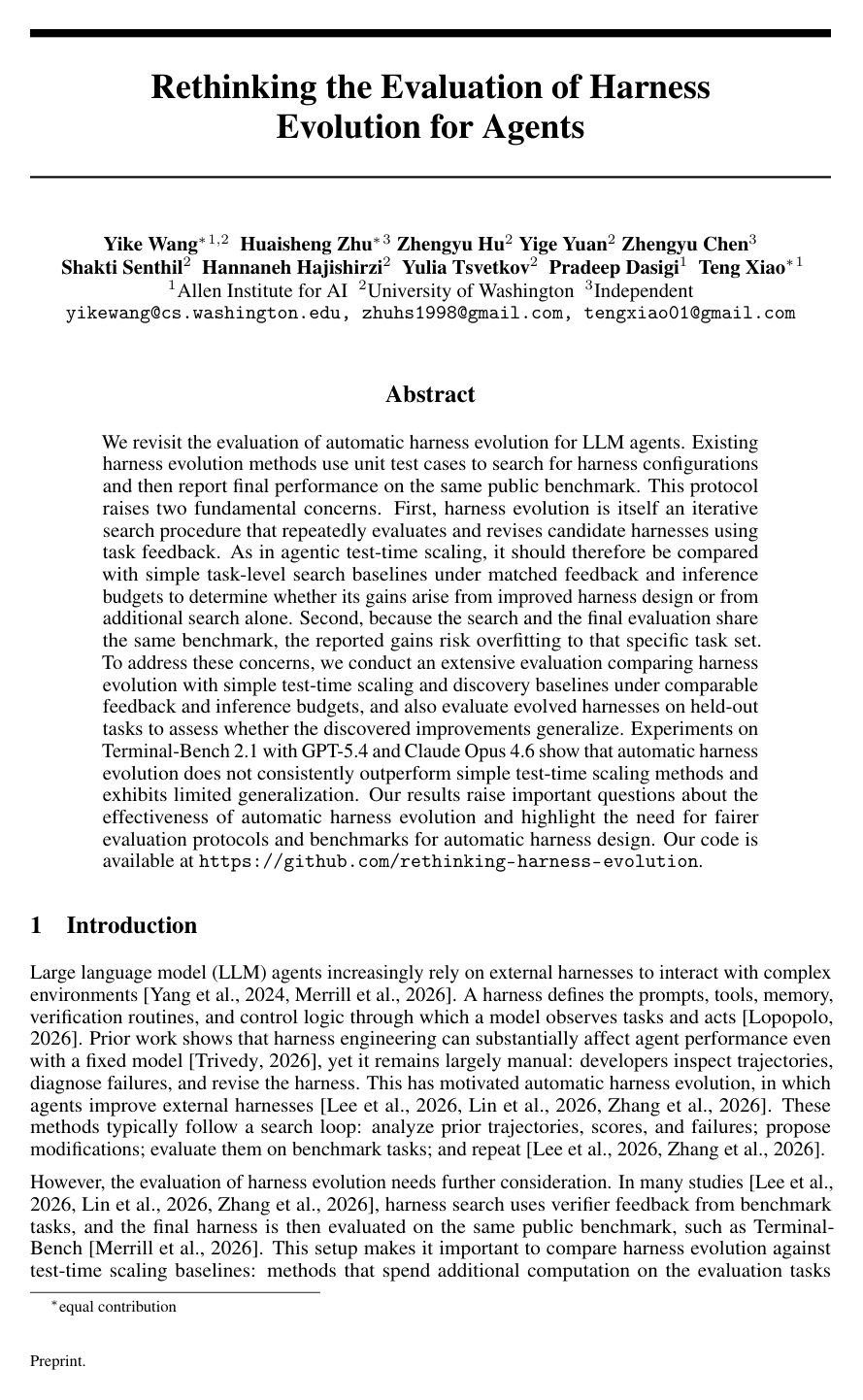
Rethinking the Evaluation of Harness Evolution for Agents
Yike Wang, Huaisheng Zhu, Zhengyu Hu, Yige Yuan, Zhengyu Chen, Shakti Senthil, Hannaneh Hajishirzi, Yulia Tsvetkov, Pradeep Dasigi, Teng Xiao
Why you should read this
Demonstrates that automated agent scaffolding evolution fails to consistently outperform simple test-time scaling baselines or generalize to held-out tasks when evaluated under equal compute and feedback budgets.
We revisit the evaluation of automatic harness evolution for LLM agents. Existing harness evolution methods use unit test cases to search for harness configurations and then report final performance on the same public benchmark. This protocol raises two fundamental concerns. First, harness evolution is itself an iterative search procedure that repeatedly evaluates and revises candidate harnesses using task feedback. As in agentic test-time scaling, it should therefore be compared with simple task-level search baselines under matched feedback and inference budgets to determine whether its gains arise from improved harness design or from additional search alone. Second, because the search and the final evaluation share the same benchmark, the reported gains risk overfitting to that specific task set. To address these concerns, we conduct an extensive evaluation comparing harness evolution with simple test-time scaling and discovery baselines under comparable feedback and inference budgets, and also evaluate evolved harnesses on held-out tasks to assess whether the discovered improvements generalize. Experiments on Terminal-Bench 2.1 with GPT-5.4 and Claude Opus 4.6 show that automatic harness evolution does not consistently outperform simple test-time scaling methods and exhibits limited generalization. Our results raise important questions about the effectiveness of automatic harness evolution and highlight the need for fairer evaluation protocols and benchmarks for automatic harness design. Our code is available at this https URL.
Added
2026-10-04
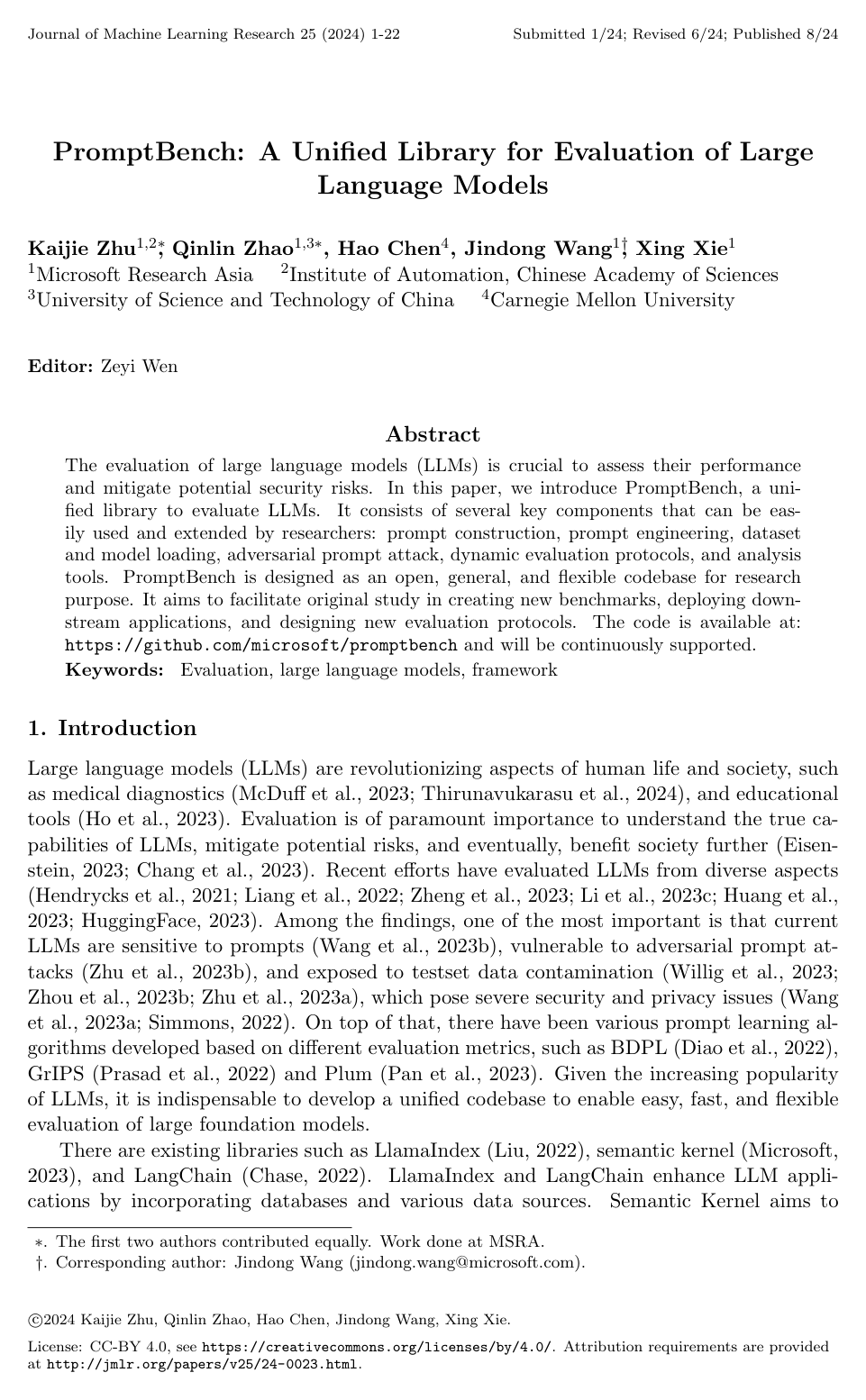
PromptBench: A Unified Library for Evaluation of Large Language Models
Kaijie Zhu, Qinlin Zhao, Hao Chen, Jindong Wang, Xing Xie
Why you should read this
Introduces PromptBench, an open-source evaluation framework that unifies model benchmarking, prompt engineering, multi-level adversarial attacks, and dynamic testing protocols to rigorously assess large language models.
The evaluation of large language models (LLMs) is crucial to assess their performance and mitigate potential security risks. In this paper, we introduce PromptBench, a unified library to evaluate LLMs. It consists of several key components that can be easily used and extended by researchers: prompt construction, prompt engineering, dataset and model loading, adversarial prompt attack, dynamic evaluation protocols, and analysis tools. PromptBench is designed as an open, general, and flexible codebase for research purpose. It aims to facilitate original study in creating new benchmarks, deploying downstream applications, and designing new evaluation protocols. The code is available at: https://github.com/microsoft/promptbench and will be continuously supported.
Added
2026-10-03
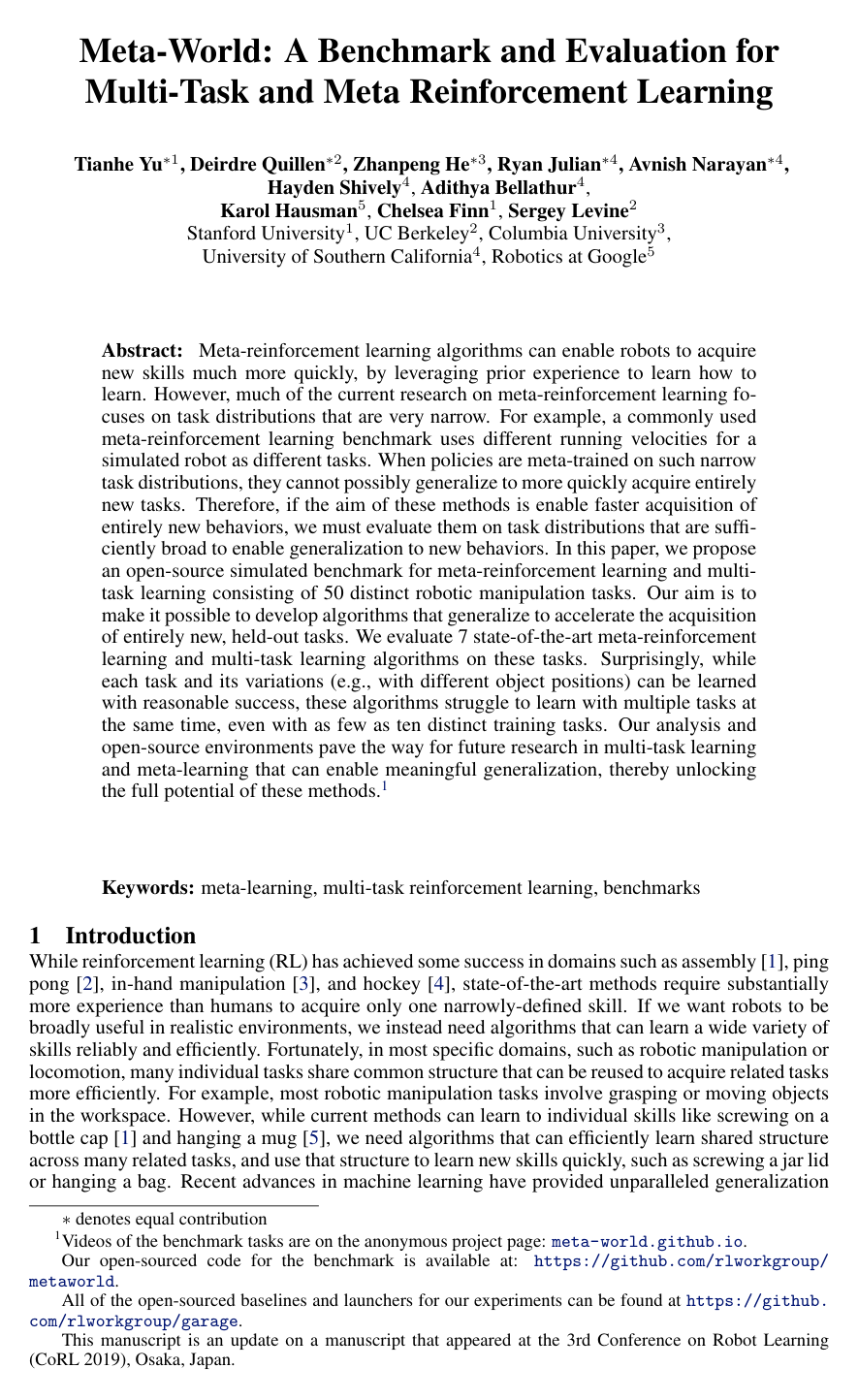
Meta-World: A Benchmark and Evaluation for Multi-Task and Meta Reinforcement Learning
Tianhe Yu, Deirdre Quillen, Zhanpeng He, Ryan C. Julian, Karol Hausman, Chelsea Finn, S. Levine
Why you should read this
Introduces Meta-World, a standardized benchmark of 50 distinct robotic manipulation tasks, revealing that state-of-the-art meta-reinforcement learning algorithms struggle to generalize across broad task distributions.
Meta-reinforcement learning algorithms can enable robots to acquire new skills much more quickly, by leveraging prior experience to learn how to learn. However, much of the current research on meta-reinforcement learning focuses on task distributions that are very narrow. For example, a commonly used meta-reinforcement learning benchmark uses different running velocities for a simulated robot as different tasks. When policies are meta-trained on such narrow task distributions, they cannot possibly generalize to more quickly acquire entirely new tasks. Therefore, if the aim of these methods is to enable faster acquisition of entirely new behaviors, we must evaluate them on task distributions that are sufficiently broad to enable generalization to new behaviors. In this paper, we propose an open-source simulated benchmark for meta-reinforcement learning and multi-task learning consisting of 50 distinct robotic manipulation tasks. Our aim is to make it possible to develop algorithms that generalize to accelerate the acquisition of entirely new, held-out tasks. We evaluate 7 state-of-the-art meta-reinforcement learning and multi-task learning algorithms on these tasks. Surprisingly, while each task and its variations (e.g., with different object positions) can be learned with reasonable success, these algorithms struggle to learn with multiple tasks at the same time, even with as few as ten distinct training tasks. Our analysis and open-source environments pave the way for future research in multi-task learning and meta-learning that can enable meaningful generalization, thereby unlocking the full potential of these methods.
Added
2026-09-24