Built independently by an author, for readers. Read the story and support ChapterPal

keyword

EdgeConv layers

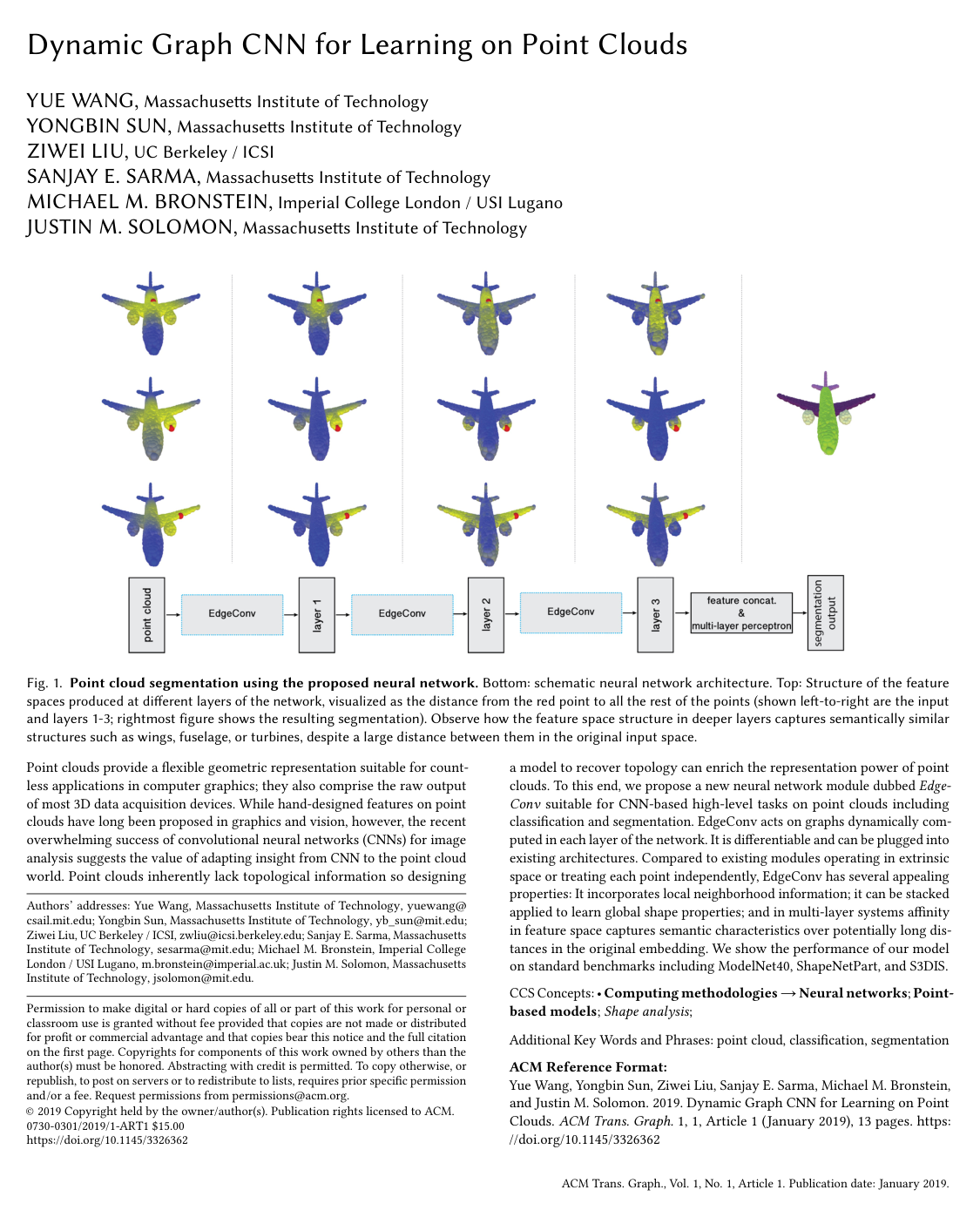
EdgeConv layers are graph neural network operations designed to process unstructured geometric data, such as 3D point clouds, by learning local and global features across dynamically constructed graphs. For each point in a dataset, an EdgeConv layer identifies its nearest neighbors in feature space to construct a local neighborhood graph, computes edge features by evaluating both the central point features and the relative differences between the point and its neighbors, and aggregates these edge representations using a symmetric function such as max pooling. Unlike static graph convolutions, EdgeConv dynamically recomputes the neighborhood graph in the updated feature space at each layer, enabling the network to capture semantic relationships and structural topology across both local neighborhoods and distant points while maintaining permutation invariance.

1 item

Dynamic Graph CNN for Learning on Point Clouds

Dynamic Graph CNN for Learning on Point Clouds

Yue Wang, Yongbin Sun, Ziwei Liu, Sanjay E. Sarma, Michael M. Bronstein, Justin M. Solomon

OrganizationsImperial College LondonInternational Computer Science InstituteMassachusetts Institute of TechnologyUniversità della Svizzera italianaUniversity of California Berkeley

Why you should read this

Proposes Dynamic Graph CNN and its core EdgeConv module, which dynamically computes nearest-neighbor graphs in feature space across network layers to capture both local geometric details and global shape semantics in point clouds.

Point clouds provide a flexible geometric representation suitable for countless applications in computer graphics; they also comprise the raw output of most 3D data acquisition devices. While hand-designed features on point clouds have long been proposed in graphics and vision, however, the recent overwhelming success of convolutional neural networks (CNNs) for image analysis suggests the value of adapting insight from CNN to the point cloud world. Point clouds inherently lack topological information so designing a model to recover topology can enrich the representation power of point clouds. To this end, we propose a new neural network module dubbed EdgeConv suitable for CNN-based high-level tasks on point clouds including classification and segmentation. EdgeConv acts on graphs dynamically computed in each layer of the network. It is differentiable and can be plugged into existing architectures. Compared to existing modules operating in extrinsic space or treating each point independently, EdgeConv has several appealing properties: It incorporates local neighborhood information; it can be stacked applied to learn global shape properties; and in multi-layer systems affinity in feature space captures semantic characteristics over potentially long distances in the original embedding. We show the performance of our model on standard benchmarks including ModelNet40, ShapeNetPart, and S3DIS.

Added

2026-09-08