Built independently by an author, for readers. Read the story and support ChapterPal

keyword

dynamic social networks

Dynamic social networks are network models that represent social entities and their relationships as systems that evolve over time. Unlike static networks that capture a single snapshot of connections, dynamic social networks incorporate temporal changes in both structure and attributes, such as the formation and dissolution of relationships, the arrival or departure of individuals, and shifting behavioral or contextual features. They provide a framework for analyzing continuous or discrete changes in social systems, enabling the study of information diffusion, community evolution, and shifting relational patterns across time and space.

1 item

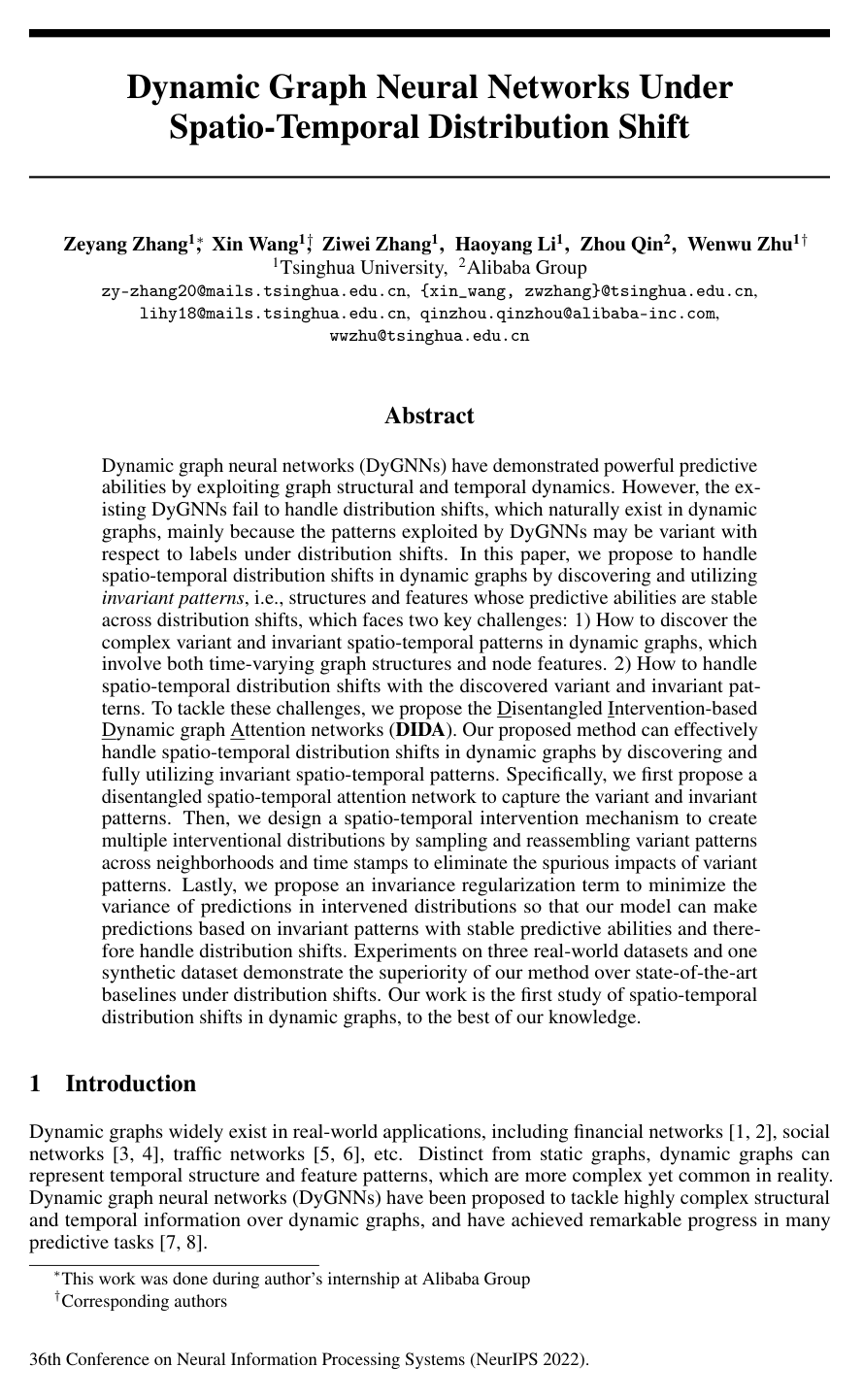
Dynamic Graph Neural Networks Under Spatio-Temporal Distribution Shift

Dynamic Graph Neural Networks Under Spatio-Temporal Distribution Shift

Zeyang Zhang, Xin Wang, Ziwei Zhang, Haoyang Li, Zhou Qin, Wenwu Zhu

OrganizationsAlibaba GroupTsinghua University

Why you should read this

Develops a causal attention framework named DIDA that disentangles invariant spatio-temporal patterns from spurious correlations to enable dynamic graph neural networks to generalize under distribution shifts.

Dynamic graph neural networks (DyGNNs) have demonstrated powerful predictive abilities by exploiting graph structural and temporal dynamics. However, the existing DyGNNs fail to handle distribution shifts, which naturally exist in dynamic graphs, mainly because the patterns exploited by DyGNNs may be variant with respect to labels under distribution shifts. In this paper, we propose to handle spatio-temporal distribution shifts in dynamic graphs by discovering and utilizing invariant patterns, i.e., structures and features whose predictive abilities are stable across distribution shifts, which faces two key challenges: 1) How to discover the complex variant and invariant spatio-temporal patterns in dynamic graphs, which involve both time-varying graph structures and node features. 2) How to handle spatio-temporal distribution shifts with the discovered variant and invariant patterns. To tackle these challenges, we propose the Disentangled Intervention-based Dynamic graph Attention networks (DIDA). Our proposed method can effectively handle spatio-temporal distribution shifts in dynamic graphs by discovering and fully utilizing invariant spatio-temporal patterns. Specifically, we first propose a disentangled spatio-temporal attention network to capture the variant and invariant patterns. Then, we design a spatio-temporal intervention mechanism to create multiple interventional distributions by sampling and reassembling variant patterns across neighborhoods and time stamps to eliminate the spurious impacts of variant patterns. Lastly, we propose an invariance regularization term to minimize the variance of predictions in intervened distributions so that our model can make predictions based on invariant patterns with stable predictive abilities and therefore handle distribution shifts. Experiments on three real-world datasets and one synthetic dataset demonstrate the superiority of our method over state-of-the-art baselines under distribution shifts. Our work is the first study of spatio-temporal distribution shifts in dynamic graphs, to the best of our knowledge.

Added

2026-09-26