
Built independently by an author, for readers. Read the story and support ChapterPal

keyword

dynamic representation

A dynamic representation is a machine learning feature encoding that adapts, expands, or reorganizes over time as new data, classes, or tasks are introduced, rather than remaining fixed after initial training. In contrast to static embeddings, a dynamic representation allows a model to continuously update its latent feature space or expand its network capacity to incorporate novel patterns while preserving previously acquired knowledge. This capability is essential in continual and incremental learning scenarios, as it balances stability and plasticity to prevent catastrophic forgetting when training on evolving data streams without requiring complete retraining on past data.

1 item
Self-Sustaining Representation Expansion for Non-Exemplar Class-Incremental Learning

Self-Sustaining Representation Expansion for Non-Exemplar Class-Incremental Learning

Kai Zhu, Wei Zhai, Yang Cao, Jiebo Luo, Zhengjun Zha

OrganizationsInstitute of Artificial Intelligence, Hefei Comprehensive National Science CenterUniversity of RochesterUniversity of Science and Technology of China

Why you should read this

Develops a self-sustaining representation expansion framework for non-exemplar class-incremental learning that prevents catastrophic forgetting and parameter explosion by dynamically reorganizing network structures and selectively distilling knowledge using new class prototypes.

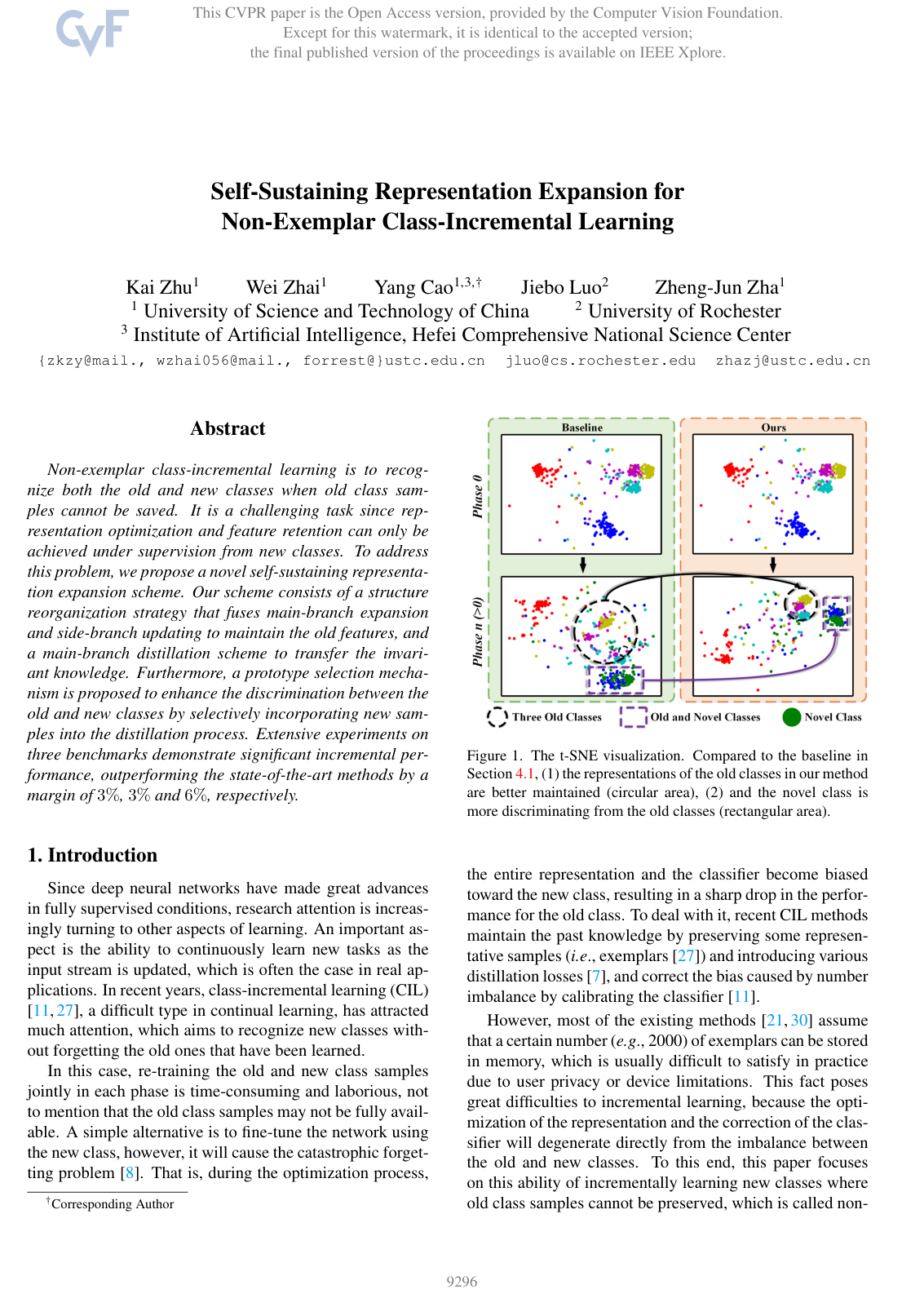
Non-exemplar class-incremental learning is to recognize both the old and new classes when old class samples cannot be saved. It is a challenging task since representation optimization and feature retention can only be achieved under supervision from new classes. To address this problem, we propose a novel self-sustaining representation expansion scheme. Our scheme consists of a structure reorganization strategy that fuses main-branch expansion and side-branch updating to maintain the old features, and a main-branch distillation scheme to transfer the invariant knowledge. Furthermore, a prototype selection mechanism is proposed to enhance the discrimination between the old and new classes by selectively incorporating new samples into the distillation process. Extensive experiments on three benchmarks demonstrate significant incremental performance, outperforming the state-of-the-art methods by a margin of 3%, 3% and 6%, respectively.

Added

2026-09-26