Built independently by an author, for readers. Read the story and support ChapterPal

keyword

Dual Memory Networks

Dual Memory Networks refers to an adaptation framework designed to transfer pre-trained vision-language models to downstream classification tasks using a combination of static and dynamic memory modules. In this architecture, a static memory component caches feature representations from available labeled training data to support few-shot and training-free adaptation, while a dynamic memory component continuously records historical test features during inference to exploit patterns in test data beyond the initial training distribution. By integrating both memory stores through a shared interactive retrieval mechanism, the network operates across zero-shot, few-shot, and training-free settings, enhancing classification accuracy and providing robustness against distribution shifts.

1 item

Dual Memory Networks: A Versatile Adaptation Approach for Vision-Language Models

Dual Memory Networks: A Versatile Adaptation Approach for Vision-Language Models

Yabin Zhang, Wenjie Zhu, Hui Tang, Zhiyuan Ma, Kaiyang Zhou, Lei Zhang

OrganizationsHong Kong Baptist UniversityHong Kong Polytechnic UniversityOPPOThe Hong Kong University of Science and Technology

Why you should read this

Proposes Dual Memory Networks, a unified framework combining static training caches with dynamic test-time memory to adapt pre-trained vision-language models across zero-shot, few-shot, and training-free settings without relying on external data.

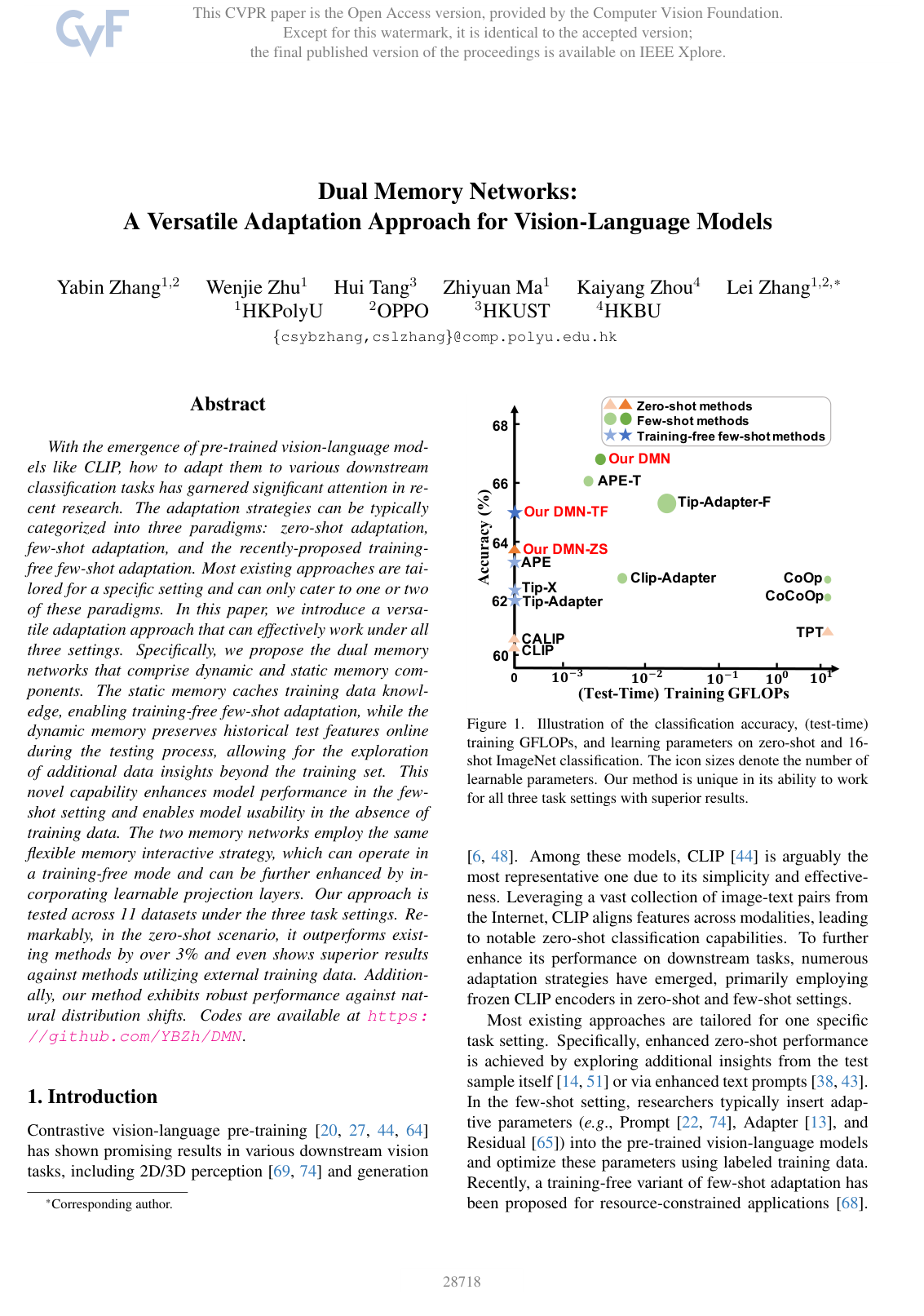
With the emergence of pre-trained vision-language models like CLIP, how to adapt them to various downstream classification tasks has garnered significant attention in recent research. The adaptation strategies can be typically categorized into three paradigms: zero-shot adaptation, few-shot adaptation, and the recently-proposed training-free few-shot adaptation. Most existing approaches are tailored for a specific setting and can only cater to one or two of these paradigms. In this paper, we introduce a versatile adaptation approach that can effectively work under all three settings. Specifically, we propose the dual memory networks that comprise dynamic and static memory components. The static memory caches training data knowledge, enabling training-free few-shot adaptation, while the dynamic memory preserves historical test features online during the testing process, allowing for the exploration of additional data insights beyond the training set. This novel capability enhances model performance in the few-shot setting and enables model usability in the absence of training data. The two memory networks employ the same flexible memory interactive strategy, which can operate in a training-free mode and can be further enhanced by incorporating learnable projection layers. Our approach is tested across 11 datasets under the three task settings. Remarkably, in the zero-shot scenario, it outperforms existing methods by over 3% and even shows superior results against methods utilizing external training data. Additionally, our method exhibits robust performance against natural distribution shifts. Codes are available at https://github.com/YBZh/DMN.

Added

2026-09-26