
Built independently by an author, for readers. Read the story and support ChapterPal

keyword

discriminative nearest neighbor classification

Discriminative nearest neighbor classification is a hybrid machine learning approach that combines non-parametric nearest neighbor search with local discriminative modeling to predict the class label of an input query. Instead of relying solely on a simple majority vote among adjacent examples or training a single, computationally demanding global model across the entire dataset, this framework first retrieves the nearest training samples to a given query point and then trains a local discriminative classifier, such as a support vector machine, specifically on that retrieved subset. By constructing an optimized decision boundary tailored to the query local neighborhood, the method mitigates the high variance often encountered in traditional nearest neighbor classification under limited sampling while avoiding the training complexity and multiclass scaling difficulties associated with global discriminative models.

1 item
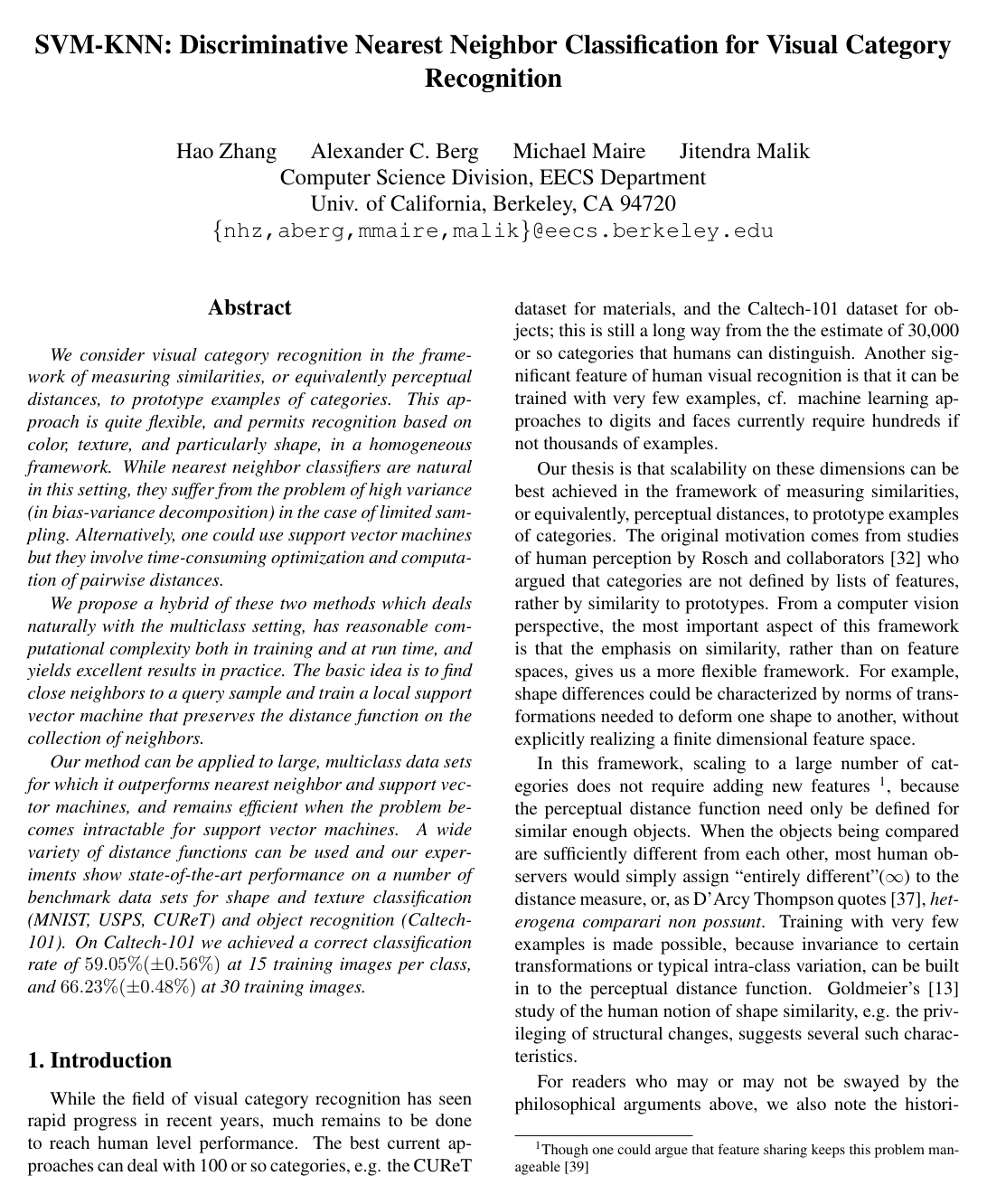
SVM-KNN: Discriminative Nearest Neighbor Classification for Visual Category Recognition

SVM-KNN: Discriminative Nearest Neighbor Classification for Visual Category Recognition

Haotong Zhang, A. Berg, M. Maire, Jitendra Malik

OrganizationsUniversity of California Berkeley

Why you should read this

Combines nearest-neighbor retrieval with local support vector machine training to enable scalable multiclass image classification using complex perceptual distance functions without the steep computational cost of full SVM training.

We consider visual category recognition in the framework of measuring similarities, or equivalently perceptual distances, to prototype examples of categories. This approach is quite flexible, and permits recognition based on color, texture, and particularly shape, in a homogeneous framework. While nearest neighbor classifiers are natural in this setting, they suffer from the problem of high variance (in bias-variance decomposition) in the case of limited sampling. Alternatively, one could use support vector machines but they involve time-consuming optimization and computation of pairwise distances. We propose a hybrid of these two methods which deals naturally with the multiclass setting, has reasonable computational complexity both in training and at run time, and yields excellent results in practice. The basic idea is to find close neighbors to a query sample and train a local support vector machine that preserves the distance function on the collection of neighbors. Our method can be applied to large, multiclass data sets for which it outperforms nearest neighbor and support vector machines, and remains efficient when the problem becomes intractable for support vector machines. A wide variety of distance functions can be used and our experiments show state-of-the-art performance on a number of benchmark data sets for shape and texture classification (MNIST, USPS, CUReT) and object recognition (Caltech-101). On Caltech-101 we achieved a correct classification rate of 59.05%(±0.56%) at 15 training images per class, and 66.23%(±0.48%) at 30 training images.

Added

2026-09-25