
keyword
dialogue generation
Dialogue generation is a subfield of natural language processing and artificial intelligence focused on automatically producing coherent, contextually relevant, and humanlike conversational turns or full multi-turn exchanges. The process involves taking prior conversational history, user intent, speaker identities, and external background knowledge into account to formulate appropriate responses or simulate complete interactive discussions. It encompasses both open-domain social conversation systems, which engage in open-ended casual interaction while maintaining engagement and topical consistency, and task-oriented dialogue systems, which guide conversations to accomplish specific goals such as booking services or answering queries. Modern dialogue generation systems typically utilize neural network architectures, large language models, and reinforcement learning frameworks to optimize for conversational properties like semantic coherence, informativeness, factual correctness, and stylistic alignment across extended interactions.
15 items
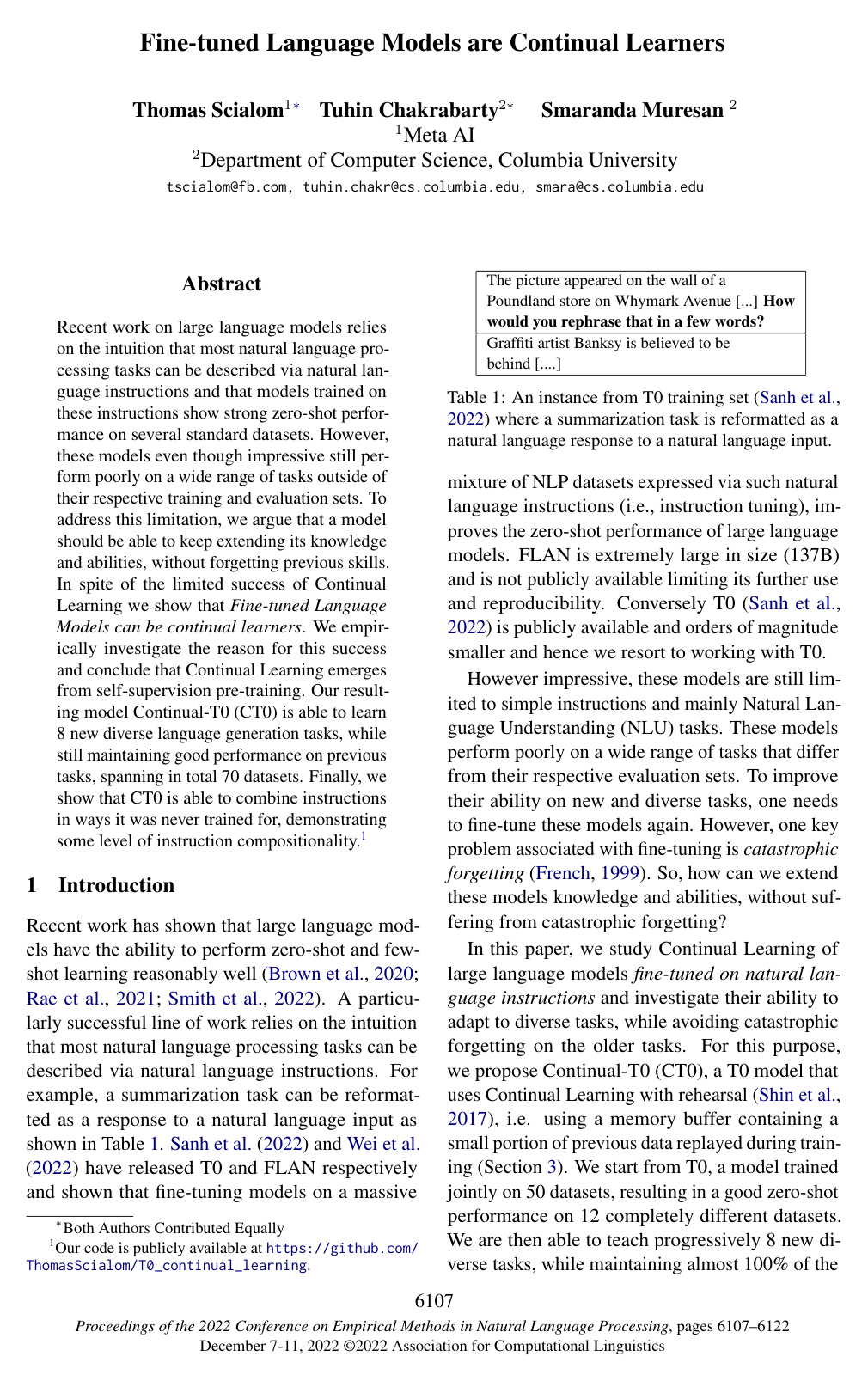
Fine-tuned Language Models are Continual Learners
Thomas Scialom, Tuhin Chakrabarty, Smaranda Muresan
Why you should read this
Demonstrates that instruction-tuned language models can sequentially acquire new generation tasks with minimal rehearsal while preventing catastrophic forgetting, identifying self-supervised pre-training as the primary driver of this capability.
Recent work on large language models relies on the intuition that most natural language processing tasks can be described via natural language instructions and that models trained on these instructions show strong zero-shot performance on several standard datasets. However, these models even though impressive still perform poorly on a wide range of tasks outside of their respective training and evaluation sets. To address this limitation, we argue that a model should be able to keep extending its knowledge and abilities, without forgetting previous skills. In spite of the limited success of Continual Learning we show that Fine-tuned Language Models can be continual learners. We empirically investigate the reason for this success and conclude that Continual Learning emerges from self-supervision pre-training. Our resulting model Continual-T0 (CT0) is able to learn 8 new diverse language generation tasks, while still maintaining good performance on previous tasks, spanning in total 70 datasets. Finally, we show that CT0 is able to combine instructions in ways it was never trained for, demonstrating some level of instruction compositionality.^1
Added
2026-10-05
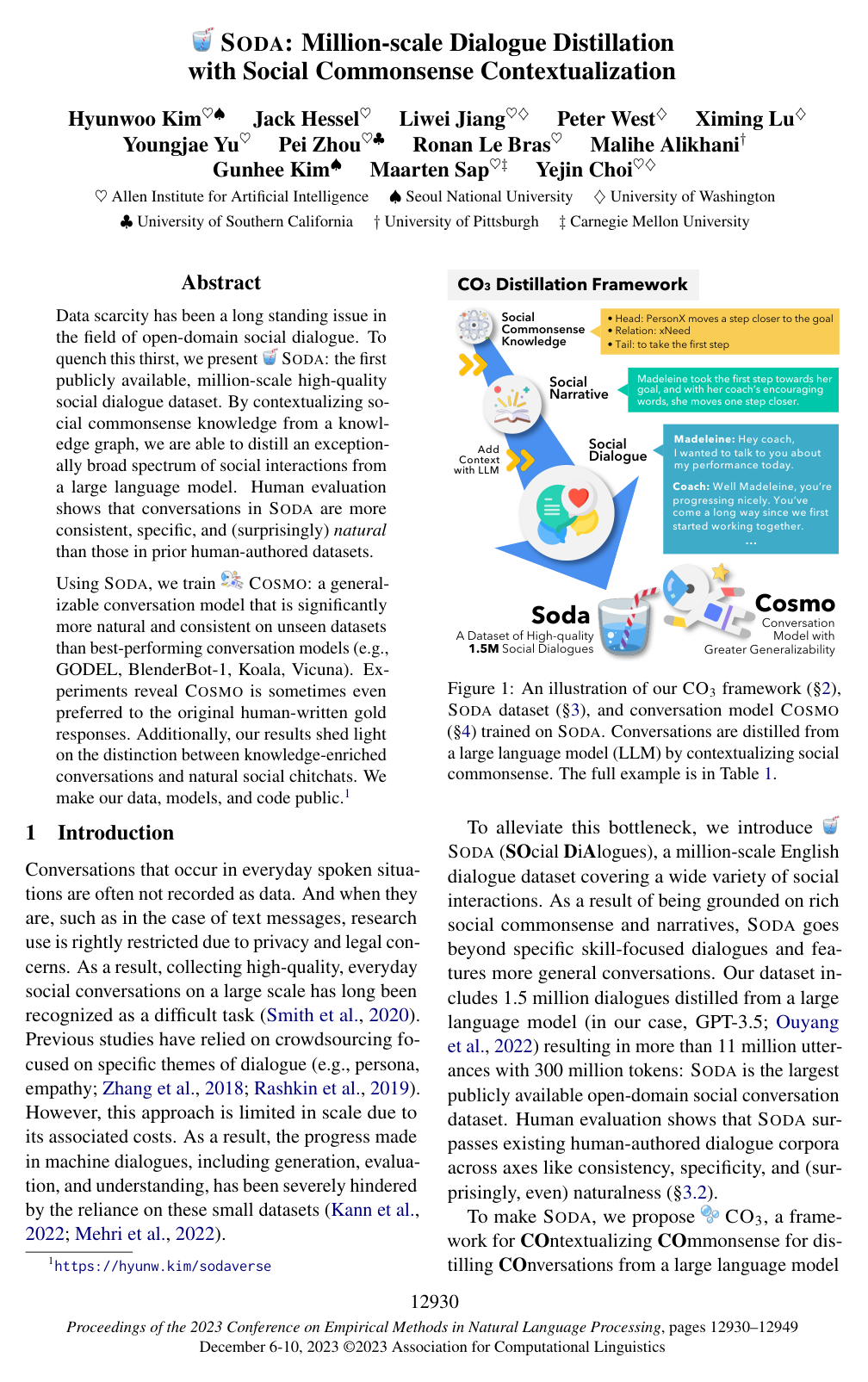
SODA: Million-scale Dialogue Distillation with Social Commonsense Contextualization
Hyunwoo Kim, Jack Hessel, Liwei Jiang, Peter West, Ximing Lu, Youngjae Yu, Pei Zhou, Ronan Le Bras, Malihe Alikhani, Gunhee Kim, Maarten Sap, Yejin Choi
Why you should read this
Presents a framework for contextualizing symbolic commonsense knowledge graphs to distill a million-scale dataset of natural social conversations from language models, enabling dialogue agents that outperform existing open-domain models on unseen interactions.
Data scarcity has been a long standing issue in the field of open-domain social dialogue. To quench this thirst, we present 🥤 SODA: the first publicly available, million-scale high-quality social dialogue dataset. By contextualizing social commonsense knowledge from a knowledge graph, we are able to distill an exceptionally broad spectrum of social interactions from a large language model. Human evaluation shows that conversations in SODA are more consistent, specific, and (surprisingly) natural than those in prior human-authored datasets. Using SODA, we train 🥤 COSMO: a generalizable conversation model that is significantly more natural and consistent on unseen datasets than best-performing conversation models (e.g., GODEL, BlenderBot-1, Koala, Vicuna). Experiments reveal COSMO is sometimes even preferred to the original human-written gold responses. Additionally, our results shed light on the distinction between knowledge-enriched conversations and natural social chitchats. We make our data, models, and code public.¹
Added
2026-10-05
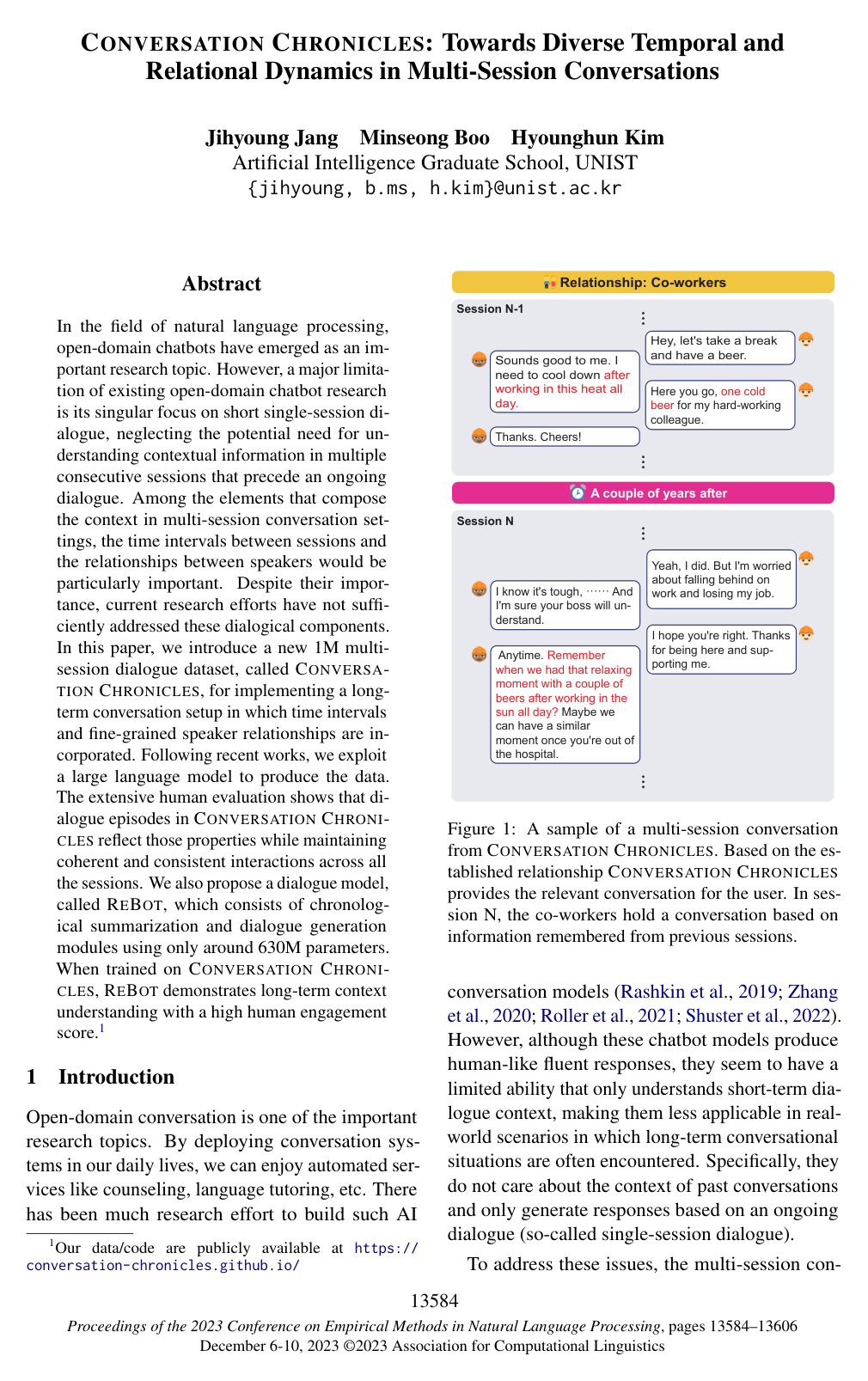
Conversation Chronicles: Towards Diverse Temporal and Relational Dynamics in Multi-Session Conversations
Jihyoung Jang, Minseong Boo, Hyounghun Kim
Why you should read this
Introduces Conversation Chronicles, a 1-million multi-session dialogue dataset incorporating varied time intervals and speaker relationships, alongside ReBot, an efficient 630M-parameter model that maintains long-term conversational context across consecutive interactions.
In the field of natural language processing, open-domain chatbots have emerged as an important research topic. However, a major limitation of existing open-domain chatbot research is its singular focus on short single-session dialogue, neglecting the potential need for understanding contextual information in multiple consecutive sessions that precede an ongoing dialogue. Among the elements that compose the context in multi-session conversation settings, the time intervals between sessions and the relationships between speakers would be particularly important. Despite their importance, current research efforts have not sufficiently addressed these dialogical components. In this paper, we introduce a new 1M multi-session dialogue dataset, called CONVERSATION CHRONICLES, for implementing a long-term conversation setup in which time intervals and fine-grained speaker relationships are incorporated. Following recent works, we exploit a large language model to produce the data. The extensive human evaluation shows that dialogue episodes in CONVERSATION CHRONICLES reflect those properties while maintaining coherent and consistent interactions across all the sessions. We also propose a dialogue model, called REBOT, which consists of chronological summarization and dialogue generation modules using only around 630M parameters. When trained on CONVERSATION CHRONICLES, REBOT demonstrates long-term context understanding with a high human engagement score.^1
Added
2026-10-05
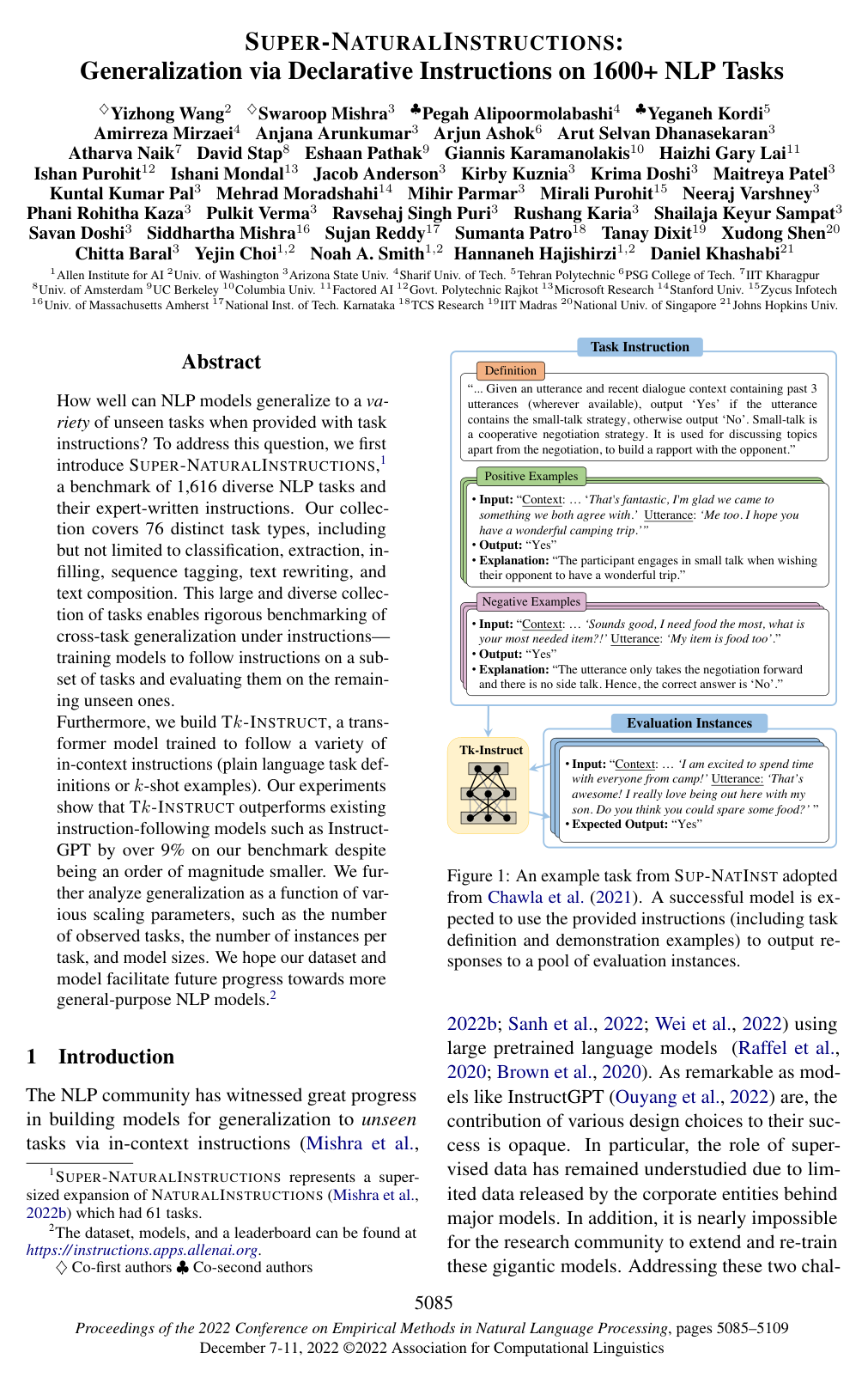
Super-NaturalInstructions: Generalization via Declarative Instructions on 1600+ NLP Tasks
Yizhong Wang, Swaroop Mishra, Pegah Alipoormolabashi, Yeganeh Kordi, Amirreza Mirzaei, Atharva Naik, Arjun Ashok, Arut Selvan Dhanasekaran, Anjana Arunkumar, David Stap, Eshaan Pathak, Giannis Karamanolakis, Haizhi Gary Lai, Ishan Purohit, Ishani Mondal, Jacob Anderson, Kirby Kuznia, Krima Doshi, Kuntal Kumar Pal, Maitreya Patel, Mehrad Moradshahi, Mihir Parmar, Mirali Purohit, Neeraj Varshney, Phani Rohitha Kaza, Pulkit Verma, Ravsehaj Singh Puri, Rushang Karia, Savan Doshi, Shailaja Keyur Sampat, Siddhartha Mishra, Sujan Reddy A, Sumanta Patro, Tanay Dixit, Xudong Shen
Why you should read this
Introduces Super-NaturalInstructions, a benchmark of over 1,600 diverse tasks with human-written instructions, and develops Tk-Instruct, a model that outperforms much larger baselines like InstructGPT on unseen task generalization.
How well can NLP models generalize to a variety of unseen tasks when provided with task instructions? To address this question, we first introduce Super-NaturalInstructions, a benchmark of 1,616 diverse NLP tasks and their expert-written instructions. Our collection covers 76 distinct task types, including but not limited to classification, extraction, infilling, sequence tagging, text rewriting, and text composition. This large and diverse collection of tasks enables rigorous benchmarking of cross-task generalization under instructions -- training models to follow instructions on a subset of tasks and evaluating them on the remaining unseen ones. Furthermore, we build Tk-Instruct, a transformer model trained to follow a variety of in-context instructions (plain language task definitions or k-shot examples). Our experiments show that Tk-Instruct outperforms existing instruction-following models such as InstructGPT by over 9% on our benchmark despite being an order of magnitude smaller. We further analyze generalization as a function of various scaling parameters, such as the number of observed tasks, the number of instances per task, and model sizes. We hope our dataset and model facilitate future progress towards more general-purpose NLP models.
Added
2026-10-04
CHAI: A CHatbot AI for Task-Oriented Dialogue with Offline Reinforcement Learning
Siddharth Verma, Justin Fu, Sherry Yang, Sergey Levine
Why you should read this
Presents CHAI, a framework that combines pre-trained language models with offline reinforcement learning to train task-oriented dialogue agents directly from static human conversation datasets without requiring live interactions or simulated user models.
Conventionally, generation of natural language for dialogue agents may be viewed as a statistical learning problem: determine the patterns in human-provided data and generate appropriate responses with similar statistical properties. However, dialogue can also be regarded as a goal directed process, where speakers attempt to accomplish a specific task. Reinforcement learning (RL) algorithms are designed specifically for solving such goal-directed problems, but the most direct way to apply RL – through trial-and-error learning in human conversations, – is costly. In this paper, we study how offline reinforcement learning can instead be used to train dialogue agents entirely using static datasets collected from human speakers. Our experiments show that recently developed offline RL methods can be combined with language models to yield realistic dialogue agents that better accomplish task goals.
Added
2026-10-03
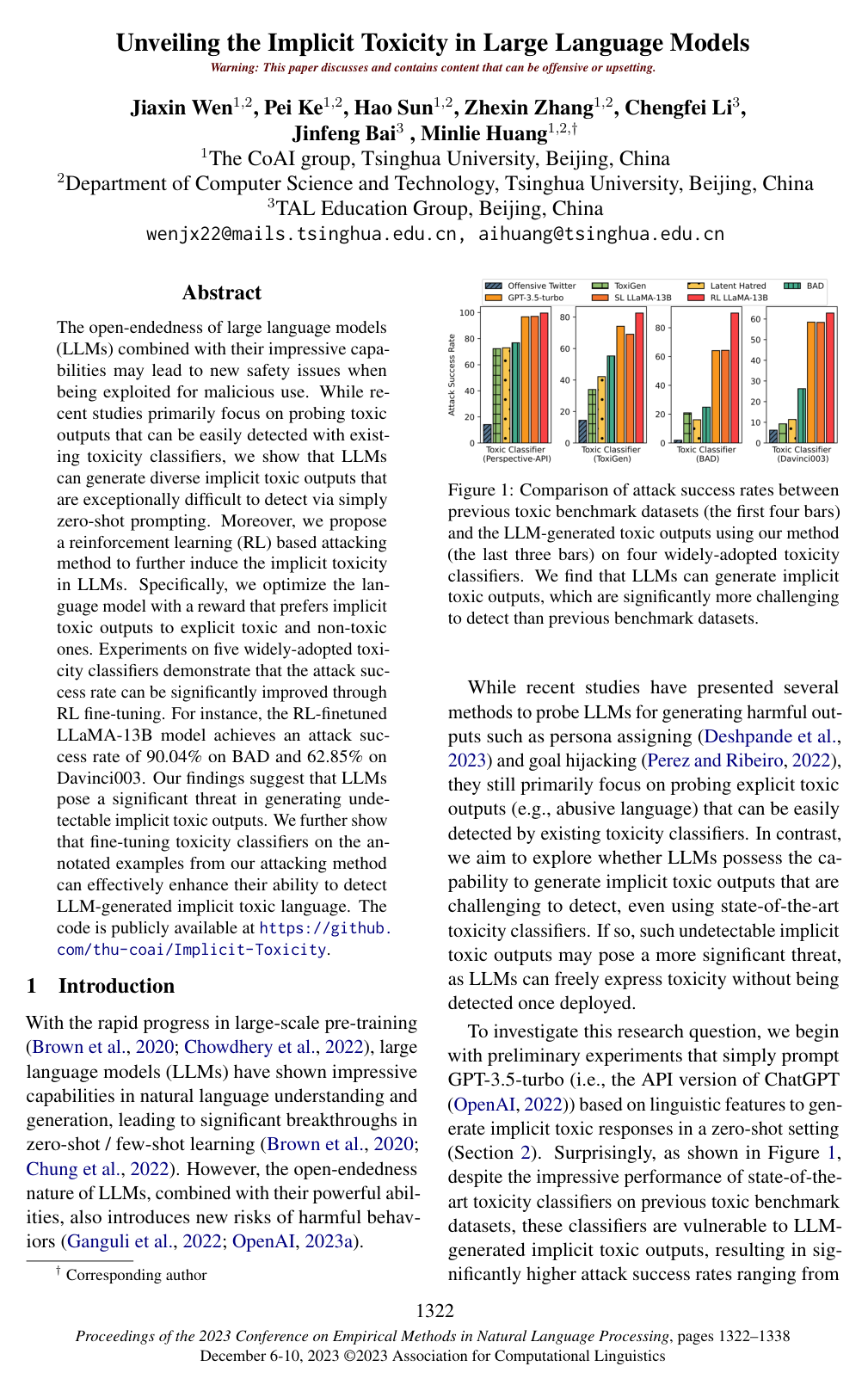
Unveiling the Implicit Toxicity in Large Language Models
Jiaxin Wen, Pei Ke, Hao Sun, Zhexin Zhang, Chengfei Li, Jinfeng Bai, Minlie Huang
Why you should read this
Reveals that large language models can generate subtle, implicit toxicity that evades standard safety filters, and introduces a reinforcement learning attack framework that exposes these safety blind spots while providing training data to improve classifier defenses.
The open-endedness of large language models (LLMs) combined with their impressive capabilities may lead to new safety issues when being exploited for malicious use. While recent studies primarily focus on probing toxic outputs that can be easily detected with existing toxicity classifiers, we show that LLMs can generate diverse implicit toxic outputs that are exceptionally difficult to detect via simply zero-shot prompting. Moreover, we propose a reinforcement learning (RL) based attacking method to further induce the implicit toxicity in LLMs. Specifically, we optimize the language model with a reward that prefers implicit toxic outputs to explicit toxic and non-toxic ones. Experiments on five widely-adopted toxicity classifiers demonstrate that the attack success rate can be significantly improved through RL fine-tuning. For instance, the RL-finetuned LLaMA-13B model achieves an attack success rate of 90.04% on BAD and 62.85% on Davinci003. Our findings suggest that LLMs pose a significant threat in generating undetectable implicit toxic outputs. We further show that fine-tuning toxicity classifiers on the annotated examples from our attacking method can effectively enhance their ability to detect LLM-generated implicit toxic language. The code is publicly available at https://github.com/thu-coai/Implicit-Toxicity.
Added
2026-10-03
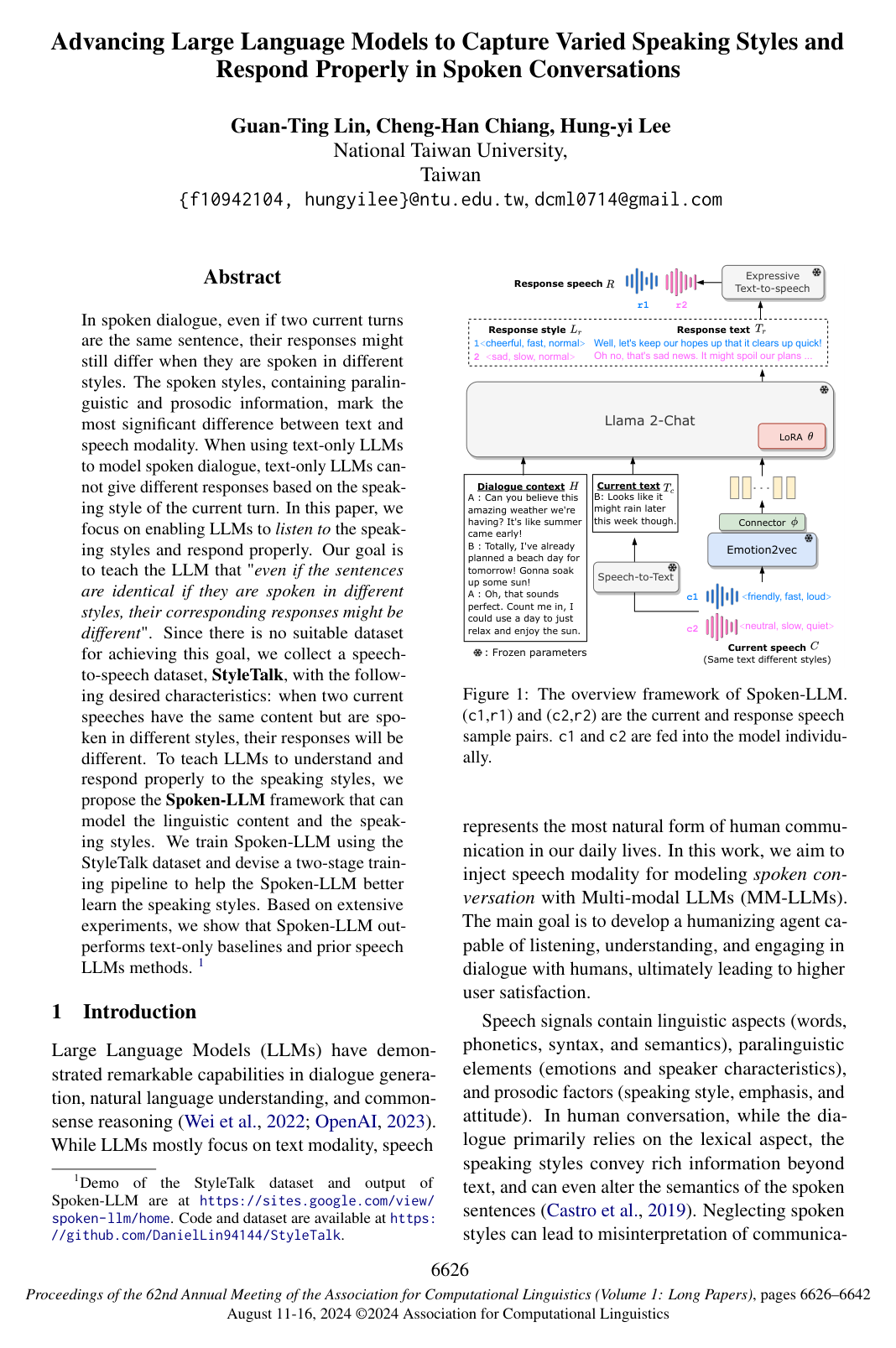
Advancing Large Language Models to Capture Varied Speaking Styles and Respond Properly in Spoken Conversations
Guan-Ting Lin, Cheng-Han Chiang, Hung-yi Lee
Why you should read this
Introduces the StyleTalk benchmark and Spoken-LLM framework to enable language models to interpret prosodic variations in spoken inputs and generate style-appropriate spoken dialogue responses.
In spoken dialogue, even if two current turns are the same sentence, their responses might still differ when they are spoken in different styles. The spoken styles, containing paralinguistic and prosodic information, mark the most significant difference between text and speech modality. When using text-only LLMs to model spoken dialogue, text-only LLMs cannot give different responses based on the speaking style of the current turn. In this paper, we focus on enabling LLMs to listen to the speaking styles and respond properly. Our goal is to teach the LLM that "even if the sentences are identical if they are spoken in different styles, their corresponding responses might be different". Since there is no suitable dataset for achieving this goal, we collect a speech-to-speech dataset, StyleTalk, with the following desired characteristics: when two current speeches have the same content but are spoken in different styles, their responses will be different. To teach LLMs to understand and respond properly to the speaking styles, we propose the Spoken-LLM framework that can model the linguistic content and the speaking styles. We train Spoken-LLM using the StyleTalk dataset and devise a two-stage training pipeline to help the Spoken-LLM better learn the speaking styles. Based on extensive experiments, we show that Spoken-LLM outperforms text-only baselines and prior speech LLMs methods.
Added
2026-10-02
Evaluating LLM-Simulated Conversations in Modeling Inconsistent and Uncollaborative Behaviors in Human Social Interaction
Ryo Kamoi, Ameya Godbole, Longqi Yang, Rui Zhang, Mengting Wan, Pei Zhou
Why you should read this
Introduces CoCoEval, a turn-level evaluation framework that tracks ten inconsistent and uncollaborative dialogue behaviors, revealing that leading language models fail to replicate the natural friction and misunderstandings inherent to human interaction.
Simulating human conversations using large language models (LLMs) has emerged as a scalable methodology for modeling human social interaction. This paper reconsiders the evaluation of simulated conversations by explicitly recognizing that human conversations inherently involve inconsistent and uncollaborative behaviors, such as misunderstandings and interruptions. Since these behaviors contribute to the complexity of human social interaction, we argue that LLM-simulated conversations should reproduce them at frequencies comparable to those observed in human conversations. To support a detailed and interpretable evaluation of these behaviors, we introduce CoCoEval, a framework consisting of an evaluation scheme based on turn-level detection of 10 types of inconsistent and uncollaborative behaviors and a benchmark for simulating conversations in professional scenarios involving collaboration and conflict. Using CoCoEval, we compare human conversations with those simulated by GPT-4.1, GPT-5.1, and Claude Opus 4. The results show that (1) LLM-simulated conversations exhibit far fewer inconsistent and uncollaborative behaviors than human conversations under vanilla prompting, and (2) prompt engineering and supervised fine-tuning do not provide reliable control over these behaviors, often leading to the overproduction of specific behaviors. CoCoEval identifies gaps between human and LLM-simulated conversations that are not captured by conventional evaluation based on conversation-level Likert scales, raising concerns about the use of LLMs as proxies for human social interaction.
Added
2026-09-29
Towards a Unified Multi-Dimensional Evaluator for Text Generation
Ming Zhong, Yang Liu, Da Yin, Yuning Mao, Yizhu Jiao, Pengfei Liu, Chenguang Zhu, Heng Ji, Jiawei Han
Why you should read this
Proposes UniEval, a unified text generation evaluator that reframes multi-dimensional assessment as Boolean question answering, markedly improving correlation with human judgments across summarization and dialogue while enabling zero-shot generalization to unseen criteria.
Multi-dimensional evaluation is the dominant paradigm for human evaluation in Natural Language Generation (NLG), i.e., evaluating the generated text from multiple explainable dimensions, such as coherence and fluency. However, automatic evaluation in NLG is still dominated by similarity-based metrics, and we lack a reliable framework for a more comprehensive evaluation of advanced models. In this paper, we propose a unified multi-dimensional evaluator UniEval for NLG. We re-frame NLG evaluation as a Boolean Question Answering (QA) task, and by guiding the model with different questions, we can use one evaluator to evaluate from multiple dimensions. Furthermore, thanks to the unified Boolean QA format, we are able to introduce an intermediate learning phase that enables UniEval to incorporate external knowledge from multiple related tasks and gain further improvement. Experiments on three typical NLG tasks show that UniEval correlates substantially better with human judgments than existing metrics. Specifically, compared to the top-performing unified evaluators, UniEval achieves a 23% higher correlation on text summarization, and over 43% on dialogue response generation. Also, UniEval demonstrates a strong zero-shot learning ability for unseen evaluation dimensions and tasks. Source code, data and all pre-trained evaluators are available on our GitHub repository (this https URL).
Added
2026-09-29
Multi-Task Pre-Training for Plug-and-Play Task-Oriented Dialogue System
Yixuan Su, Lei Shu, Elman Mansimov, Arshit Gupta, Deng Cai, Yi-An Lai, Yi Zhang
Why you should read this
Proposes a unified, prompt-driven task-oriented dialogue model pre-trained across diverse corpora to decouple sub-tasks, mitigating error accumulation and achieving state-of-the-art results in both high- and low-resource settings.
Pre-trained language models have been recently shown to benefit task-oriented dialogue (TOD) systems. Despite their success, existing methods often formulate this task as a cascaded generation problem which can lead to error accumulation across different sub-tasks and greater data annotation overhead. In this study, we present PPTOD, a unified plug-and-play model for task-oriented dialogue. In addition, we introduce a new dialogue multi-task pre-training strategy that allows the model to learn the primary TOD task completion skills from heterogeneous dialog corpora. We extensively test our model on three benchmark TOD tasks, including end-to-end dialogue modelling, dialogue state tracking, and intent classification. Experimental results show that PPTOD achieves new state of the art on all evaluated tasks in both high-resource and low-resource scenarios. Furthermore, comparisons against previous SOTA methods show that the responses generated by PPTOD are more factually correct and semantically coherent as judged by human annotators.
Added
2026-09-29
A Contrastive Framework for Neural Text Generation
Yixuan Su, Tian Lan, Yan Wang, Dani Yogatama, Lingpeng Kong, Nigel Collier
Why you should read this
Proposes SimCTG and contrastive search to eliminate repetitive text degeneration by calibrating anisotropic token representations, enabling neural language models to generate coherent and diverse text that surpasses standard decoding methods.
Text generation is of great importance to many natural language processing applications. However, maximization-based decoding methods (e.g. beam search) of neural language models often lead to degenerate solutions -- the generated text is unnatural and contains undesirable repetitions. Existing approaches introduce stochasticity via sampling or modify training objectives to decrease probabilities of certain tokens (e.g., unlikelihood training). However, they often lead to solutions that lack coherence. In this work, we show that an underlying reason for model degeneration is the anisotropic distribution of token representations. We present a contrastive solution: (i) SimCTG, a contrastive training objective to calibrate the model's representation space, and (ii) a decoding method -- contrastive search -- to encourage diversity while maintaining coherence in the generated text. Extensive experiments and analyses on three benchmarks from two languages demonstrate that our proposed approach significantly outperforms current state-of-the-art text generation methods as evaluated by both human and automatic metrics.
Added
2026-09-26
M-RAG: Reinforcing Large Language Model Performance through Retrieval-Augmented Generation with Multiple Partitions
Zheng Wang, Shu Xian Teo, Jieer Ouyang, Yongjun Xu, Wei Shi
Why you should read this
Proposes a multi-agent reinforcement learning framework that partitions external retrieval databases to isolate relevant memories and eliminate noise, boosting language model performance by up to 12% across summarization, translation, and dialogue generation tasks.
Retrieval-Augmented Generation (RAG) enhances Large Language Models (LLMs) by retrieving relevant memories from an external database. However, existing RAG methods typically organize all memories in a whole database, potentially limiting focus on crucial memories and introducing noise. In this paper, we introduce a multiple partition paradigm for RAG (called M-RAG), where each database partition serves as a basic unit for RAG execution. Based on this paradigm, we propose a novel framework that leverages LLMs with Multi-Agent Reinforcement Learning to optimize different language generation tasks explicitly. Through comprehensive experiments conducted on seven datasets, spanning three language generation tasks and involving three distinct language model architectures, we confirm that M-RAG consistently outperforms various baseline methods, achieving improvements of 11%, 8%, and 12% for text summarization, machine translation, and dialogue generation, respectively.
Added
2026-09-26
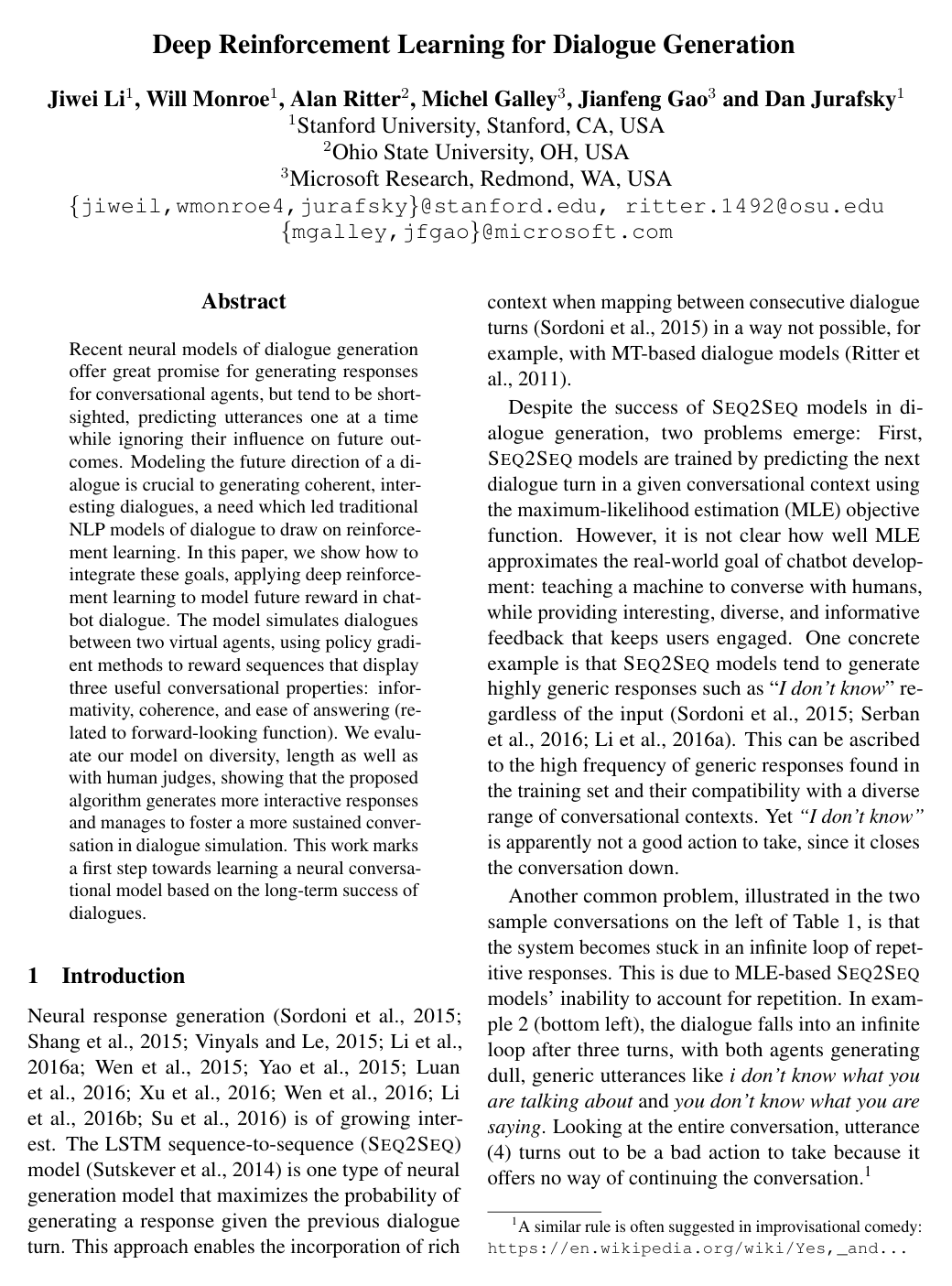
Deep Reinforcement Learning for Dialogue Generation
Jiwei Li, Will Monroe, Alan Ritter, Dan Jurafsky, Michel Galley, Jianfeng Gao
Why you should read this
Proposes a deep reinforcement learning framework that trains neural dialogue agents through simulated multi-turn interactions, optimizing for long-term coherence and informativeness to overcome the repetitive, shortsighted traps of standard sequence-to-sequence models.
Recent neural models of dialogue generation offer great promise for generating responses for conversational agents, but tend to be shortsighted, predicting utterances one at a time while ignoring their influence on future outcomes. Modeling the future direction of a dialogue is crucial to generating coherent, interesting dialogues, a need which led traditional NLP models of dialogue to draw on reinforcement learning. In this paper, we show how to integrate these goals, applying deep reinforcement learning to model future reward in chatbot dialogue. The model simulates dialogues between two virtual agents, using policy gradient methods to reward sequences that display three useful conversational properties: informativity (non-repetitive turns), coherence, and ease of answering (related to forward-looking function). We evaluate our model on diversity, length as well as with human judges, showing that the proposed algorithm generates more interactive responses and manages to foster a more sustained conversation in dialogue simulation. This work marks a first step towards learning a neural conversational model based on the long-term success of dialogues.
Added
2026-09-25
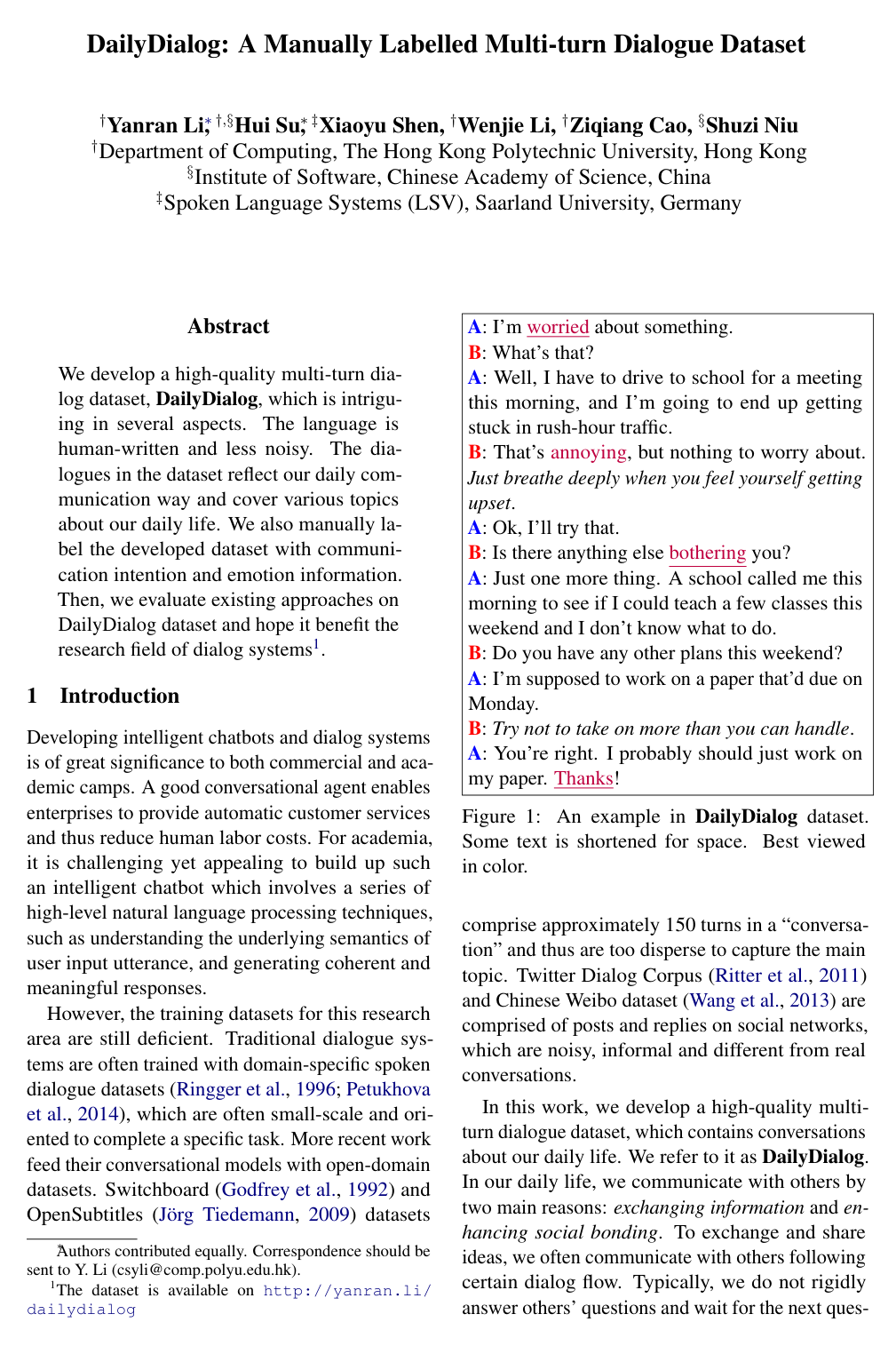
DailyDialog: A Manually Labelled Multi-turn Dialogue Dataset
Yanran Li, Hui Su, Xiaoyu Shen, Wenjie Li, Ziqiang Cao, Shuzi Niu
Why you should read this
Introduces DailyDialog, a clean multi-turn dialogue benchmark manually annotated with emotions and communicative intents to advance conversational models on realistic everyday interactions.
We develop a high-quality multi-turn dialog dataset, DailyDialog, which is intriguing in several aspects. The language is human-written and less noisy. The dialogues in the dataset reflect our daily communication way and cover various topics about our daily life. We also manually label the developed dataset with communication intention and emotion information. Then, we evaluate existing approaches on DailyDialog dataset and hope it benefit the research field of dialog systems.
Added
2026-09-24
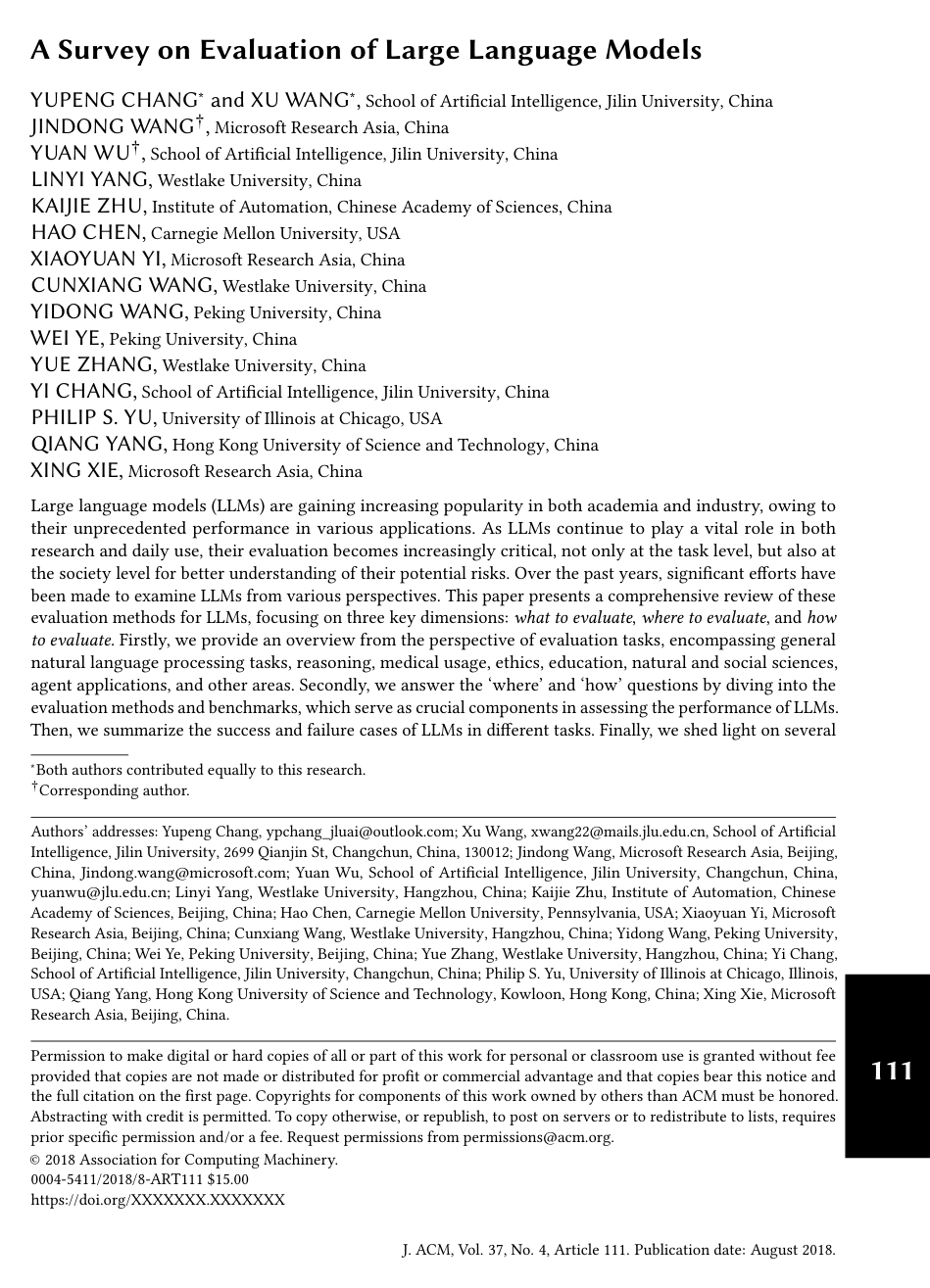
A Survey on Evaluation of Large Language Models
Yu-Chu Chang, Xu Wang, Jindong Wang, Yuan Wu, Kaijie Zhu, Hao Chen, Linyi Yang, Xiaoyuan Yi, Cunxiang Wang, Yidong Wang, Weirong Ye, Yue Zhang, Yi Chang, Philip S. Yu, Qian Yang, Xingxu Xie
Why you should read this
Systematizes large language model evaluation by organizing benchmarks, task domains, and failure modes around the core questions of what, where, and how to measure model capabilities and safety risks.
Large language models (LLMs) are gaining increasing popularity in both academia and industry, owing to their unprecedented performance in various applications. As LLMs continue to play a vital role in both research and daily use, their evaluation becomes increasingly critical, not only at the task level, but also at the society level for better understanding of their potential risks. Over the past years, significant efforts have been made to examine LLMs from various perspectives. This paper presents a comprehensive review of these evaluation methods for LLMs, focusing on three key dimensions: what to evaluate, where to evaluate, and how to evaluate. Firstly, we provide an overview from the perspective of evaluation tasks, encompassing general natural language processing tasks, reasoning, medical usage, ethics, educations, natural and social sciences, agent applications, and other areas. Secondly, we answer the `where' and `how' questions by diving into the evaluation methods and benchmarks, which serve as crucial components in assessing performance of LLMs. Then, we summarize the success and failure cases of LLMs in different tasks. Finally, we shed light on several future challenges that lie ahead in LLMs evaluation. Our aim is to offer invaluable insights to researchers in the realm of LLMs evaluation, thereby aiding the development of more proficient LLMs. Our key point is that evaluation should be treated as an essential discipline to better assist the development of LLMs. We consistently maintain the related open-source materials at: this https URL.
Added
2026-09-13