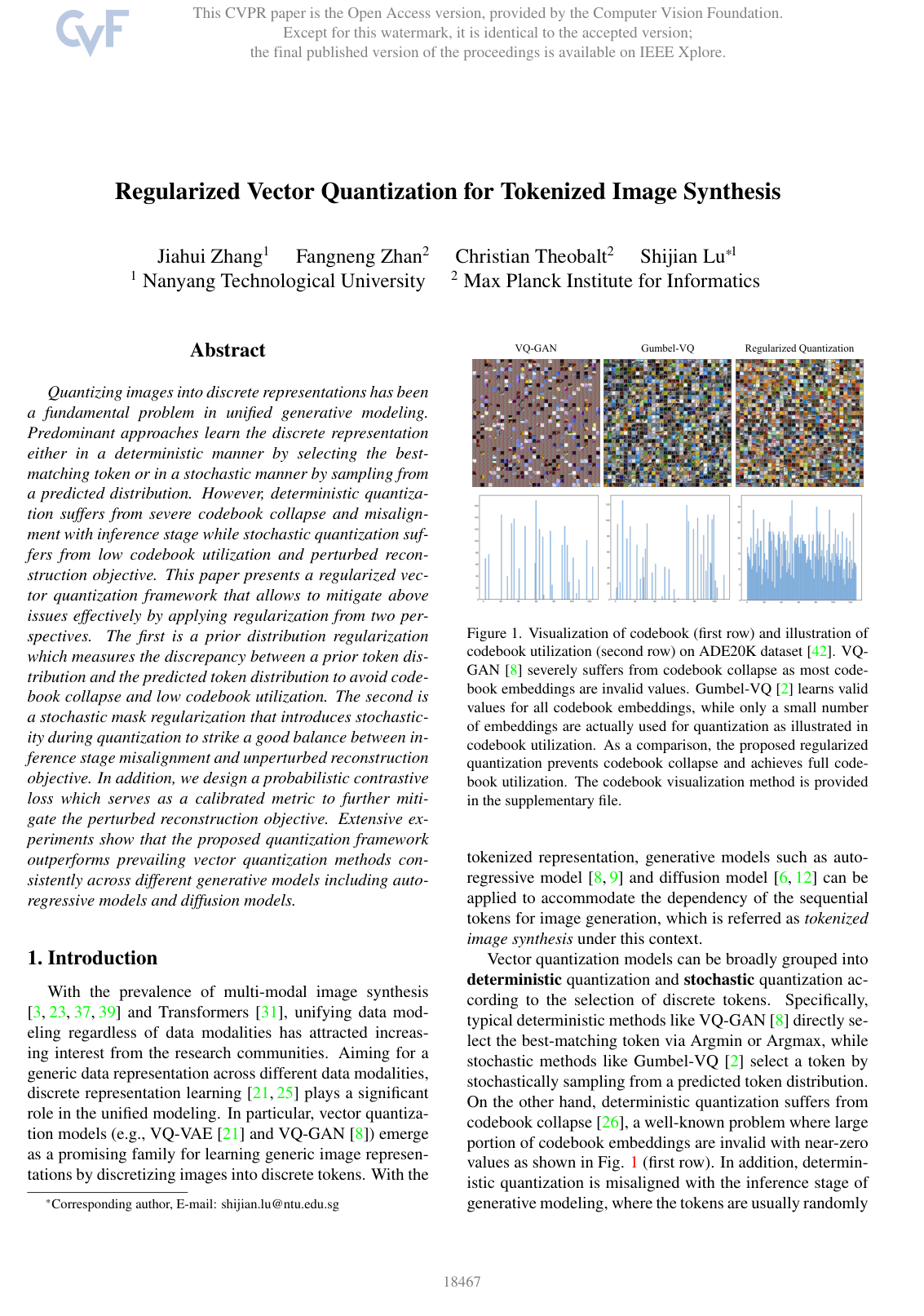
Deterministic quantization is a process in representation learning and signal processing that maps continuous-valued data into discrete representations using a fixed, non-random rule, typically by assigning each continuous vector to its nearest or best-matching vector in a predefined codebook. Unlike stochastic quantization, which samples discrete tokens from a probability distribution, deterministic quantization guarantees that identical inputs always produce the exact same discrete outputs. While this approach provides straightforward, unperturbed, and reproducible mappings for generative modeling and data compression, its rigid nearest-neighbor selection mechanism can lead to training challenges such as codebook underutilization, where only a subset of the available discrete codebook entries is actively utilized.