Built independently by an author, for readers. Read the story and support ChapterPal

keyword

deep image compression

Deep image compression is a class of digital image coding techniques that employs deep neural networks to compress images into compact representations and reconstruct them with minimal loss of fidelity. Unlike conventional compression standards that depend on handcrafted transformations and fixed quantization heuristics, deep image compression architectures typically utilize autoencoders and learned entropy models trained end-to-end on image datasets. This allows the system to automatically learn optimized non-linear mappings between raw pixel values and latent representations, effectively balancing the trade-off between compressed file size and visual reconstruction quality.

1 item

Backdoor Attacks Against Deep Image Compression via Adaptive Frequency Trigger

Backdoor Attacks Against Deep Image Compression via Adaptive Frequency Trigger

Yi Yu, Yufei Wang, Wenhan Yang, Shijian Lu, Yap-Peng Tan, Alex C. Kot

OrganizationsNanyang Technological UniversityPeng Cheng Laboratory

Why you should read this

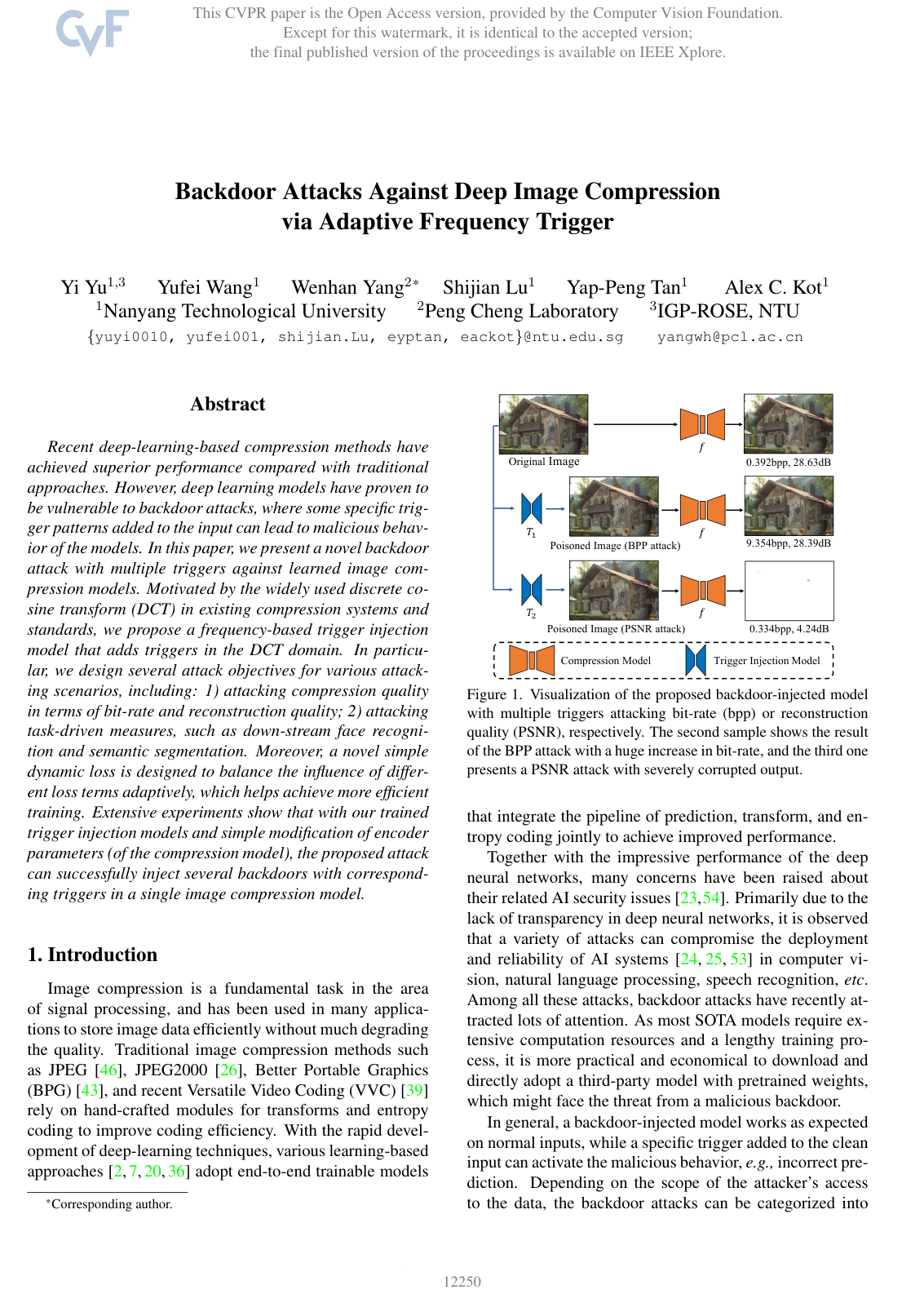
Presents a frequency-based backdoor attack targeting deep image compression models by injecting adaptive discrete cosine transform triggers into only the encoder, effectively compromising reconstruction quality, bit-rate, and downstream vision tasks without altering the decoder.

Recent deep-learning-based compression methods have achieved superior performance compared with traditional approaches. However, deep learning models have proven to be vulnerable to backdoor attacks, where some specific trigger patterns added to the input can lead to malicious behavior of the models. In this paper, we present a novel backdoor attack with multiple triggers against learned image compression models. Motivated by the widely used discrete cosine transform (DCT) in existing compression systems and standards, we propose a frequency-based trigger injection model that adds triggers in the DCT domain. In particular, we design several attack objectives for various attacking scenarios, including: 1) attacking compression quality in terms of bit-rate and reconstruction quality; 2) attacking task-driven measures, such as down-stream face recognition and semantic segmentation. Moreover, a novel simple dynamic loss is designed to balance the influence of different loss terms adaptively, which helps achieve more efficient training. Extensive experiments show that with our trained trigger injection models and simple modification of encoder parameters (of the compression model), the proposed attack can successfully inject several backdoors with corresponding triggers in a single image compression model.

Added

2026-09-26