
keyword
Deep Gaussian Processes
A deep Gaussian process is a hierarchical Bayesian machine learning model constructed by composing multiple Gaussian processes in sequential layers, where the latent outputs of one layer serve as the inputs to the next. By stacking these probabilistic mappings, deep Gaussian processes combine the expressive power of deep neural network architectures with the principled uncertainty quantification and non-parametric nature of standard Gaussian processes. This layered structure allows the model to capture complex, non-stationary, and multiscale patterns in data that a single Gaussian process cannot easily represent. Because exact posterior inference in such deep architectures is analytically intractable, training and prediction typically rely on approximate Bayesian techniques, such as variational inference, allowing the model to learn rich hierarchical representations while remaining resilient to overfitting.
3 items
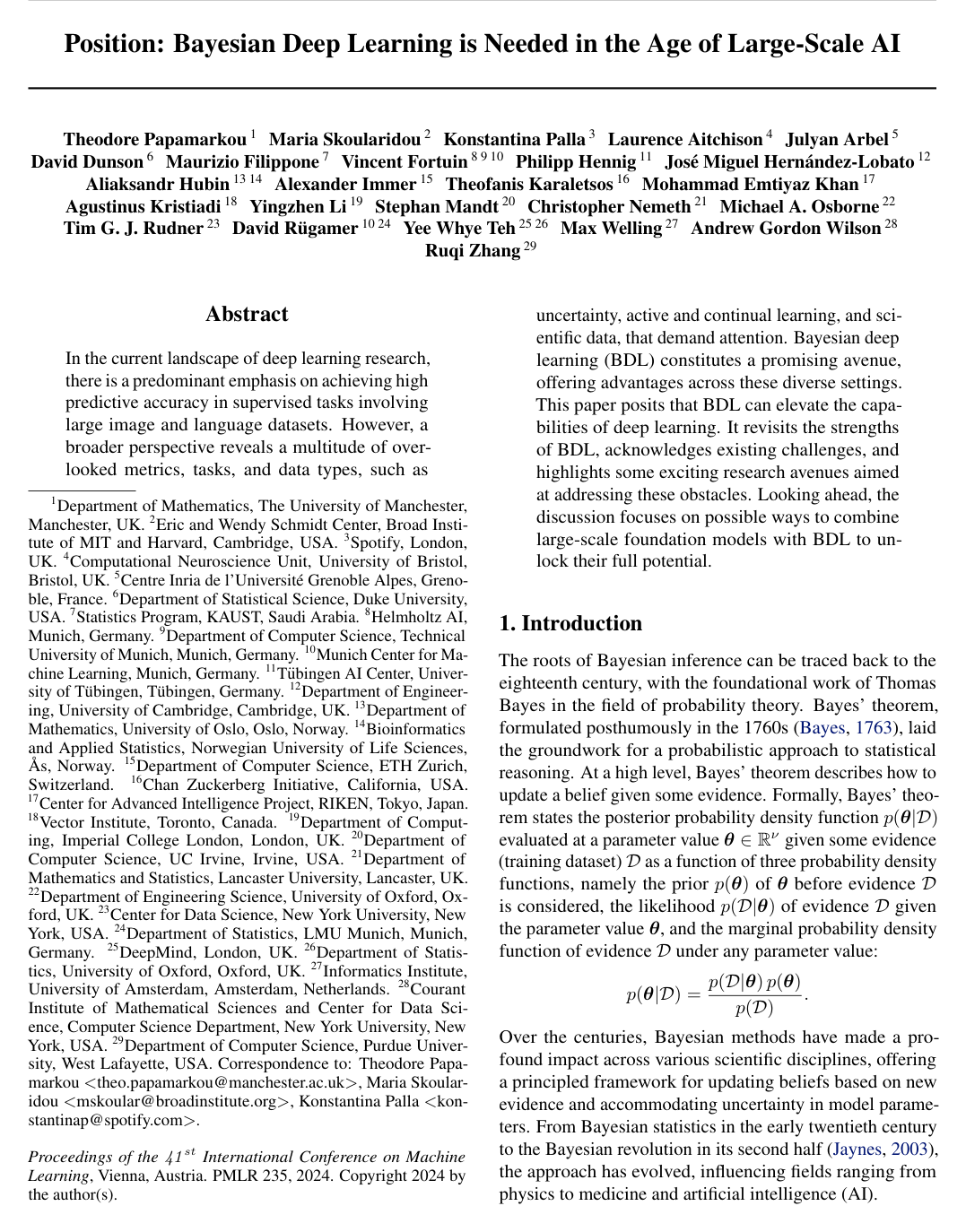
Position: Bayesian Deep Learning is Needed in the Age of Large-Scale AI
Theodore Papamarkou, Maria Skoularidou, Konstantina Palla, Laurence Aitchison, Julyan Arbel, David B. Dunson, Maurizio Filippone, Vincent Fortuin, Philipp Hennig, José Miguel Hernández-Lobato, Aliaksandr Hubin, Alexander Immer, Theofanis Karaletsos, Mohammad Emtiyaz Khan, Agustinus Kristiadi, Yingzhen Li, Stephan Mandt, Christopher Nemeth, Michael A. Osborne, Tim G. J. Rudner, David Rügamer, Yee Whye Teh, Max Welling, Andrew Gordon Wilson, Ruqi Zhang
Why you should read this
Argues that integrating Bayesian deep learning into massive foundation models is essential for mitigating overconfident hallucinations, improving uncertainty quantification in safety-critical decision-making, and enabling data-efficient learning.
Added
2026-10-02
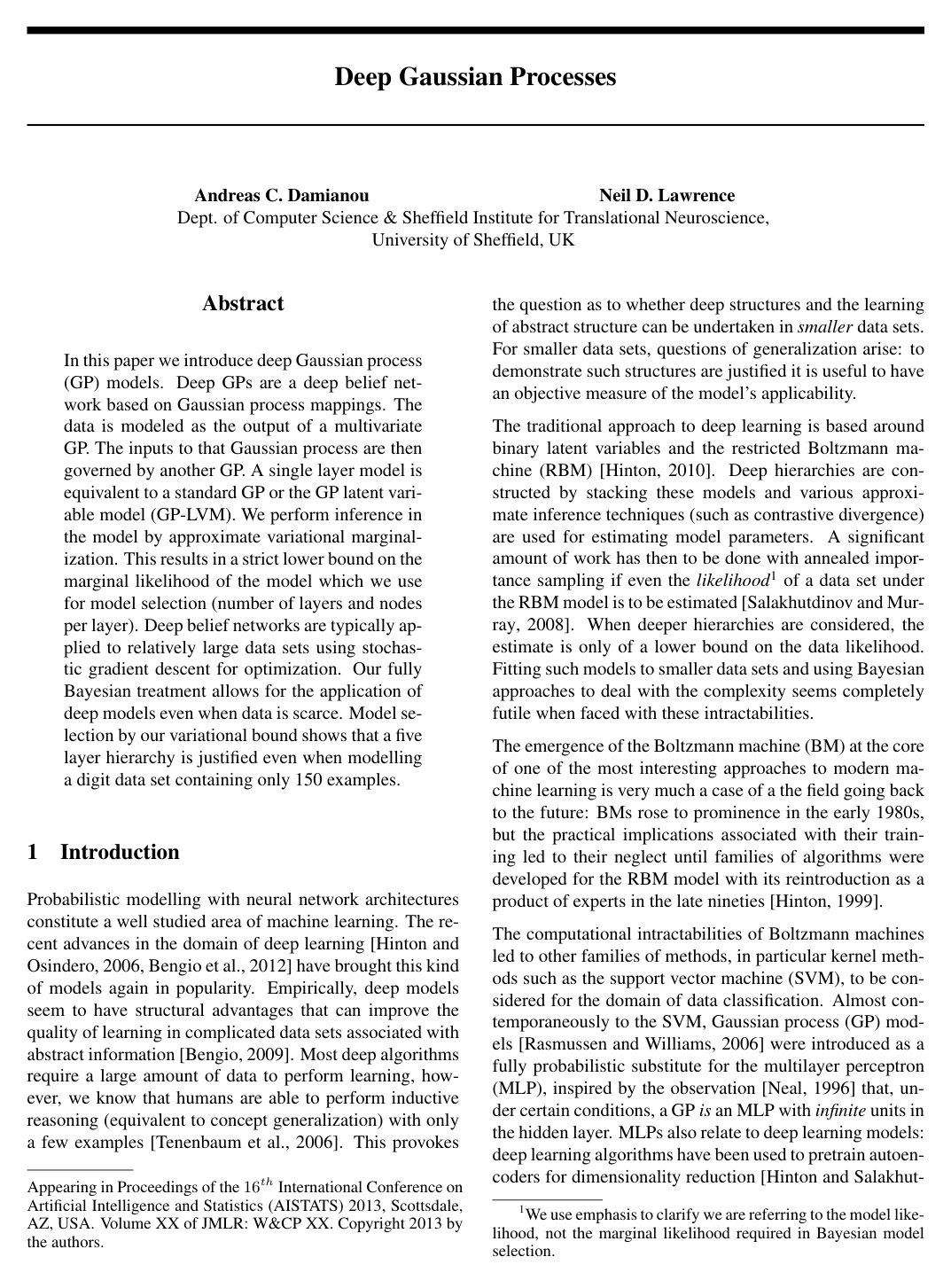
Deep Gaussian Processes
Andreas C. Damianou, Neil D. Lawrence
Why you should read this
Introduces deep Gaussian processes and a variational inference framework that enables fully Bayesian hierarchical modeling and automated architecture selection on small datasets without overfitting.
In this paper we introduce deep Gaussian process (GP) models. Deep GPs are a deep belief network based on Gaussian process mappings. The data is modeled as the output of a multivariate GP. The inputs to that Gaussian process are then governed by another GP. A single layer model is equivalent to a standard GP or the GP latent variable model (GP-LVM). We perform inference in the model by approximate variational marginalization. This results in a strict lower bound on the marginal likelihood of the model which we use for model selection (number of layers and nodes per layer). Deep belief networks are typically applied to relatively large data sets using stochastic gradient descent for optimization. Our fully Bayesian treatment allows for the application of deep models even when data is scarce. Model selection by our variational bound shows that a five layer hierarchy is justified even when modelling a digit data set containing only 150 examples.
Added
2026-09-25
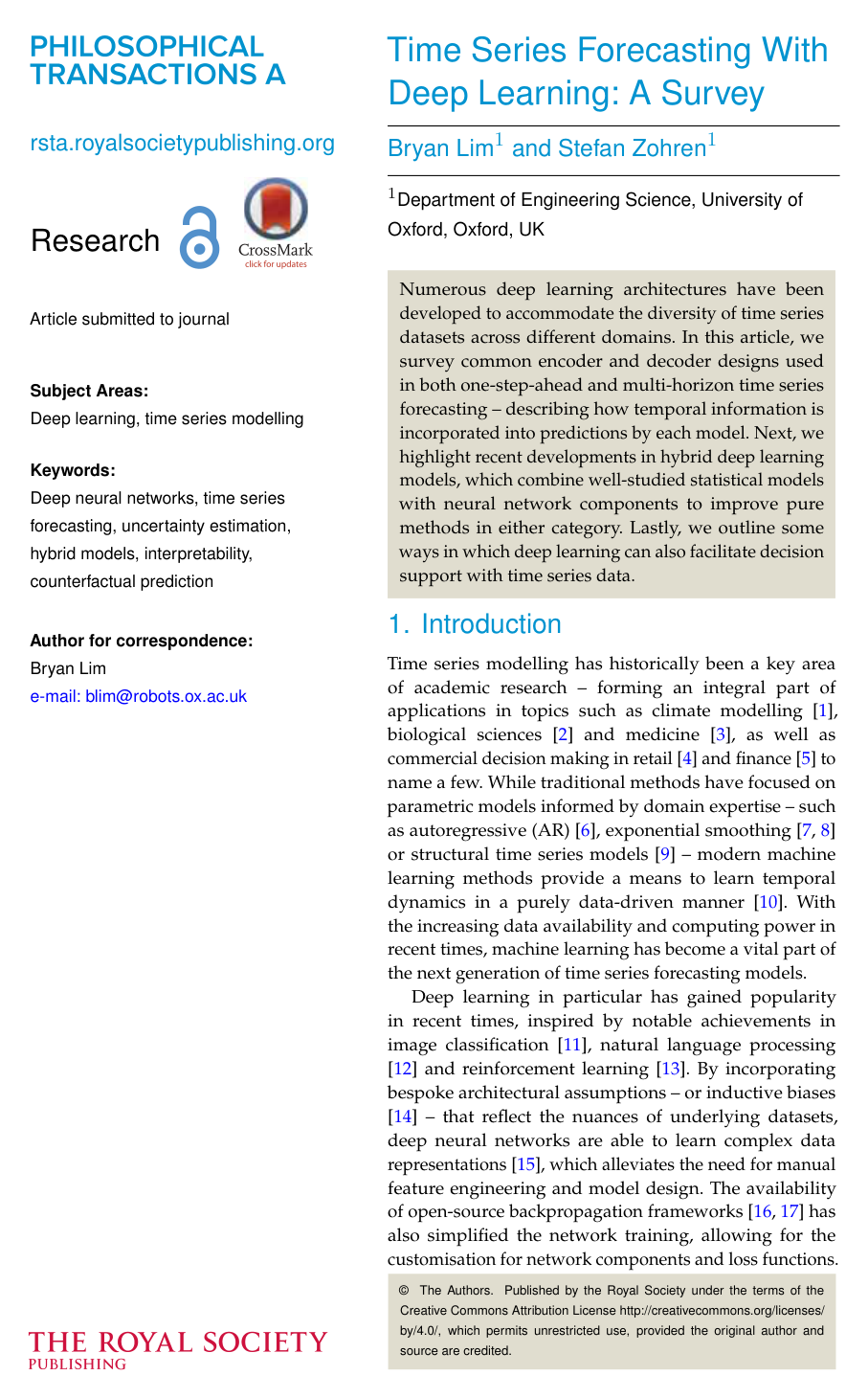
Time-series forecasting with deep learning: a survey
Bryan Lim, Stefan Zohren
Why you should read this
Categorizes modern deep learning and hybrid statistical architectures for multi-horizon time series forecasting, providing a clear guide on how different models encode temporal dynamics for operational decision support.
Numerous deep learning architectures have been developed to accommodate the diversity of time series datasets across different domains. In this article, we survey common encoder and decoder designs used in both one-step-ahead and multi-horizon time series forecasting -- describing how temporal information is incorporated into predictions by each model. Next, we highlight recent developments in hybrid deep learning models, which combine well-studied statistical models with neural network components to improve pure methods in either category. Lastly, we outline some ways in which deep learning can also facilitate decision support with time series data.
Added
2026-09-18