
keyword
decision lists
A decision list is an ordered sequence of if-then rules used in machine learning and knowledge representation to classify data or make predictions. During inference, an input instance is evaluated against each rule sequentially from top to bottom, and the output is determined by the first rule whose condition is satisfied. If an instance satisfies none of the specified conditions, it is assigned a classification defined by a final default rule at the end of the sequence. The explicit ordering of the rules ensures that every input is assigned a single, unambiguous outcome, preventing the rule conflicts that can arise in unordered rule sets. Decision lists are widely utilized because their linear structure provides transparent interpretability and can be efficiently constructed from data through inductive rule-learning algorithms.
2 items
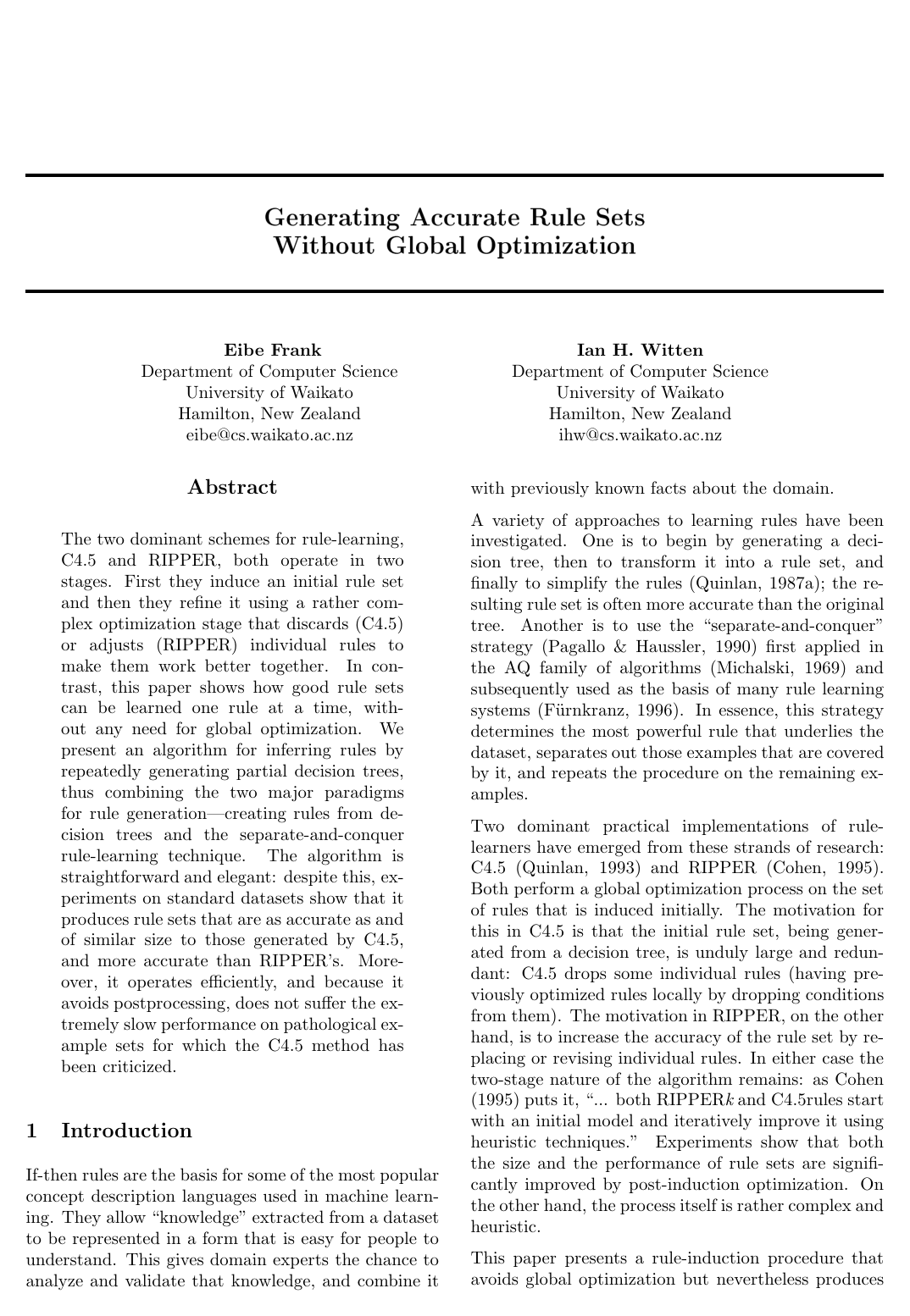
Generating Accurate Rule Sets Without Global Optimization
Eibe Frank, Ian H. Witten
Why you should read this
Presents PART, a fast rule-learning algorithm that avoids complex global optimization by deriving rules from partial decision trees within a separate-and-conquer framework to achieve accuracy and compact model sizes matching or exceeding C4.5 and RIPPER.
The two dominant schemes for rule-learning, C4.5 and RIPPER, both operate in two stages. First they induce an initial rule set and then they refine it using a rather complex optimization stage that discards (C4.5) or adjusts (RIPPER) individual rules to make them work better together. In contrast, this paper shows how good rule sets can be learned one rule at a time, without any need for global optimization. We present an algorithm for inferring rules by repeatedly generating partial decision trees, thus combining the two major paradigms for rule generation—creating rules from decision trees and the separate-and-conquer rule-learning technique. The algorithm is straightforward and elegant: despite this, experiments on standard datasets show that it produces rule sets that are as accurate as and of similar size to those generated by C4.5, and more accurate than RIPPER's. Moreover, it operates efficiently, and because it avoids postprocessing, does not suffer the extremely slow performance on pathological example sets for which the C4.5 method has been criticized.
Source
https://researchcommons.waikato.ac.nz/bitstreams/2e1b230f-cab4-471b-8076-915fd9a2d79c/downloadAdded
2026-09-25
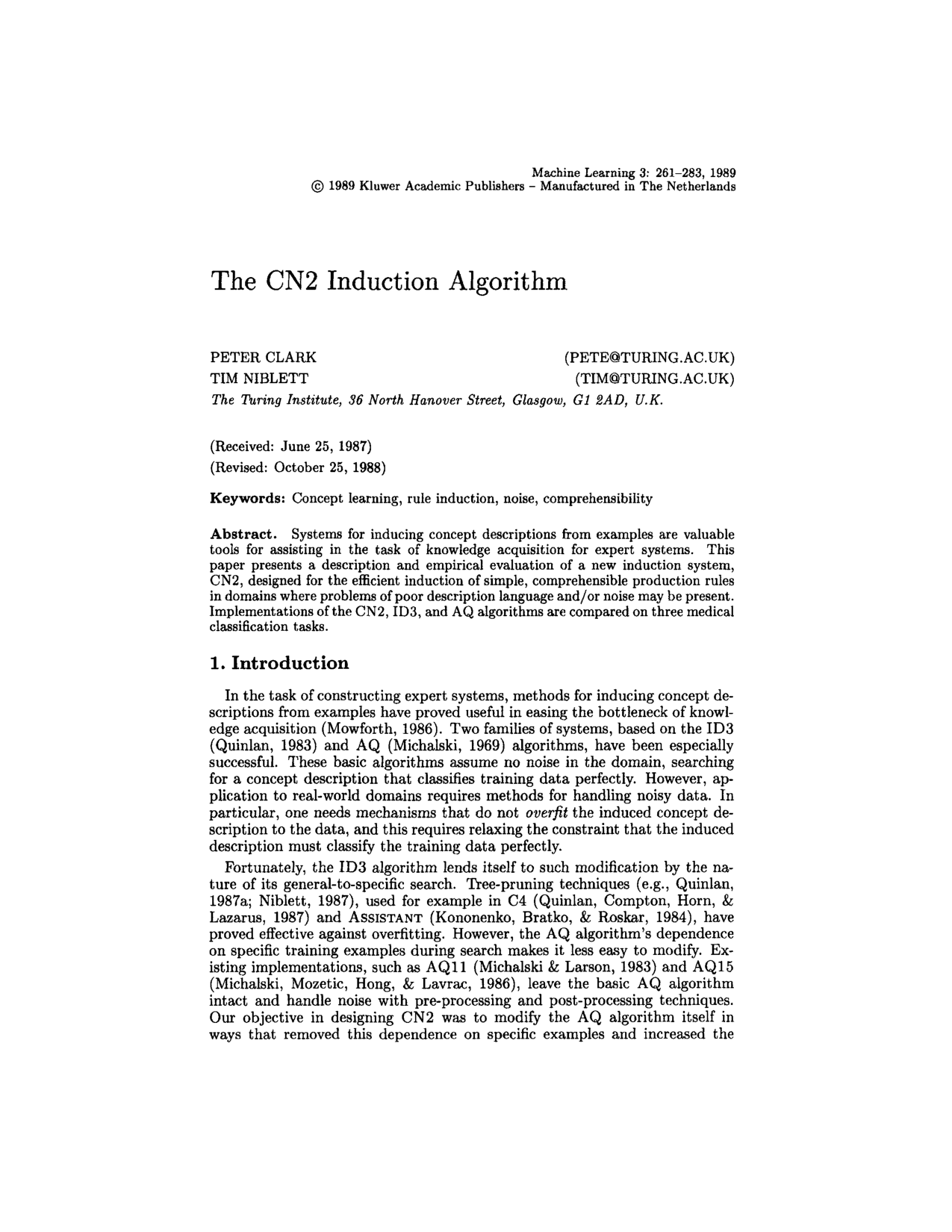
The CN2 Induction Algorithm
Peter Clark, T. Niblett
Why you should read this
Introduces the CN2 rule induction algorithm, which combines the noise-handling capabilities and efficiency of decision trees with the flexible if-then representation of the AQ algorithm to learn accurate, interpretable classification rules from imperfect data.
Systems for inducing concept descriptions from examples are valuable tools for assisting in the task of knowledge acquisition for expert systems. This paper presents a description and empirical evaluation of a new induction system, CN2, designed for the efficient induction of simple, comprehensible production rules in domains where problems of poor description language and/or noise may be present. Implementations of the CN2, ID3, and AQ algorithms are compared on three medical classification tasks.
Added
2026-09-24