
keyword
decision boundary
A decision boundary is a hypersurface in the feature space of a classification model that separates data points belonging to different classes. Points lying on one side of this boundary are assigned to one categorical label by the model, while points on the other side receive a different label. Depending on the underlying learning algorithm, a decision boundary can range from a simple linear hyperplane to an intricate, high-dimensional nonlinear surface. The geometric characteristics, margin width, and smoothness of this boundary significantly influence how effectively a classifier generalizes to unseen data as well as its susceptibility to adversarial perturbations.
6 items
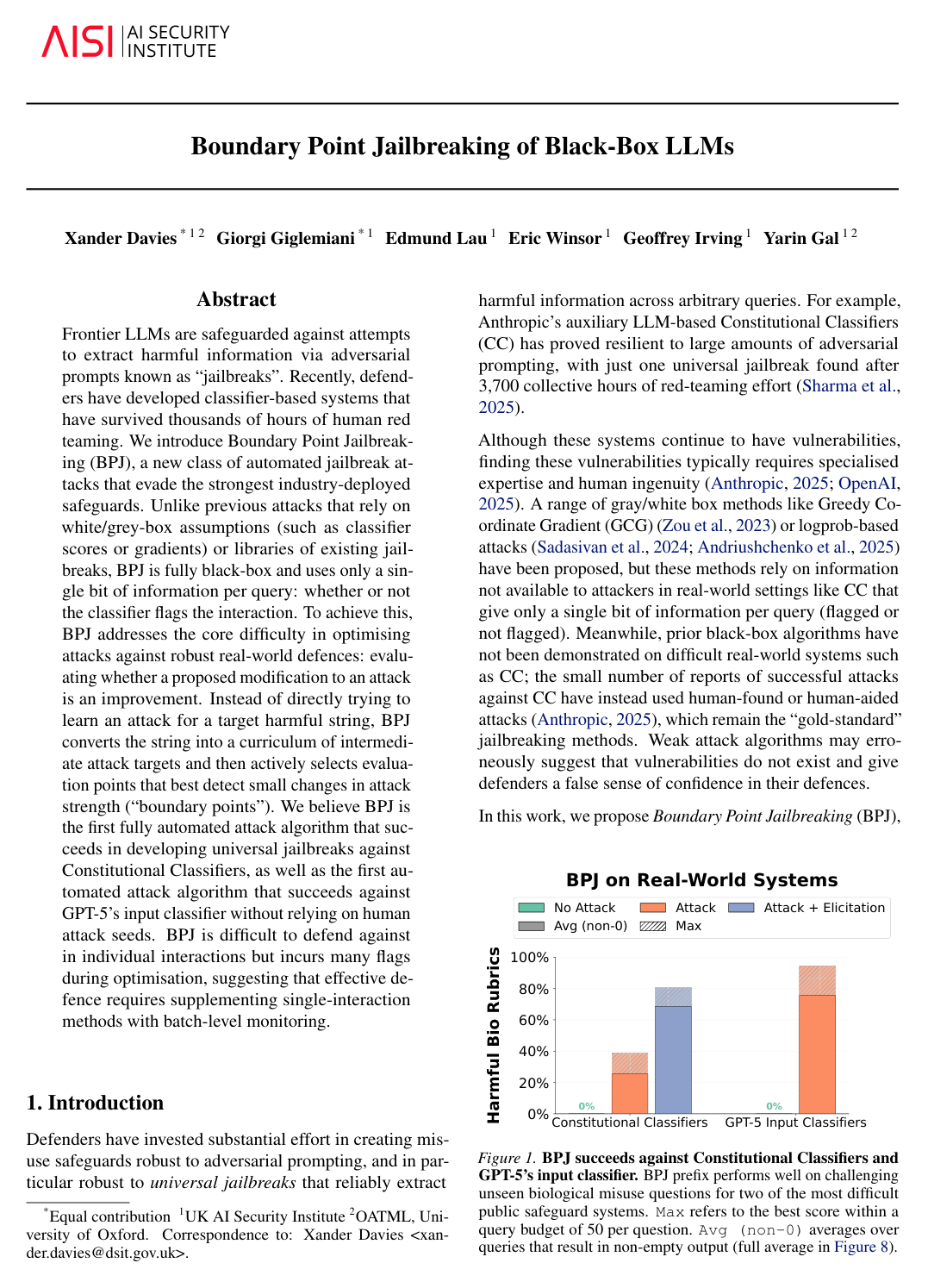
Boundary Point Jailbreaking of Black-Box LLMs
Xander Davies, Giorgi Giglemiani, Edmund Lau, Eric Winsor, Geoffrey Irving, Yarin Gal
Why you should read this
Develops an automated black-box jailbreak method that circumvents frontier language model defenses using only single-bit binary feedback per query, presenting the first successful automated attack against Constitutional Classifiers without relying on human seeds.
Frontier LLMs are safeguarded against attempts to extract harmful information via adversarial prompts known as "jailbreaks". Recently, defenders have developed classifier-based systems that have survived thousands of hours of human red teaming. We introduce Boundary Point Jailbreaking (BPJ), a new class of automated jailbreak attacks that evade the strongest industry-deployed safeguards. Unlike previous attacks that rely on white/grey-box assumptions (such as classifier scores or gradients) or libraries of existing jailbreaks, BPJ is fully black-box and uses only a single bit of information per query: whether or not the classifier flags the interaction. To achieve this, BPJ addresses the core difficulty in optimising attacks against robust real-world defences: evaluating whether a proposed modification to an attack is an improvement. Instead of directly trying to learn an attack for a target harmful string, BPJ converts the string into a curriculum of intermediate attack targets and then actively selects evaluation points that best detect small changes in attack strength ("boundary points"). We believe BPJ is the first fully automated attack algorithm that succeeds in developing universal jailbreaks against Constitutional Classifiers, as well as the first automated attack algorithm that succeeds against GPT-5's input classifier without relying on human attack seeds. BPJ is difficult to defend against in individual interactions but incurs many flags during optimisation, suggesting that effective defence requires supplementing single-interaction methods with batch-level monitoring.
Added
2026-10-04
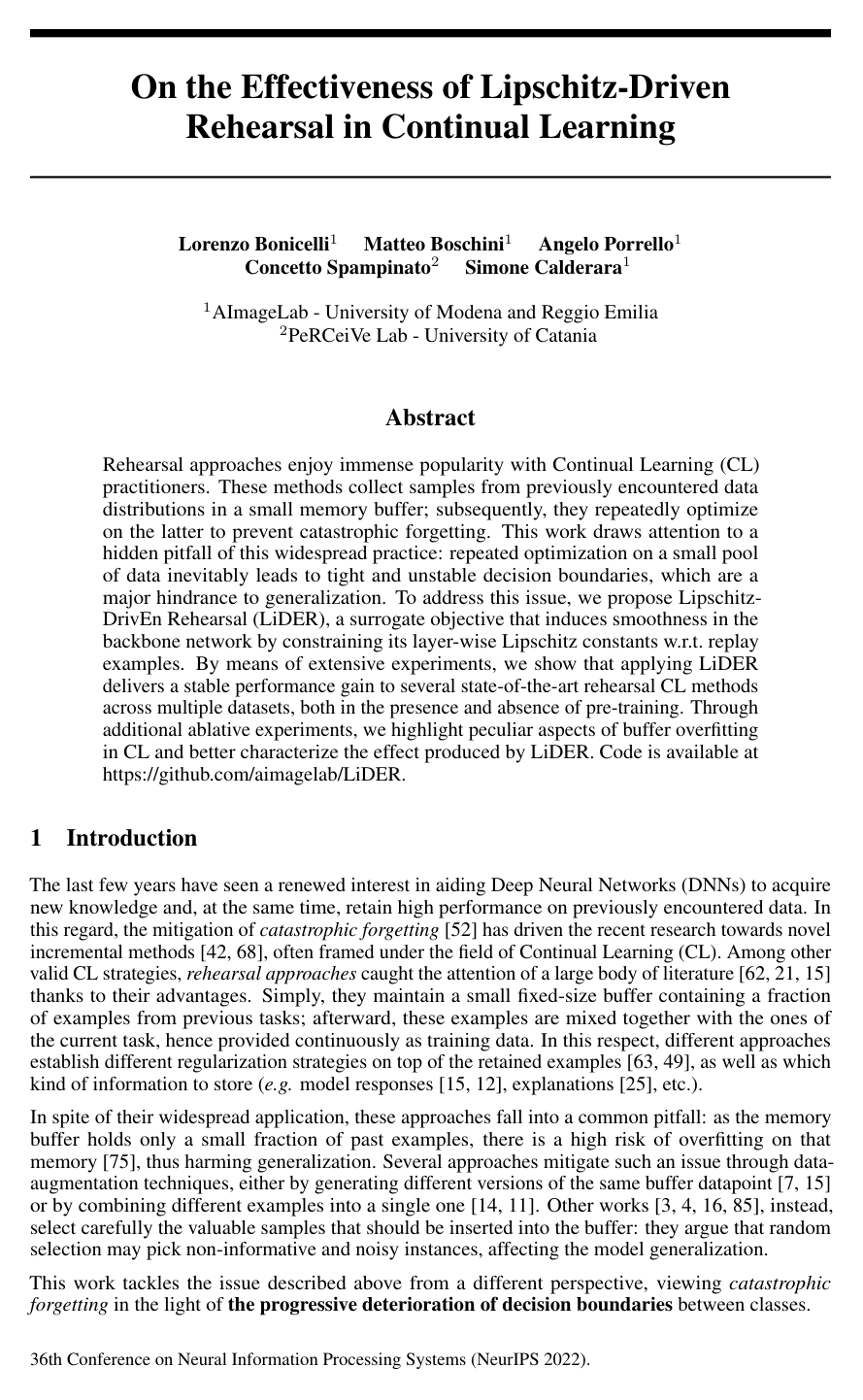
On the Effectiveness of Lipschitz-Driven Rehearsal in Continual Learning
Lorenzo Bonicelli, Matteo Boschini, Angelo Porrello, Concetto Spampinato, Simone Calderara
Why you should read this
Proposes a surrogate objective that constrains layer-wise Lipschitz constants on replay data to prevent unstable decision boundaries and buffer overfitting across standard continual learning methods.
Rehearsal approaches enjoy immense popularity with Continual Learning (CL) practitioners. These methods collect samples from previously encountered data distributions in a small memory buffer; subsequently, they repeatedly optimize on the latter to prevent catastrophic forgetting. This work draws attention to a hidden pitfall of this widespread practice: repeated optimization on a small pool of data inevitably leads to tight and unstable decision boundaries, which are a major hindrance to generalization. To address this issue, we propose Lipschitz-DrivEn Rehearsal (LiDER), a surrogate objective that induces smoothness in the backbone network by constraining its layer-wise Lipschitz constants w.r.t. replay examples. By means of extensive experiments, we show that applying LiDER delivers a stable performance gain to several state-of-the-art rehearsal CL methods across multiple datasets, both in the presence and absence of pre-training. Through additional ablative experiments, we highlight peculiar aspects of buffer overfitting in CL and better characterize the effect produced by LiDER. Code is available at https://github.com/aimagelab/LiDER.
Added
2026-09-26
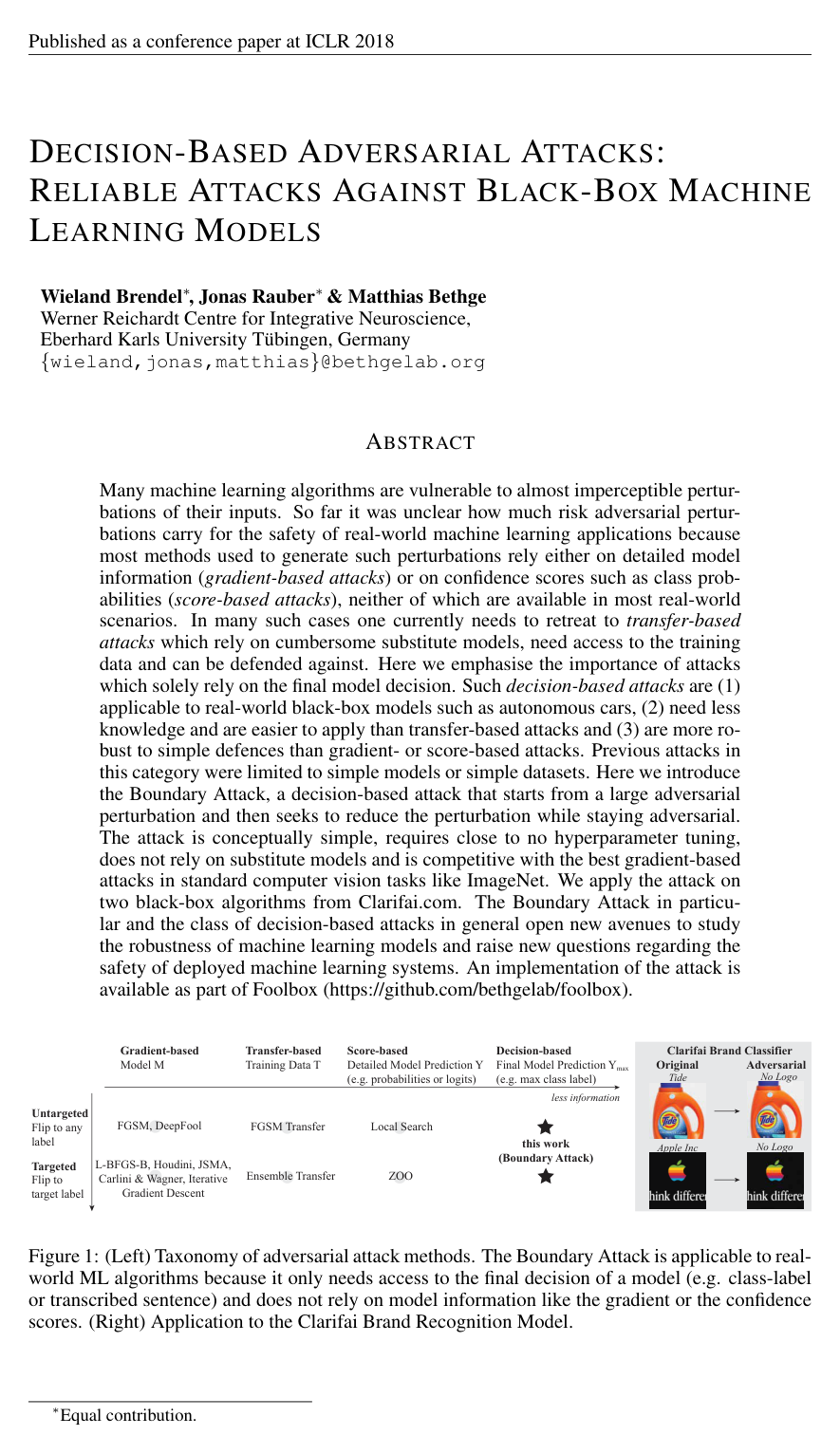
Decision-Based Adversarial Attacks: Reliable Attacks Against Black-Box Machine Learning Models
Wieland Brendel, Jonas Rauber, Matthias Bethge
Why you should read this
Introduces the Boundary Attack, a method that generates adversarial perturbations using only the final class label of a black-box model and achieves performance competitive with gradient-based attacks on complex datasets like ImageNet.
Many machine learning algorithms are vulnerable to almost imperceptible perturbations of their inputs. So far it was unclear how much risk adversarial perturbations carry for the safety of real-world machine learning applications because most methods used to generate such perturbations rely either on detailed model information (gradient-based attacks) or on confidence scores such as class probabilities (score-based attacks), neither of which are available in most real-world scenarios. In many such cases one currently needs to retreat to transfer-based attacks which rely on cumbersome substitute models, need access to the training data and can be defended against. Here we emphasise the importance of attacks which solely rely on the final model decision. Such decision-based attacks are (1) applicable to real-world black-box models such as autonomous cars, (2) need less knowledge and are easier to apply than transfer-based attacks and (3) are more robust to simple defences than gradient- or score-based attacks. Previous attacks in this category were limited to simple models or simple datasets. Here we introduce the Boundary Attack, a decision-based attack that starts from a large adversarial perturbation and then seeks to reduce the perturbation while staying adversarial. The attack is conceptually simple, requires close to no hyperparameter tuning, does not rely on substitute models and is competitive with the best gradient-based attacks in standard computer vision tasks like ImageNet. We apply the attack on two black-box algorithms from this http URL. The Boundary Attack in particular and the class of decision-based attacks in general open new avenues to study the robustness of machine learning models and raise new questions regarding the safety of deployed machine learning systems. An implementation of the attack is available as part of Foolbox at this https URL .
Added
2026-09-24
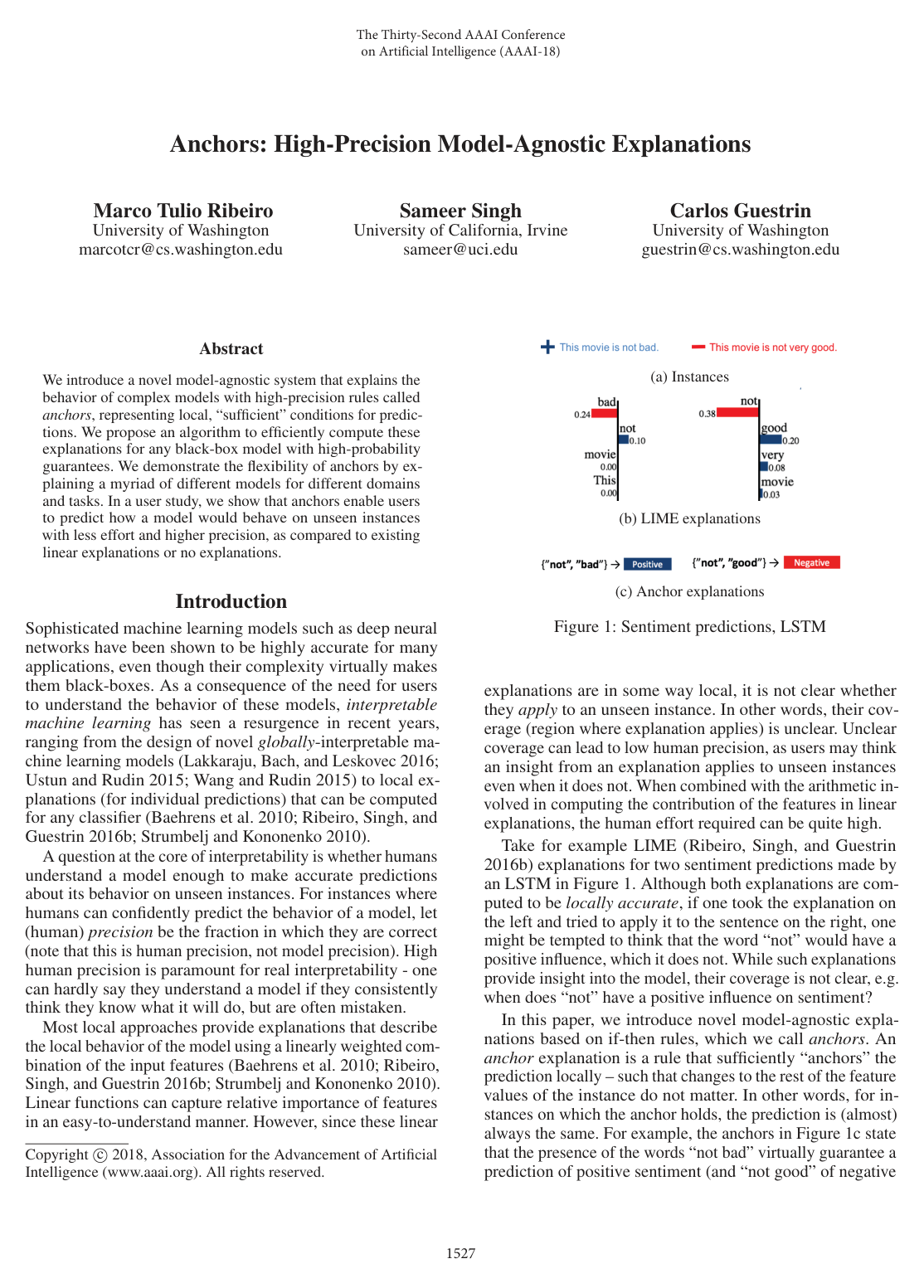
Anchors: High-Precision Model-Agnostic Explanations
Marco Tulio Ribeiro, Sameer Singh, Carlos Guestrin
Why you should read this
Introduces high-precision rule explanations that let users understand and predict black-box model behavior with less effort than linear local explanations.
We introduce a novel model-agnostic system that explains the behavior of complex models with high-precision rules called anchors, representing local, “sufficient” conditions for predictions. We propose an algorithm to efficiently compute these explanations for any black-box model with high-probability guarantees. We demonstrate the flexibility of anchors by explaining a myriad of different models for different domains and tasks. In a user study, we show that anchors enable users to predict how a model would behave on unseen instances with less effort and higher precision, as compared to existing linear explanations or no explanations.
Added
2026-09-14
Universal Adversarial Perturbations
Seyed-Mohsen Moosavi-Dezfooli, Alhussein Fawzi, Omar Fawzi, Pascal Frossard
Why you should read this
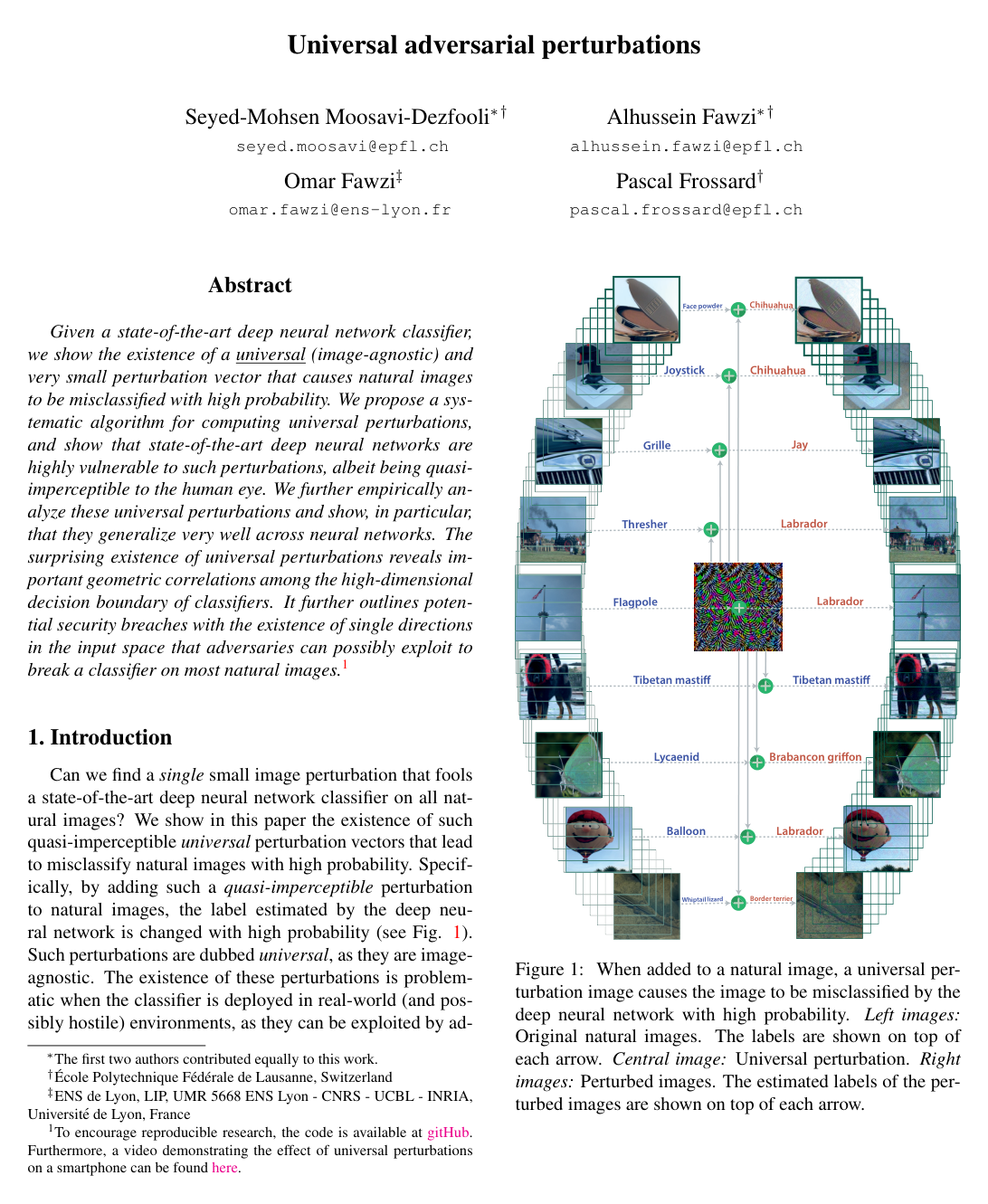
Reveals that deep neural networks can be systematically fooled on nearly all natural images using a single, image-agnostic perturbation vector that transfers across different model architectures.
Given a state-of-the-art deep neural network classifier, we show the existence of a universal (image-agnostic) and very small perturbation vector that causes natural images to be misclassified with high probability. We propose a systematic algorithm for computing universal perturbations, and show that state-of-the-art deep neural networks are highly vulnerable to such perturbations, albeit being quasi-imperceptible to the human eye. We further empirically analyze these universal perturbations and show, in particular, that they generalize very well across neural networks. The surprising existence of universal perturbations reveals important geometric correlations among the high-dimensional decision boundary of classifiers. It further outlines potential security breaches with the existence of single directions in the input space that adversaries can possibly exploit to break a classifier on most natural images.
Added
2026-09-14
One-Layer Transformer Provably Learns Multiclass One-Nearest Neighbor in Context
Skanda Athreya, Yutong Wang
We extend recent work establishing an equivalence between one-layer transformers and nearest-neighbor classifiers in the binary setting to the multiclass case. By leveraging the simplex encoding, we show that one-layer transformers with an argmax classification head behave identically to a one-nearest-neighbor classifier in the multiclass setting. This closes a gap left by prior work, whose multiclass result relied on a non-standard rounding-based approach rather than the typical argmax head used in practice.
Added
2026-09-02