
Built independently by an author, for readers. Read the story and support ChapterPal

keyword

crowd-sourced knowledge

Crowd-sourced knowledge is information, facts, or understanding gathered collaboratively from a large, decentralized group of contributors, typically over the internet. Rather than relying exclusively on curated expert sources or centralized authorities, this approach harnesses collective human intelligence through open-contribution platforms, collaborative databases, citizen science initiatives, and interactive tasks or purposeful games. The resulting data often captures broad common-sense relationships, cultural context, and everyday linguistic associations, making it widely used to construct large-scale knowledge graphs, train machine learning models, and improve natural language processing applications.

1 item
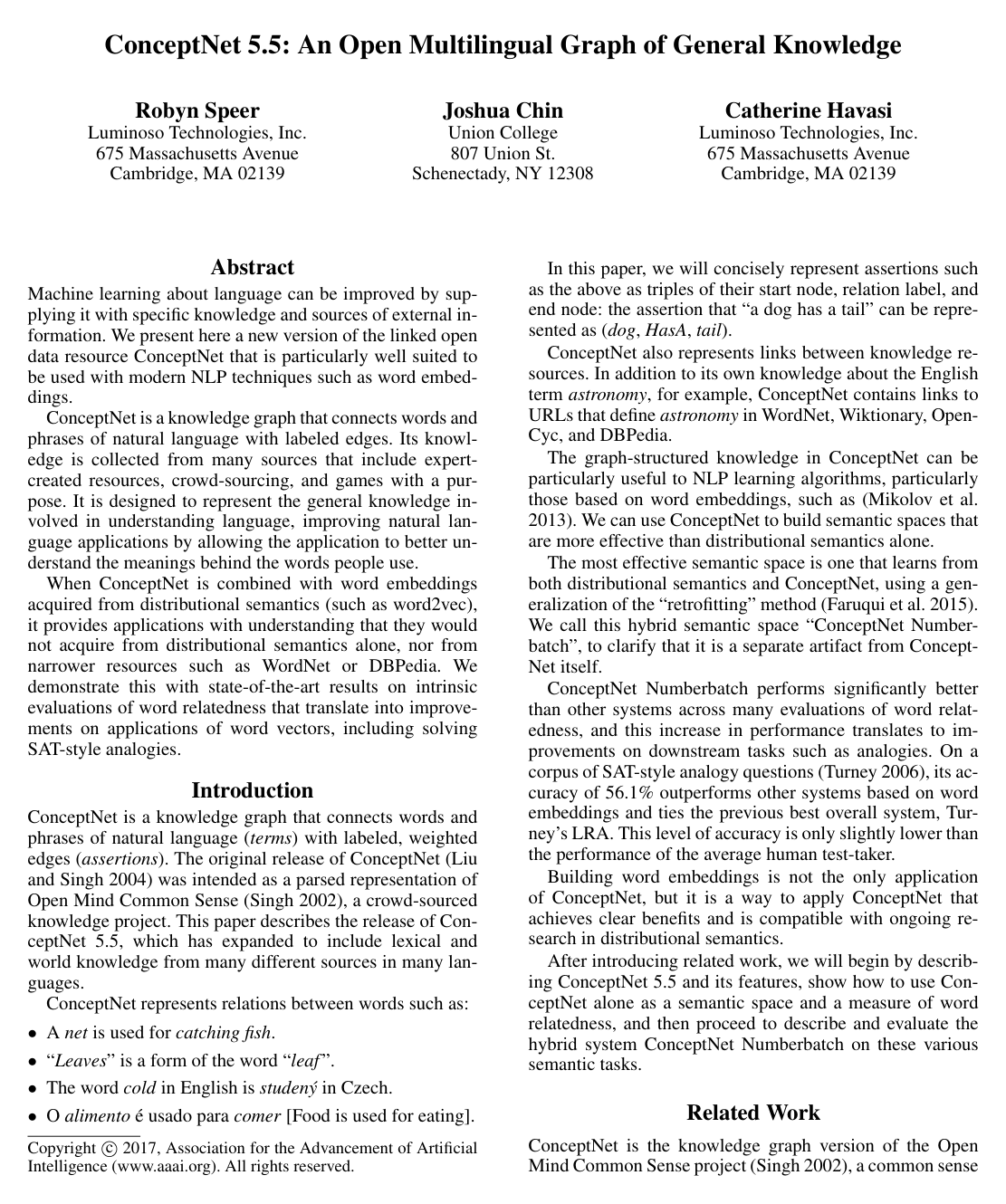
ConceptNet 5.5: An Open Multilingual Graph of General Knowledge

ConceptNet 5.5: An Open Multilingual Graph of General Knowledge

Robyn Speer, Joshua Chin, Catherine Havasi

OrganizationsLuminoso Technologies, Inc.Union College

Why you should read this

Presents ConceptNet 5.5 and demonstrates how retrofitting its multilingual common-sense knowledge graph onto distributional word embeddings creates ConceptNet Numberbatch, achieving state-of-the-art accuracy across standard word relatedness and SAT-style analogy benchmarks.

Machine learning about language can be improved by supplying it with specific knowledge and sources of external information. We present here a new version of the linked open data resource ConceptNet that is particularly well suited to be used with modern NLP techniques such as word embeddings. ConceptNet is a knowledge graph that connects words and phrases of natural language with labeled edges. Its knowledge is collected from many sources that include expert-created resources, crowd-sourcing, and games with a purpose. It is designed to represent the general knowledge involved in understanding language, improving natural language applications by allowing the application to better understand the meanings behind the words people use. When ConceptNet is combined with word embeddings acquired from distributional semantics (such as word2vec), it provides applications with understanding that they would not acquire from distributional semantics alone, nor from narrower resources such as WordNet or DBPedia. We demonstrate this with state-of-the-art results on intrinsic evaluations of word relatedness that translate into improvements on applications of word vectors, including solving SAT-style analogies.

Added

2026-09-11