
keyword
cross-view attention
Cross-view attention is an attention mechanism in computer vision neural networks that allows feature representations from different camera viewpoints or visual perspectives to interact and share information. By computing attention weights where queries representing one perspective attend to keys and values from another, the mechanism identifies spatial and semantic correspondences across distinct views of a scene or object. This inter-view feature exchange enables models in tasks such as multi-view image generation, 3D reconstruction, and novel view synthesis to preserve geometric alignment, visual details, and structural consistency across changing angles and camera poses.
3 items
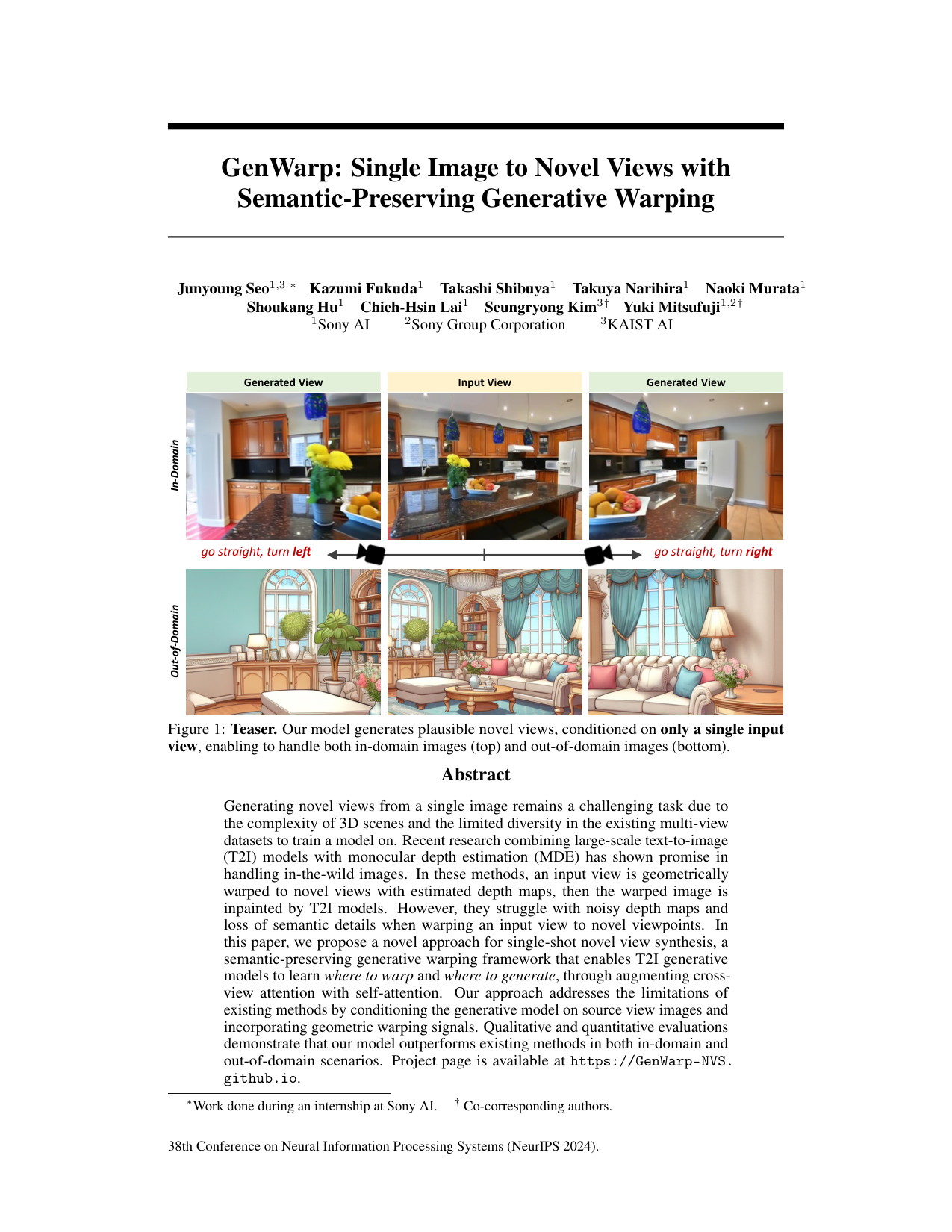
GenWarp: Single Image to Novel Views with Semantic-Preserving Generative Warping
Junyoung Seo, Kazumi Fukuda, Takashi Shibuya, Takuya Narihira, Naoki Murata, Shoukang Hu, Chieh-Hsin Lai, Seungryong Kim, Yuki Mitsufuji
Why you should read this
Proposes a single-image novel view synthesis framework that unifies geometric warping and occlusion inpainting via cross-view attention mechanisms to prevent visual artifacts caused by noisy monocular depth estimation.
Generating novel views from a single image remains a challenging task due to the complexity of 3D scenes and the limited diversity in the existing multi-view datasets to train a model on. Recent research combining large-scale text-to-image (T2I) models with monocular depth estimation (MDE) has shown promise in handling in-the-wild images. In these methods, an input view is geometrically warped to novel views with estimated depth maps, then the warped image is inpainted by T2I models. However, they struggle with noisy depth maps and loss of semantic details when warping an input view to novel viewpoints. In this paper, we propose a novel approach for single-shot novel view synthesis, a semantic-preserving generative warping framework that enables T2I generative models to learn where to warp and where to generate, through augmenting cross-view attention with self-attention. Our approach addresses the limitations of existing methods by conditioning the generative model on source view images and incorporating geometric warping signals. Qualitative and quantitative evaluations demonstrate that our model outperforms existing methods in both in-domain and out-of-domain scenarios. Project page is available at https://GenWarp-NVS.github.io.
Added
2026-09-26
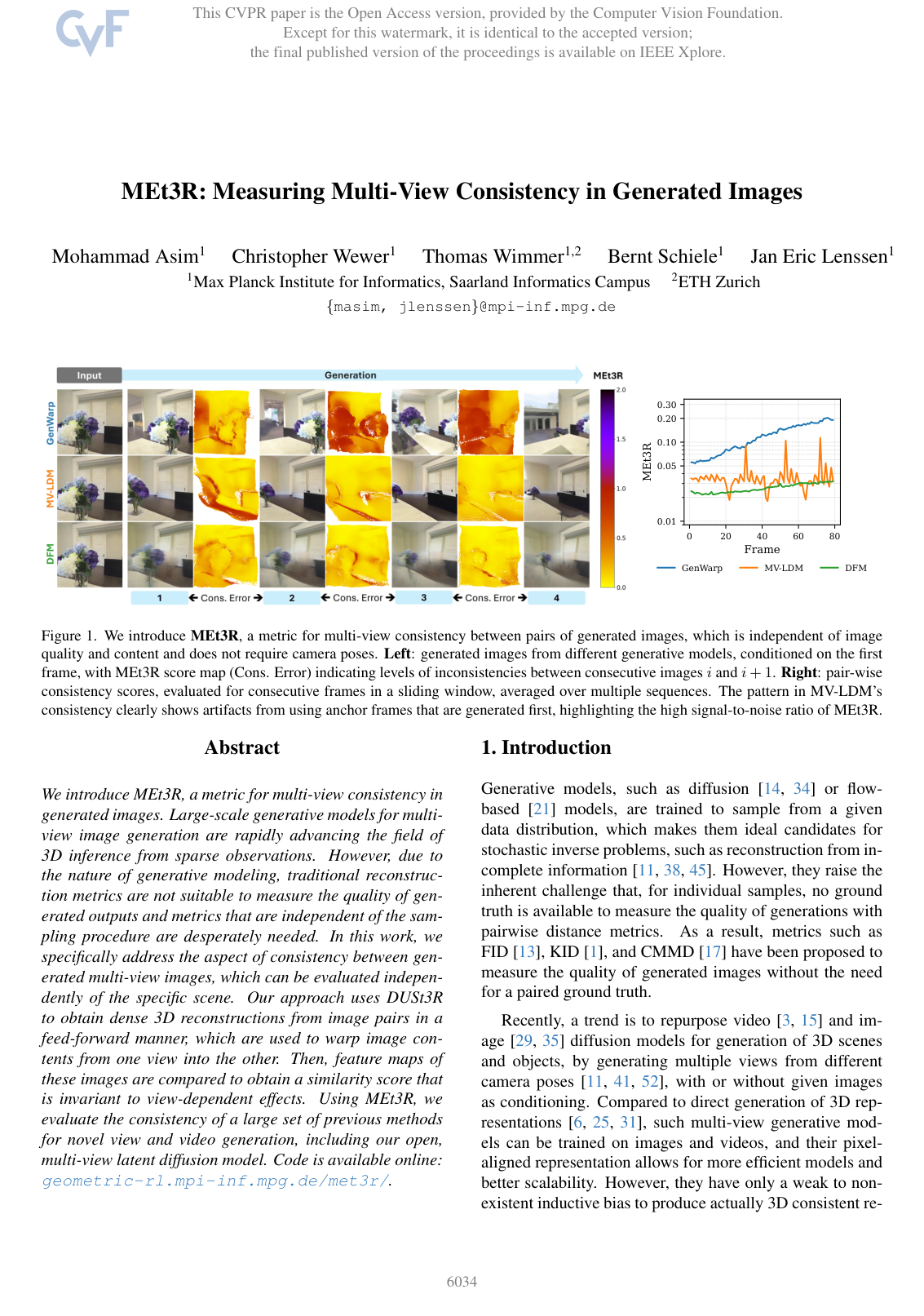
MET3R: Measuring Multi-View Consistency in Generated Images
Mohammad Asim, Christopher Wewer, Thomas Wimmer, Bernt Schiele, Jan Eric Lenssen
Why you should read this
Introduces a pose-free metric that leverages feed-forward 3D reconstructions from DUSt3R and semantic feature warping to reliably evaluate geometric consistency across generated multi-view images without requiring ground truth.
We introduce MEt3R, a metric for multi-view consistency in generated images. Large-scale generative models for multi-view image generation are rapidly advancing the field of 3D inference from sparse observations. However, due to the nature of generative modeling, traditional reconstruction metrics are not suitable to measure the quality of generated outputs and metrics that are independent of the sampling procedure are desperately needed. In this work, we specifically address the aspect of consistency between generated multi-view images, which can be evaluated independently of the specific scene. Our approach uses DUST3R to obtain dense 3D reconstructions from image pairs in a feed-forward manner, which are used to warp image contents from one view into the other. Then, feature maps of these images are compared to obtain a similarity score that is invariant to view-dependent effects. Using MEt3R, we evaluate the consistency of a large set of previous methods for novel view and video generation, including our open, multi-view latent diffusion model. Code is available online: geometric-rl.mpi-inf.mpg.de/met3r/.
Added
2026-09-26
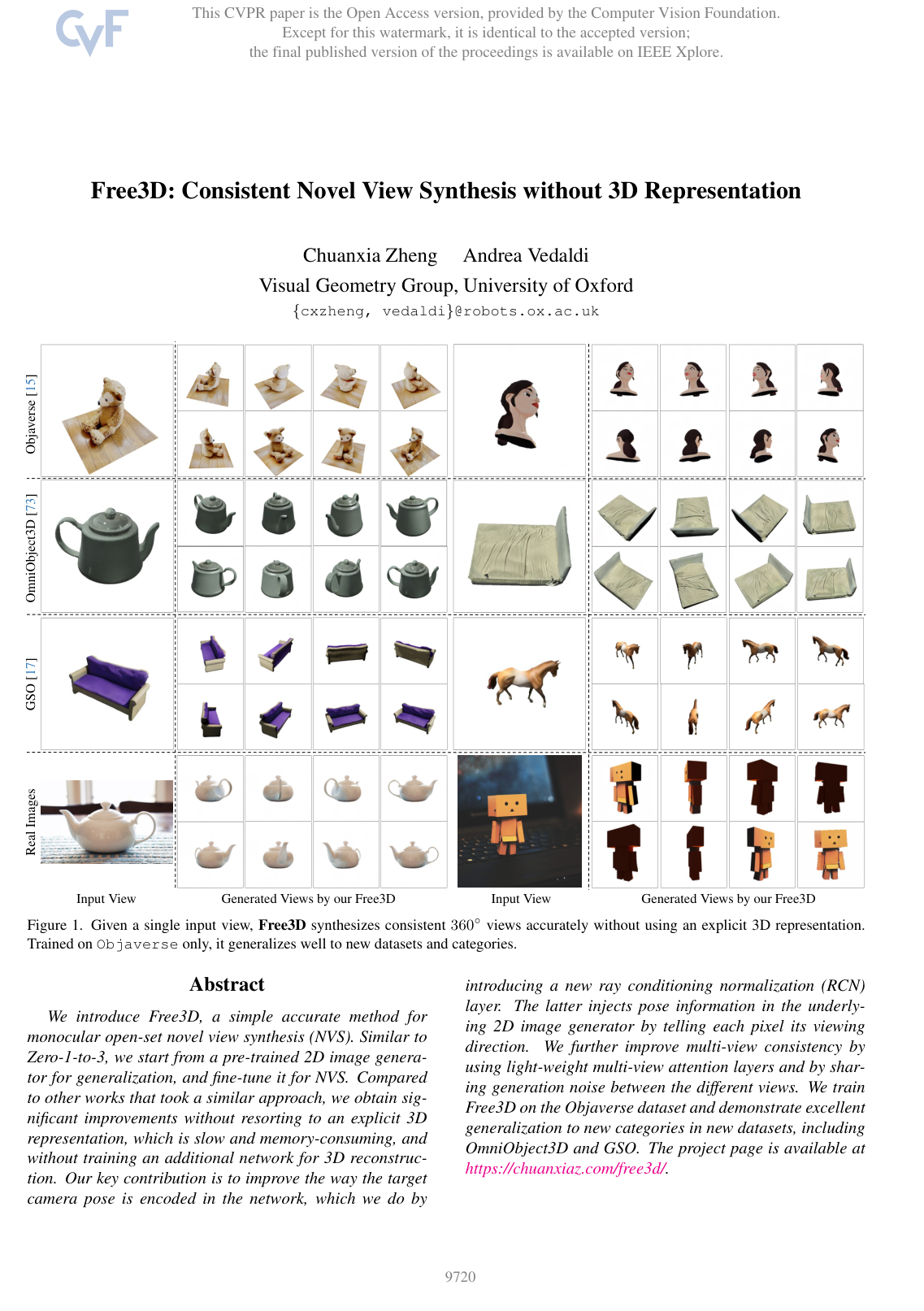
Free3D: Consistent Novel View Synthesis Without 3D Representation
Chuanxia Zheng, Andrea Vedaldi
Why you should read this
Presents Free3D, a lightweight framework that achieves accurate, consistent multi-view image generation from a single image without explicit 3D representations by using ray conditioning normalization and cross-view attention layers.
We introduce Free3D, a simple accurate method for monocular open-set novel view synthesis (NVS). Similar to Zero-1-to-3, we start from a pre-trained 2D image generator for generalization, and fine-tune it for NVS. Compared to other works that took a similar approach, we obtain significant improvements without resorting to an explicit 3D representation, which is slow and memory-consuming, and without training an additional network for 3D reconstruction. Our key contribution is to improve the way the target camera pose is encoded in the network, which we do by introducing a new ray conditioning normalization (RCN) layer. The latter injects pose information in the underlying 2D image generator by telling each pixel its viewing direction. We further improve multi-view consistency by using light-weight multi-view attention layers and by sharing generation noise between the different views. We train Free3D on the Objaverse dataset and demonstrate excellent generalization to new categories in new datasets, including OmniObject3D and GSO. The project page is available at https://chuanxiaz.com/free3d/.
Added
2026-09-26