
keyword
cross-task generalization
Cross-task generalization refers to the ability of a machine learning model to successfully perform novel, previously unseen tasks after being trained on a separate set of observed tasks. Unlike conventional multi-task learning, which evaluates models on the same tasks encountered during training, cross-task generalization specifically measures out-of-distribution transfer across distinct task formulations, categories, and objectives. In modern artificial intelligence and natural language processing, this capability is commonly developed by training models to interpret declarative natural language instructions, meta-learn from few-shot in-context demonstrations, or utilize modular task representations, enabling systems to execute new tasks at inference time without requiring dedicated task-specific retraining.
7 items
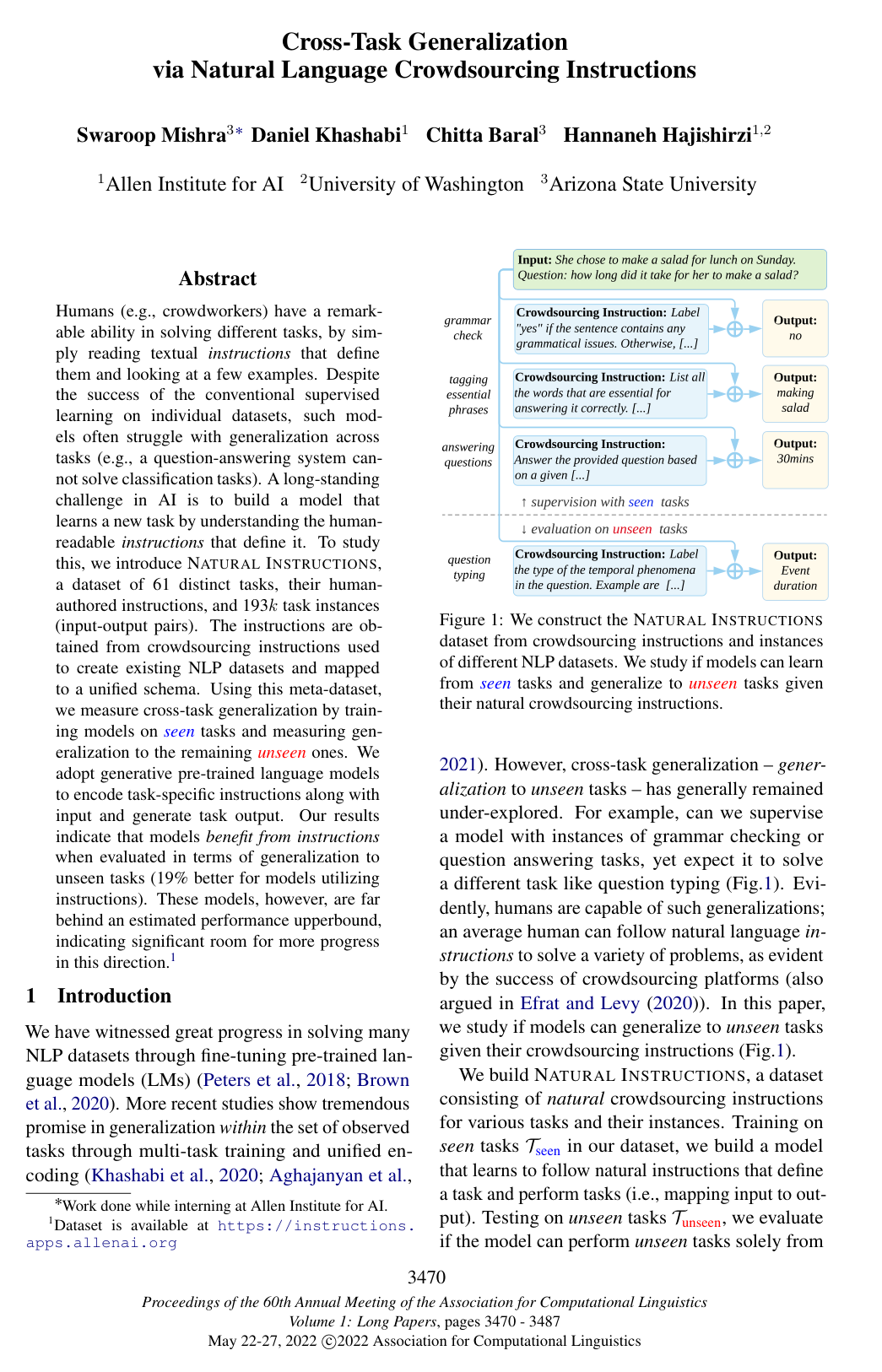
Cross-Task Generalization via Natural Language Crowdsourcing Instructions
Swaroop Mishra, Daniel Khashabi, Chitta Baral, Hannaneh Hajishirzi
Why you should read this
Introduces NATURAL INSTRUCTIONS, a benchmark of 61 diverse NLP tasks mapped to human-authored crowdsourcing guidelines, demonstrating that training language models to follow structured task definitions substantially improves their ability to generalize to completely unseen tasks.
Humans (e.g., crowdworkers) have a remark- able ability in solving different tasks, by sim- ply reading textual instructions that define them and looking at a few examples. Despite the success of the conventional supervised learning on individual datasets, such mod- els often struggle with generalization across tasks (e.g., a question-answering system can- not solve classification tasks). A long-standing challenge in AI is to build a model that learns a new task by understanding the human- readable instructions that define it. To study this, we introduce NATURAL INSTRUCTIONS, a dataset of 61 distinct tasks, their human- authored instructions, and 193k task instances (input-output pairs). The instructions are ob- tained from crowdsourcing instructions used to create existing NLP datasets and mapped to a unified schema. Using this meta-dataset, we measure cross-task generalization by train- ing models on seen tasks and measuring gen- eralization to the remaining unseen ones. We adopt generative pre-trained language models to encode task-specific instructions along with input and generate task output. Our results indicate that models benefit from instructions when evaluated in terms of generalization to unseen tasks (19% better for models utilizing instructions). These models, however, are far behind an estimated performance upperbound, indicating significant room for more progress in this direction.^1
Added
2026-10-05
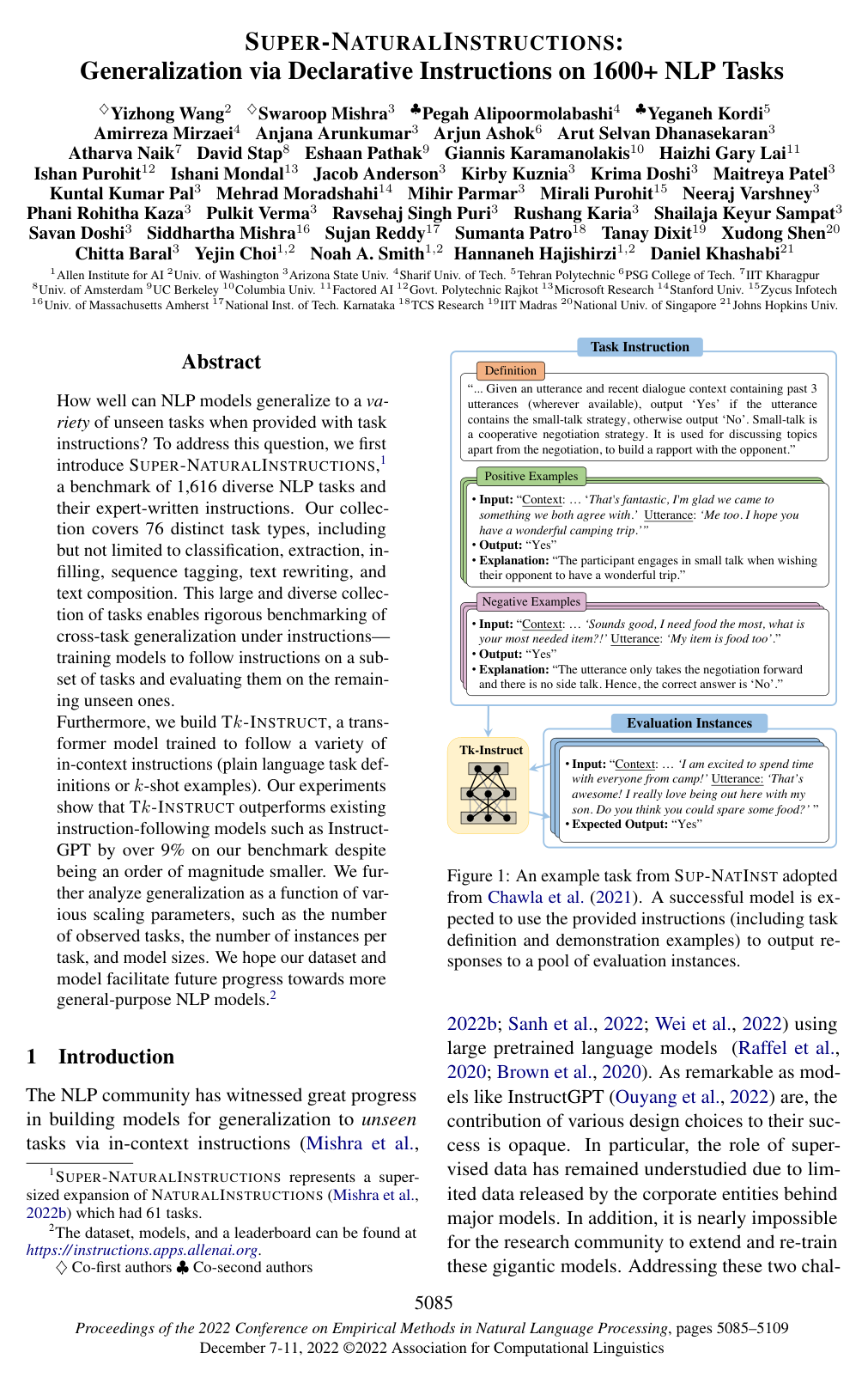
Super-NaturalInstructions: Generalization via Declarative Instructions on 1600+ NLP Tasks
Yizhong Wang, Swaroop Mishra, Pegah Alipoormolabashi, Yeganeh Kordi, Amirreza Mirzaei, Atharva Naik, Arjun Ashok, Arut Selvan Dhanasekaran, Anjana Arunkumar, David Stap, Eshaan Pathak, Giannis Karamanolakis, Haizhi Gary Lai, Ishan Purohit, Ishani Mondal, Jacob Anderson, Kirby Kuznia, Krima Doshi, Kuntal Kumar Pal, Maitreya Patel, Mehrad Moradshahi, Mihir Parmar, Mirali Purohit, Neeraj Varshney, Phani Rohitha Kaza, Pulkit Verma, Ravsehaj Singh Puri, Rushang Karia, Savan Doshi, Shailaja Keyur Sampat, Siddhartha Mishra, Sujan Reddy A, Sumanta Patro, Tanay Dixit, Xudong Shen
Why you should read this
Introduces Super-NaturalInstructions, a benchmark of over 1,600 diverse tasks with human-written instructions, and develops Tk-Instruct, a model that outperforms much larger baselines like InstructGPT on unseen task generalization.
How well can NLP models generalize to a variety of unseen tasks when provided with task instructions? To address this question, we first introduce Super-NaturalInstructions, a benchmark of 1,616 diverse NLP tasks and their expert-written instructions. Our collection covers 76 distinct task types, including but not limited to classification, extraction, infilling, sequence tagging, text rewriting, and text composition. This large and diverse collection of tasks enables rigorous benchmarking of cross-task generalization under instructions -- training models to follow instructions on a subset of tasks and evaluating them on the remaining unseen ones. Furthermore, we build Tk-Instruct, a transformer model trained to follow a variety of in-context instructions (plain language task definitions or k-shot examples). Our experiments show that Tk-Instruct outperforms existing instruction-following models such as InstructGPT by over 9% on our benchmark despite being an order of magnitude smaller. We further analyze generalization as a function of various scaling parameters, such as the number of observed tasks, the number of instances per task, and model sizes. We hope our dataset and model facilitate future progress towards more general-purpose NLP models.
Added
2026-10-04
Unveiling the Generalization Power of Fine-Tuned Large Language Models
Haoran Yang, Yumeng Zhang, Jiaqi Xu, Hongyuan Lu, Pheng-Ann Heng, Wai Lam
Why you should read this
Reveals how task-specific fine-tuning alters the out-of-domain and cross-task generalization of large language models differently across classification and generation tasks, demonstrating that incorporating in-context demonstrations during fine-tuning prevents loss of generalizability.
While Large Language Models (LLMs) have demonstrated exceptional multitasking abilities, fine-tuning these models on downstream, domain-specific datasets is often necessary to yield superior performance on test sets compared to their counterparts without fine-tuning. However, the comprehensive effects of fine-tuning on the LLMs’ generalization ability are not fully understood. This paper delves into the differences between original, unmodified LLMs and their fine-tuned variants. Our primary investigation centers on whether fine-tuning affects the generalization ability intrinsic to LLMs. To elaborate on this, we conduct extensive experiments across five distinct language tasks on various datasets. Our main findings reveal that models fine-tuned on generation and classification tasks exhibit dissimilar behaviors in generalizing to different domains and tasks. Intriguingly, we observe that integrating the in-context learning strategy during fine-tuning on generation tasks can enhance the model’s generalization ability. Through this systematic investigation, we aim to contribute valuable insights into the evolving landscape of fine-tuning practices for LLMs. The code and data are available at https://github.com/LHRYANG/Generalization_of_FT-LLM.
Added
2026-10-02
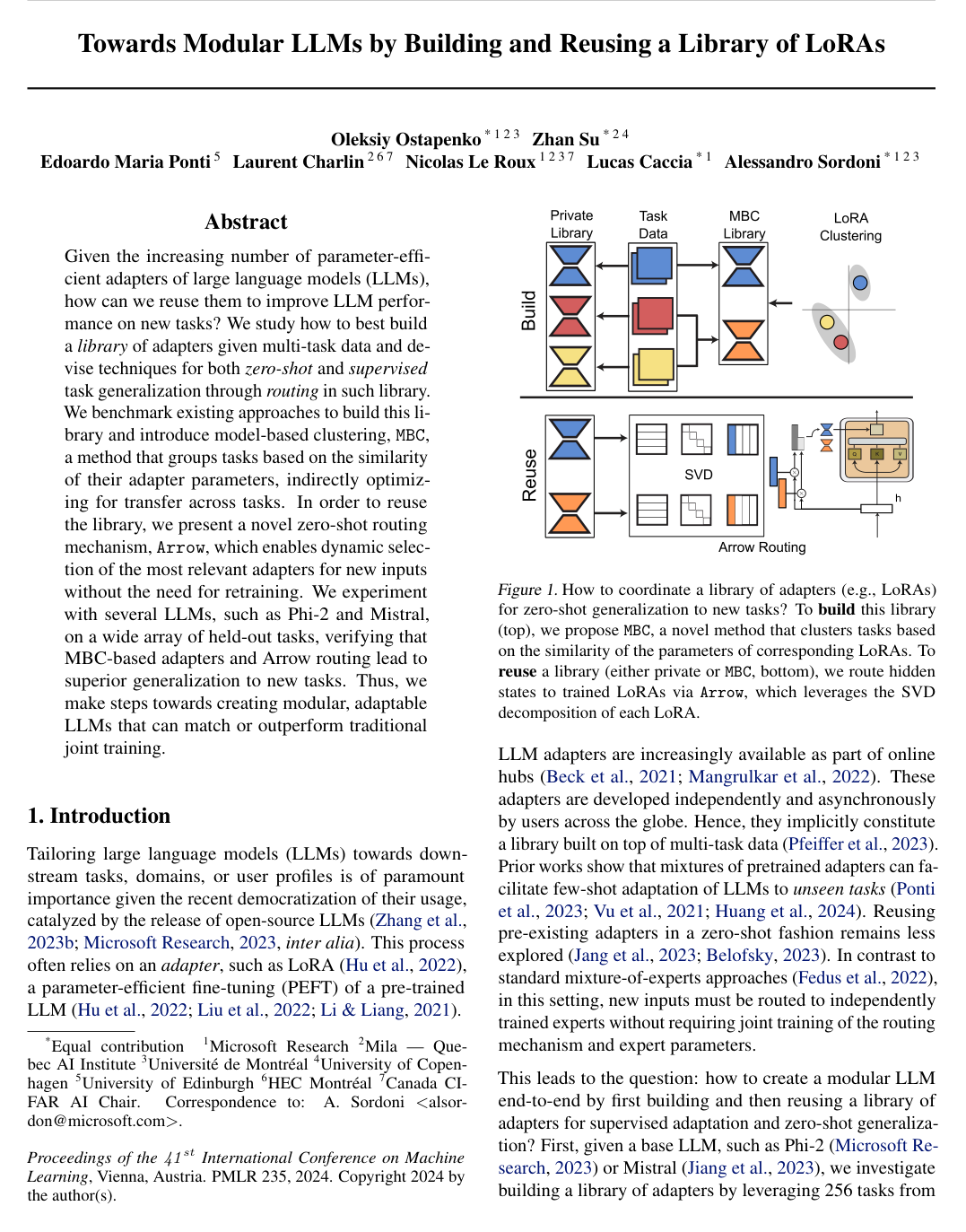
Towards Modular LLMs by Building and Reusing a Library of LoRAs
Oleksiy Ostapenko, Zhan Su, Edoardo M. Ponti, Laurent Charlin, Nicolas Le Roux, Lucas Caccia, Alessandro Sordoni
Why you should read this
Proposes a modular framework that clusters LoRA adapters by parameter similarity and dynamically routes hidden states to the most relevant adapters at inference time, achieving superior zero-shot and supervised generalization without requiring joint retraining.
Given the increasing number of parameter-efficient adapters of large language models (LLMs), how can we reuse them to improve LLM performance on new tasks? We study how to best build a library of adapters given multi-task data and devise techniques for both zero-shot and supervised task generalization through routing in such library. We benchmark existing approaches to build this library and introduce model-based clustering, MBC, a method that groups tasks based on the similarity of their adapter parameters, indirectly optimizing for transfer across tasks. In order to reuse the library, we present a novel zero-shot routing mechanism, Arrow, which enables dynamic selection of the most relevant adapters for new inputs without the need for retraining. We experiment with several LLMs, such as Phi-2 and Mistral, on a wide array of held-out tasks, verifying that MBC-based adapters and Arrow routing lead to superior generalization to new tasks. Thus, we make steps towards creating modular, adaptable LLMs that can match or outperform traditional joint training.
Added
2026-09-26
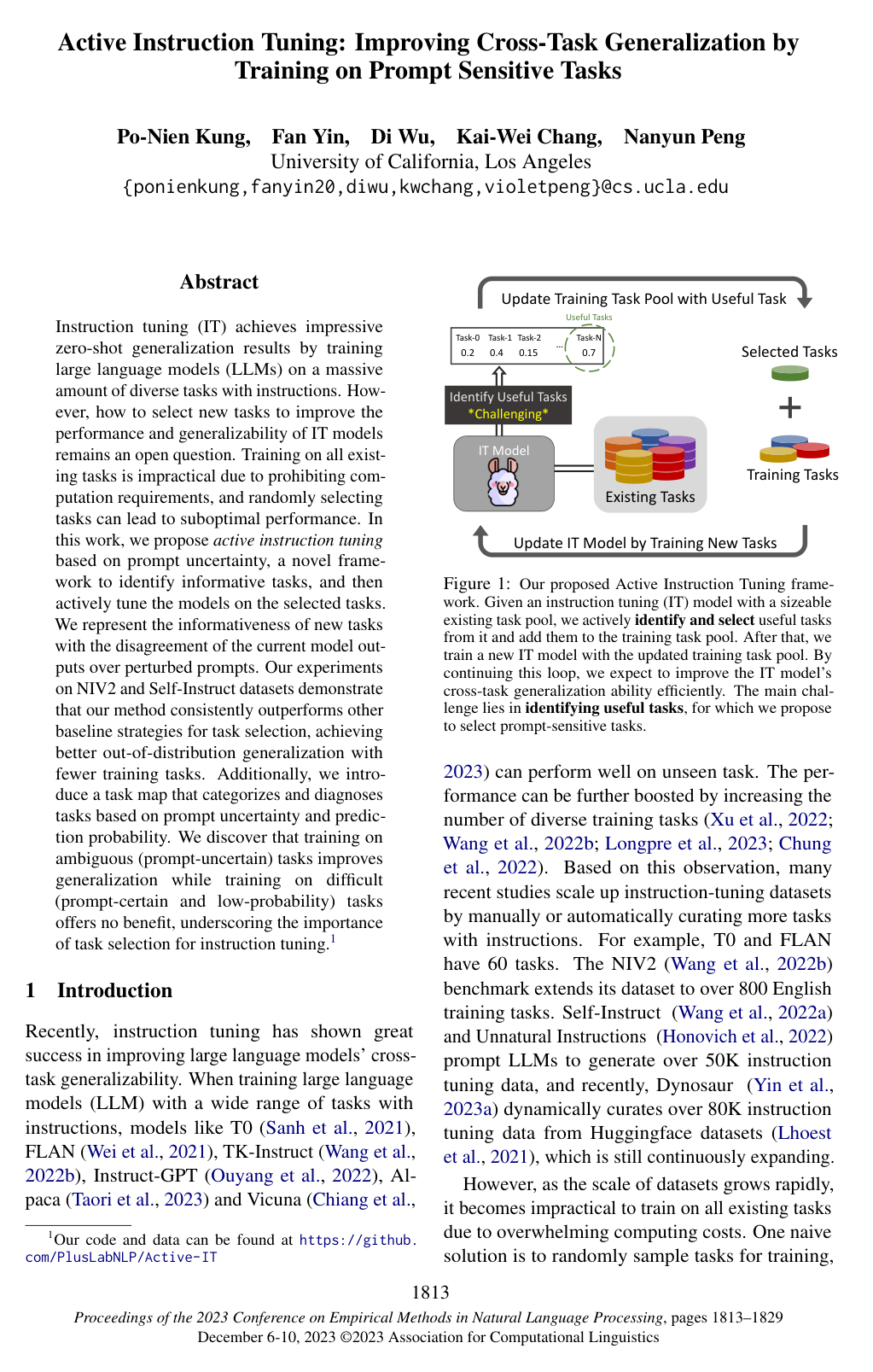
Active Instruction Tuning: Improving Cross-Task Generalization by Training on Prompt Sensitive Tasks
Po-Nien Kung, Fan Yin, Di Wu, Kai-Wei Chang, Nanyun Peng
Why you should read this
Proposes an active instruction tuning framework that quantifies prompt uncertainty to identify and train on the most informative tasks, achieving superior cross-task generalization with substantially fewer training datasets.
Instruction tuning (IT) achieves impressive zero-shot generalization results by training large language models (LLMs) on a massive amount of diverse tasks with instructions. However, how to select new tasks to improve the performance and generalizability of IT models remains an open question. Training on all existing tasks is impractical due to prohibiting computation requirements, and randomly selecting tasks can lead to suboptimal performance. In this work, we propose active instruction tuning based on prompt uncertainty, a novel framework to identify informative tasks, and then actively tune the models on the selected tasks. We represent the informativeness of new tasks with the disagreement of the current model outputs over perturbed prompts. Our experiments on NIV2 and Self-Instruct datasets demonstrate that our method consistently outperforms other baseline strategies for task selection, achieving better out-of-distribution generalization with fewer training tasks. Additionally, we introduce a task map that categorizes and diagnoses tasks based on prompt uncertainty and prediction probability. We discover that training on ambiguous (prompt-uncertain) tasks improves generalization while training on difficult (prompt-certain and low-probability) tasks offers no benefit, underscoring the importance of task selection for instruction tuning.¹
Added
2026-09-26
Meta-learning via Language Model In-context Tuning
Yanda Chen, Ruiqi Zhong, Sheng Zha, George Karypis, He He
Why you should read this
Proposes in-context tuning, a meta-learning method that fine-tunes language models directly on concatenated task prompts and demonstration examples to outperform gradient-based meta-learning while substantially decreasing sensitivity to example selection and ordering.
The goal of meta-learning is to learn to adapt to a new task with only a few labeled examples. Inspired by the recent progress in large language models, we propose in-context tuning (ICT), which recasts task adaptation and prediction as a simple sequence prediction problem: to form the input sequence, we concatenate the task instruction, labeled in-context examples, and the target input to predict; to meta-train the model to learn from in-context examples, we fine-tune a pre-trained language model (LM) to predict the target label given the input sequence on a collection of tasks. We benchmark our method on two collections of text classification tasks: LAMA and BinaryClfs. Compared to MAML which adapts the model through gradient descent, our method leverages the inductive bias of pre-trained LMs to perform pattern matching, and outperforms MAML by an absolute 6% average AUC-ROC score on BinaryClfs, gaining more advantage with increasing model size. Compared to non-fine-tuned in-context learning (i.e. prompting a raw LM), in-context tuning meta-trains the model to learn from in-context examples. On BinaryClfs, ICT improves the average AUC-ROC score by an absolute 10%, and reduces the variance due to example ordering by 6x and example choices by 2x.
Added
2026-09-26
Training language models to follow instructions with human feedback
Long Ouyang, Jeff Wu, Xu Jiang, Diogo Almeida, Carroll L. Wainwright, Pamela Mishkin, Chong Zhang, Sandhini Agarwal, Katarina Slama, Alex Ray, John Schulman, Jacob Hilton, Fraser Kelton, Luke Miller, Maddie Simens, Amanda Askell, Peter Welinder, Paul Christiano, Jan Leike, Ryan Lowe
Why you should read this
Demonstrates how fine-tuning language models with human feedback can produce significantly more aligned, truthful, and less toxic outputs, even with substantially fewer parameters, drastically improving their practical utility.
Making language models bigger does not inherently make them better at following a user's intent. For example, large language models can generate outputs that are untruthful, toxic, or simply not helpful to the user. In other words, these models are not aligned with their users. In this paper, we show an avenue for aligning language models with user intent on a wide range of tasks by fine-tuning with human feedback. Starting with a set of labeler-written prompts and prompts submitted through the OpenAI API, we collect a dataset of labeler demonstrations of the desired model behavior, which we use to fine-tune GPT-3 using supervised learning. We then collect a dataset of rankings of model outputs, which we use to further fine-tune this supervised model using reinforcement learning from human feedback. We call the resulting models InstructGPT. In human evaluations on our prompt distribution, outputs from the 1.3B parameter InstructGPT model are preferred to outputs from the 175B GPT-3, despite having 100x fewer parameters. Moreover, InstructGPT models show improvements in truthfulness and reductions in toxic output generation while having minimal performance regressions on public NLP datasets. Even though InstructGPT still makes simple mistakes, our results show that fine-tuning with human feedback is a promising direction for aligning language models with human intent.
Added
2026-03-23
License
Published with permission