
Built independently by an author, for readers. Read the story and support ChapterPal

keyword

cross-modality medical image

A cross-modality medical image refers to clinical diagnostic data acquired from different imaging technologies or scanning protocols, such as magnetic resonance imaging, computed tomography, ultrasound, and positron emission tomography. In computational healthcare and image analysis, cross-modality medical images depict shared anatomical structures or pathological findings while exhibiting pronounced domain shifts, including distinct tissue contrasts, intensity distributions, spatial resolutions, and physical acquisition principles. Processing, registering, segmenting, or translating cross-modality medical images allows practitioners and algorithmic models to integrate complementary diagnostic information, though the substantial statistical and visual variation between different imaging mechanisms poses a primary challenge for algorithmic transferability and domain generalization.

1 item
Rethinking Data Augmentation for Single-Source Domain Generalization in Medical Image Segmentation

Rethinking Data Augmentation for Single-Source Domain Generalization in Medical Image Segmentation

Zixian Su, Kai Yao, Xi Yang, Kaizhu Huang, Qiufeng Wang, Jie Sun

OrganizationsDuke UniversityUniversity of LiverpoolXi'an Jiaotong-Liverpool University

Why you should read this

Proposes a class-level location-scale data augmentation framework paired with gradient-guided saliency balancing to guarantee bounded generalization risk and improve medical image segmentation across unseen domains.

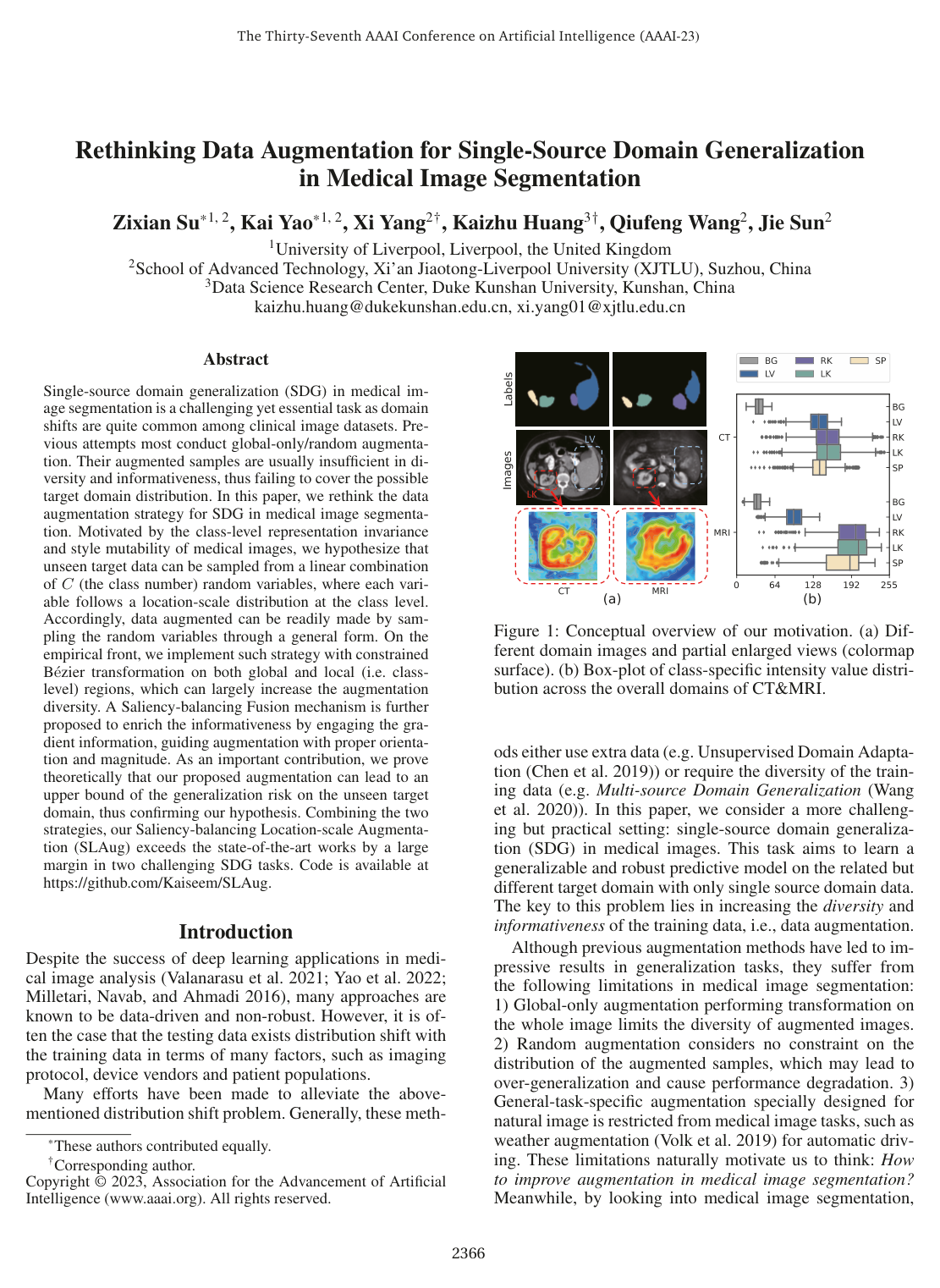
Single-source domain generalization (SDG) in medical image segmentation is a challenging yet essential task as domain shifts are quite common among clinical image datasets. Previous attempts most conduct global-only/random augmentation. Their augmented samples are usually insufficient in diversity and informativeness, thus failing to cover the possible target domain distribution. In this paper, we rethink the data augmentation strategy for SDG in medical image segmentation. Motivated by the class-level representation invariance and style mutability of medical images, we hypothesize that unseen target data can be sampled from a linear combination of C (the class number) random variables, where each variable follows a location-scale distribution at the class level. Accordingly, data augmented can be readily made by sampling the random variables through a general form. On the empirical front, we implement such strategy with constrained Bézier transformation on both global and local (i.e. class-level) regions, which can largely increase the augmentation diversity. A Saliency-balancing Fusion mechanism is further proposed to enrich the informativeness by engaging the gradient information, guiding augmentation with proper orientation and magnitude. As an important contribution, we prove theoretically that our proposed augmentation can lead to an upper bound of the generalization risk on the unseen target domain, thus confirming our hypothesis. Combining the two strategies, our Saliency-balancing Location-scale Augmentation (SLAug) exceeds the state-of-the-art works by a large margin in two challenging SDG tasks. Code is available at https://github.com/Kaiseem/SLAug.

Added

2026-09-26