
keyword
cross-lingual transfer
Cross-lingual transfer is a machine learning and natural language processing approach in which a model applies knowledge, representations, or task capabilities learned from one or more source languages to perform tasks in different target languages. This technique enables models trained or fine-tuned on resource-rich source languages to generalize to other languages, particularly low-resource languages that lack substantial annotated training data. Commonly achieved through multilingual pre-training, parameter sharing, vocabulary adaptation, or cross-lingual alignment, cross-lingual transfer supports zero-shot or few-shot task performance across diverse linguistic domains without requiring fully supervised data or separate models to be trained from scratch for every target language.
16 items
Crosslingual Generalization through Multitask Finetuning
Niklas Muennighoff, Thomas Wang, Lintang Sutawika, Adam Roberts, Stella Biderman, Teven Le Scao, M. Saiful Bari, Sheng Shen, Zheng Xin Yong, Hailey Schoelkopf, Xiangru Tang, Dragomir Radev, Alham Fikri Aji, Khalid Almubarak, Samuel Albanie, Zaid Alyafeai, Albert Webson, Edward Raff, Colin Raffel
Why you should read this
Demonstrates that multitask prompted finetuning on multilingual datasets enables language models to generalize zero-shot to unseen tasks across diverse and even previously unseen languages.
Multitask prompted finetuning (MTF) has been shown to help large language models generalize to new tasks in a zero-shot setting, but so far explorations of MTF have focused on English data and models. We apply MTF to the pretrained multilingual BLOOM and mT5 model families to produce finetuned variants called BLOOMZ and mT0. We find finetuning large multilingual language models on English tasks with English prompts allows for task generalization to non-English languages that appear only in the pretraining corpus. Finetuning on multilingual tasks with English prompts further improves performance on English and non-English tasks leading to various state-of-the-art zero-shot results. We also investigate finetuning on multilingual tasks with prompts that have been machine-translated from English to match the language of each dataset. We find training on these machine-translated prompts leads to better performance on human-written prompts in the respective languages. Surprisingly, we find models are capable of zero-shot generalization to tasks in languages they have never intentionally seen. We conjecture that the models are learning higher-level capabilities that are both task- and language-agnostic. In addition, we introduce xP3, a composite of supervised datasets in 46 languages with English and machine-translated prompts. Our code, datasets and models are freely available at https://github.com/bigscience-workshop/xmtf.
Added
2026-10-05
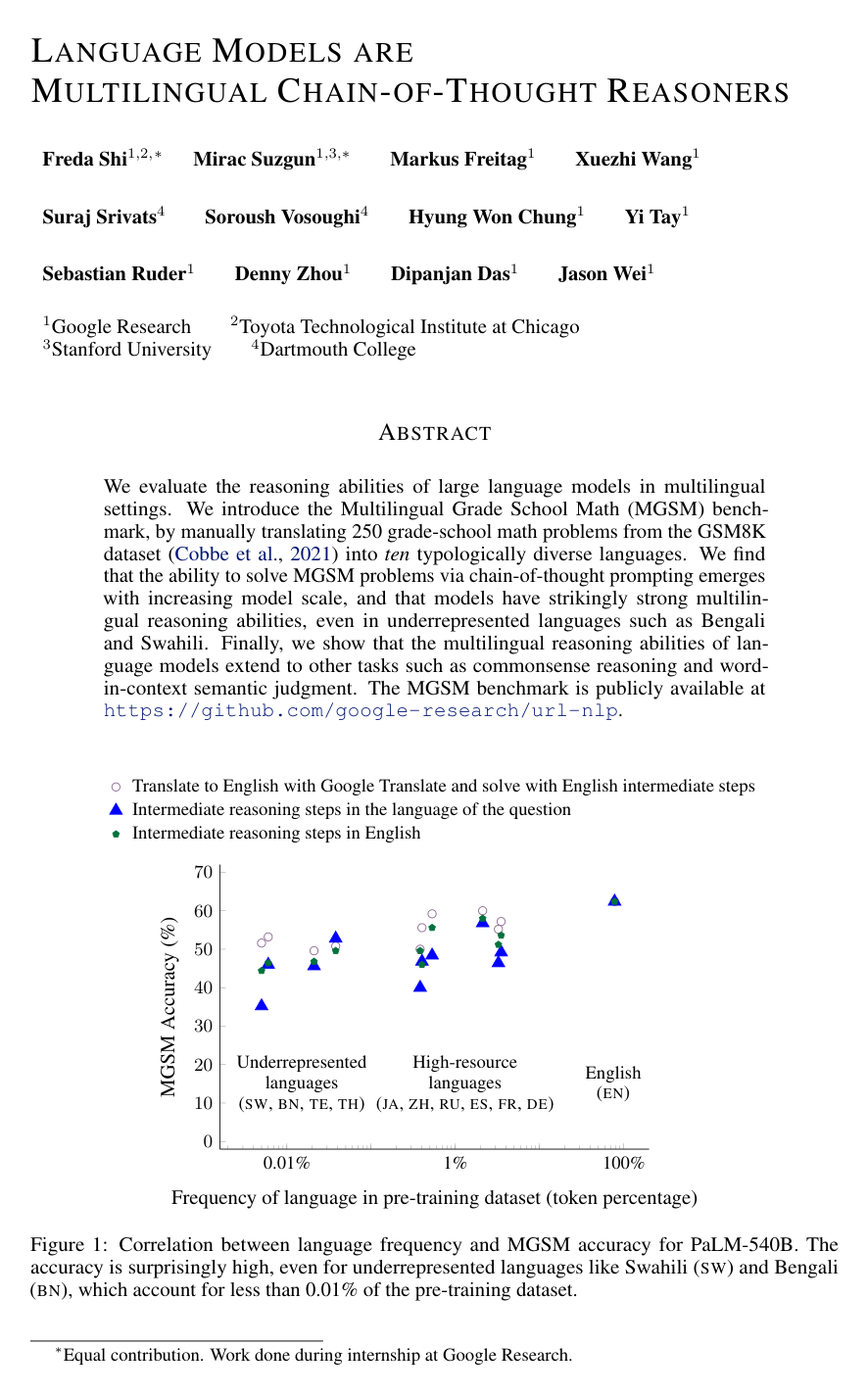
Language Models are Multilingual Chain-of-Thought Reasoners
Freda Shi, Mirac Suzgun, Markus Freitag, Xuezhi Wang, Suraj Srivats, Soroush Vosoughi, Hyung Won Chung, Yi Tay, Sebastian Ruder, Denny Zhou, Dipanjan Das, Jason Wei
Why you should read this
Demonstrates that chain-of-thought reasoning emerges across typologically diverse and underrepresented languages as language models scale, introducing the Multilingual Grade School Math benchmark to evaluate cross-lingual problem solving.
We evaluate the reasoning abilities of large language models in multilingual settings. We introduce the Multilingual Grade School Math (MGSM) benchmark, by manually translating 250 grade-school math problems from the GSM8K dataset (Cobbe et al., 2021) into ten typologically diverse languages. We find that the ability to solve MGSM problems via chain-of-thought prompting emerges with increasing model scale, and that models have strikingly strong multilingual reasoning abilities, even in underrepresented languages such as Bengali and Swahili. Finally, we show that the multilingual reasoning abilities of language models extend to other tasks such as commonsense reasoning and word-in-context semantic judgment. The MGSM benchmark is publicly available at this https URL.
Added
2026-10-05
IrokoBench: A New Benchmark for African Languages in the Age of Large Language Models
David Ifeoluwa Adelani, Jessica Ojo, Israel Abebe Azime, Jian Yun Zhuang, Jesujoba Oluwadara Alabi, Xuanli He, Millicent Ochieng, Sara Hooker, Andiswa Bukula, En-Shiun Annie Lee, Chiamaka Ijeoma Chukwuneke, Happy Buzaaba, Blessing K. Sibanda, Godson Koffi Kalipe, Jonathan Mukiibi, Salomon Kabongo Kabenamualu, Foutse Yuehgoh, Mmasibidi Setaka, Lolwethu Ndolela, Nkiruka Odu, Rooweither Mabuya, Salomey Osei, Shamsuddeen Hassan Muhammad, Sokhar Samb, Tadesse Kebede Guge, Tombekai Vangoni Sherman, Pontus Stenetorp
Why you should read this
Introduces IrokoBench, a human-translated benchmark across 17 African languages that evaluates 16 open and proprietary language models on natural language inference, mathematical reasoning, and question answering to measure performance disparities against high-resource languages.
Despite the widespread adoption of Large language models (LLMs), their remarkable capabilities remain limited to a few high-resource languages. Additionally, many low-resource languages (\eg African languages) are often evaluated only on basic text classification tasks due to the lack of appropriate or comprehensive benchmarks outside of high-resource languages. In this paper, we introduce IrokoBench -- a human-translated benchmark dataset for 17 typologically-diverse low-resource African languages covering three tasks: natural language inference~(AfriXNLI), mathematical reasoning~(AfriMGSM), and multi-choice knowledge-based question answering~(AfriMMLU). We use IrokoBench to evaluate zero-shot, few-shot, and translate-test settings~(where test sets are translated into English) across 10 open and six proprietary LLMs. Our evaluation reveals a significant performance gap between high-resource languages~(such as English and French) and low-resource African languages. We observe a significant performance gap between open and proprietary models, with the highest performing open model, Gemma 2 27B only at 63\% of the best-performing proprietary model GPT-4o performance. In addition, machine translating the test set to English before evaluation helped to close the gap for larger models that are English-centric, such as Gemma 2 27B and LLaMa 3.1 70B. These findings suggest that more efforts are needed to develop and adapt LLMs for African languages.
Added
2026-10-04
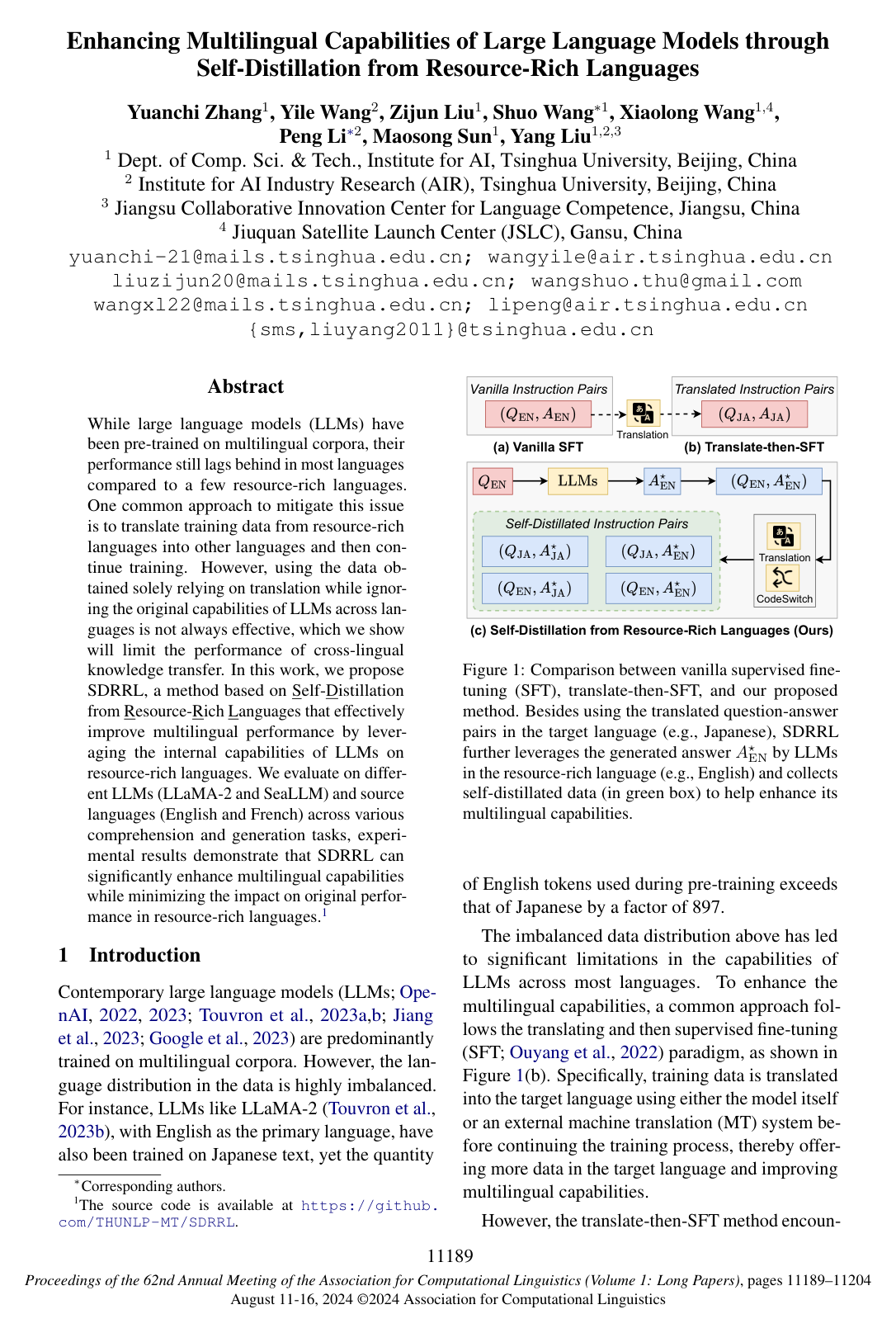
Enhancing Multilingual Capabilities of Large Language Models through Self-Distillation from Resource-Rich Languages
Yuanchi Zhang, Yile Wang, Zijun Liu, Shuo Wang, Xiaolong Wang, Peng Li, Maosong Sun, Yang Liu
Why you should read this
Proposes SDRRL, a self-distillation framework that transfers knowledge from an LLM's own high-resource language outputs to low-resource languages, improving multilingual comprehension and generation while preserving source-language performance.
While large language models (LLMs) have been pre-trained on multilingual corpora, their performance still lags behind in most languages compared to a few resource-rich languages. One common approach to mitigate this issue is to translate training data from resource-rich languages into other languages and then continue training. However, using the data obtained solely relying on translation while ignoring the original capabilities of LLMs across languages is not always effective, which we show will limit the performance of cross-lingual knowledge transfer. In this work, we propose SDRRL, a method based on Self-Distillation from Resource-Rich Languages that effectively improve multilingual performance by leveraging the internal capabilities of LLMs on resource-rich languages. We evaluate on different LLMs (LLaMA-2 and SeaLLM) and source languages (English and French) across various comprehension and generation tasks, experimental results demonstrate that SDRRL can significantly enhance multilingual capabilities while minimizing the impact on original performance in resource-rich languages.
Added
2026-10-04
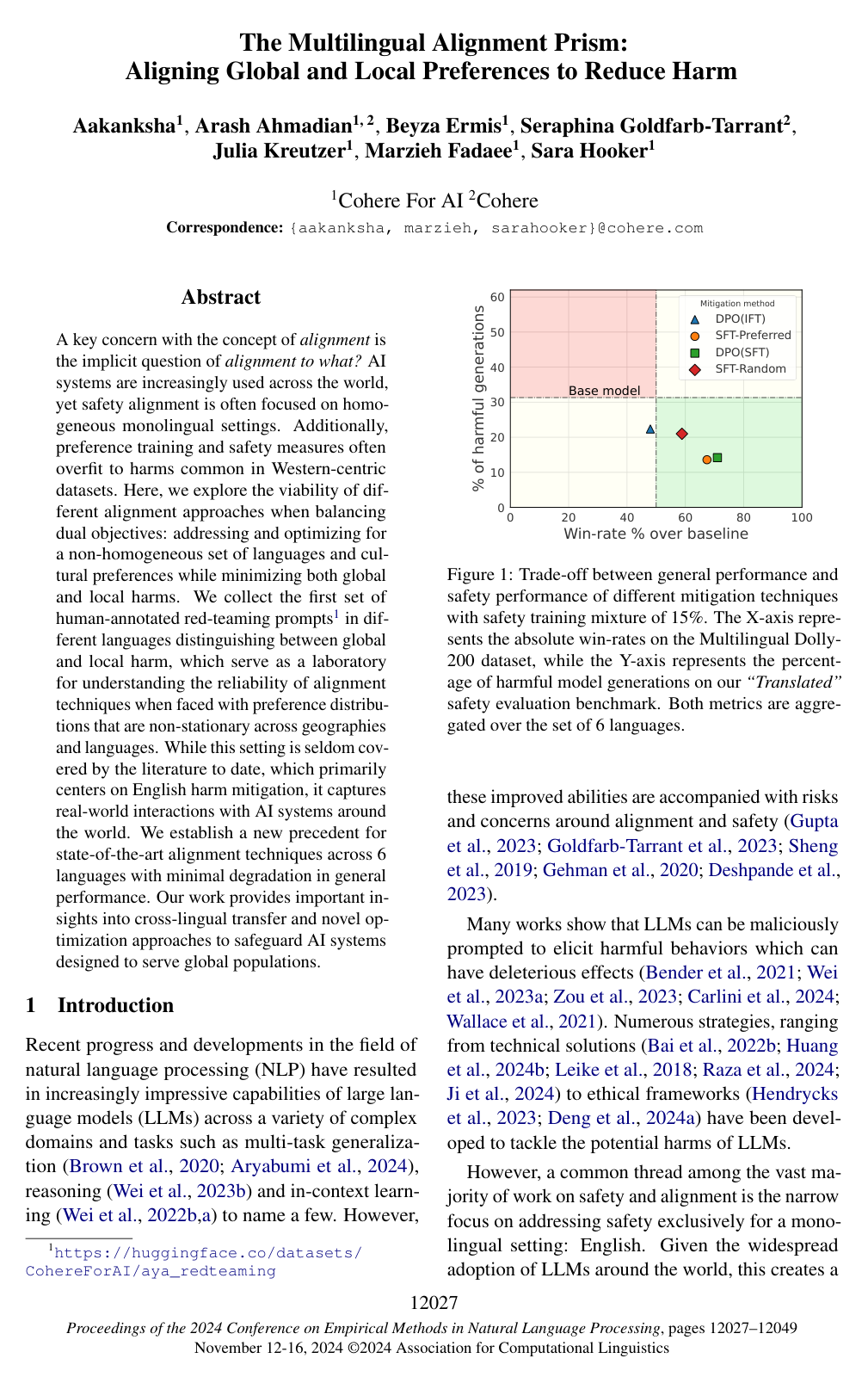
The Multilingual Alignment Prism: Aligning Global and Local Preferences to Reduce Harm
Aakanksha, Arash Ahmadian, Beyza Ermis, Seraphina Goldfarb-Tarrant, Julia Kreutzer, Marzieh Fadaee, Sara Hooker
Why you should read this
Presents the Aya Red-teaming dataset across eight languages and demonstrates that Direct Preference Optimization effectively reduces both universally recognized and culturally specific harms across multiple languages without degrading general model capabilities.
A key concern with the concept of alignment is the implicit question of alignment to what? AI systems are increasingly used across the world, yet safety alignment is often focused on homogeneous monolingual settings. Additionally, preference training and safety measures often overfit to harms common in Western-centric datasets. Here, we explore the viability of different alignment approaches when balancing dual objectives: addressing and optimizing for a non-homogeneous set of languages and cultural preferences while minimizing both global and local harms. We collect the first set of human-annotated red-teaming prompts¹ in different languages distinguishing between global and local harm, which serve as a laboratory for understanding the reliability of alignment techniques when faced with preference distributions that are non-stationary across geographies and languages. While this setting is seldom covered by the literature to date, which primarily centers on English harm mitigation, it captures real-world interactions with AI systems around the world. We establish a new precedent for state-of-the-art alignment techniques across 6 languages with minimal degradation in general performance. Our work provides important insights into cross-lingual transfer and novel optimization approaches to safeguard AI systems designed to serve global populations.
Added
2026-10-03
MasakhaNER 2.0: Africa-centric Transfer Learning for Named Entity Recognition
David Ifeoluwa Adelani, Graham Neubig, Sebastian Ruder, Shruti Rijhwani, Michael Beukman, Chester Palen-Michel, Constantine Lignos, Jesujoba O. Alabi, Shamsuddeen Hassan Muhammad, Peter Nabende, Cheikh M. Bamba Dione, Andiswa Bukula, Rooweither Mabuya, Bonaventure F. P. Dossou, Blessing K. Sibanda, Happy Buzaaba, Jonathan Mukiibi, Godson Kalipe, Derguene Mbaye, Amelia V. Taylor, Fatoumata Ouoba Kabore, Chris Chinenye Emezue, Aremu Anuoluwapo, Perez Ogayo, Catherine Gitau, Edwin Munkoh-Buabeng, Victoire Memdjokam Koagne, Allahsera Auguste Tapo, Tebogo Macucwa, Vukosi Marivate, Elvis Mboning, Tajuddeen Gwadabe, Tosin P. Adewumi, Orevaoghene Ahia, Joyce Nakatumba-Nabende, Neo L. Mokono, Ignatius Ezeani, Chiamaka Chukwuneke, Mofetoluwa Adeyemi, Gilles Hacheme, Idris Abdulmumin, Odunayo Ogundepo, Oreen Yousuf, Tatiana Moteu Ngoli, Dietrich Klakow
Why you should read this
Presents the largest human-annotated named entity recognition benchmark across 20 African languages, demonstrating that selecting linguistically related African source languages over English yields an average gain of 14 F1 points in zero-shot cross-lingual transfer.
African languages are spoken by over a billion people, but are underrepresented in NLP research and development. The challenges impeding progress include the limited availability of annotated datasets, as well as a lack of understanding of the settings where current methods are effective. In this paper, we make progress towards solutions for these challenges, focusing on the task of named entity recognition (NER). We create the largest human-annotated NER dataset for 20 African languages, and we study the behavior of state-of-the-art cross-lingual transfer methods in an Africa-centric setting, demonstrating that the choice of source language significantly affects performance. We show that choosing the best transfer language improves zero-shot F1 scores by an average of 14 points across 20 languages compared to using English. Our results highlight the need for benchmark datasets and models that cover typologically-diverse African languages.
Added
2026-10-03
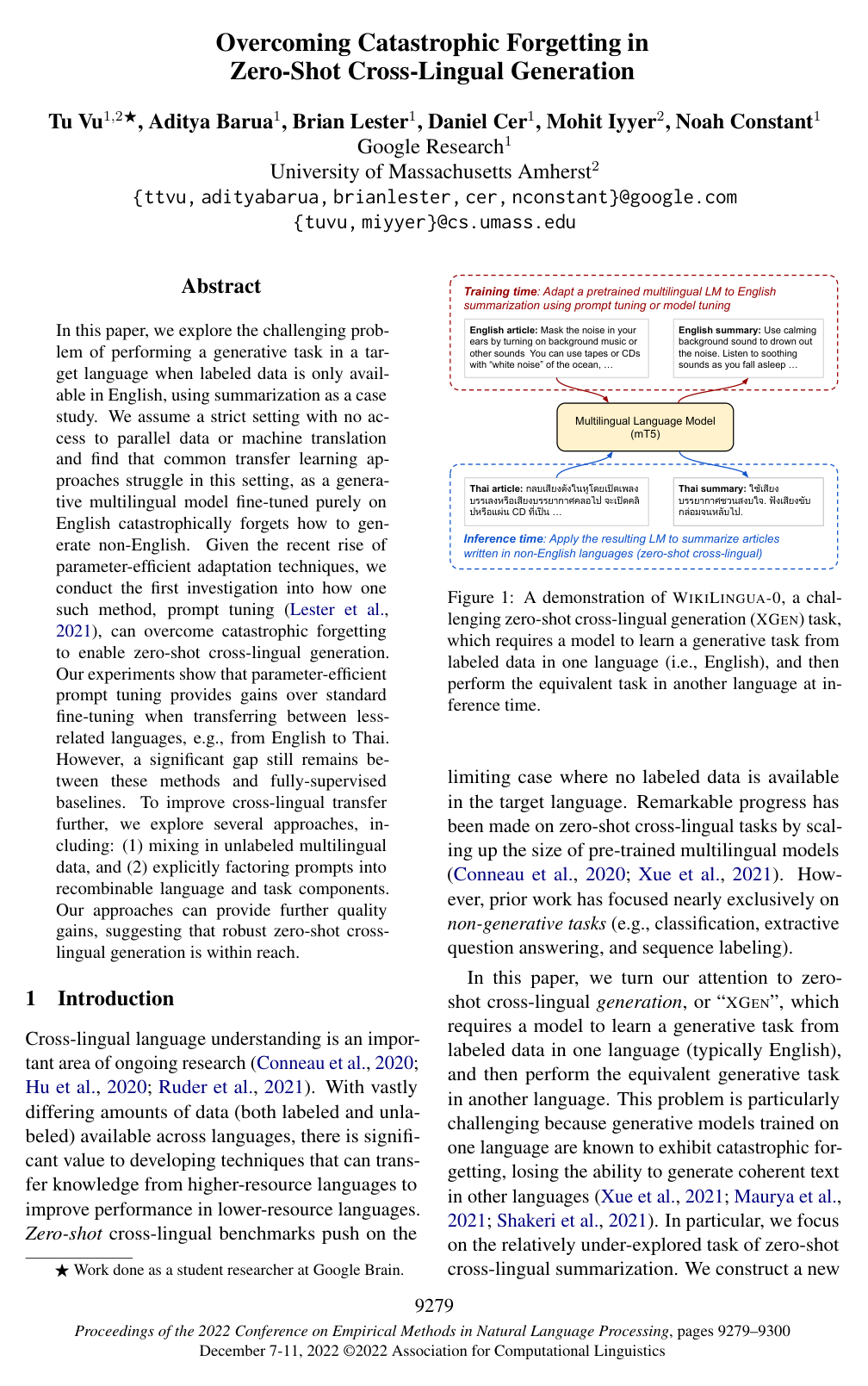
Overcoming Catastrophic Forgetting in Zero-Shot Cross-Lingual Generation
Tu Vu, Aditya Barua, Brian Lester, Daniel Cer, Mohit Iyyer, Noah Constant
Why you should read this
Proposes factorized prompt tuning and unlabeled data mixing to prevent multilingual language models from catastrophically forgetting non-English text generation capabilities when adapted only on English data.
Recent advances in speculative decoding have led to diverse perspectives among language models...
Added
2026-10-02
WECHSEL: Effective initialization of subword embeddings for cross-lingual transfer of monolingual language models
Benjamin Minixhofer, Fabian Paischer, Navid Rekabsaz
Why you should read this
Presents WECHSEL, an efficient method that transfers English language models to new languages by initializing target subword embeddings via multilingual static word vectors, outperforming models trained from scratch while reducing training compute by up to 64x.
Large pretrained language models (LMs) have become the central building block of many NLP applications. Training these models requires ever more computational resources and most of the existing models are trained on English text only. It is exceedingly expensive to train these models in other languages. To alleviate this problem, we introduce a novel method – called WECHSEL – to efficiently and effectively transfer pretrained LMs to new languages. WECHSEL can be applied to any model which uses subword-based tokenization and learns an embedding for each subword. The tokenizer of the source model (in English) is replaced with a tokenizer in the target language and token embeddings are initialized such that they are semantically similar to the English tokens by utilizing multilingual static word embeddings covering English and the target language. We use WECHSEL to transfer the English RoBERTa and GPT-2 models to four languages (French, German, Chinese and Swahili). We also study the benefits of our method on very low-resource languages. WECHSEL improves over proposed methods for cross-lingual parameter transfer and outperforms models of comparable size trained from scratch with up to 64x less training effort. Our method makes training large language models for new languages more accessible and less damaging to the environment. We make our code and models publicly available.
Added
2026-10-01
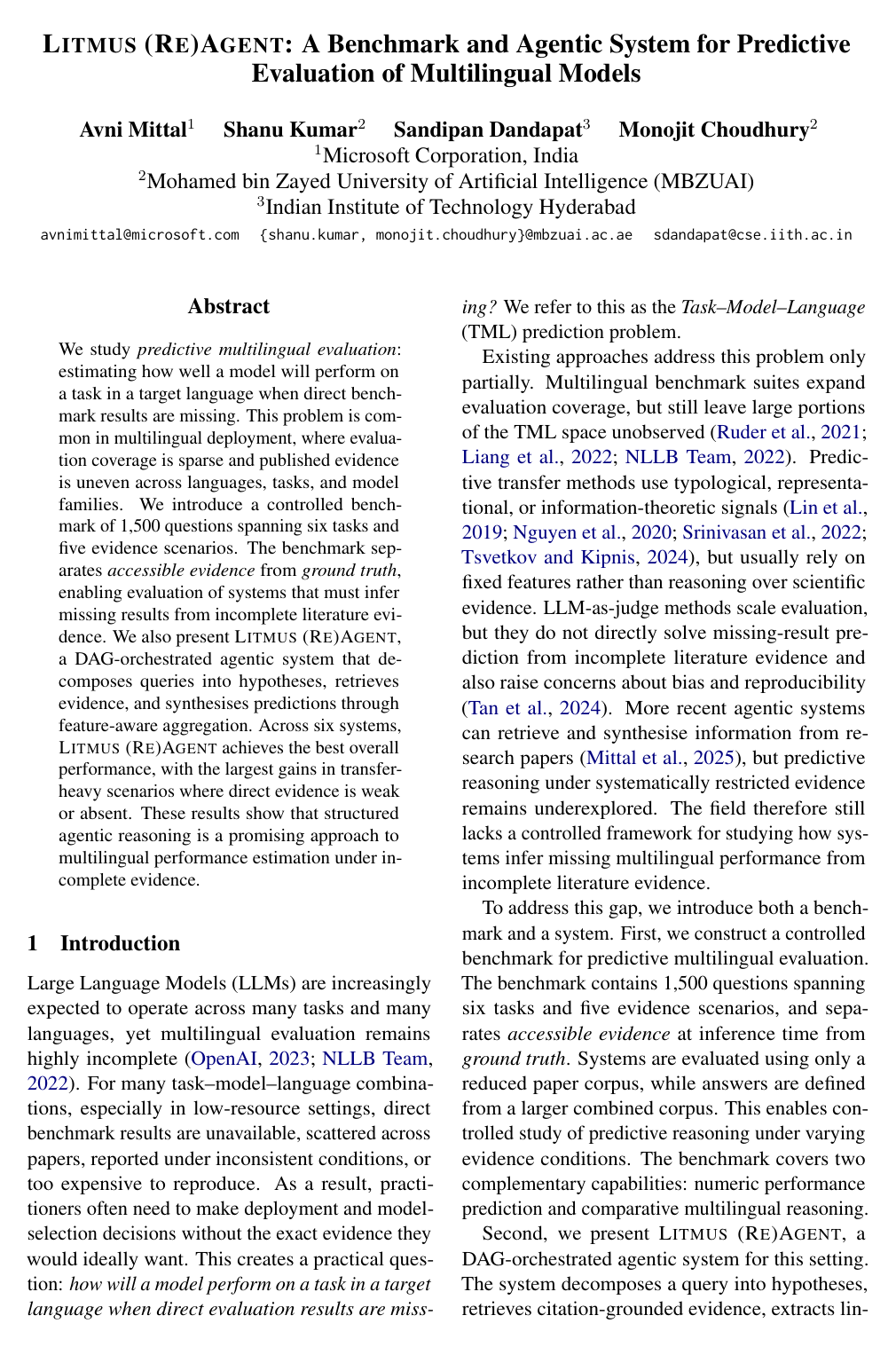
Litmus (Re)Agent: A Benchmark and Agentic System for Predictive Evaluation of Multilingual Models
Avni Mittal, Shanu Kumar, Sandipan Dandapat, Monojit Choudhury
Why you should read this
Introduces a 1,500-question benchmark and a DAG-orchestrated agentic system to accurately predict multilingual model performance across target languages and tasks when direct evaluation data is missing from published literature.
We study predictive multilingual evaluation: estimating how well a model will perform on a task in a target language when direct benchmark results are missing. This problem is common in multilingual deployment, where evaluation coverage is sparse and published evidence is uneven across languages, tasks, and model families. We introduce a controlled benchmark of 1,500 questions spanning six tasks and five evidence scenarios. The benchmark separates accessible evidence from ground truth, enabling evaluation of systems that must infer missing results from incomplete literature evidence. We also present Litmus (Re)Agent, a DAG-orchestrated agentic system that decomposes queries into hypotheses, retrieves evidence, and synthesises predictions through feature-aware aggregation. Across six systems, Litmus (Re)Agent achieves the best overall performance, with the largest gains in transfer-heavy scenarios where direct evidence is weak or absent. These results show that structured agentic reasoning is a promising approach to multilingual performance estimation under incomplete evidence.
Added
2026-09-30
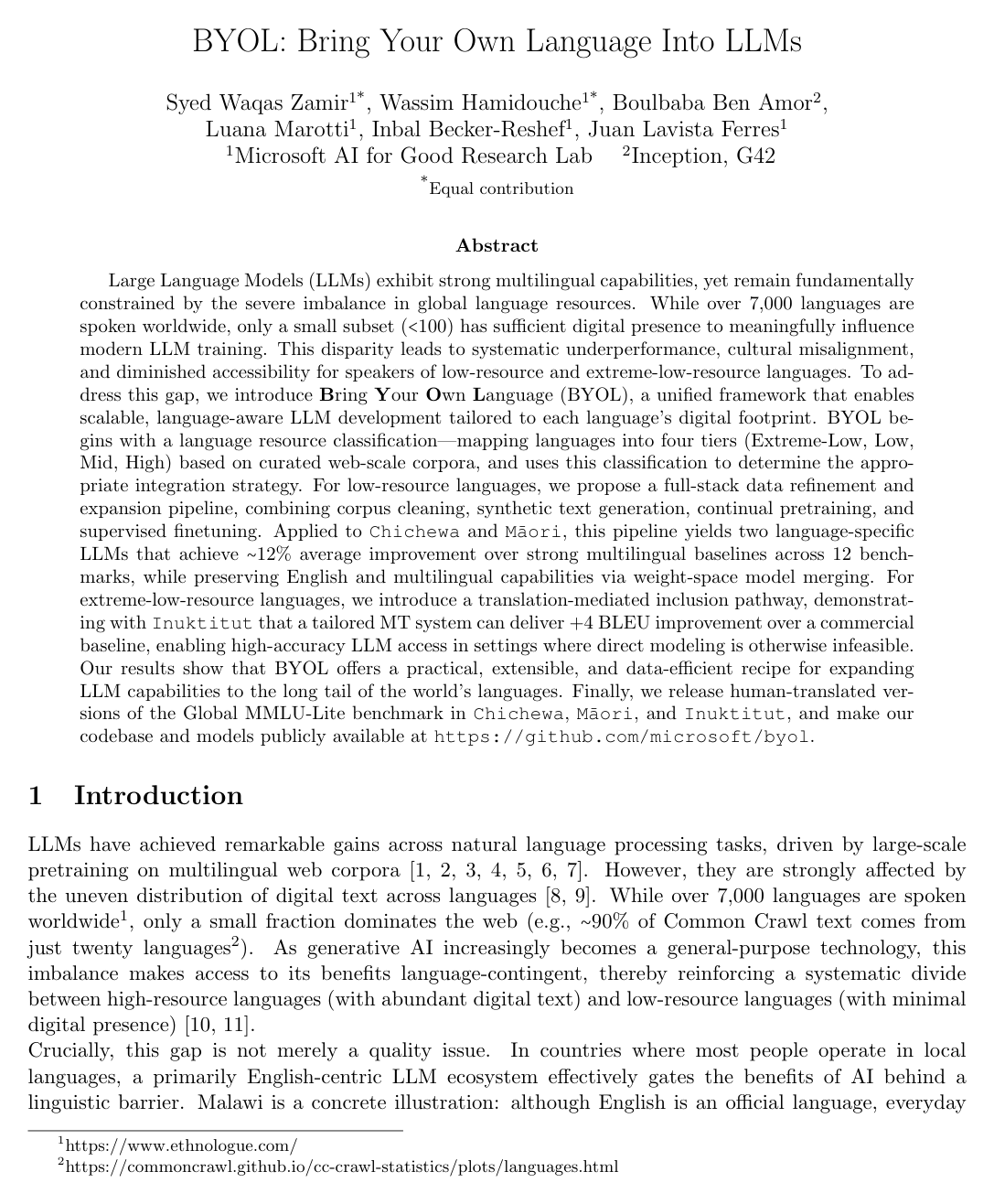
BYOL: Bring Your Own Language into LLMs
Waqas Zamir, Wassim Hamidouche, Boulbaba Ben Amor, Luana Marotti, Inbal Becker-Reshef, Juan M. Lavista Ferres
Why you should read this
Presents a scalable framework for integrating low- and extreme-low-resource languages into large language models, demonstrating how targeted data refinement, weight-space merging, and tailored translation pipelines significantly improve performance on underrepresented languages like Chichewa, Maori, and Inuktitut without degrading existing multilingual capabilities.
Large Language Models (LLMs) exhibit strong multilingual capabilities, yet remain fundamentally constrained by the severe imbalance in global language resources. While over 7,000 languages are spoken worldwide, only a small subset (fewer than 100) has sufficient digital presence to meaningfully influence modern LLM training. This disparity leads to systematic underperformance, cultural misalignment, and limited accessibility for speakers of low-resource and extreme-low-resource languages. To address this gap, we introduce Bring Your Own Language (BYOL), a unified framework for scalable, language-aware LLM development tailored to each language's digital footprint. BYOL begins with a language resource classification that maps languages into four tiers (Extreme-Low, Low, Mid, High) using curated web-scale corpora, and uses this classification to select the appropriate integration pathway. For low-resource languages, we propose a full-stack data refinement and expansion pipeline that combines corpus cleaning, synthetic text generation, continual pretraining, and supervised finetuning. Applied to Chichewa and Maori, this pipeline yields language-specific LLMs that achieve approximately 12 percent average improvement over strong multilingual baselines across 12 benchmarks, while preserving English and multilingual capabilities via weight-space model merging. For extreme-low-resource languages, we introduce a translation-mediated inclusion pathway, and show on Inuktitut that a tailored machine translation system improves over a commercial baseline by 4 BLEU, enabling high-accuracy LLM access when direct language modeling is infeasible. Finally, we release human-translated versions of the Global MMLU-Lite benchmark in Chichewa, Maori, and Inuktitut, and make our codebase and models publicly available at this https URL .
Added
2026-09-30
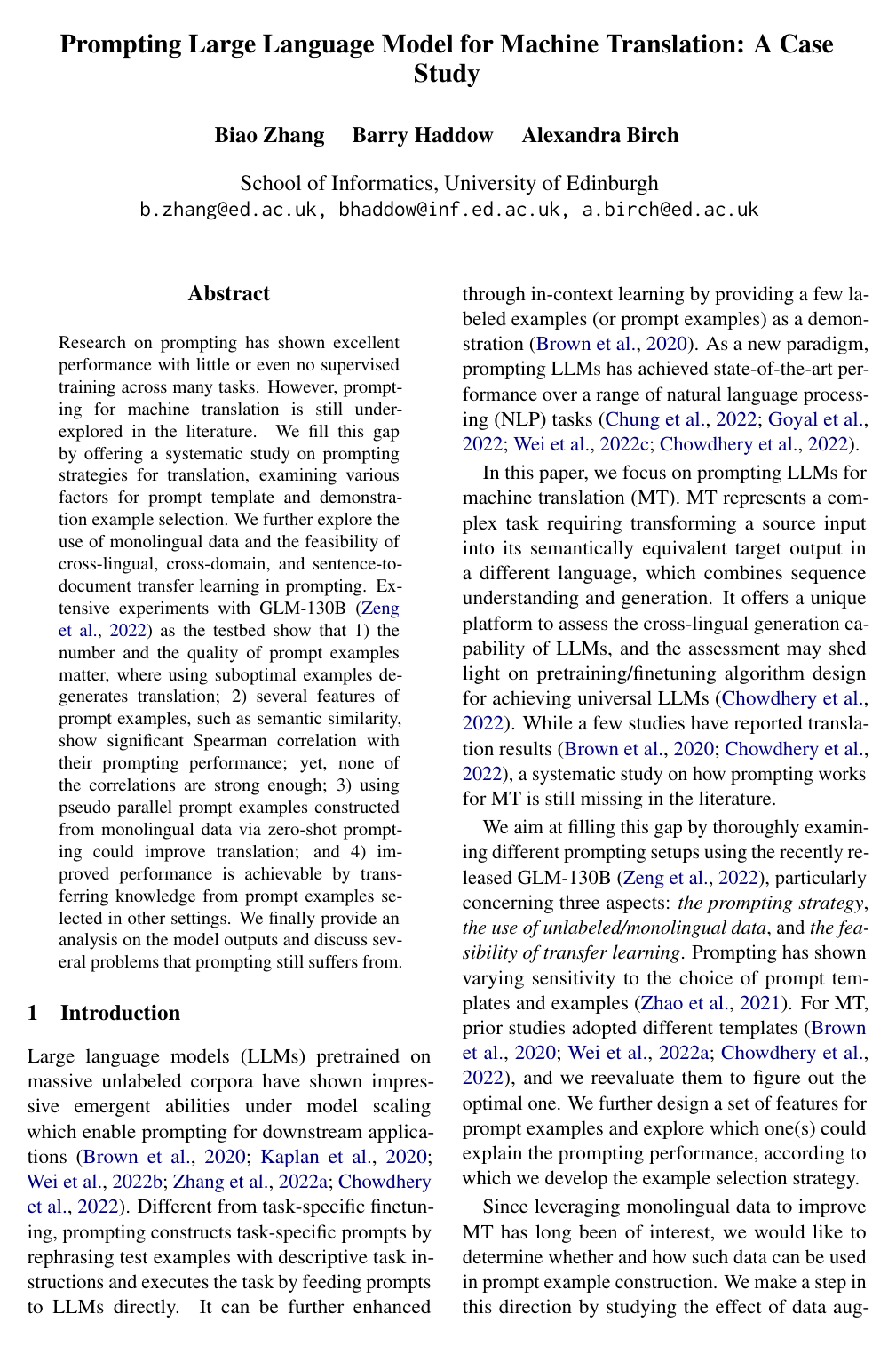
Prompting Large Language Model for Machine Translation: A Case Study
Biao Zhang, Barry Haddow, Alexandra Birch
Why you should read this
Presents a systematic evaluation of prompting strategies for machine translation, identifying how demonstration quality, pseudo-parallel data from monolingual text, and cross-domain transfer govern large language model performance.
Research on prompting has shown excellent performance with little or even no supervised training across many tasks. However, prompting for machine translation is still under-explored in the literature. We fill this gap by offering a systematic study on prompting strategies for translation, examining various factors for prompt template and demonstration example selection. We further explore the use of monolingual data and the feasibility of cross-lingual, cross-domain, and sentence-to-document transfer learning in prompting. Extensive experiments with GLM-130B (Zeng et al., 2022) as the testbed show that 1) the number and the quality of prompt examples matter, where using suboptimal examples degenerates translation; 2) several features of prompt examples, such as semantic similarity, show significant Spearman correlation with their prompting performance; yet, none of the correlations are strong enough; 3) using pseudo parallel prompt examples constructed from monolingual data via zero-shot prompting could improve translation; and 4) improved performance is achievable by transferring knowledge from prompt examples selected in other settings. We finally provide an analysis on the model outputs and discuss several problems that prompting still suffers from.
Added
2026-09-28
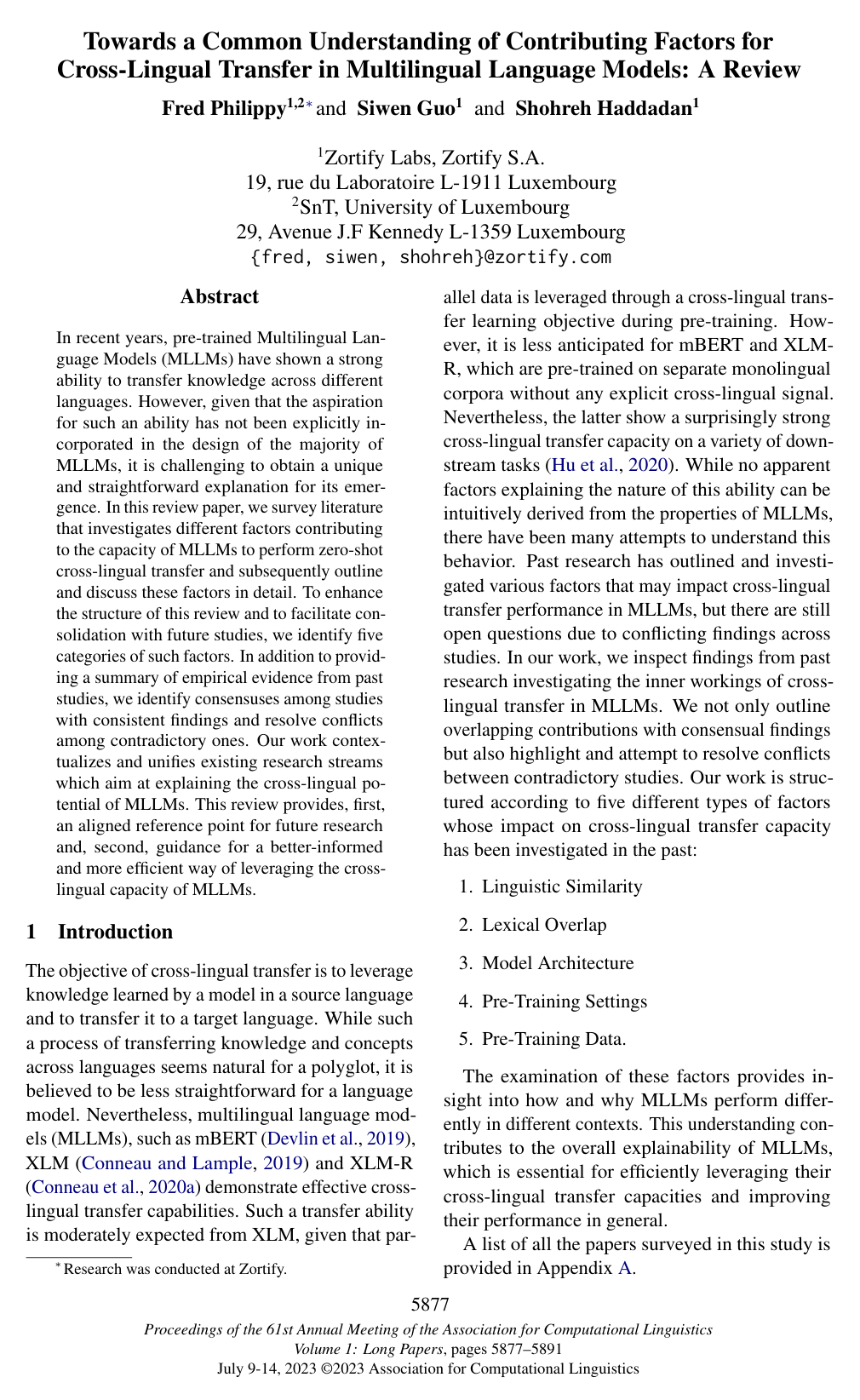
Towards a Common Understanding of Contributing Factors for Cross-Lingual Transfer in Multilingual Language Models: A Review
Fred Philippy, Siwen Guo, Shohreh Haddadan
Why you should read this
Categorizes and synthesizes empirical findings across five key drivers of cross-lingual transfer in multilingual language models to reconcile conflicting literature and guide more effective zero-shot cross-lingual adaptation.
In recent years, pre-trained Multilingual Language Models (MLLMs) have shown a strong ability to transfer knowledge across different languages. However, given that the aspiration for such an ability has not been explicitly incorporated in the design of the majority of MLLMs, it is challenging to obtain a unique and straightforward explanation for its emergence. In this review paper, we survey literature that investigates different factors contributing to the capacity of MLLMs to perform zero-shot cross-lingual transfer and subsequently outline and discuss these factors in detail. To enhance the structure of this review and to facilitate consolidation with future studies, we identify five categories of such factors. In addition to providing a summary of empirical evidence from past studies, we identify consensuses among studies with consistent findings and resolve conflicts among contradictory ones. Our work contextualizes and unifies existing research streams which aim at explaining the cross-lingual potential of MLLMs. This review provides, first, an aligned reference point for future research and, second, guidance for a better-informed and more efficient way of leveraging the cross-lingual capacity of MLLMs.
Added
2026-09-26
Make the Best of Cross-lingual Transfer: Evidence from POS Tagging with over 100 Languages
Wietse de Vries, Martijn Wieling, Malvina Nissim
Why you should read this
Evaluates zero-shot cross-lingual transfer across 65 source and 105 target languages to identify the key linguistic and pre-training factors that determine successful transfer to low-resource languages.
Cross-lingual transfer learning with large multilingual pre-trained models can be an effective approach for low-resource languages with no labeled training data. Existing evaluations of zero-shot cross-lingual generalisability of large pre-trained models use datasets with English training data, and test data in a selection of target languages. We explore a more extensive transfer learning setup with 65 different source languages and 105 target languages for part-of-speech tagging. Through our analysis, we show that pre-training of both source and target language, as well as matching language families, writing systems, word order systems, and lexical-phonetic distance significantly impact cross-lingual performance. The findings described in this paper can be used as indicators of which factors are important for effective zero-shot cross-lingual transfer to zero- and low-resource languages.
Added
2026-09-26
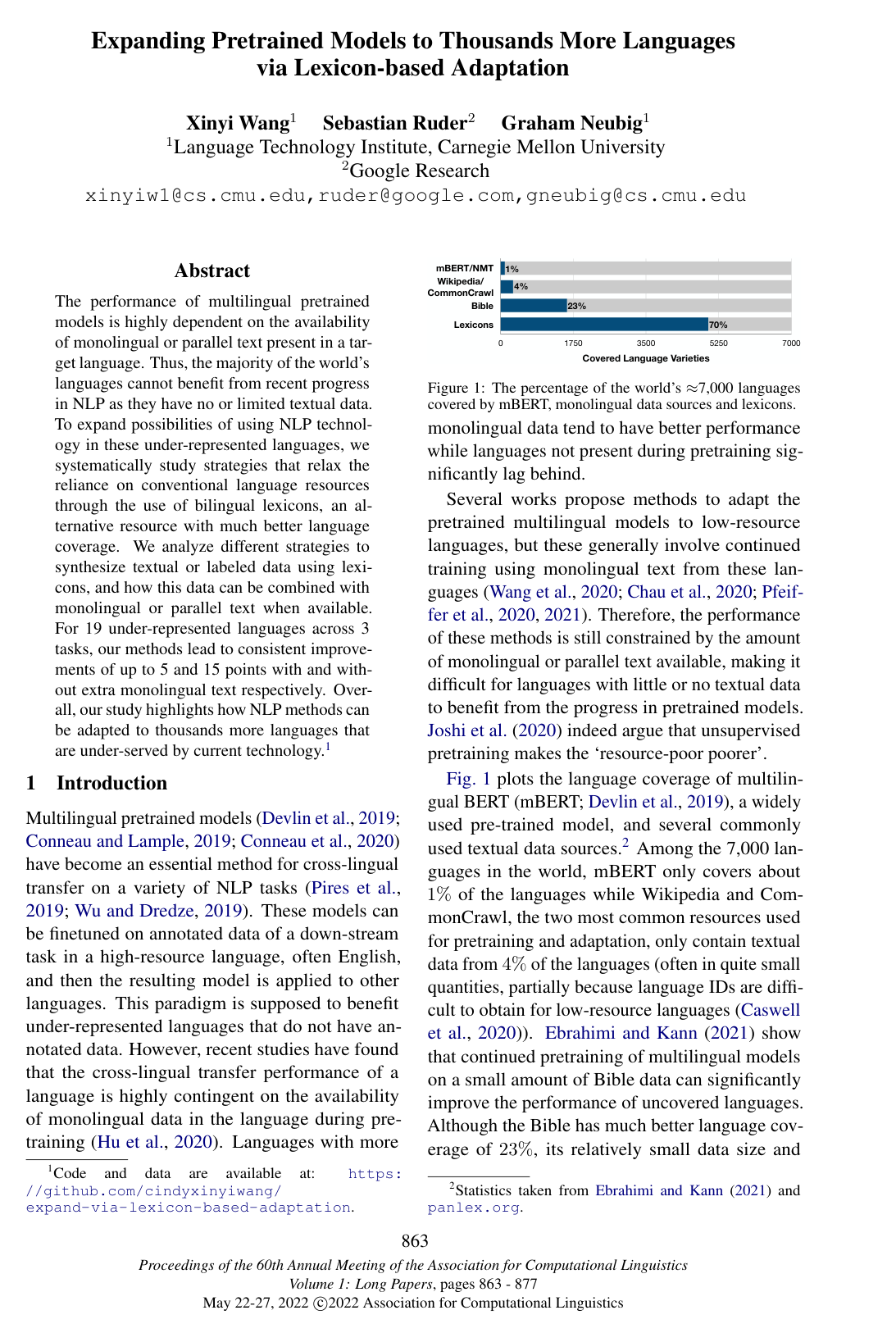
Expanding Pretrained Models to Thousands More Languages via Lexicon-based Adaptation
Xinyi Wang, Sebastian Ruder, Graham Neubig
Why you should read this
Proposes a data augmentation framework using widely available bilingual lexicons to adapt multilingual pretrained models to under-represented languages with little to no existing text corpora.
The performance of multilingual pretrained models is highly dependent on the availability of monolingual or parallel text present in a target language. Thus, the majority of the world’s languages cannot benefit from recent progress in NLP as they have no or limited textual data. To expand possibilities of using NLP technology in these under-represented languages, we systematically study strategies that relax the reliance on conventional language resources through the use of bilingual lexicons, an alternative resource with much better language coverage. We analyze different strategies to synthesize textual or labeled data using lexicons, and how this data can be combined with monolingual or parallel text when available. For 19 under-represented languages across 3 tasks, our methods lead to consistent improvements of up to 5 and 15 points with and without extra monolingual text respectively. Overall, our study highlights how NLP methods can be adapted to thousands more languages that are under-served by current technology.1
Added
2026-09-26
Glot500: Scaling Multilingual Corpora and Language Models to 500 Languages
Ayyoob Imani, Peiqin Lin, Amir Hossein Kargaran, Silvia Severini, Masoud Jalili Sabet, Nora Kassner, Chunlan Ma, Helmut Schmid, André F. T. Martins, François Yvon, Hinrich Schütze
Why you should read this
Presents an open-source multilingual corpus and language model spanning over 500 predominantly low-resource languages, outperforming XLM-R across multiple natural language understanding benchmarks while identifying the key drivers of multilingual representation quality.
The NLP community has mainly focused on scaling Large Language Models (LLMs) vertically, i.e., making them better for about 100 languages. We instead scale LLMs horizontally: we create, through continued pretraining, Glot500-m, an LLM that covers 511 predominantly low-resource languages. An important part of this effort is to collect and clean Glot500-c, a corpus that covers these 511 languages and allows us to train Glot500-m. We evaluate Glot500-m on five diverse tasks across these languages. We observe large improvements for both high-resource and low-resource languages compared to an XLM-R baseline. Our analysis shows that no single factor explains the quality of multilingual LLM representations. Rather, a combination of factors determines quality including corpus size, script, “help” from related languages and the total capacity of the model. Our work addresses an important goal of NLP research: we should not limit NLP to a small fraction of the world’s languages and instead strive to support as many languages as possible to bring the benefits of NLP technology to all languages and cultures. Code, data and models are available at https://github.com/cisnlp/Glot500.
Added
2026-09-26
Composable Sparse Fine-Tuning for Cross-Lingual Transfer
Alan Ansell, Edoardo Maria Ponti, Anna Korhonen, Ivan Vulic
Why you should read this
Proposes Lottery Ticket Sparse Fine-Tuning, a parameter-efficient technique that learns and composes task- and language-specific parameter masks to achieve superior zero-shot cross-lingual transfer over adapter-based methods without altering model architecture or slowing inference.
Fine-tuning the entire set of parameters of a large pretrained model has become the mainstream approach for transfer learning. To increase its efficiency and prevent catastrophic forgetting and interference, techniques like adapters and sparse fine-tuning have been developed. Adapters are modular, as they can be combined to adapt a model towards different facets of knowledge (e.g., dedicated language and/or task adapters). Sparse fine-tuning is expressive, as it controls the behavior of all model components. In this work, we introduce a new fine-tuning method with both these desirable properties. In particular, we learn sparse, real-valued masks based on a simple variant of the Lottery Ticket Hypothesis. Task-specific masks are obtained from annotated data in a source language, and language-specific masks from masked language modeling in a target language. Both these masks can then be composed with the pretrained model. Unlike adapter-based fine-tuning, this method neither increases the number of parameters at inference time nor alters the original model architecture. Most importantly, it outperforms adapters in zero-shot cross-lingual transfer by a large margin in a series of multilingual benchmarks, including Universal Dependencies, MasakhaNER, and AmericasNLI. Based on an in-depth analysis, we additionally find that sparsity is crucial to prevent both 1) interference between the fine-tunings to be composed and 2) overfitting. We release the code and models at https://github.com/cambridgeltl/composable-sft.
Added
2026-09-26