
keyword
cross-lingual instruction tuning
Cross-lingual instruction tuning is the process of fine-tuning a language model on examples that teach it to follow instructions across different languages. It can transfer instruction-following abilities from a resource-rich language to a lower-resource one, for example by using one language to interpret an instruction and another to provide the response.
2 items
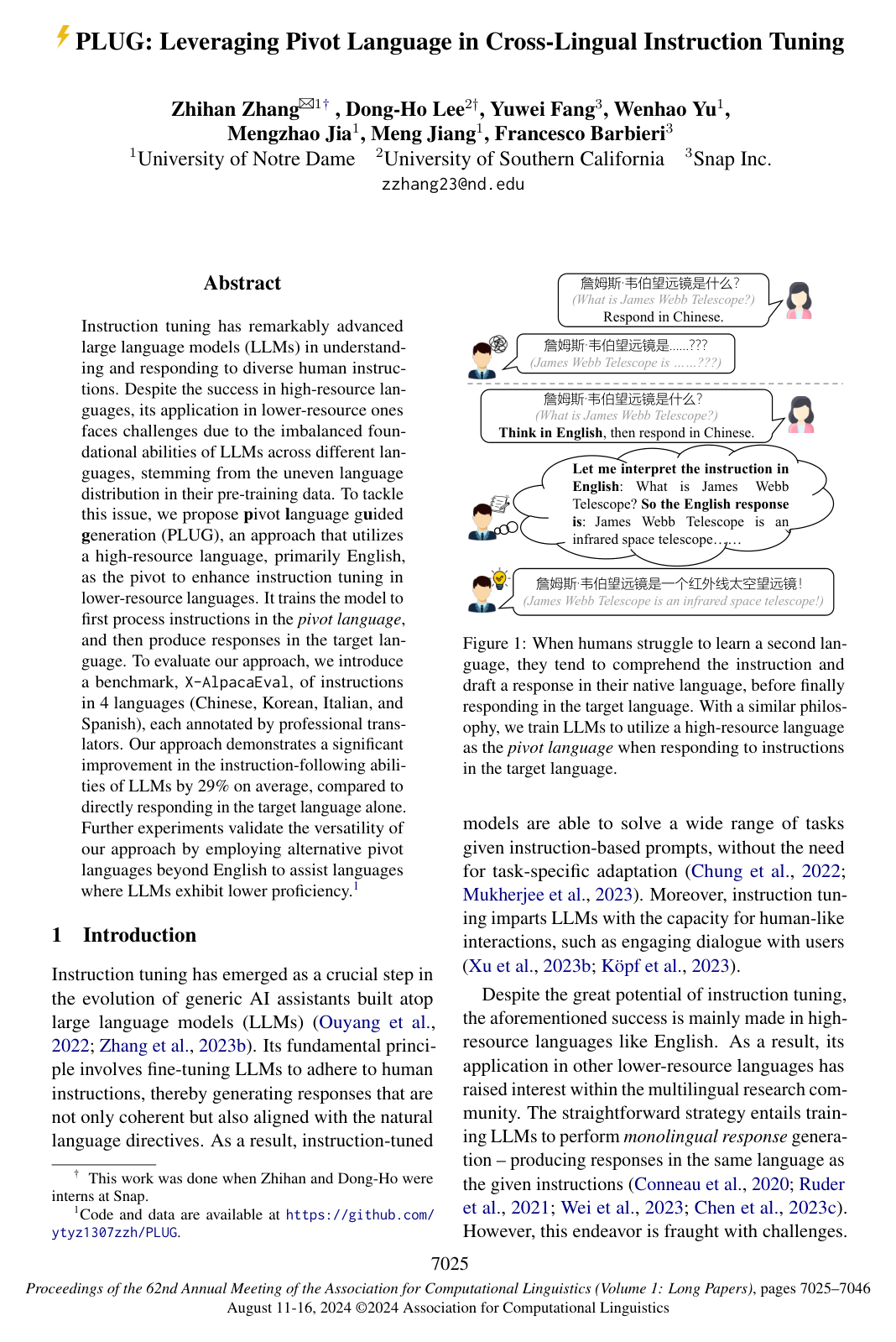
PLUG: Leveraging Pivot Language in Cross-Lingual Instruction Tuning
Zhihan Zhang, Dong-Ho Lee, Yuwei Fang, Wenhao Yu, Mengzhao Jia, Meng Jiang, Francesco Barbieri
Why you should read this
Proposes a cross-lingual instruction tuning framework that processes queries and drafts intermediate responses in a high-resource pivot language before outputting in the target language, boosting lower-resource language performance by an average of 29%.
Instruction tuning has remarkably advanced large language models (LLMs) in understanding and responding to diverse human instructions. Despite the success in high-resource languages, its application in lower-resource ones faces challenges due to the imbalanced foundational abilities of LLMs across different languages, stemming from the uneven language distribution in their pre-training data. To tackle this issue, we propose pivot language guided generation (PLUG), an approach that utilizes a high-resource language, primarily English, as the pivot to enhance instruction tuning in lower-resource languages. It trains the model to first process instructions in the pivot language, and then produce responses in the target language. To evaluate our approach, we introduce a benchmark, X-AlpacaEval, of instructions in 4 languages (Chinese, Korean, Italian, and Spanish), each annotated by professional translators. Our approach demonstrates a significant improvement in the instruction-following abilities of LLMs by 29% on average, compared to directly responding in the target language alone. Further experiments validate the versatility of our approach by employing alternative pivot languages beyond English to assist languages where LLMs exhibit lower proficiency.
Added
2026-10-04
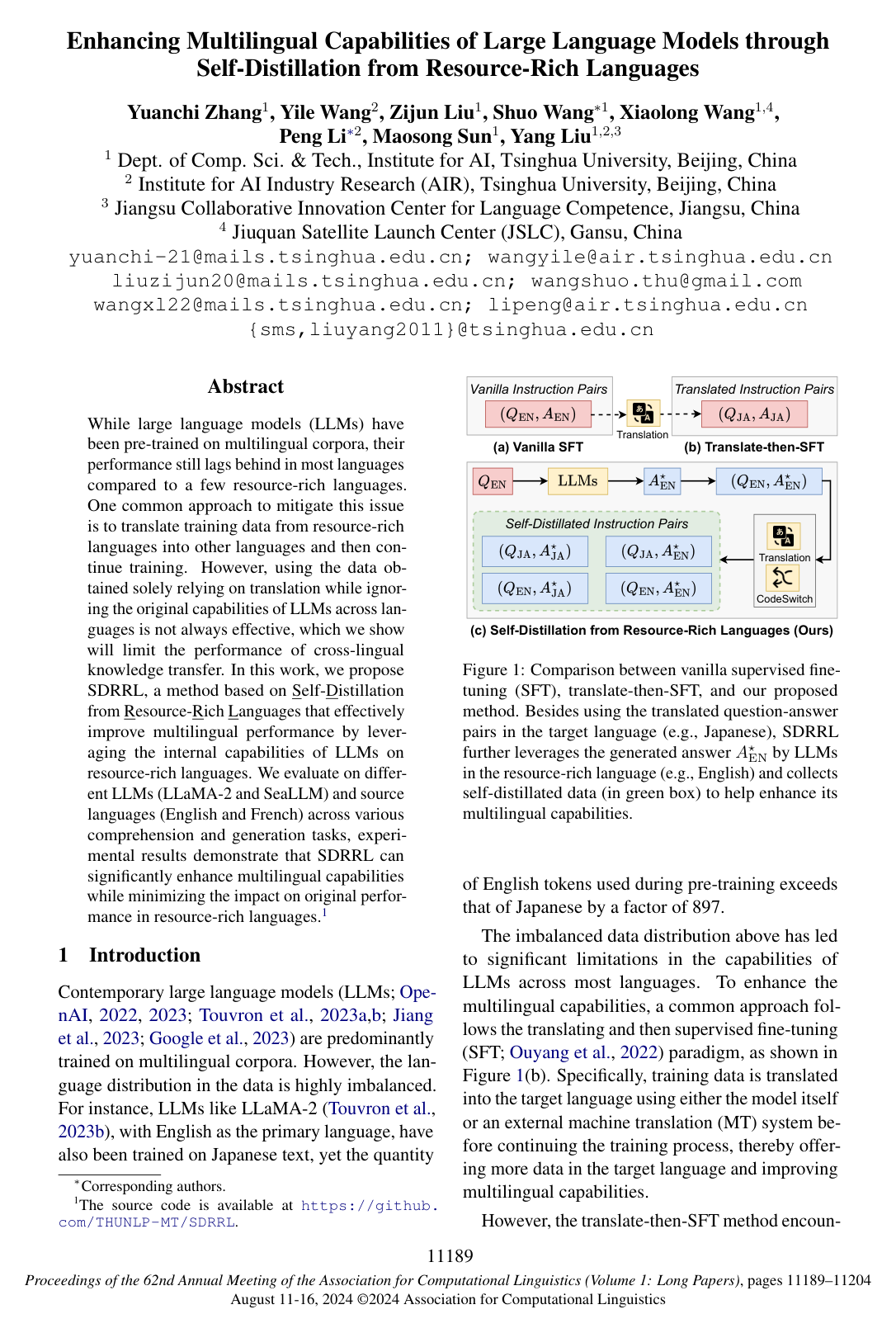
Enhancing Multilingual Capabilities of Large Language Models through Self-Distillation from Resource-Rich Languages
Yuanchi Zhang, Yile Wang, Zijun Liu, Shuo Wang, Xiaolong Wang, Peng Li, Maosong Sun, Yang Liu
Why you should read this
Proposes SDRRL, a self-distillation framework that transfers knowledge from an LLM's own high-resource language outputs to low-resource languages, improving multilingual comprehension and generation while preserving source-language performance.
While large language models (LLMs) have been pre-trained on multilingual corpora, their performance still lags behind in most languages compared to a few resource-rich languages. One common approach to mitigate this issue is to translate training data from resource-rich languages into other languages and then continue training. However, using the data obtained solely relying on translation while ignoring the original capabilities of LLMs across languages is not always effective, which we show will limit the performance of cross-lingual knowledge transfer. In this work, we propose SDRRL, a method based on Self-Distillation from Resource-Rich Languages that effectively improve multilingual performance by leveraging the internal capabilities of LLMs on resource-rich languages. We evaluate on different LLMs (LLaMA-2 and SeaLLM) and source languages (English and French) across various comprehension and generation tasks, experimental results demonstrate that SDRRL can significantly enhance multilingual capabilities while minimizing the impact on original performance in resource-rich languages.
Added
2026-10-04