
keyword
cross-domain detection
Cross-domain detection is a machine learning paradigm in which a detection model trained on data from one or more source domains is designed to accurately identify specific targets, objects, or patterns in a distinct target domain. In conventional machine learning systems, model accuracy typically declines when testing data diverges from the training distribution due to variations in context, environment, topic, or recording conditions, a phenomenon known as domain shift. Cross-domain detection addresses this discrepancy through domain adaptation, domain generalization, and feature alignment techniques that extract invariant representations between source and target datasets. This approach enables detectors to generalize reliably to new domains or adapt to novel operational scenarios with limited or no target-domain annotations.
3 items
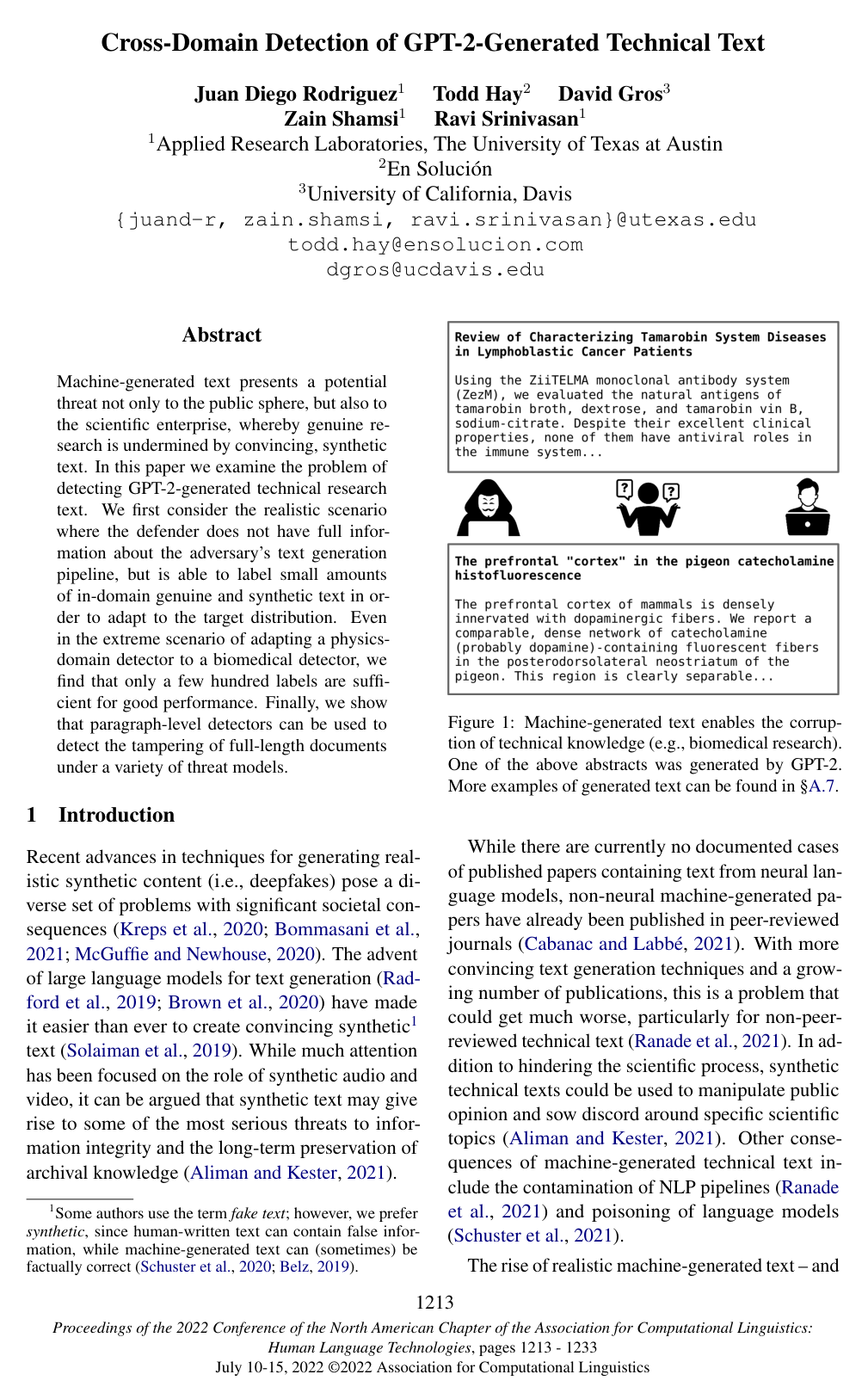
Cross-Domain Detection of GPT-2-Generated Technical Text
Juan Diego Rodriguez, Todd Hay, David Gros, Zain Shamsi, Ravi Srinivasan
Why you should read this
Demonstrates that machine-generated technical text detectors can successfully transfer across distinct scientific domains with only a few hundred labeled examples, enabling effective identification of synthetic content and paragraph tampering in full-length research papers.
Machine-generated text presents a potential threat not only to the public sphere, but also to the scientific enterprise, whereby genuine research is undermined by convincing, synthetic text. In this paper we examine the problem of detecting GPT-2-generated technical research text. We first consider the realistic scenario where the defender does not have full information about the adversary's text generation pipeline, but is able to label small amounts of in-domain genuine and synthetic text in order to adapt to the target distribution. Even in the extreme scenario of adapting a physics-domain detector to a biomedical detector, we find that only a few hundred labels are sufficient for good performance. Finally, we show that paragraph-level detectors can be used to detect the tampering of full-length documents under a variety of threat models.
Added
2026-09-26
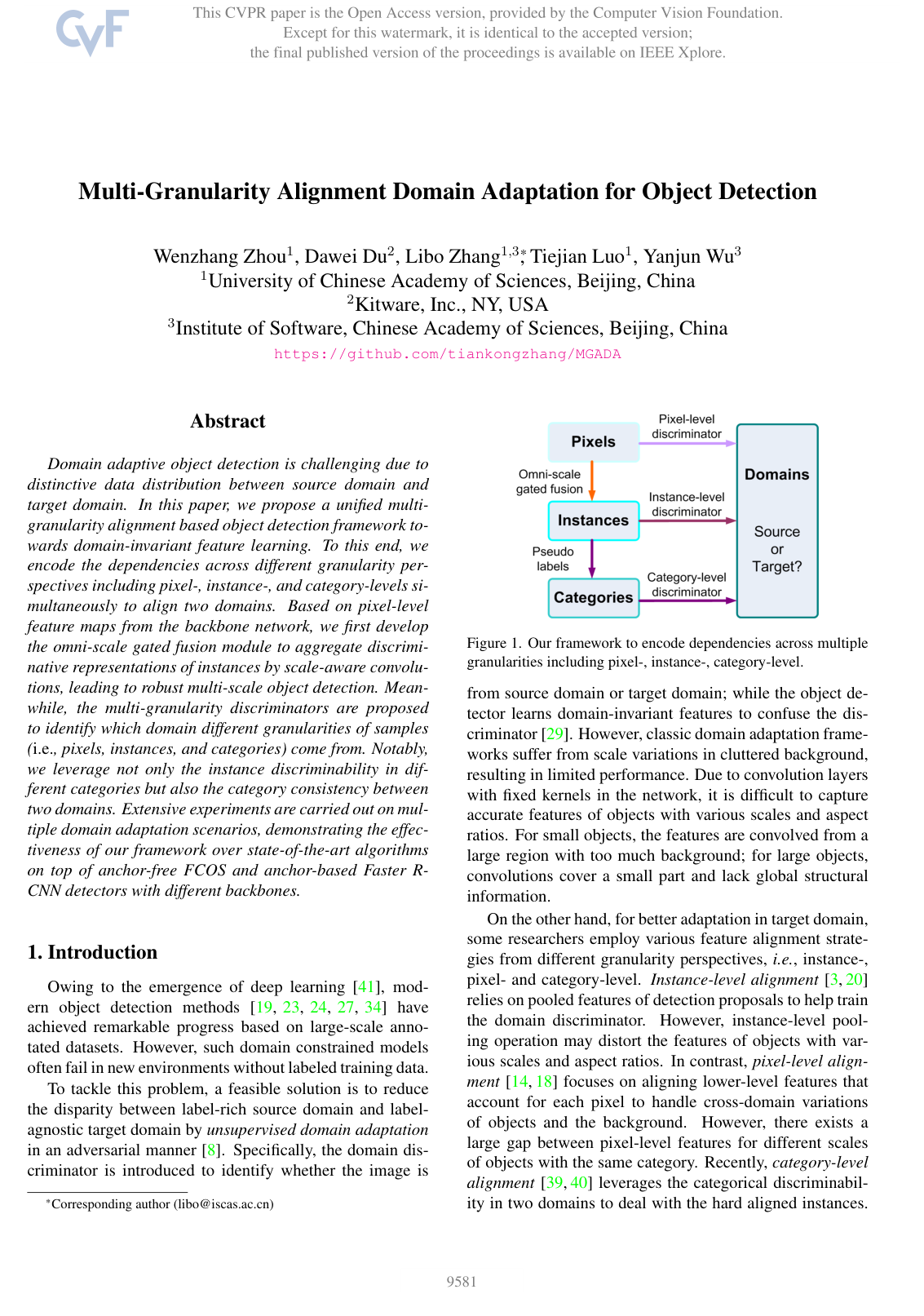
Multi-Granularity Alignment Domain Adaptation for Object Detection
Wenzhang Zhou, Dawei Du, Libo Zhang, Tiejian Luo, Yanjun Wu
Why you should read this
Proposes a unified domain adaptive object detection framework that couples an omni-scale gated fusion module with simultaneous pixel-, instance-, and category-level discriminators to effectively align multi-scale features across disparate domains.
Added
2026-09-26
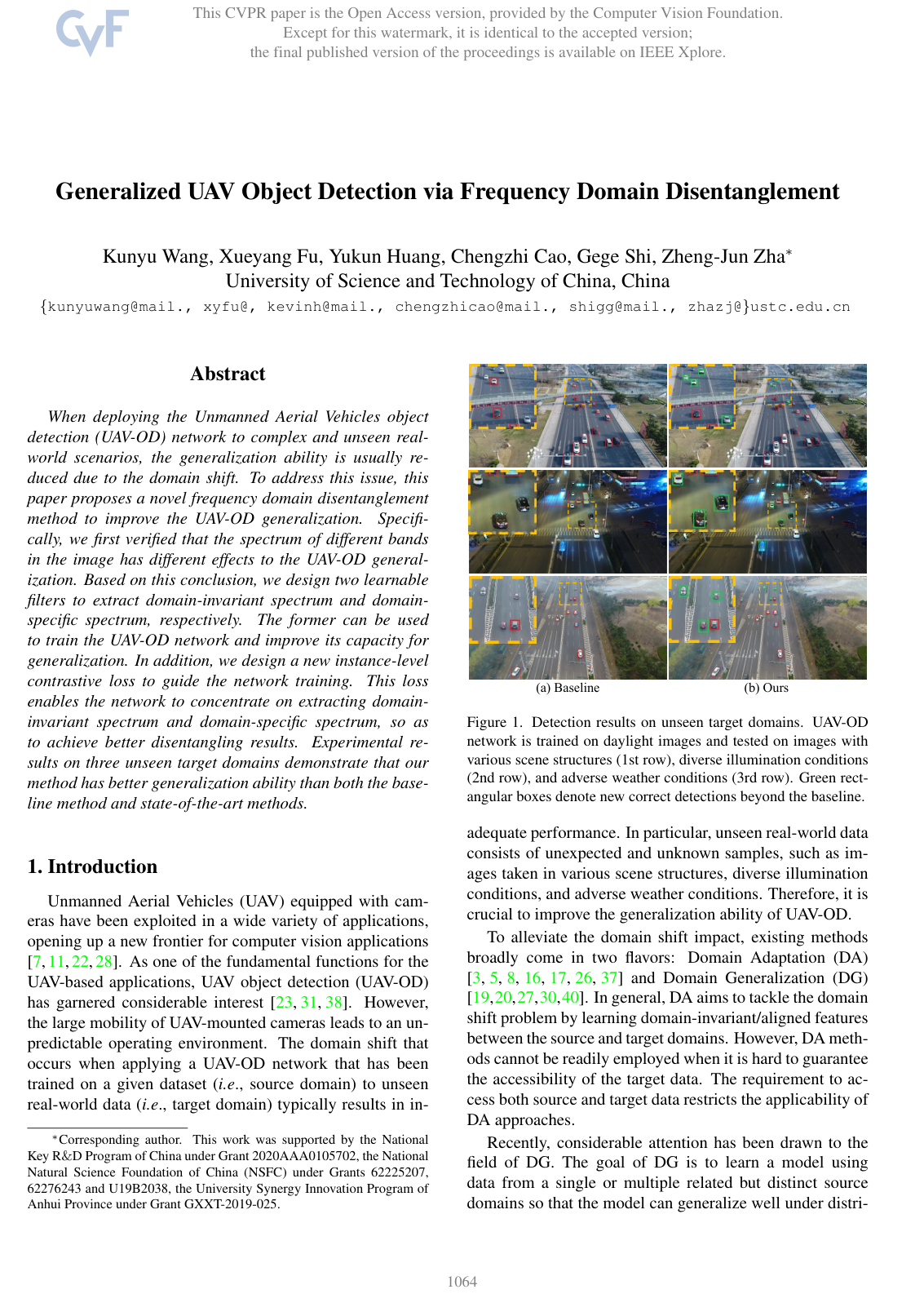
Generalized UAV Object Detection via Frequency Domain Disentanglement
Kunyu Wang, Xueyang Fu, Yukun Huang, Chengzhi Cao, Gege Shi, Zheng-Jun Zha
Why you should read this
Proposes a frequency-domain disentanglement framework using learnable spectral filters and instance-level contrastive learning to separate domain-invariant features from domain-specific variations, significantly improving drone-based object detection across unseen target environments.
When deploying the Unmanned Aerial Vehicles object detection (UAV-OD) network to complex and unseen real-world scenarios, the generalization ability is usually reduced due to the domain shift. To address this issue, this paper proposes a novel frequency domain disentanglement method to improve the UAV-OD generalization. Specifically, we first verified that the spectrum of different bands in the image has different effects to the UAV-OD generalization. Based on this conclusion, we design two learnable filters to extract domain-invariant spectrum and domain-specific spectrum, respectively. The former can be used to train the UAV-OD network and improve its capacity for generalization. In addition, we design a new instance-level contrastive loss to guide the network training. This loss enables the network to concentrate on extracting domain-invariant spectrum and domain-specific spectrum, so as to achieve better disentangling results. Experimental results on three unseen target domains demonstrate that our method has better generalization ability than both the base-line method and state-of-the-art methods.
Added
2026-09-26