
keyword
counterfactual edits
Counterfactual edits refer to targeted modifications applied to the internal parameters or knowledge representations of a machine learning model, such as a large language model, to replace an existing factual belief with a hypothetical, synthetic, or altered alternative without retraining the entire network from scratch. In knowledge editing and evaluation frameworks, these edits alter specific factual associations to assess how precisely an editing algorithm can inject new information into a model. An effective counterfactual edit enables the model to adopt and generalize the modified assertion across varied linguistic phrasing and multi-hop reasoning tasks, while strictly preserving unrelated facts and maintaining the model's overall performance.
2 items
PMET: Precise Model Editing in a Transformer
Xiaopeng Li, Shasha Li, Shezheng Song, Jing Yang, Jun Ma, Jie Yu
Why you should read this
Proposes PMET, a model editing framework that jointly optimizes attention and feed-forward hidden states while selectively updating feed-forward weights, preventing the transfer of irrelevant attention signals for more accurate factual updates in large language models.
Model editing techniques modify a minor proportion of knowledge in Large Language Models (LLMs) at a relatively low cost, which have demonstrated notable success. Existing methods assume Transformer Layer (TL) hidden states are values of key-value memories of the Feed-Forward Network (FFN). They usually optimize the TL hidden states to memorize target knowledge and use it to update the weights of the FFN in LLMs. However, the information flow of TL hidden states comes from three parts: Multi-Head Self-Attention (MHSA), FFN, and residual connections. Existing methods neglect the fact that the TL hidden states contains information not specifically required for FFN. Consequently, the performance of model editing decreases. To achieve more precise model editing, we analyze hidden states of MHSA and FFN, finding that MHSA encodes certain general knowledge extraction patterns. This implies that MHSA weights do not require updating when new knowledge is introduced. Based on above findings, we introduce PMET, which simultaneously optimizes Transformer Component (TC, namely MHSA and FFN) hidden states, while only using the optimized TC hidden states of FFN to precisely update FFN weights. Our experiments demonstrate that PMET exhibits state-of-the-art performance on both the COUNTERFACT and zsRE datasets. Our ablation experiments substantiate the effectiveness of our enhancements, further reinforcing the finding that the MHSA encodes certain general knowledge extraction patterns and indicating its storage of a small amount of factual knowledge. Our code is available at https://github.com/xpq-tech/PMET.
Added
2026-09-26
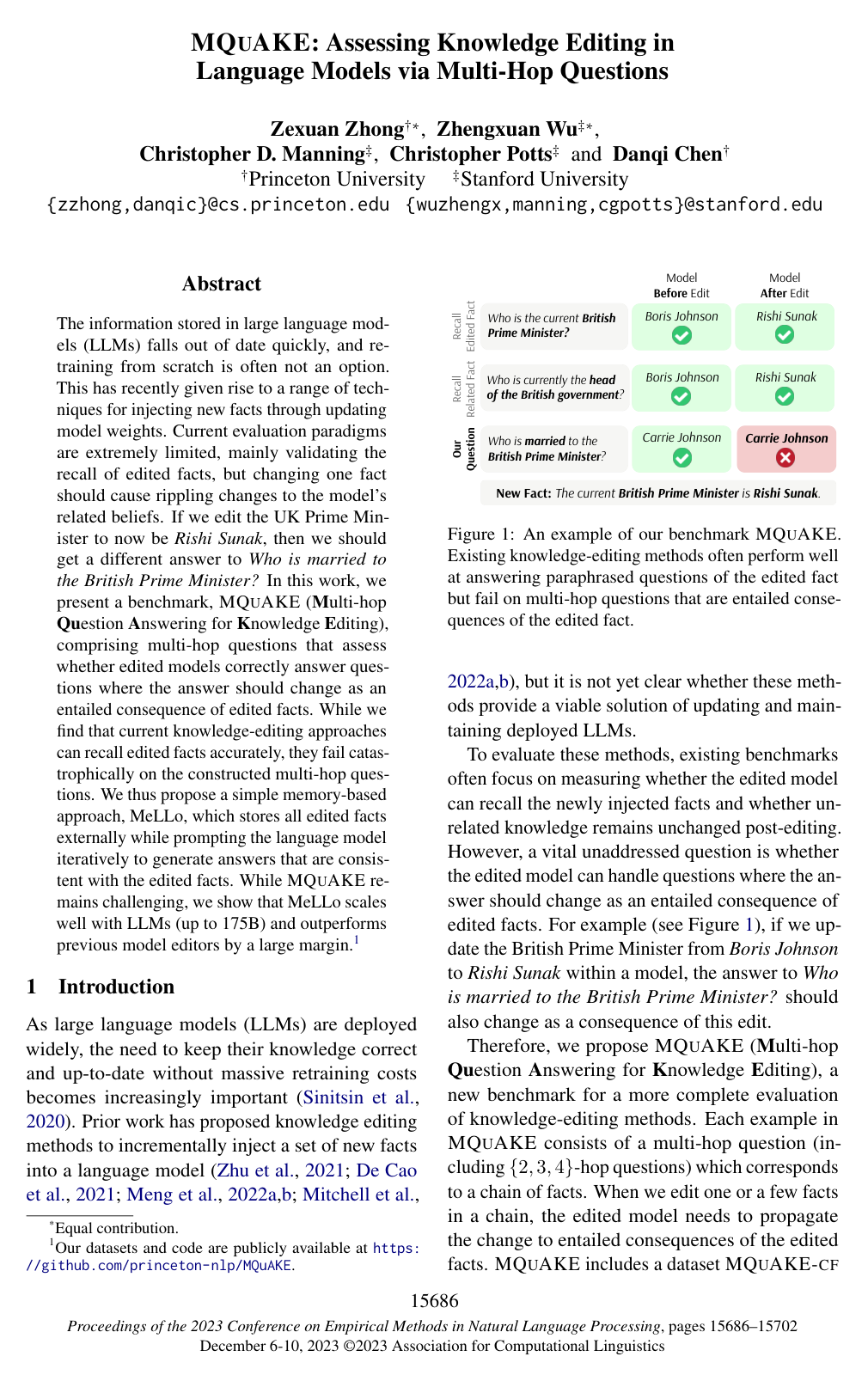
MQuAKE: Assessing Knowledge Editing in Language Models via Multi-Hop Questions
Zexuan Zhong, Zhengxuan Wu, Christopher D. Manning, Christopher Potts, Danqi Chen
Why you should read this
Introduces the MQuAKE benchmark to evaluate whether knowledge-edited language models can propagate updates through multi-hop reasoning, revealing that existing weight-editing methods fail catastrophically and proposing a memory-based prompting alternative, MeLLo, that outperforms them by a large margin.
The information stored in large language models (LLMs) falls out of date quickly, and retraining from scratch is often not an option. This has recently given rise to a range of techniques for injecting new facts through updating model weights. Current evaluation paradigms are extremely limited, mainly validating the recall of edited facts, but changing one fact should cause rippling changes to the model's related beliefs. If we edit the UK Prime Minister to now be Rishi Sunak, then we should get a different answer to Who is married to the British Prime Minister? In this work, we present a benchmark, MQuAKE (Multi-hop Question Answering for Knowledge Editing), comprising multi-hop questions that assess whether edited models correctly answer questions where the answer should change as an entailed consequence of edited facts. While we find that current knowledge-editing approaches can recall edited facts accurately, they fail catastrophically on the constructed multi-hop questions. We thus propose a simple memory-based approach, MeLLo, which stores all edited facts externally while prompting the language model iteratively to generate answers that are consistent with the edited facts. While MQuAKE remains challenging, we show that MeLLo scales well with LLMs (up to 175B) and outperforms previous model editors by a large margin.¹
Added
2026-09-26