
keyword
cosine similarity
Cosine similarity is a metric that measures the similarity between two non-zero vectors by calculating the cosine of the angle between them in a multi-dimensional space. Rather than measuring the difference in magnitude or length between vectors, it evaluates their directional alignment. The resulting value ranges from -1 to 1, where 1 indicates that the vectors point in the exact same direction, 0 indicates that they are orthogonal, and -1 indicates that they point in diametrically opposite directions. Because it is invariant to vector scaling, cosine similarity is extensively used in data science, natural language processing, and machine learning to evaluate the semantic or feature-level relatedness between high-dimensional representations, such as text and image embeddings.
5 items
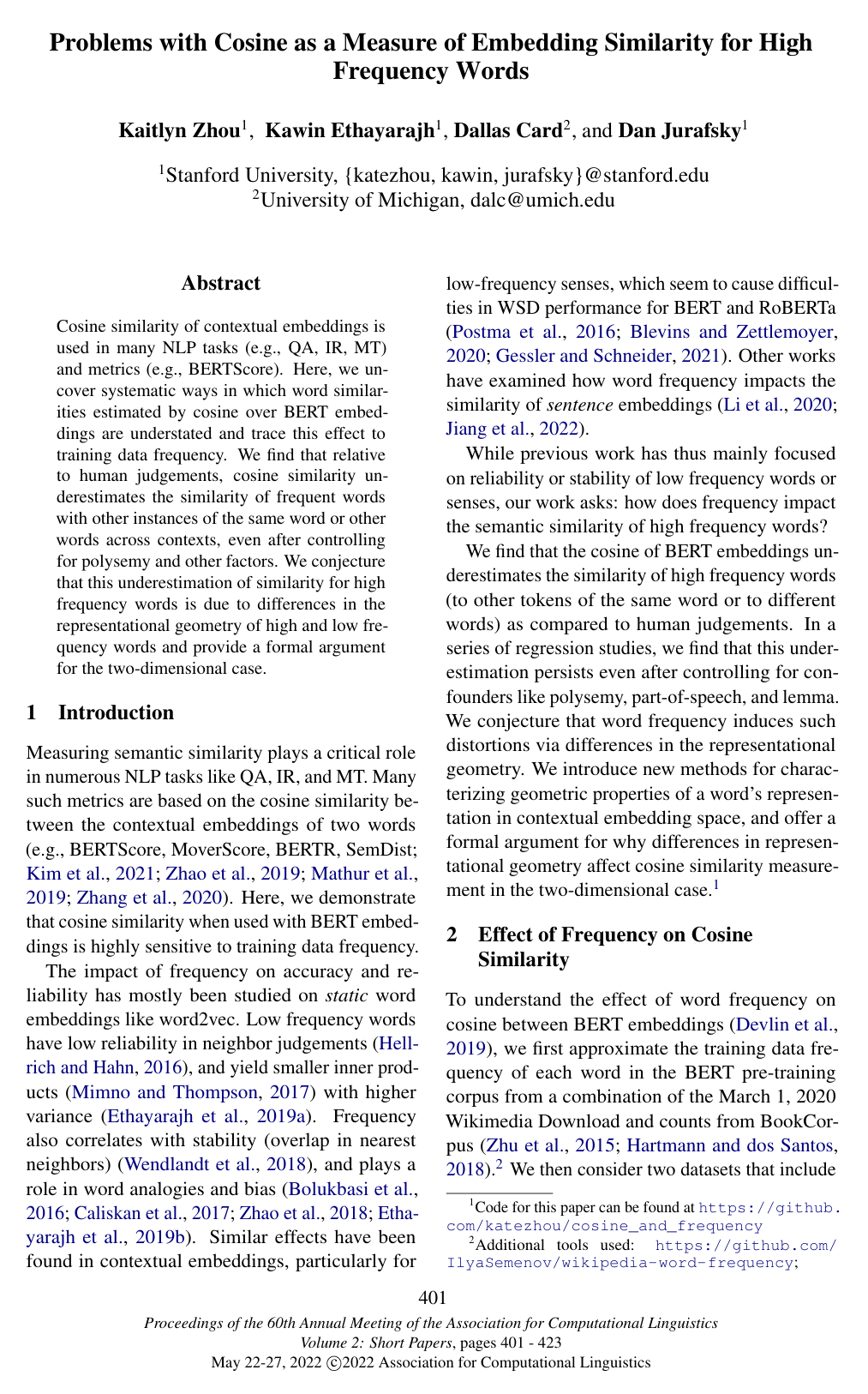
Problems with Cosine as a Measure of Embedding Similarity for High Frequency Words
Kaitlyn Zhou, Kawin Ethayarajh, Dallas Card, Dan Jurafsky
Why you should read this
Demonstrates that cosine similarity systematically underestimates the semantic similarity of high-frequency words in contextual embedding models like BERT relative to human judgment due to frequency-induced geometric distortions in embedding space.
Cosine similarity of contextual embeddings is used in many NLP tasks (e.g., QA, IR, MT) and metrics (e.g., BERTScore). Here, we uncover systematic ways in which word similarities estimated by cosine over BERT embeddings are understated and trace this effect to training data frequency. We find that relative to human judgements, cosine similarity underestimates the similarity of frequent words with other instances of the same word or other words across contexts, even after controlling for polysemy and other factors. We conjecture that this underestimation of similarity for high frequency words is due to differences in the representational geometry of high and low frequency words and provide a formal argument for the two-dimensional case.
Added
2026-10-02
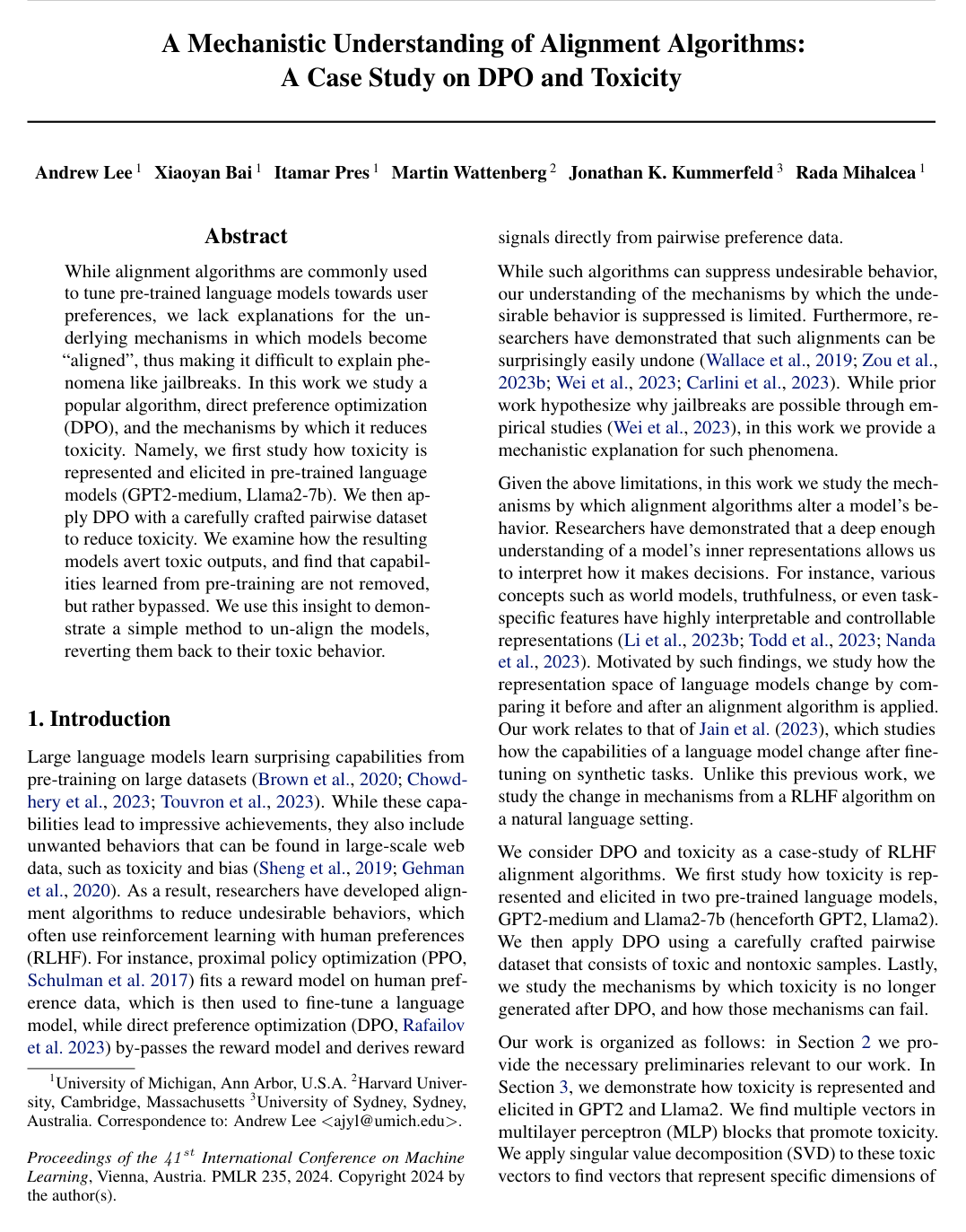
A Mechanistic Understanding of Alignment Algorithms: A Case Study on DPO and Toxicity
Andrew Lee, Xiaoyan Bai, Itamar Pres, Martin Wattenberg, Jonathan K. Kummerfeld, Rada Mihalcea
Why you should read this
Reveals that Direct Preference Optimization merely bypasses rather than eliminates toxic capabilities in language models, providing a mechanistic explanation for safety jailbreaks and enabling a simple method to reverse alignment.
While alignment algorithms are commonly used to tune pre-trained language models towards user preferences, we lack explanations for the underlying mechanisms in which models become “aligned”, thus making it difficult to explain phenomena like jailbreaks. In this work we study a popular algorithm, direct preference optimization (DPO), and the mechanisms by which it reduces toxicity. Namely, we first study how toxicity is represented and elicited in pre-trained language models (GPT2-medium, Llama2-7b). We then apply DPO with a carefully crafted pairwise dataset to reduce toxicity. We examine how the resulting models avert toxic outputs, and find that capabilities learned from pre-training are not removed, but rather bypassed. We use this insight to demonstrate a simple method to un-align the models, reverting them back to their toxic behavior.
Added
2026-09-30
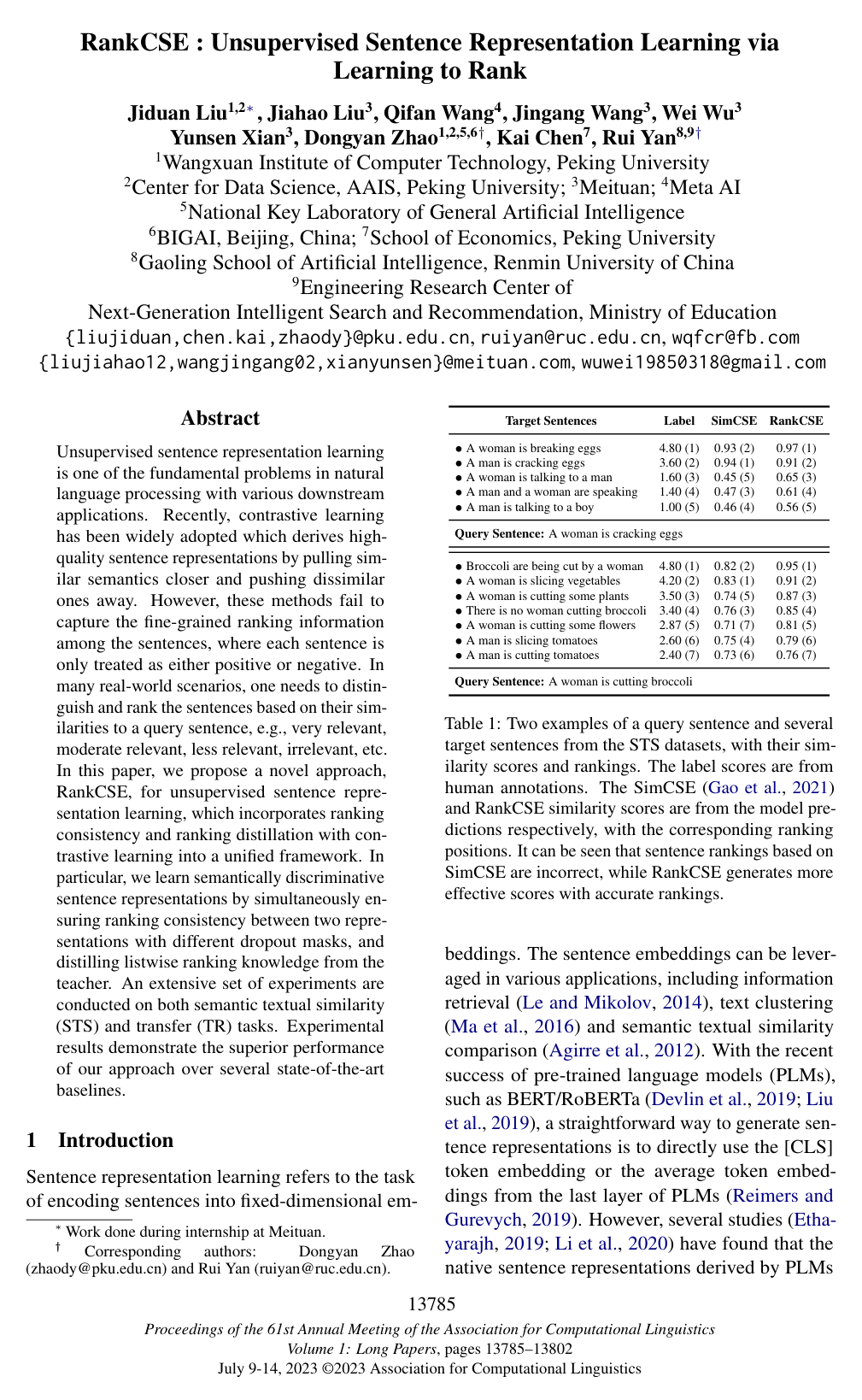
RankCSE: Unsupervised Sentence Representations Learning via Learning to Rank
Jiduan Liu, Jiahao Liu, Qifan Wang, Jingang Wang, Wei Wu, Yunsen Xian, Dongyan Zhao, Kai Chen, Rui Yan
Why you should read this
Proposes RankCSE, an unsupervised sentence representation framework that integrates ranking consistency and listwise ranking distillation into contrastive learning to capture fine-grained semantic similarities and outperform existing baselines on semantic textual similarity tasks.
Unsupervised sentence representation learning is one of the fundamental problems in natural language processing with various downstream applications. Recently, contrastive learning has been widely adopted which derives high-quality sentence representations by pulling similar semantics closer and pushing dissimilar ones away. However, these methods fail to capture the fine-grained ranking information among the sentences, where each sentence is only treated as either positive or negative. In many real-world scenarios, one needs to distinguish and rank the sentences based on their similarities to a query sentence, e.g., very relevant, moderate relevant, less relevant, irrelevant, etc. In this paper, we propose a novel approach, RankCSE, for unsupervised sentence representation learning, which incorporates ranking consistency and ranking distillation with contrastive learning into a unified framework. In particular, we learn semantically discriminative sentence representations by simultaneously ensuring ranking consistency between two representations with different dropout masks, and distilling listwise ranking knowledge from the teacher. An extensive set of experiments are conducted on both semantic textual similarity (STS) and transfer (TR) tasks. Experimental results demonstrate the superior performance of our approach over several state-of-the-art baselines.
Added
2026-09-26
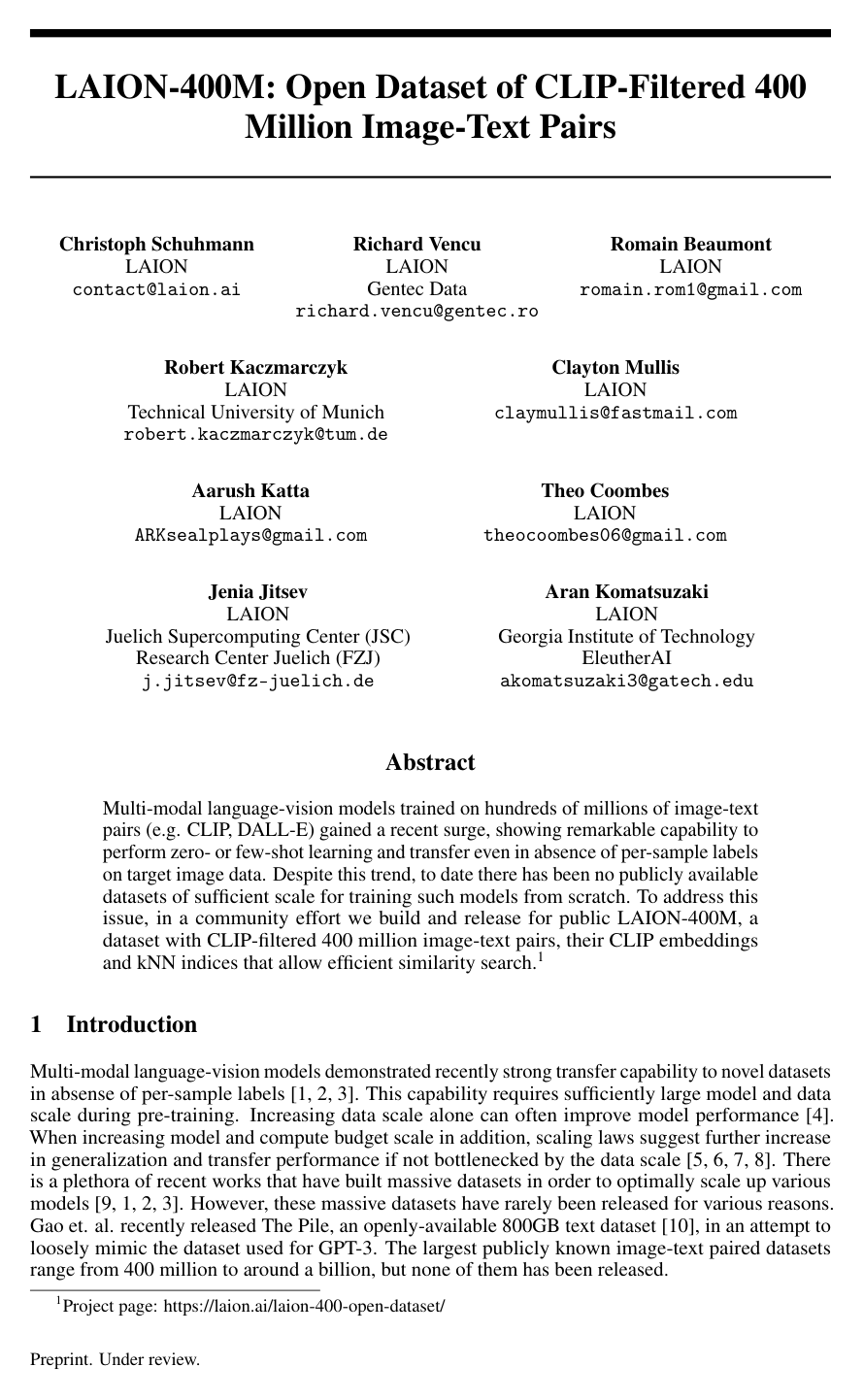
LAION-400M: Open Dataset of CLIP-Filtered 400 Million Image-Text Pairs
Christoph Schuhmann, Richard Vencu, Romain Beaumont, Robert Kaczmarczyk, Clayton Mullis, Aarush Katta, Theo Coombes, Jenia Jitsev, Aran Komatsuzaki
Why you should read this
Presents the first publicly accessible dataset of 400 million filtered image-text pairs with precomputed embeddings and indexing, enabling the broader research community to train large multimodal vision-language models from scratch.
Multi-modal language-vision models trained on hundreds of millions of image-text pairs (e.g. CLIP, DALL-E) gained a recent surge, showing remarkable capability to perform zero- or few-shot learning and transfer even in absence of per-sample labels on target image data. Despite this trend, to date there has been no publicly available datasets of sufficient scale for training such models from scratch. To address this issue, in a community effort we build and release for public LAION-400M, a dataset with CLIP-filtered 400 million image-text pairs, their CLIP embeddings and kNN indices that allow efficient similarity search.
Added
2026-09-18
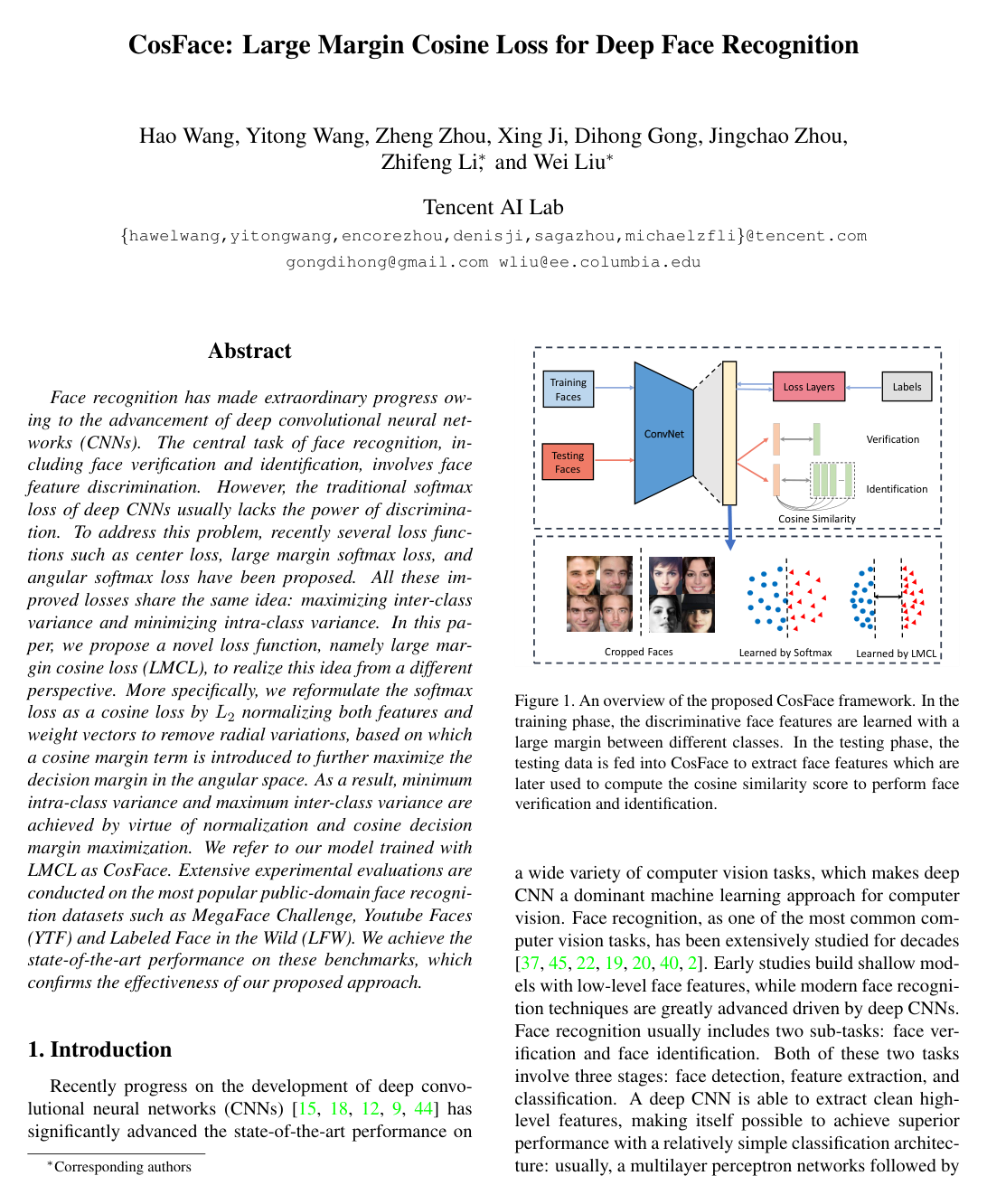
CosFace: Large Margin Cosine Loss for Deep Face Recognition
Hao Wang, Yitong Wang, Zheng Zhou, Xing Ji, Dihong Gong, Jingchao Zhou, Zhifeng Li, Wei Liu
Why you should read this
Introduces the Large Margin Cosine Loss (CosFace), which reformulates traditional softmax loss through vector normalization and an angular margin penalty to maximize feature discrimination for deep face recognition.
Face recognition has made extraordinary progress owing to the advancement of deep convolutional neural networks (CNNs). The central task of face recognition, including face verification and identification, involves face feature discrimination. However, the traditional softmax loss of deep CNNs usually lacks the power of discrimination. To address this problem, recently several loss functions such as center loss, large margin softmax loss, and angular softmax loss have been proposed. All these improved losses share the same idea: maximizing inter-class variance and minimizing intra-class variance. In this paper, we propose a novel loss function, namely large margin cosine loss (LMCL), to realize this idea from a different perspective. More specifically, we reformulate the softmax loss as a cosine loss by normalizing both features and weight vectors to remove radial variations, based on which a cosine margin term is introduced to further maximize the decision margin in the angular space. As a result, minimum intra-class variance and maximum inter-class variance are achieved by virtue of normalization and cosine decision margin maximization. We refer to our model trained with LMCL as CosFace. Extensive experimental evaluations are conducted on the most popular public-domain face recognition datasets such as MegaFace Challenge, Youtube Faces (YTF) and Labeled Face in the Wild (LFW). We achieve the state-of-the-art performance on these benchmarks, which confirms the effectiveness of our proposed approach.
Added
2026-09-13