Built independently by an author, for readers. Read the story and support ChapterPal

keyword

convolution-free architecture

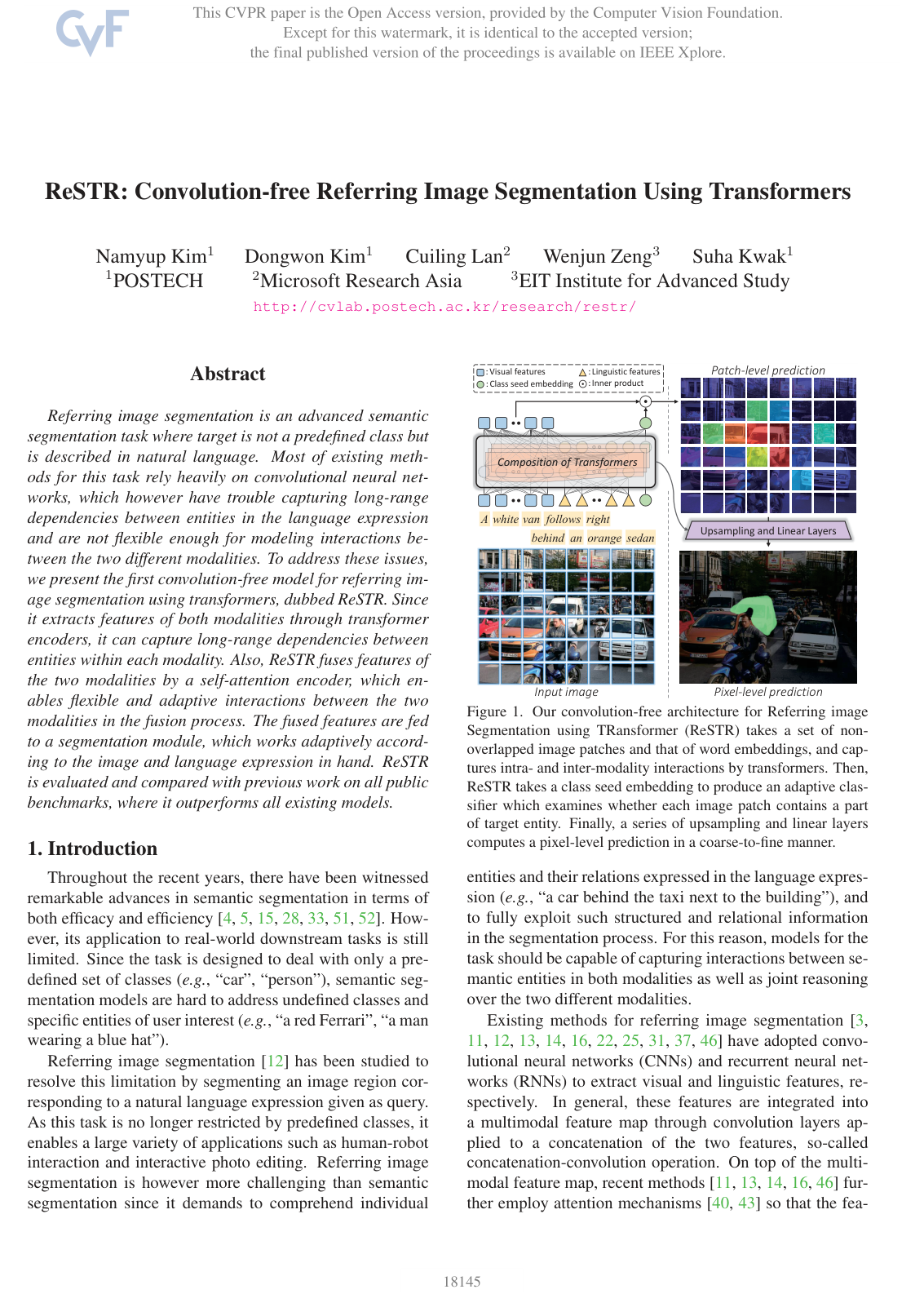
A convolution-free architecture is a neural network design that processes spatial or multidimensional data, such as images or multimodal inputs, without using standard convolutional layers. Unlike traditional convolutional neural networks that rely on localized sliding filters to extract features, convolution-free models depend on alternative processing mechanisms, most notably self-attention layers in transformer models or fully connected multilayer perceptrons. By dispensing with convolutional operations and their inherent localized inductive biases, these architectures are capable of capturing global context and modeling long-range dependencies across entire input representations and between diverse data modalities directly from the initial stages of feature extraction.

1 item

ReSTR: Convolution-free Referring Image Segmentation Using Transformers

ReSTR: Convolution-free Referring Image Segmentation Using Transformers

Namyup Kim, Dongwon Kim, Suha Kwak, Cuiling Lan, Wenjun Zeng

OrganizationsEIT Institute for Advanced StudyMicrosoftPohang University of Science and Technology

Why you should read this

Proposes ReSTR, the first purely transformer-based, convolution-free model for referring image segmentation that unifies vision and language processing through self-attention to capture long-range cross-modal dependencies and achieve state-of-the-art performance across major benchmarks.

Referring image segmentation is an advanced semantic segmentation task where target is not a predefined class but is described in natural language. Most of existing methods for this task rely heavily on convolutional neural networks, which however have trouble capturing long-range dependencies between entities in the language expression and are not flexible enough for modeling interactions between the two different modalities. To address these issues, we present the first convolution-free model for referring image segmentation using transformers, dubbed ReSTR. Since it extracts features of both modalities through transformer encoders, it can capture long-range dependencies between entities within each modality. Also, ReSTR fuses features of the two modalities by a self-attention encoder, which enables flexible and adaptive interactions between the two modalities in the fusion process. The fused features are fed to a segmentation module, which works adaptively according to the image and language expression in hand. ReSTR is evaluated and compared with previous work on all public benchmarks, where it outperforms all existing models.

Added

2026-09-26