Built independently by an author, for readers. Read the story and support ChapterPal

keyword

conversational QA

Conversational question answering is a subfield of natural language processing in which an automated system answers questions within an interactive, multi-turn dialogue. Unlike traditional single-turn question answering systems that treat each query independently, a conversational question answering system maintains dialogue history to resolve contextual dependencies, such as pronouns and elliptical references, across successive exchanges. This allows the system to follow the flow of a discussion, perform multi-step reasoning, and retrieve or compute relevant information from source data to address interconnected user inquiries.

1 item

ConvFinQA: Exploring the Chain of Numerical Reasoning in Conversational Finance Question Answering

ConvFinQA: Exploring the Chain of Numerical Reasoning in Conversational Finance Question Answering

Zhiyu Chen, Shiyang Li, Charese Smiley, Zhiqiang Ma, Sameena Shah, William Yang Wang

OrganizationsJ.P. MorganUniversity of California, Santa Barbara

Why you should read this

Introduces a large-scale financial question answering benchmark to evaluate how language models execute multi-turn, chained numerical reasoning over complex financial reports.

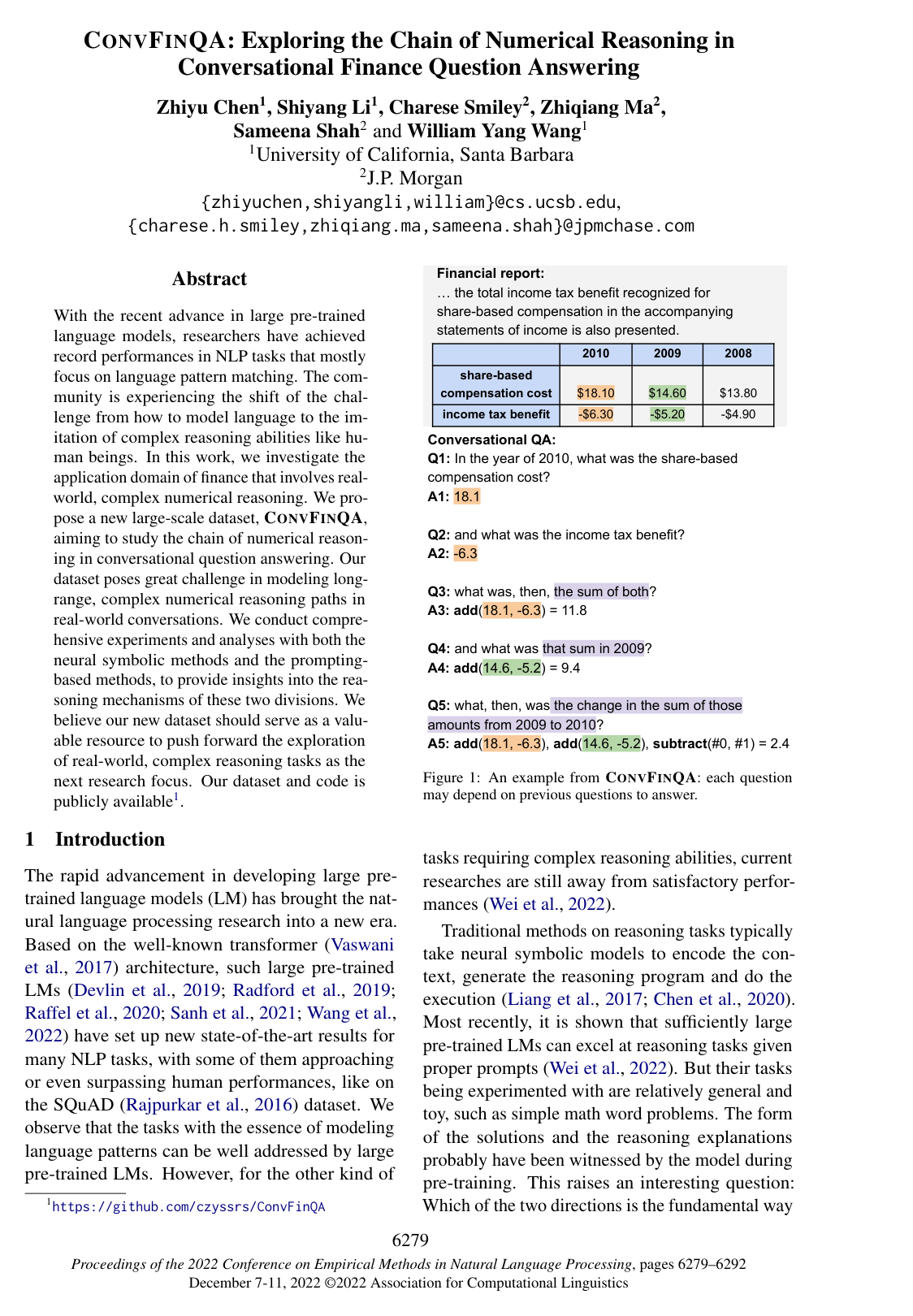
With the recent advance in large pre-trained language models, researchers have achieved record performances in NLP tasks that mostly focus on language pattern matching. The community is experiencing the shift of the challenge from how to model language to the imitation of complex reasoning abilities like human beings. In this work, we investigate the application domain of finance that involves real-world, complex numerical reasoning. We propose a new large-scale dataset, CONVFINQA, aiming to study the chain of numerical reasoning in conversational question answering. Our dataset poses great challenge in modeling long-range, complex numerical reasoning paths in real-world conversations. We conduct comprehensive experiments and analyses with both the neural symbolic methods and the prompting-based methods, to provide insights into the reasoning mechanisms of these two divisions. We believe our new dataset should serve as a valuable resource to push forward the exploration of real-world, complex reasoning tasks as the next research focus. Our dataset and code is publicly available¹.

Added

2026-09-26