
keyword
continual pretraining
Continual pretraining is a machine learning process in which an already pretrained model is further trained on new, unlabeled data to incorporate emerging information, adapt to specialized domains, or expand into new languages without training from scratch. Unlike downstream fine-tuning, which typically adapts a model to specific tasks using smaller, labeled datasets, continual pretraining extends the original self-supervised learning objective over additional large-scale text or data streams. A central focus of this approach is balancing plasticity and stability, enabling the model to internalize new vocabulary, temporal updates, and domain-specific knowledge while mitigating catastrophic forgetting of the broad foundational capabilities acquired during its initial pretraining.
6 items
DrBERT: A Robust Pre-trained Model in French for Biomedical and Clinical domains
Yanis Labrak, Adrien Bazoge, Richard Dufour, Mickael Rouvier, Emmanuel Morin, Béatrice Daille, Pierre-Antoine Gourraud
Why you should read this
Presents DrBERT, the first open-source French biomedical language model, alongside the billion-word NACHOS corpus and an empirical comparison demonstrating that public web data can match the performance of restricted hospital records on medical NLP tasks.
In recent years, pre-trained language models (PLMs) achieve the best performance on a wide range of natural language processing (NLP) tasks. While the first models were trained on general domain data, specialized ones have emerged to more effectively treat specific domains. In this paper, we propose an original study of PLMs in the medical domain on French language. We compare, for the first time, the performance of PLMs trained on both public data from the web and private data from healthcare establishments. We also evaluate different learning strategies on a set of biomedical tasks. In particular, we show that we can take advantage of already existing biomedical PLMs in a foreign language by further pre-train it on our targeted data. Finally, we release the first specialized PLMs for the biomedical field in French, called DrBERT, as well as the largest corpus of medical data under free license on which these models are trained.
Added
2026-09-26
Lifelong Pretraining: Continually Adapting Language Models to Emerging Corpora
Xisen Jin, Dejiao Zhang, Henghui Zhu, Wei Xiao, Shang-Wen Li, Xiaokai Wei, Andrew O. Arnold, Xiang Ren
Why you should read this
Establishes a continual pretraining framework for language models across evolving domains and temporal data streams, demonstrating that distillation-based methods effectively prevent catastrophic forgetting on earlier tasks while improving adaptation to new data.
Pretrained language models (PTLMs) are typically learned over a large, static corpus and further fine-tuned for various downstream tasks. However, when deployed in the real world, a PTLM-based model must deal with data distributions that deviate from what the PTLM was initially trained on. In this paper, we study a lifelong language model pretraining challenge where a PTLM is continually updated so as to adapt to emerging data. Over a domain-incremental research paper stream and a chronologically-ordered tweet stream, we incrementally pretrain a PTLM with different continual learning algorithms, and keep track of the downstream task performance (after fine-tuning). We evaluate PTLM’s ability to adapt to new corpora while retaining learned knowledge in earlier corpora. Our experiments show distillation-based approaches to be most effective in retaining downstream performance in earlier domains. The algorithms also improve knowledge transfer, allowing models to achieve better downstream performance over the latest data, and improve temporal generalization when distribution gaps exist between training and evaluation because of time. We believe our problem formulation, methods, and analysis will inspire future studies towards continual pretraining of language models.
Added
2026-09-26
Understanding R1-Zero-Like Training: A Critical Perspective
Zichen Liu, Changyu Chen, Wenjun Li, Penghui Qi, Tianyu Pang, Chao Du, Wee Sun Lee, Min Lin
Why you should read this
Reveals critical pretraining and optimization biases in R1-Zero-like reasoning models, introducing an unbiased algorithm called Dr. GRPO that prevents response length inflation and sets a 7B state-of-the-art benchmark of 43.3% on AIME 2024.
DeepSeek-R1-Zero has shown that reinforcement learning (RL) at scale can directly enhance the reasoning capabilities of LLMs without supervised fine-tuning. In this work, we critically examine R1-Zero-like training by analyzing its two core components: base models and RL. We investigate a wide range of base models, including DeepSeek-V3-Base, to understand how pretraining characteristics influence RL performance. Our analysis reveals that DeepSeek-V3-Base already exhibit ''Aha moment'', while Qwen2.5 base models demonstrate strong reasoning capabilities even without prompt templates, suggesting potential pretraining biases. Additionally, we identify an optimization bias in Group Relative Policy Optimization (GRPO), which artificially increases response length (especially for incorrect outputs) during training. To address this, we introduce Dr. GRPO, an unbiased optimization method that improves token efficiency while maintaining reasoning performance. Leveraging these insights, we present a minimalist R1-Zero recipe that achieves 43.3% accuracy on AIME 2024 with a 7B base model, establishing a new state-of-the-art. Our code is available at this https URL.
Added
2026-09-25
Continual Learning Mechanisms Compose for Long-Horizon Memorization
Zheyuan Zhang, Alvin Zhang, Daniel Khashabi, Tianmin Shu
Why you should read this
Demonstrates that composing complementary continual learning mechanisms—combining data, function, and weight anchors with merged low-rank adaptation—substantially mitigates catastrophic forgetting across 100 sequential tasks, yielding a 28-fold increase in long-horizon knowledge retention.
Language models may need to internalize information that arrives over time and retain it through many subsequent updates. To study this challenge, we introduce long-horizon memorization, a setting in which a model learns 100 query-answer tasks through continual supervised fine-tuning without retaining earlier training examples or receiving task identifiers at inference. Sequential updates cause catastrophic forgetting, and no single continual learning mechanism we evaluate maintains strong retention at this horizon. We hypothesize that mechanisms addressing complementary sources of forgetting will be more effective when composed. We organize these compositions along two design dimensions. Data, function, and weight anchors specify what prior information each update should preserve, while low-rank allocation rules determine where successive updates are retained. To test this hypothesis systematically, we construct three distinct 100-task memorization datasets. We introduce task-level successive halving to search the combinatorial design space and use a factorial experiment to measure individual and interaction effects. Our best method combines all three anchors with merged LoRA, ranks among the top 3 methods in all datasets, and raises average final retention from 1.2% under naive sequential fine-tuning to 34.9%, a 28-fold improvement. The data anchor and merged LoRA provide the largest average gains and interact super-additively on all three datasets. Together, these results show that composing complementary mechanisms substantially improves long-horizon memorization beyond what any individual mechanism achieves.
Added
2026-09-10

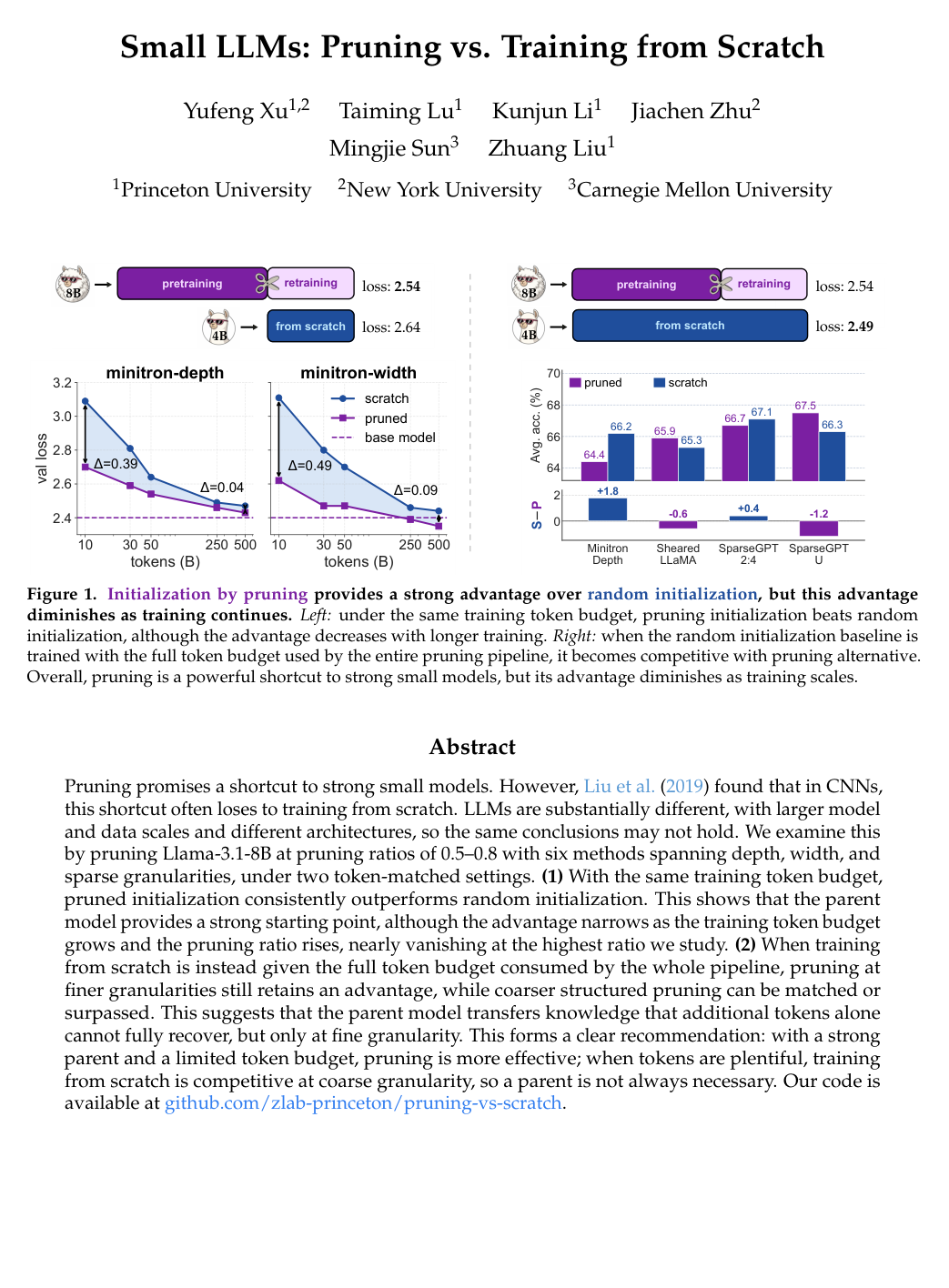
Small LLMs: Pruning vs. Training from Scratch
Yufeng Xu, Taiming Lu, Kunjun Li, Jiachen Zhu, Mingjie Sun, Zhuang Liu
Pruning promises a shortcut to strong small language models. In this work, we examine this promise by pruning Llama-3.1-8B at pruning ratios of 0.5--0.8 with six methods spanning depth, width, and sparse granularities, under two controlled token-matched settings. (1) With the same training token budget, pruned initialization consistently outperforms random initialization. This shows that the parent model provides a strong starting point, although the advantage narrows as the training token budget grows and as the pruning ratio rises, nearly vanishing at the highest pruning ratio we study. (2) When training from scratch is instead given the full token budget consumed by the whole pipeline, pruning at finer granularities still retains an advantage, while coarser structured pruning can be matched or surpassed. This suggests that the parent model transfers knowledge that additional training tokens alone cannot fully recover, but only at fine granularity. Taken together, our results yield a clear recommendation: with a large pretrained model in hand and a limited training token budget, pruning is better than training from scratch; when the training budget is not limited, training from scratch can be competitive for coarser pruning, so a large pretrained parent is not always necessary.
Added
2026-07-31
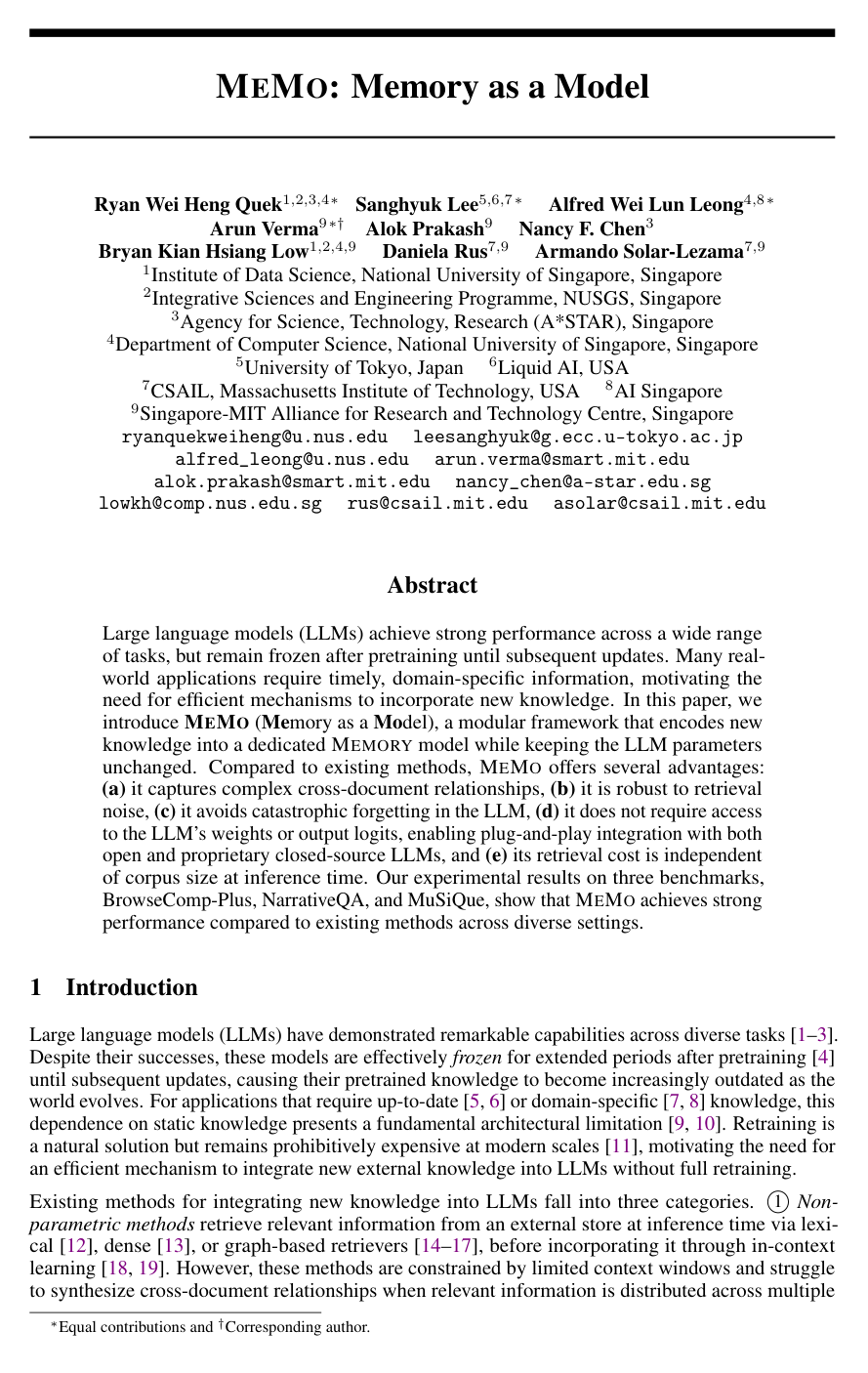
MeMo: Memory as a Model
Ryan Wei Heng Quek, Sanghyuk Lee, Alfred Wei Lun Leong, Arun Verma, Alok Prakash, Nancy F. Chen, Bryan Kian Hsiang Low, Daniela Rus, Armando Solar-Lezama
Why you should read this
Introduces MeMo, a modular framework that efficiently incorporates new knowledge into frozen LLMs by encoding it into a dedicated memory model, offering robustness to noise, avoiding catastrophic forgetting, and ensuring plug-and-play compatibility with both open and closed-source LLMs with inference costs independent of corpus size.
Large language models (LLMs) achieve strong performance across a wide range of tasks, but remain frozen after pretraining until subsequent updates. Many real-world applications require timely, domain-specific information, motivating the need for efficient mechanisms to incorporate new knowledge. In this paper, we introduce MeMo (Memory as a Model), a modular framework that encodes new knowledge into a dedicated memory model while keeping the LLM parameters unchanged. Compared to existing methods, MeMo offers several advantages: (a) it captures complex cross-document relationships, (b) it is robust to retrieval noise, (c) it avoids catastrophic forgetting in the LLM, (d) it does not require access to the LLM's weights or output logits, enabling plug-and-play integration with both open and proprietary closed-source LLMs, and (e) its retrieval cost is independent of corpus size at inference time. Our experimental results on three benchmarks, BrowseComp-Plus, NarrativeQA, and MuSiQue, show that MeMo achieves strong performance compared to existing methods across diverse settings.
Added
2026-06-11